The phrase China vs local suppliers shows up in almost every email I get. Buyers want a quick, clean price answer. The problem is the sticker price never tells the full story. Delays, inspections, duties, and miscommunication all add cost. The solution is to map your total landed cost, risk, and capacity before you choose who to trust.
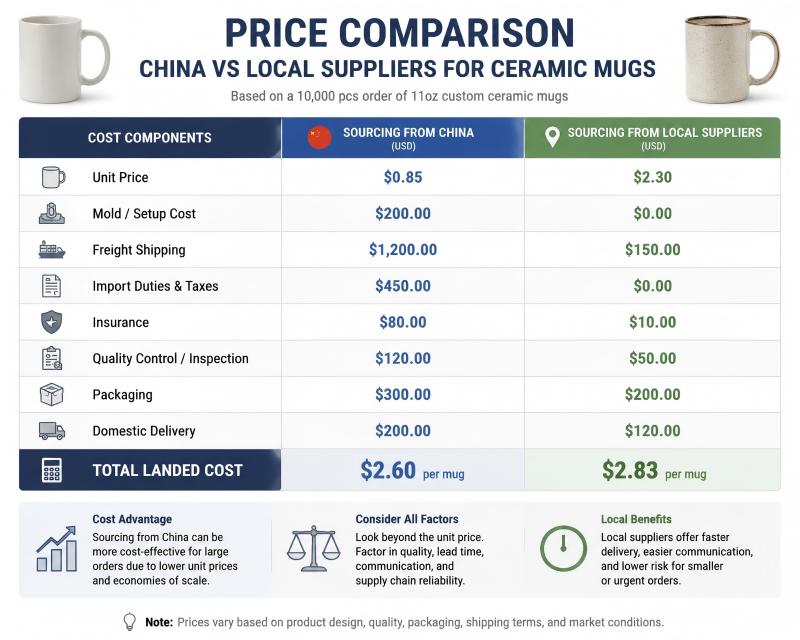
China vs local suppliers can be cheaper or more expensive depending on your total landed cost. Add up unit price, freight, duties, insurance, packaging, quality inspection, rejects, time delays, and your team’s communication hours. Then compare that with local quotes that may have higher unit prices but lower risk, smaller MOQ, and faster cash conversion.
I will unpack the math I share with wholesalers and e‑commerce sellers every week. I will also point out the questions buyers miss when they ask, “What’s your price?” By the end, you can run your own side‑by‑side and choose with confidence.
What actually drives total landed cost in China vs local suppliers?
You want a simple price, but the problem is the final invoice includes more than a unit quote. The agitation comes when shipments run late or duties spike and the margin vanishes. The solution is to itemize every component and compare apples to apples.
The total landed cost in China vs local suppliers equals unit price plus freight, duties, insurance, packaging, inland drayage, inspections, warehousing, finance costs, and the cost of delays or defects. A local quote may bundle some of these. A China quote usually separates them, so you must add them back in to compare.
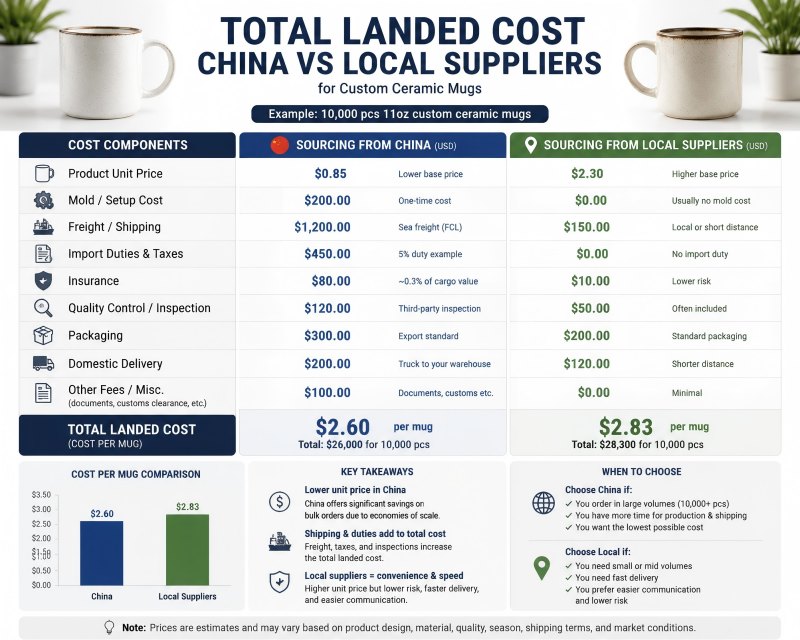
The complete cost stack you should model
I have spent 15 years in Hunan’s Liling ceramics hub walking buyers through this worksheet. A common question we get from e‑commerce sellers is, “Why is your quote lower, but my landed cost ends up similar to local?” Here is why.
- Unit price: Often lower in China, especially for scale.
- Ocean or air shipping costs: Highly variable by season and route. Ocean FCL is cheapest, LCL and air are costly.
- Duties and taxes: Depends on HS code and destination. Check current rates, and do not rely on last year’s numbers.
- Insurance: Cheap but vital. It protects your cash when something goes wrong.
- Packaging and labeling: Retail packaging can add $0.10–$0.50 per piece.
- Quality inspection: Third‑party checks can save you thousands in returns.
- Inland trucking and port fees: Both origin and destination legs matter.
- Finance costs: Deposits, balance timing, and inventory carrying costs.
- Failure costs: Rework, returns, and opportunity loss if stockouts occur.
Below is a simplified china manufacturing cost comparison to illustrate why the lowest unit price is not always the lowest landed cost.
| Component | China (Example) | Local (Example) |
|---|---|---|
| Unit price (ceramic mug, printed) | $1.25 | $2.10 |
| Freight per unit (40’ FCL vs LTL) | $0.12 | $0.08 |
| Duties + fees per unit | $0.10–$0.18 | $0.00–$0.05 |
| Inspection per unit | $0.02 | $0.00–$0.01 |
| Packaging upgrade per unit | $0.20 | $0.25 |
| Financing (90 days vs 30 days) | $0.03 | $0.01 |
| Estimated rejects/rework | $0.03 | $0.02 |
| Total landed (range) | $1.75–$1.93 | $2.47–$2.52 |
The China option is still cheaper in this example, but only after you add everything. For light shipments, seasonal freight spikes, or complex packaging, that gap can narrow quickly. This is why a proper china supplier comparison is about the full stack, not just ex‑works price.
As you build your spreadsheet, link it to internal references like ceramic mug pricing and hidden sourcing costs so your team does not forget line items.
When does a lower China unit price cost you more than local?
The problem appears when an “unbeatable” quote looks great on paper but leaks money in transit. The stress rises as lead times slip into peak season. The solution is to identify the common traps that push China vs local suppliers toward parity or even reverse the advantage.
A lower China unit price can cost more if you ship small volumes, pay peak-season freight, face high duties, need rush air shipments, or suffer rework and delays. In those cases, local production with higher unit cost but lower complexity often wins on cash and predictability.
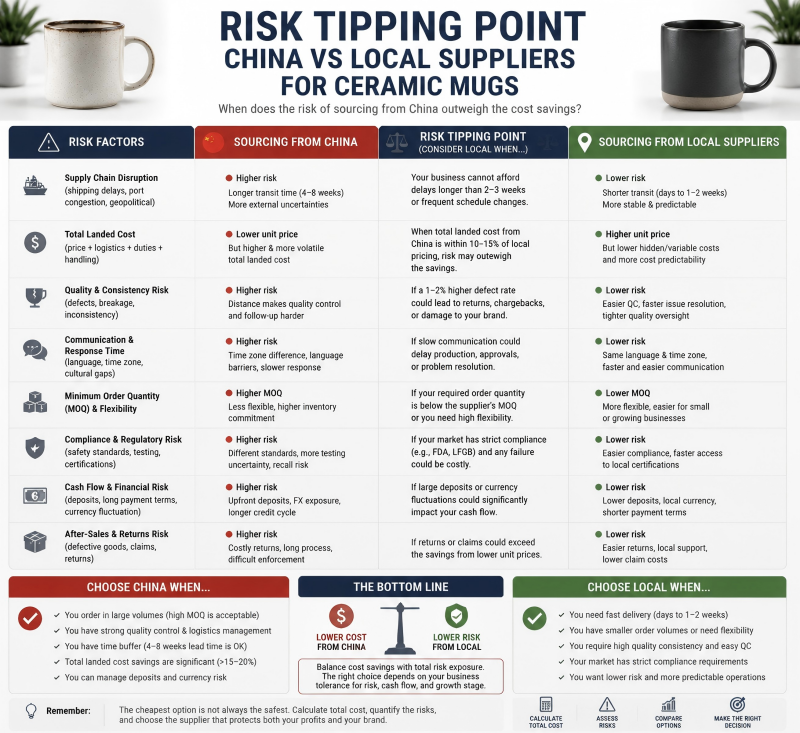
The five situations where “cheap” becomes expensive
I see these scenarios all the time:
- Micro‑batches: If you import from China vs buy locally in quantities under a pallet, LCL fees and handling can erase savings.
- Urgent launches: A promotion slips; now you need air freight. Air can add $0.50–$1.50 per mug. That flips the math.
- Complex compliance: New food‑contact or labeling rules trigger extra tests, holds, and fees.
- Design churn: Frequent artwork changes add setup waste. Local can turn small iterations faster.
- Cash constraints: Deposits and long lead times tie up capital. If you need fast rotations, local predictability adds value.
A common oversight is failure to price the cost of time. If a delayed container causes a two‑week stockout at $500/day contribution margin, that is a $7,000 “fee” no one wrote on an invoice. Local suppliers sometimes win because the risk of delay is lower, not because their unit price is lower.
When buyers ask us for a china manufacturing cost comparison, we include plan B. If a strike or typhoon hits, can we partial ship by air? What is the threshold where local bridging production makes sense? Modeling those breakpoints prevents surprises.
How do MOQs and cash flow differ in China vs local suppliers?
The issue for smaller sellers is not price; it is inventory. Buyers worry about buying too deep to hit factory MOQs. The pain is cash stuck on water for weeks. The solution is to match MOQ and payment terms to your stage and forecast accuracy.
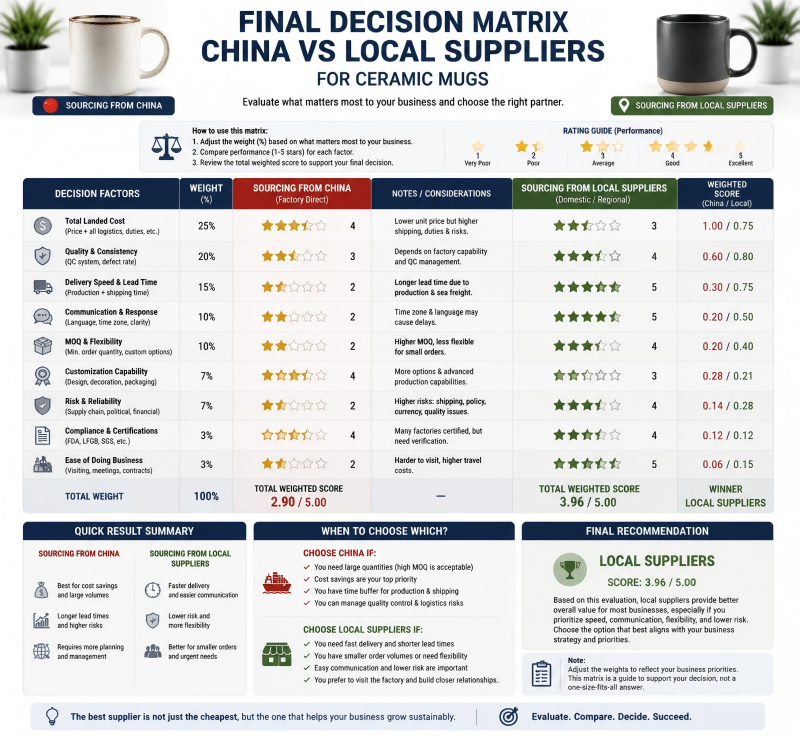
China vs local suppliers differ mainly in MOQ and cash cycle. China offers lower unit cost at higher MOQ and longer lead time with deposits. Local suppliers accept smaller runs, later payments, and faster replenishment. Your choice should match forecast reliability and working capital.
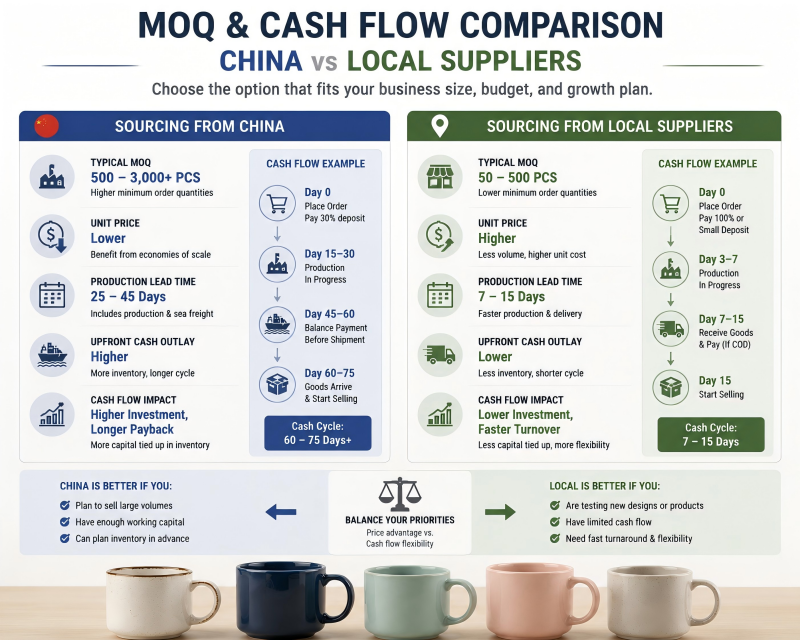
Matching volume to your risk tolerance
In my inbox, “Can you reduce the MOQ?” is the number‑one line from new e‑commerce brands. Here is how I coach them.
- Early stage or uncertain demand:
- Prefer local for test runs of 100–500 units.
- Pay a higher unit price to learn fast and keep cash flexible.
- Use results to dial designs and packaging before scaling.
- Growth stage with better forecasts:
- Split orders: local for fast movers, China for base demand.
- Use China for printed mugs once designs stabilize, e.g., custom coffee mugs wholesale.
- Scale stage:
- Consolidate SKUs into larger China runs.
- Negotiate better payment terms based on relationship and volume.
When buying direct from China manufacturers, you often pay 30% deposit and 70% balance at shipment, then wait 30–45 days for ocean transit. That is a long cash cycle. Local may allow 30‑day terms after delivery. The extra 60–90 days of cash freedom can be more valuable than a $0.30 savings on unit price.
If you pursue private label ceramic mugs with seasonal artwork, consider a rolling program: three China runs a year for the core range, supplemented by agile local drops for trends. This hybrid approach balances cost and agility.
And yes, MOQs are negotiable when you buy a family of SKUs using the same glaze, clay body, and box sizes. Ask your factory—an experienced OEM supplier can often pool materials to lower effective MOQs without raising waste.
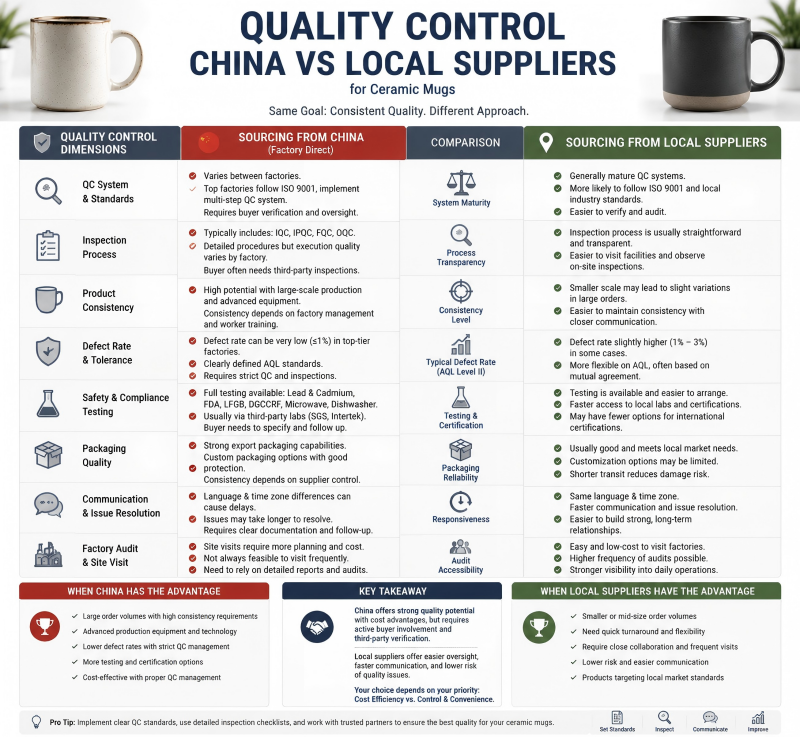
How should you handle quality control with a local supplier vs overseas supplier?
The problem with overseas buying is fear of defects you only discover after arrival. The anxiety doubles when the selling season is narrow. The solution is a layered QA plan that prevents issues upstream and verifies before shipment.
For a local supplier vs overseas supplier, align on specifications early, run pre‑production samples, and conduct third‑party inspections before shipment. Overseas requires clearer documentation, more checkpoints, and independent verification to offset distance and time.
Building a QA chain that actually works
A wholesaler once told me, “We trusted the sample but missed the decal registration on 10% of the production.” We rebuilt their process together:
- Specification pack:
- Define clay body, glaze standard (e.g., Lab* color), capacity tolerance, handle pull test (e.g., 10 kg for 1 minute), and print position in millimeters.
- Include food‑contact and dishwasher/microwave test requirements.
- Pre‑production approval:
- Sign off production samples made with final tooling and final inks—not hand‑made mockups.
- In‑process checks:
- First‑article inspection during printing and glazing.
- Random checks for pinholes, glaze runs, and decal alignment.
- Pre‑shipment inspection:
- Use a third party or your agent for AQL sampling on critical, major, and minor defects.
- Post‑arrival spot check:
- Verify a few cartons to validate the process end‑to‑end.
We explain printing techniques up front—decal firing vs direct screen print vs hydrographics—because each has different risk points and costs. When a wholesaler is comparing our quote, they often overlook the time and cost we bake in for QA. That is part of your total landed cost, and it pays for itself in fewer returns.
If you are evaluating ceramic mug manufacturers China claims as “best,” ask to see their process control sheets and past inspection reports. The best ceramic mug manufacturer is the one who shows you how they prevent defects, not just how they fix them.
Does speed and communication tip the scale in china sourcing vs local sourcing?
The pain point is lost time. Emails bounce across time zones, and small misunderstandings become costly rework. The stress is higher during peak season. The solution is to map actual lead times and communication friction into your cost model.
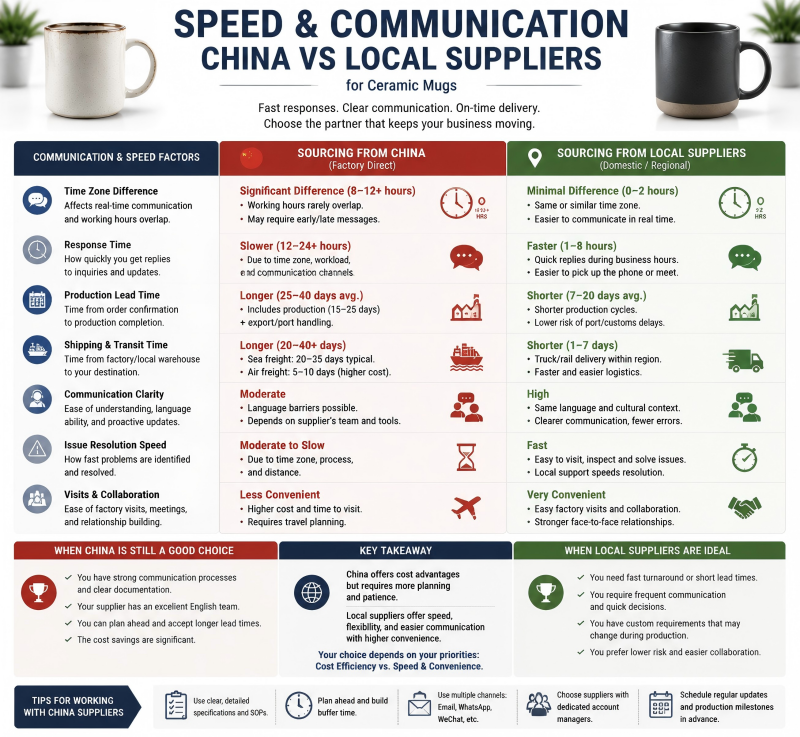
In china sourcing vs local sourcing, speed often favors local: shorter lead times, same‑day calls, easier changes. China excels when you plan ahead and lock specs. If your model depends on fast design churn, local may offset higher unit cost with faster market response.
Lead times and the real cost of time
Typical cycles I see for mugs:
- China:
- Tooling or color match: 5–10 days
- Production: 15–25 days
- Ocean transit: 25–40 days (route‑dependent)
- Total to warehouse: 45–75 days
- Local:
- Production: 7–14 days
- Domestic transit: 2–5 days
- Total to warehouse: 9–19 days
If you have weekly drops or celebrity collabs, the flexibility of local reduces stockout and markdown risk. If you build a forecastable core line—think wholesale ceramic mugs from China that repeat every quarter—China’s scale wins.
Communication overhead also costs money. I block time for late‑night calls to align fast with US and EU clients. That responsiveness reduces friction that buyers often budget as “project management hours.” If your China partner offers structured updates, clear timelines, and bilingual staff, your hidden cost of communication drops dramatically.
How do you compare ceramic mug quotes apples‑to‑apples?
The problem is two quotes rarely match on materials, print method, or packaging. The frustration is deciding without clarity. The solution is a standardized RFQ sheet that forces alignment and reveals true value.
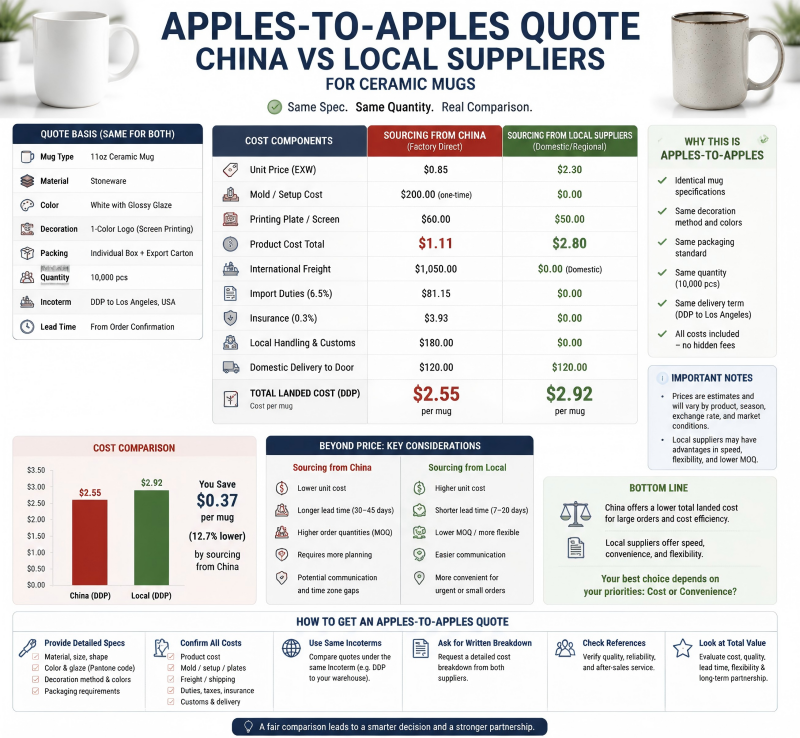
Compare quotes by fixing specifications: clay body, glaze, capacity, print method, color count, packaging, inspection, and delivery terms. Ask for unit price by Incoterm, plus line items for freight and duties. Only then can you run a fair China vs local suppliers comparison.
The specification checklist I send buyers
I share this template when someone asks for china supplier comparison:
- Product basics:
- Capacity (e.g., 11 oz ±3%)
- Weight and wall thickness targets
- Clay body and glaze finish (matte/gloss; color reference)
- Printing:
- Method (kiln‑fired decal, direct print)
- Color count (Pantone references)
- Artwork coverage and position tolerances
- Packaging:
- Bulk pack vs gift box; box print specs
- Carton size and palletization plan
- Compliance:
- Food‑contact, dishwasher/microwave, heavy metal tests
- Country‑specific labeling
- QA and terms:
- AQL levels, in‑line checks, pre‑shipment quality inspection
- Incoterms (EXW/FOB/CIF/DDP), warranty/returns policy
Then add a cost request:
- Unit price by Incoterm
- One‑time tooling or setup fees
- Carton count per container (for shipping costs)
- Estimated lead time by season
- Suggested MOQ and price breaks
This approach transforms “What’s your price?” into a robust china supplier comparison. It also highlights what questions you should ask: Is the print dishwasher‑safe after 500 cycles? Is the handle pull test performed? Is the box drop‑tested at 1.2 meters? Those details determine your real cost and customer satisfaction.
If you need customization, ask for an [OEM ceramic mug factory] quote. Many factories, ours included, act as a custom ceramic mug supplier that can handle OEM and private label ceramic mugs with consistent QA.
We make it clear when we are a wholesale ceramic mug supplier and when we recommend a local partner for short runs. That honesty builds long‑term value.
Frequently Asked Questions
What is the biggest hidden cost when importing mugs from China?
The biggest hidden cost is time. Freight delays, customs holds, and rework compress your selling window. That lost margin rarely appears in quotes. Add a line for delay risk when modeling total landed cost, and do not forget insurance and third‑party inspections.
How do I decide between sourcing from China vs local suppliers for my first order?
Start with a small, fast local run to validate demand and artwork. Use the data to refine specifications. Once sales stabilize, move base volume to China for scale, and keep local capacity for rush or trend items. This staged approach manages risk and cash.
Are duties and tariffs predictable for ceramic mugs?
Duties are predictable in structure but can change by policy. Confirm your HS code, check current rates for your destination, and simulate best‑ and worst‑case scenarios. Build a 2–3% buffer in your cost model to absorb fluctuations and unexpected port fees.
How do I vet ceramic mug manufacturers China offers online?
Go beyond photos. Request process documentation, past inspection reports, and kiln firing profiles. Verify certifications and ask for client references in your market. Run a pilot with clear AQL criteria and a pre‑shipment inspection before scaling up.
Can I buy small quantities when buying direct from China manufacturers?
You can, but the economics may suffer due to MOQs and logistics. Consider consolidated shipments, shared decals across designs, or a hybrid plan where local handles micro‑drops and China produces core SKUs once you exceed the break‑even volume.
Conclusion
Choosing between China vs local suppliers is not a race to the lowest quote; it is a risk management decision. Map your total landed cost, cash cycle, QA plan, and speed requirements. Then choose the mix that protects your margin and sanity. If you want a practical worksheet or a sample cost breakdown for mugs, reach out and reference ceramic mug pricing.
—
Notes:
- We are a factory in Liling with ISO9001 and BSCI, exporting to Europe and South America for 15 years. We often help clients run a china supplier comparison before they even discuss price. If you need guidance on hidden sourcing costs or a tailored QA plan, I am happy to share examples.