OEM vs ODM Ceramic Mug Production: Quick Comparison
| OEM Ceramic Mug | ODM Ceramic Mug | |
|---|---|---|
| Design ownership | Buyer owns design | Factory owns design |
| Customization | Full customization | Branding customization |
| Mold | New mold required | Existing mold |
| Investment | Higher | Lower |
| Development time | 60-120 days | 30-45 days |
| Product uniqueness | High | Medium |
| Best for | Brands & retailers | New sellers & testing |
Struggling to decide on OEM vs ODM ceramic mug production for your new product line? You're worried that picking the wrong path will lead to wasted investment, missed market opportunities, or a product that simply doesn't stand out. The truth is, aligning your production strategy with your business model from day one is the key to sourcing success.
The core difference in OEM vs ODM ceramic mug production is who owns the design. In OEM (Original Equipment Manufacturer), you provide the factory with a complete, original design to produce exclusively for you. In ODM (Original Design Manufacturer), you select a pre-existing design from the factory's catalog and add your branding.
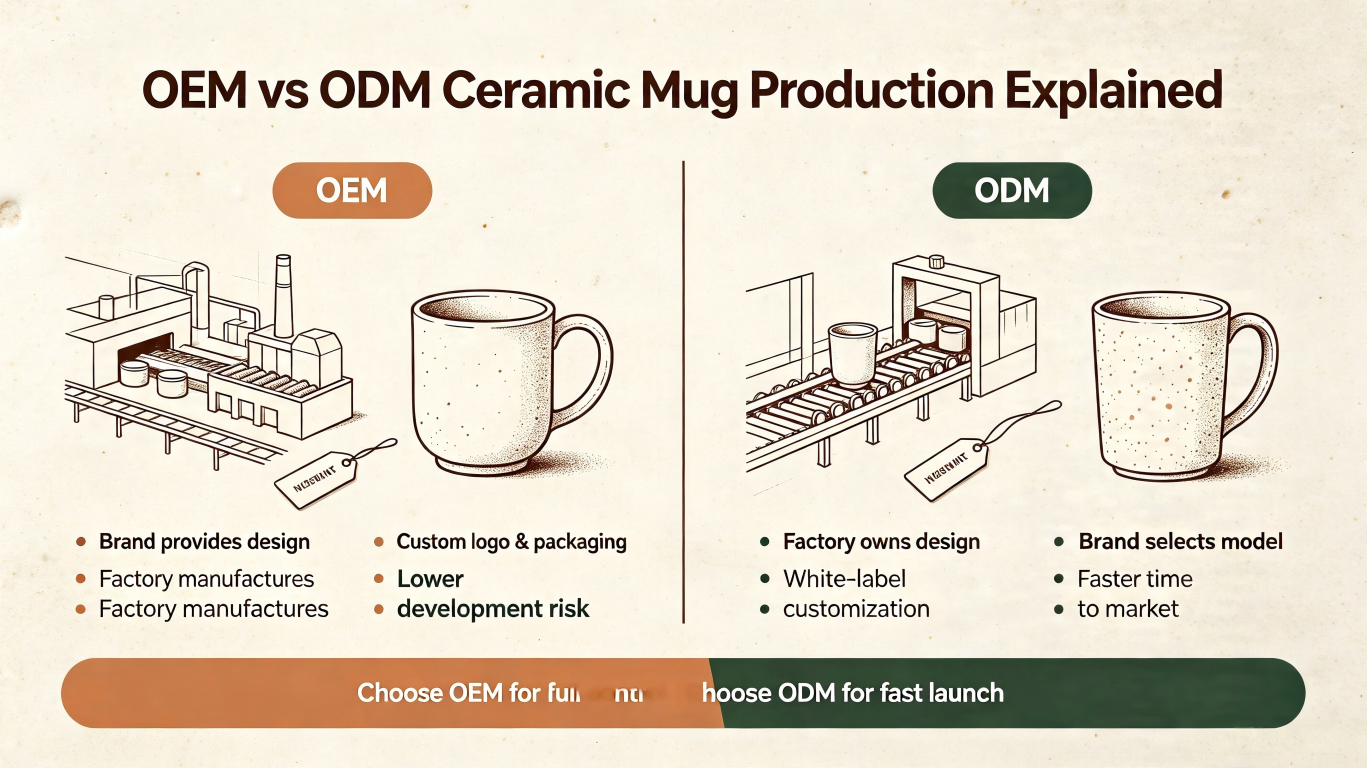
This choice is more than a technicality; it's a strategic decision that impacts your budget, timeline, and brand's future. Over my 15 years in this industry, the most common mistake I see buyers make is looking for the "best" option. Let's dive deeper into which model is the right fit for your specific goals.
When Should You Choose an OEM Ceramic Mug Manufacturer?
Do you have a truly unique vision for a ceramic mug that embodies your brand's identity? You have the design, but you're rightfully concerned about protecting your intellectual property and finding a partner who can execute your specifications with precision. The solution isn't just finding a factory that says "yes," but one with a proven process for bringing new designs to life.
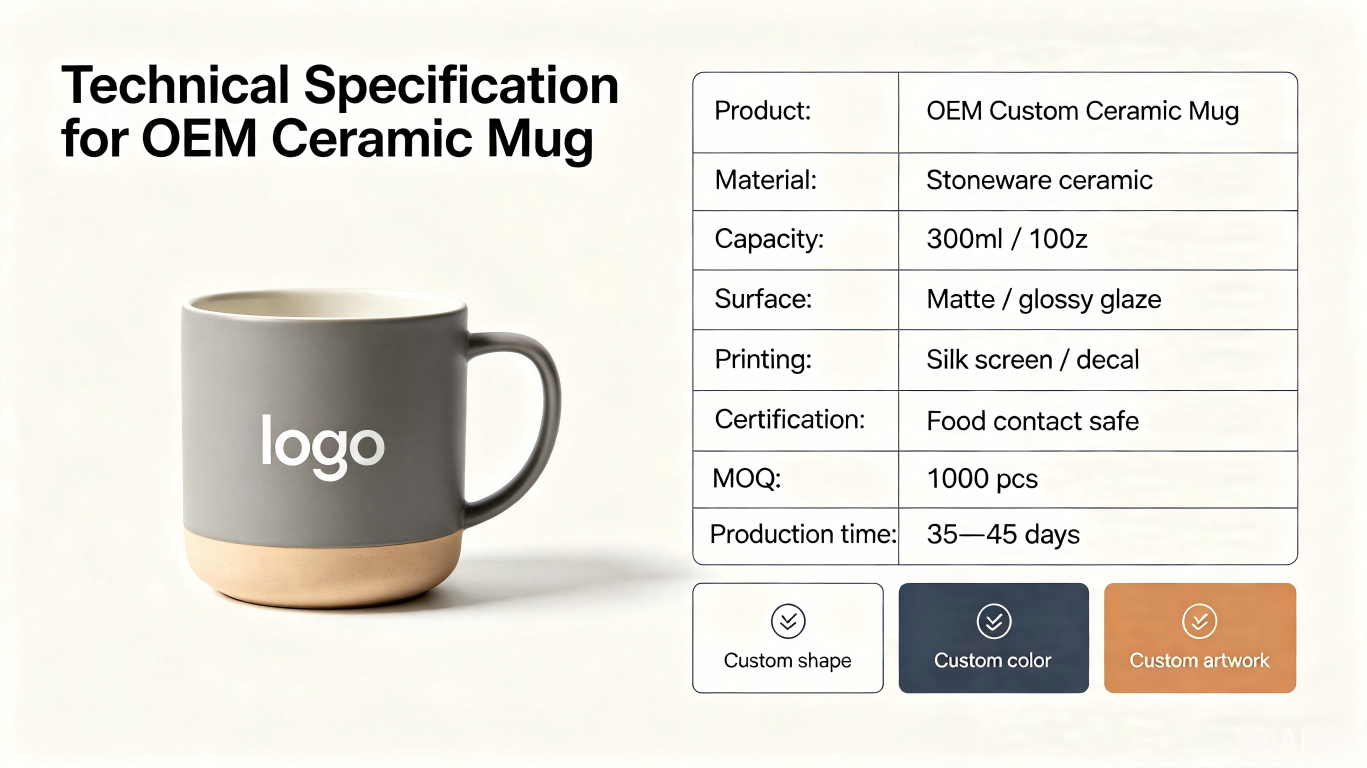
Choosing an OEM ceramic mug manufacturer is the right path when you have a strong brand, in-house design capabilities, and prioritize long-term brand equity over short-term speed to market. It is for businesses that want to create a truly proprietary product.
Dive Deeper: The Reality of the OEM Partnership
As a custom ceramic mugs manufacturer, we see OEM as a deep collaboration. It goes far beyond simply receiving a picture of a mug. A successful OEM project starts with a comprehensive "tech pack" from the client.
This document is the blueprint for the entire project. It must include:
- 3D/CAD Files: Detailed files (like .STP or .IGS) that define the mug's exact shape, dimensions, and volume.
- Material Specifications: The type of ceramic (e.g., stoneware, porcelain, bone china), its required durability, and any food-grade safety standards (like FDA or Prop 65).
- Color and Finish Details: Precise Pantone color codes for glazes, finishes (matte vs. glossy), and any special textures.
- Decoration Artwork: Vector files for logos, decals, or prints, including placement instructions.
A frequent question from buyers is, "How complex can the design be?" The answer depends on the ceramic medium, but modern molding and firing techniques allow for incredible detail. The key is providing a flawless tech pack. An incomplete pack is the number one cause of delays and sample revisions in the custom mug production process.
The Critical Trade-Off: Control vs. Investment
The primary benefit of OEM is total control. You own the design and the mold. No other company can sell your mug. This is non-negotiable for premium brands building lasting value. However, this control comes at a cost.
| Factor | OEM (Original Equipment Manufacturer) | ODM (Original Design Manufacturer) |
|---|---|---|
| Design Control | Complete control over shape, materials, and finish. | Limited to factory's existing designs. |
| Intellectual Property | You own the design and the mold. | Factory owns the design and the mold. |
| Upfront Investment | Higher (mold fees, multiple sample rounds). | Very low (no mold fees). |
| Time to Market | Slower (60–120 days for mold and samples). | Faster (30–45 days for samples and production). |
| Differentiation | High. Product is unique to your brand. | Low. Competitors may use the same base model. |
| Best For | Established brands with strong design capabilities. | New sellers, market testing, promotional items. |
The investment isn't just financial. Mold development for a new ceramic mug can cost anywhere from $500 to over $3,000, depending on complexity. It also requires a significant time investment. From initial drawings to approved final samples, the process can take several months before mass production even begins. You must factor this into your launch timeline.
Key Questions for Your OEM Partner
When vetting a factory, shift your perspective. Don't just ask, "Can you make this?" Ask strategic questions that reveal their expertise and reliability:
- "What is your process for protecting my intellectual property? Do you sign NNN (Non-Disclosure, Non-Use, Non-Circumvention) agreements?"
- "Can you walk me through your quality control checkpoints for a new OEM product?"
- "What are the most common reasons for sample revisions, and how can we avoid them?"
A good partner will have clear, confident answers. I recall a client from the US who was launching a high-end coffee shop chain. For them, the unique feel and weight of the mug were as important as the logo. The OEM path was the only option, and our ability to detail our QC process for mold accuracy and glaze consistency gave them the confidence to proceed.
Is an ODM Ceramic Mug Supplier the Faster Path to Market?
You have a great brand concept and want to start selling wholesale ceramic mugs fast, perhaps to test a new market or capitalize on a trend. The idea of investing thousands of dollars and months of time into a custom mold feels risky. An ODM supplier seems like the perfect solution, but you're worried your products will look identical to your competitors'.
Choosing an ODM ceramic mug supplier is ideal for speed and minimizing upfront investment. It allows you to leverage a factory's existing designs and molds to get a product to market quickly, making it a powerful strategy for e-commerce sellers and promotional product distributors.
Dive Deeper: The Power of "White Label" and "Private Label"
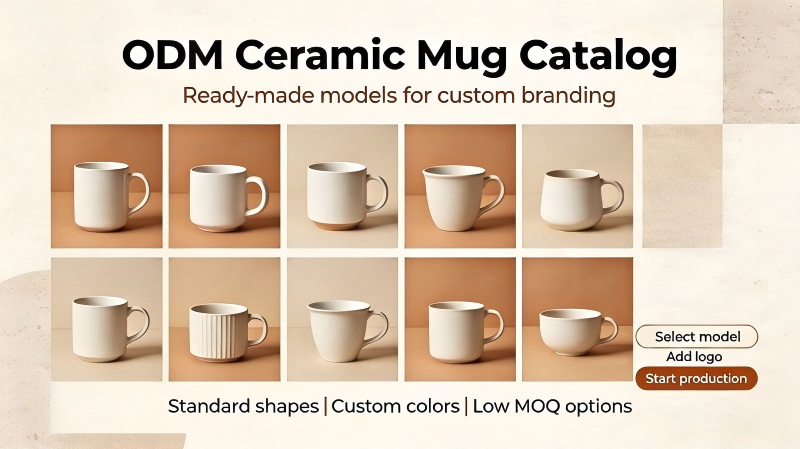
The ODM model is often called "white label" or private label ceramic mugs. As a ceramic mug factory in China, we have a large catalog of mug shapes, sizes, and handles that have already been developed and tested. The molds exist, the production process is perfected, and we know exactly how they perform.
Here’s how it works:
- Selection: You browse our catalog of existing mug designs.
- Customization: You select a base model and decide on the glaze color, finish, and branding.
- Branding: You provide your logo or artwork, and we apply it through methods like decal printing, silk screening, or laser engraving.
- Production: Because the mold and process are established, we can move to sampling and mass production very quickly.
This model is the backbone of the promotional products industry and a favorite for e-commerce sellers using platforms like Amazon or Shopify. It dramatically lowers the barrier to entry. You don't need a designer or an engineer; you need a good eye for what will sell and a strong brand to apply to the product.
The Trade-Off: Speed vs. Differentiation
The overwhelming advantage of ODM is speed. We can often produce a branded sample in a week and start mass production shortly after. There are no mold fees, which means your initial capital outlay is focused entirely on inventory. This allows you to be nimble and responsive to market trends.
However, the major risk is commoditization. If you choose a popular ODM shape, there's a high probability that other sellers are using the exact same mug body. I've seen this happen many times. A buyer in Europe will place an order for a popular 12 oz bistro mug, only to find several other online stores selling an identical product a few months later.
This is where your strategy must shift. With ODM, you can't compete on product uniqueness. You must compete on:
- Brand Story: The "why" behind your company.
- Surface Decoration: A compelling graphic or logo that resonates with your niche.
- Packaging: A custom box can elevate a standard mug into a premium gift.
- Marketing and Community: Building a loyal following around your brand.
How to Win with an ODM Strategy
A smart ODM strategy involves more than just picking a mug and adding a logo. What we often explain to clients is that ODM is a spectrum. You can achieve a degree of uniqueness by making smart customization choices.
For example, instead of choosing a standard white gloss glaze, ask your supplier about reactive glazes, custom-matched Pantone colors, or a two-tone finish. While you're still using a stock shape, a unique glaze can make the product feel much more exclusive. These small modifications typically have a lower MOQ and cost than a full OEM project but can significantly boost your product's perceived value.
Can You Combine OEM and ODM for Ceramic Mug Production?
Perhaps you feel caught in the middle. The speed and low cost of ODM are appealing, but the lack of differentiation is a major concern. On the other hand, the high investment and long timeline for full OEM feel too risky for your current stage of business. It can seem like you're forced to choose between two extremes.
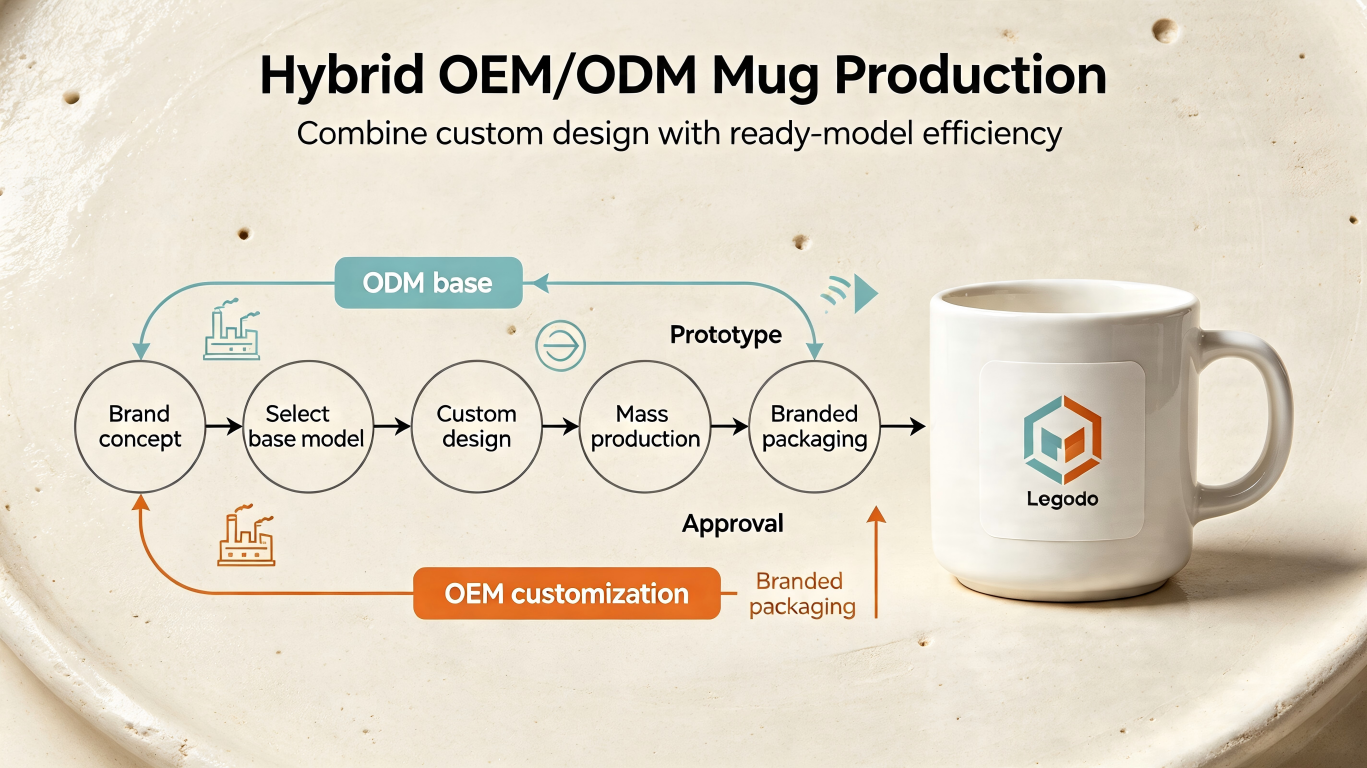
Yes, you can absolutely combine strategies in your OEM vs ODM ceramic mug production plan. A hybrid approach, where you modify an existing ODM design, offers a powerful middle ground. It balances speed and cost-effectiveness with a healthy dose of customization to help your product stand out.
Dive Deeper: Starting with ODM, Evolving to OEM
One of the most successful sourcing paths I've seen clients take is a phased approach. It's a journey we've guided many e-commerce sellers through.
- Phase 1: Market Validation (ODM). Start with a classic ODM model. Select 2-3 promising mug shapes from our catalog, apply your branding, and launch with a relatively low MOQ. The goal here isn't to build a forever product; it's to gather real-world sales data. Which shape sells best? What colors do your customers prefer?
- Phase 2: The Hybrid Step (Modified ODM). Your data shows that a 14 oz tapered mug is a clear winner, but you want to make it your own. At this stage, you can invest in a small modification. Perhaps you ask us to tool a new, more ergonomic handle for that existing mug body. This is a small "OEM" step—creating a new mold component—applied to an "ODM" base. The cost is far lower than a full OEM project, but the result is a semi-proprietary product.
- Phase 3: Brand Building (Full OEM). Once the modified mug has proven its success and your cash flow is strong, you're ready for the final step. You now have the confidence and capital to invest in a completely new, fully custom OEM design from the ground up. This product becomes your flagship, protected by your IP and impossible for competitors to copy.
What "Modifying an ODM" Looks Like
Modifying an existing design can range from simple to complex, with corresponding impacts on cost and timeline.
- Simple Modifications (Low Cost, Fast):
- Custom Glazes: Requesting a specific Pantone color match or a special finish like a reactive or speckled glaze.
- Unique Decals: Applying a complex, multi-color decal that wraps around the mug.
- Debossing/Embossing: Adding your logo as a subtle, textural element to the mug body before firing.
- Complex Modifications (Moderate Cost, Slower):
- Changing a Handle: This requires creating a new mold for the handle and a new process for attaching it. It's a common and very effective way to create a unique silhouette.
- Altering the Base: Adding a custom-stamped logo or a different foot to the mug's base.
- Slight Shape Adjustments: Minor changes to the mug's rim or curvature.
This hybrid model is perfect for agile businesses that need to balance innovation with risk management. It acknowledges that the OEM vs ODM ceramic mug production decision isn't a one-time choice but a strategic part of your business's evolution.
Frequently Asked Questions
How much does a new ceramic mug mold cost?
The cost for a new production mold typically ranges from $500 to $3,000 USD. The final price depends on the mug's complexity, size, and features like an intricate handle or textured surface. Simple, classic shapes are on the lower end, while highly unique, multi-part designs are on the higher end.
What is the minimum order quantity (MOQ) for OEM vs. ODM?
Generally, the MOQ for an OEM project is higher, often starting at 3,000 to 5,000 pieces per design. This is to offset the costs of mold development and production line setup. For ODM projects, where the mold already exists, the MOQ can be much lower, often starting around 1,000 to 2,000 pieces per design/color.
How do I protect my design when working with an OEM factory in China?
Reputable factories take IP protection seriously. The best practice is to sign a comprehensive NNN (Non-Disclosure, Non-Use, Non-Circumvention) agreement before sharing any design files. This agreement should be in Chinese and enforceable in Chinese courts. Working with an established factory with a long history of exporting to Western markets, like us, is your best safeguard.
Can I put my logo on an ODM mug?
Absolutely. That is the core of the ODM and private label model. You select a mug from the factory's existing catalog, and the factory applies your logo or artwork using methods like decal printing or silk screening. It's the fastest and most cost-effective way to create a branded product.
Conclusion
Choosing between OEM vs ODM ceramic mug production is not about finding a single "better" option, but about making a strategic decision that aligns with your specific business goals. If you have a strong brand identity and the resources to invest in a unique product, the control and long-term value of OEM are unmatched. If your priority is speed, market testing, and minimizing upfront risk, the ODM model provides an incredibly efficient path to launch. Many successful brands even use a hybrid approach, evolving from ODM to OEM as they grow.
The right choice depends on a clear-eyed assessment of your budget, timeline, design capabilities, and tolerance for risk. As a ceramic mug factory in China with 15 years of experience helping international wholesalers and e-commerce sellers, we've navigated this decision with hundreds of clients.
If you're ready to discuss your project and determine the best production strategy for your brand, please contact our team. We're here to help you source smarter, not harder.