Struggling to navigate the complex world of private label ceramic mug manufacturing? You have a great design, but the sheer number of choices in materials, printing, and suppliers can be overwhelming. You're worried that a single wrong decision could lead to a low-quality product that damages your brand or a costly mistake that drains your budget. This guide will provide a clear decision-making framework, transforming you from a confused buyer into a confident sourcing professional.
Private label ceramic mug manufacturing is the process where a specialized factory produces mugs according to your unique brand specifications, which you then sell under your own brand name. This involves selecting materials, customizing shapes and glazes, and applying your logo or design. A good private label mug manufacturer acts as your production partner, helping you create a product that aligns with your brand's quality, aesthetic, and price point.
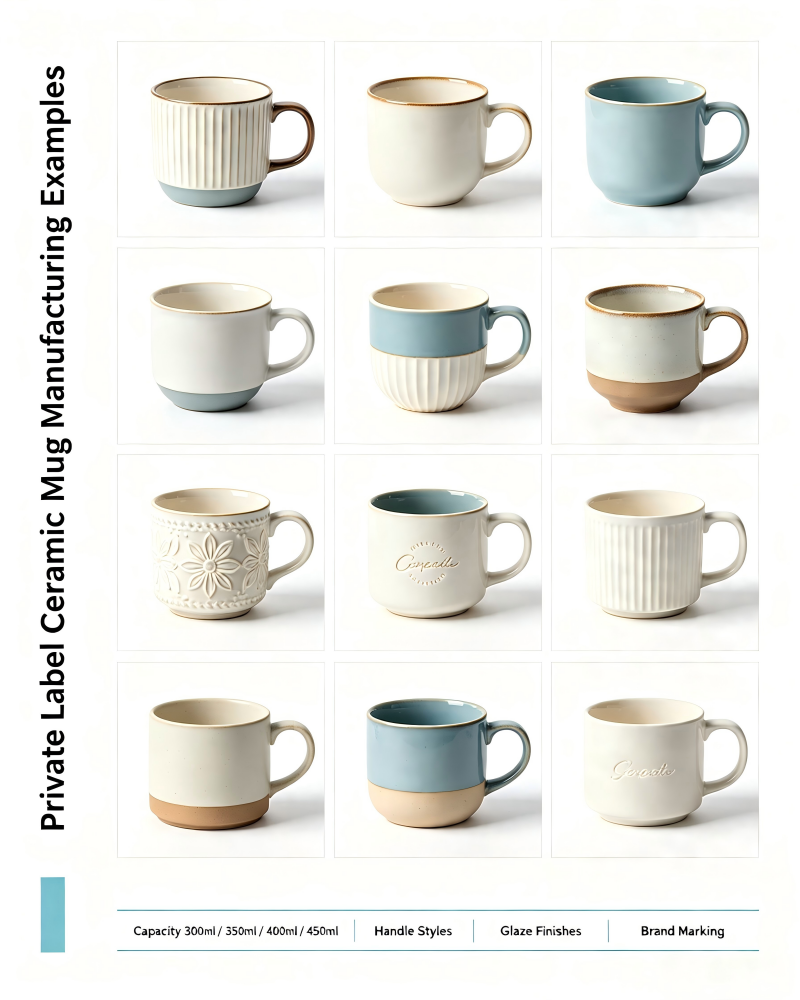
Now that you have the basic definition, let's move beyond the "what" and into the "how." The real challenge isn't just finding a factory; it's about understanding the critical decision points that determine your final product's cost, quality, and durability. Let’s dive into the key trade-offs you need to master.
What's the Best Material for Your Private Label Ceramic Mugs?
Choosing a material for your mugs feels like a high-stakes decision. Do you go for the most affordable option and risk chips and cracks, or do you invest in a premium material that might price you out of your market? The fear of getting this wrong is common.
The best material is entirely dependent on your specific use case. For high-end retail ceramic mugs, porcelain offers a premium feel. For durable, budget-conscious promotional ceramic mugs, stoneware is often the ideal choice. The right answer is a balance of brand perception, durability requirements, and budget.
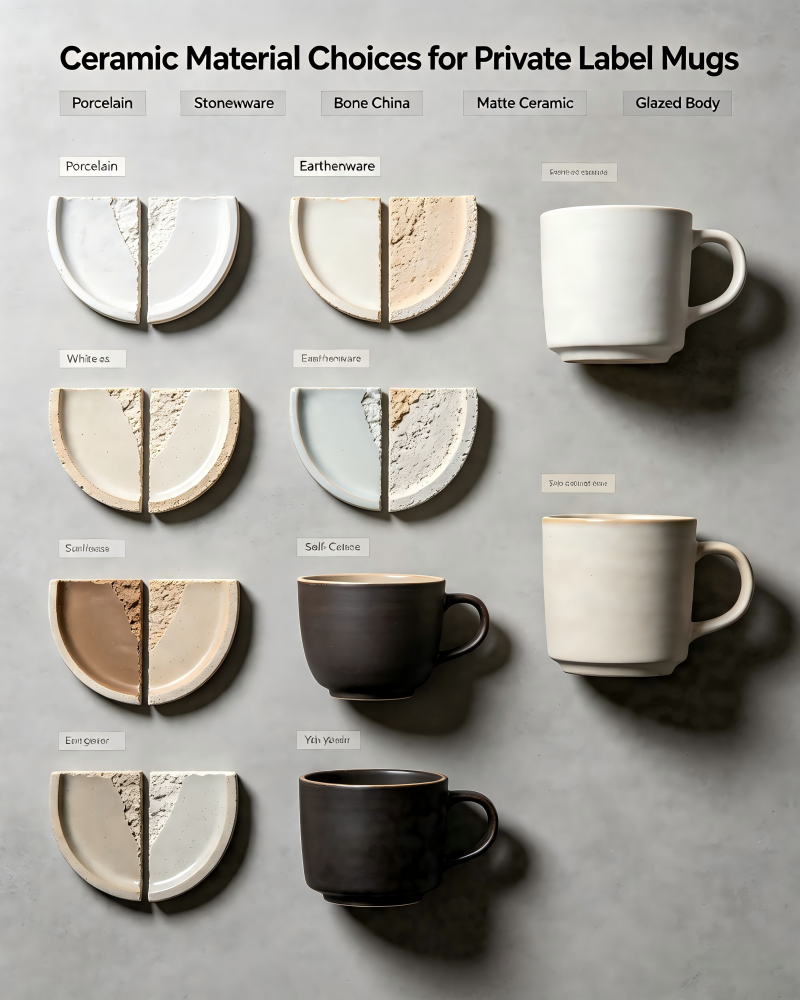
Over my 15 years in this industry, one of the first questions buyers ask is, "What's the cheapest material?" While I understand the focus on cost, this is a question that overlooks value and risk. A better approach is to define your goal first and then find the material that fits. Let's break down the most common options we work with here at our ceramic mug factory in China.
H3: Stoneware: The Workhorse for Everyday Mugs
Stoneware is arguably the most popular material for wholesale ceramic mugs. It's dense, durable, and relatively inexpensive to produce, making it a fantastic all-arounder. It has a slightly rustic, earthy feel and is known for its excellent heat retention.
For clients like coffee shop chains or companies ordering branded coffee mugs for office use, stoneware is a go-to. It can withstand the rigors of daily commercial use and repeated dishwashing. The trade-off is that it's thicker and heavier than porcelain, and the color palette of the clay body itself is typically more limited to earthy tones. However, this is easily addressed with a wide variety of glaze options.
- Best For: Everyday use, coffee shops, promotional giveaways, rustic or casual brands.
- Key Characteristics: Opaque, thick, durable, excellent heat retention.
- Cost: Low to mid-range.
H3: Porcelain & Bone China: The Premium Choice
When a client's brand is built on elegance and luxury, we almost always guide them toward porcelain or its even more refined cousin, bone china. Porcelain is fired at a much higher temperature than stoneware, which makes it non-porous, thinner, and more resistant to chipping. It has a smooth, delicate appearance and a bright white base that makes colors pop.
Bone china adds cow bone ash to the porcelain mixture, resulting in an even more translucent and lightweight, yet incredibly strong, final product. We see this chosen by high-end hotel chains and premium giftware brands. The main consideration here is cost. Manufacturing porcelain, and especially bone china, is a more complex and expensive process. It's an investment in brand perception.
- Best For: High-end retail, luxury giftware, premium hospitality, personalized ceramic mugs for special occasions.
- Key Characteristics: Thin, lightweight, often translucent, very durable, smooth finish.
- Cost: High to premium.
H3: New Bone China: A Practical Compromise?
A common point of confusion for buyers is "New Bone China." It's important to understand this is a marketing term. New Bone China is a type of porcelain formulated to mimic the look of traditional bone china (its bright whiteness and smoothness) without the bone ash. This makes it a more affordable alternative. It's a great middle-ground option for e-commerce sellers who want a more refined look than stoneware without the full cost of true porcelain or bone china.
Here is a simple table to help you decide:
| Feature | Stoneware | New Bone China | Porcelain / Bone China |
|---|---|---|---|
| Feel | Rustic, thick, heavy | Smooth, refined | Delicate, lightweight, thin |
| Durability | Very good | Good | Excellent (chip-resistant) |
| Appearance | Opaque, earthy | Bright white, opaque | Bright white, translucent |
| Best Use Case | Promotional, café, daily use | E-commerce, mid-range retail | High-end retail, luxury gifts |
| Cost | $ | $$ | $$$ |
Ultimately, the right material choice aligns your product's physical attributes with your brand's story and your customer's expectations.
How Does Customization Work in Private Label Ceramic Mug Manufacturing?
You have a fantastic logo or design, but you're unsure how it will actually be applied to the mug. Will the colors be accurate? Will it peel off in the dishwasher? The fear of a beautiful design being ruined by a poor application method is a major source of anxiety for buyers.
The best customization method depends on your design's complexity, order volume, and durability requirements. For complex, multi-color logos that need to be dishwasher-safe, decal printing is the industry standard. For full-color photographic images on smaller orders, sublimation is a better fit.
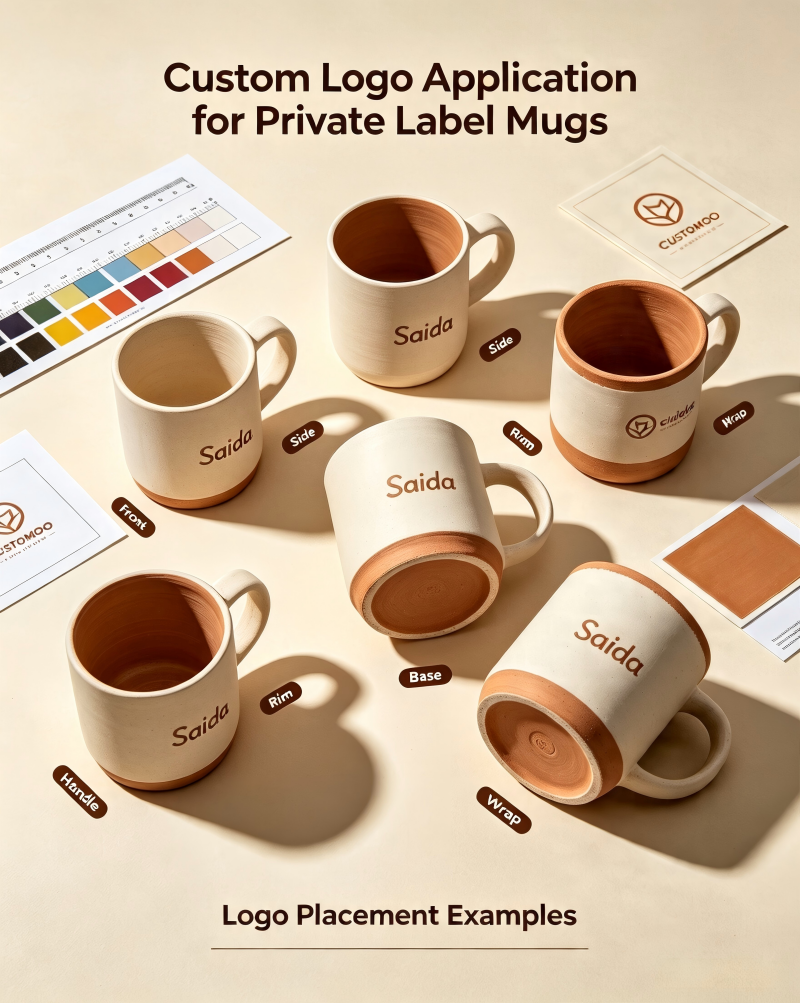
As a custom ceramic mug manufacturer, a large part of my job is helping clients match their artwork to the right technology. A design that looks great on a computer screen may not be suitable for every printing method. Understanding the pros and cons of each is crucial for managing your expectations and budget when creating custom logo mugs.
H3: Decal Printing: The Gold Standard for Detail and Durability
Decal printing is the most common method we use for high-volume wholesale ceramic mugs. Here’s how it works: your design is screen-printed onto special decal paper. This decal is then carefully applied to the mug by hand. Finally, the mug is fired in a kiln at a high temperature. This firing process essentially melts the design into the glaze, making it a permanent part of the mug.
This method is ideal for several reasons:
- Durability: When fired correctly, decal prints are extremely durable and are typically dishwasher and microwave safe. This is a critical requirement for most commercial and retail applications.
- Color Accuracy: It allows for precise Pantone (PMS) color matching, which is essential for maintaining brand consistency.
- Detail: It can reproduce very fine lines and intricate multi-color designs.
The main consideration is that it has higher setup costs, making it more cost-effective for larger order quantities (typically 500 pieces or more).
H3: Sublimation Printing: For Small Batches and Photo-Realism
Sublimation is a different process entirely. It uses heat to transfer special dye onto a mug that has a polymer coating. This process is essentially a digital printing method for ceramics.
We often recommend sublimation to new Etsy sellers or for promotional ceramic mugs needed in a hurry for an event. Its main advantages are:
- Low MOQ: Because it's a digital process, it's perfect for small orders, even a single personalized ceramic mug.
- Photo Quality: It can reproduce full-color photographic images with excellent detail and vibrancy.
- Fast Turnaround: The setup is much faster than decal printing.
However, there are trade-offs. The design is only as durable as the polymer coating it's infused into, which can sometimes be less resistant to scratching or fading over time compared to a fired decal. Furthermore, it works best on a pure white surface, and precise PMS color matching can be more challenging.
H3: Other Techniques to Consider
While decals and sublimation cover 90% of the projects we see, other methods exist for specific effects:
- Pad Printing: A very fast and cheap method for simple, one or two-color logos. It's often used for very large runs of promotional items where cost is the primary driver. Durability can be a concern if not cured properly.
- Engraving/Etching: This creates a high-end, subtle look by physically carving the design into the mug's surface. It's permanent but typically monochrome.
- Reactive Glazes & Hand-Painting: For truly unique, artisanal retail ceramic mugs, reactive glazes create one-of-a-kind patterns during firing. Hand-painting offers a bespoke touch but is labor-intensive and expensive, suitable only for premium, small-batch brands.
As your custom drinkware manufacturer, we would ask to see your artwork and understand your durability needs before recommending a path forward.
How Do You Choose the Right Private Label Mug Manufacturer?
You've found a few potential suppliers online, but their websites all look the same. How can you tell a great partner from a factory that will cause delays, quality issues, and communication headaches? Choosing the wrong ceramic mug supplier feels like the biggest risk of all.
The right private label mug manufacturer isn't just a supplier; they are a partner. You should choose them based on their communication, transparency, proven experience in your target market, and verifiable quality control systems and certifications (like BSCI and ISO9001), not just on the lowest price quoted.
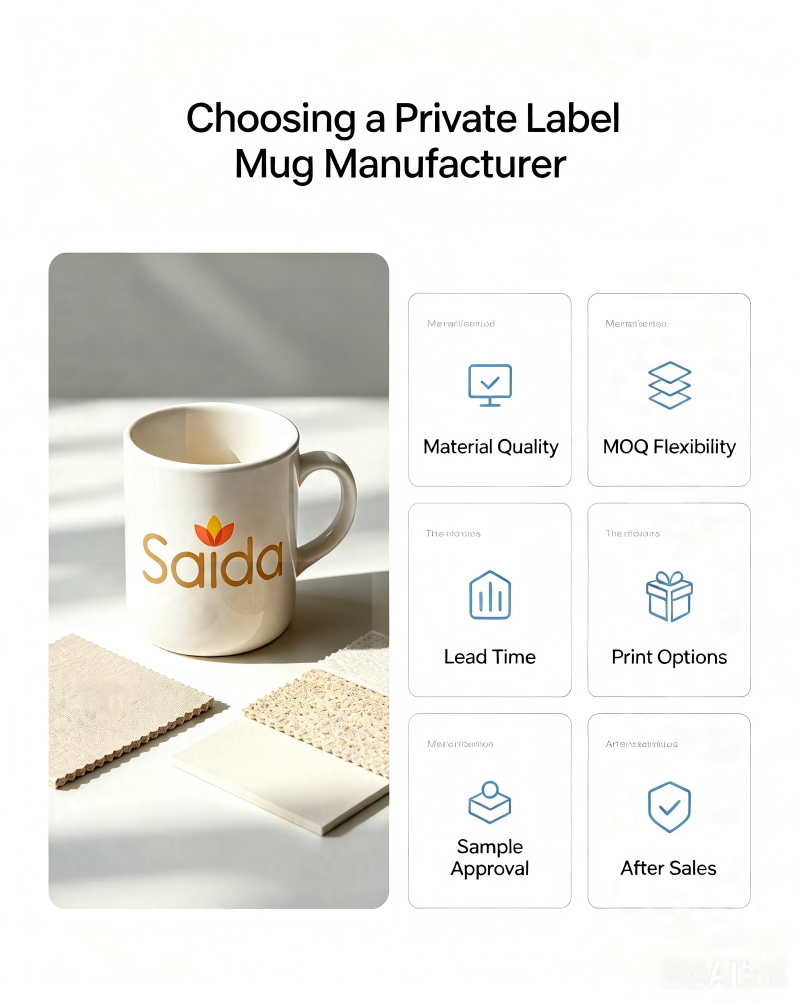
After 15 years of exporting private label coffee mugs to wholesalers and e-commerce sellers in Europe and South America, I can tell you that successful partnerships are built on trust and clear communication. A low price is meaningless if the product arrives late, fails quality checks, or violates your country's food safety regulations. Here is how to vet a potential partner and move beyond a simple price comparison.
H3: Beyond the Price: Key Questions to Ask
Many first-time buyers start the conversation with "How much for a mug?" This question is impossible to answer accurately without more information. It often leads to a misleadingly low quote that doesn't account for your real needs.
Here’s a much better question to ask a potential ceramic mug OEM factory:
"For an order of 5,000 stoneware mugs with a two-color, dishwasher-safe logo for the European market, what are your recommended material grades and decal application processes? What are the cost and durability trade-offs for each, and can you provide evidence of food-grade compliance for this configuration?"
This question shows you are a serious buyer and forces the supplier to demonstrate their expertise. Their answer will tell you volumes about their transparency and capability.
H3: Certifications Matter: BSCI, ISO9001, and Food Safety
Certifications are not just logos on a website; they are proof of a factory's commitment to quality and ethical standards.
- ISO 9001: This demonstrates that the factory has a robust Quality Management System (QMS). It means they have standardized processes for production, inspection, and continuous improvement. It's a baseline indicator of reliability.
- BSCI (Business Social Compliance Initiative): This is crucial if you sell to major retailers or are concerned with ethical sourcing. It audits a factory on factors like fair wages, working hours, and workplace safety. A BSCI-compliant factory like ours is vetted to be an ethical partner.
- Food Safety (FDA, LFGB, Prop 65): Your custom printed mugs must be safe for use. A reputable manufacturer must be able to provide test reports from third-party labs (like SGS or Intertek) showing that their products are free from harmful levels of lead and cadmium, meeting the standards for your specific sales region (e.g., FDA for the US, LFGB for Germany).
Always ask for copies of these certificates and test reports. A trustworthy supplier will provide them without hesitation.
H3: Assessing a Supplier's Experience
Does the supplier have experience exporting to your country or region? This is incredibly important. A factory that primarily serves the domestic Asian market may not be familiar with the quality expectations, packaging requirements, and customs regulations for Europe or the Americas.
Look for a partner who understands your market's nuances. For our European clients, we know that durability for dishwashers and precise color matching are paramount. For our South American clients, we often find a greater focus on unique shapes and vibrant glaze colors at a competitive price point. An experienced partner anticipates these needs, reducing friction and costly errors. The ideal ceramic mug supplier makes your job easier, not harder.
Frequently Asked Questions
What is the typical MOQ for private label ceramic mugs?
The Minimum Order Quantity (MOQ) varies greatly depending on the manufacturing process. For fully custom shapes and glazes, MOQs often start at 1,000–3,000 pieces. For standard mug shapes with a custom decal logo, MOQs are typically between 500 and 1,200 pieces. For digital sublimation printing on stock mugs, MOQs can be much lower, sometimes under 100 pieces.
Are all custom printed mugs dishwasher and microwave safe?
No, this is a critical detail to confirm. Mugs customized with high-temperature fired decals are generally very durable and safe for both dishwashers and microwaves. However, mugs with metallic prints (gold, silver) are never microwave-safe. The durability of sublimation or low-temperature prints can vary, so you must specify your durability requirements to your manufacturer.
What's the difference between OEM ceramic mugs and private label?
The terms are often used interchangeably, but there's a slight difference. Private Label typically means you select a manufacturer's existing mug style and add your brand's logo and packaging. OEM (Original Equipment Manufacturer) is a deeper partnership where the factory produces a completely custom mug shape and design based on your unique specifications. We handle both types of projects.
How long does production and shipping from a ceramic mug factory in China take?
On average, production for a custom order takes 30–60 days after the sample is confirmed. This depends on complexity and order size. Sea freight to Europe or the Americas typically adds another 30–45 days. You should budget for a total lead time of approximately 3–4 months from placing your order to receiving the goods.
Conclusion
Mastering private label ceramic mug manufacturing is not about finding a single "best" material or process. It's about a series of strategic trade-offs. The right choice for a budget-friendly promotional giveaway is the wrong choice for a luxury retail brand. By understanding the interplay between materials like stoneware and porcelain, customization methods like decals and sublimation, and the markers of a reliable supplier, you can mitigate risk and source with confidence. The most powerful tool at your disposal is the ability to ask better questions—questions that force transparency and demonstrate your expertise. This strategic approach will ensure the private label ceramic mugs you create are not only beautiful but also perfectly aligned with your business goals.
Ready to create custom ceramic mugs that elevate your brand? As a BSCI and ISO9001 certified factory with 15 years of export experience, we're here to be your manufacturing partner. Contact us today to discuss your project, and let's build something great together.