Are you sourcing products and finding the perfect design, only to be stopped cold by a high Minimum Order Quantity (MOQ)? This is a common frustration for many importers, making you wonder if ceramic mug manufacturers are being unnecessarily rigid. The truth is, this number is the key to unlocking a successful partnership.
A ceramic mug manufacturer’s MOQ, or Minimum Order Quantity, is a threshold set to cover significant fixed production costs, ensure manufacturing efficiency, and maintain consistent product quality. It is not an arbitrary number but a calculation based on the economics of mold creation, glaze preparation, kiln firing, and labor.
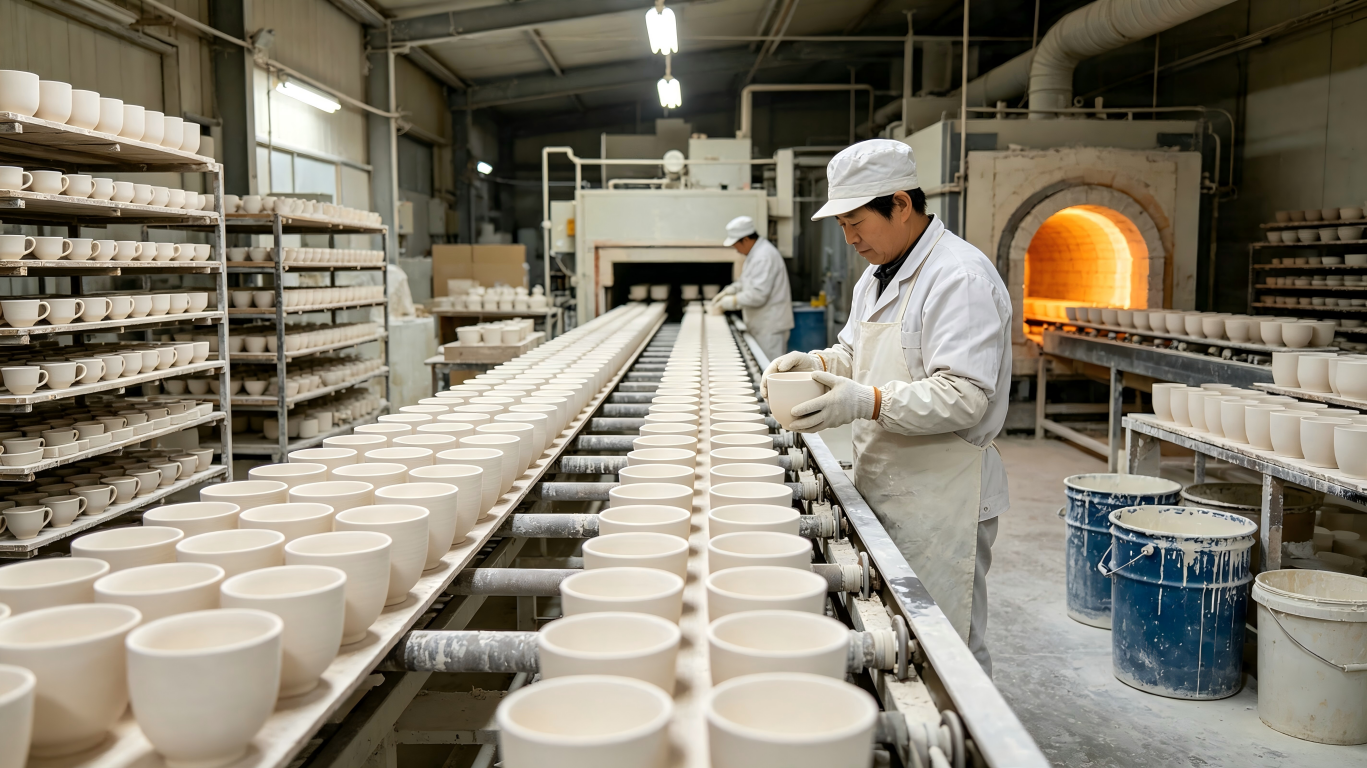
Now that you have the direct answer, you're likely wondering what those "significant fixed costs" really are. Understanding the details behind the MOQ will empower you to ask smarter questions and find the right supplier for your business scale. Let's break it down.
How Do Fixed Costs Influence a Ceramic Mug Manufacturer's MOQ?
Have you ever wondered why ordering 100 custom mugs isn't just 1/10th the price of ordering 1,000? You're dealing with the reality of fixed costs, which don't scale down with your order size. These upfront expenses must be absorbed, and a small order simply can't carry that weight.
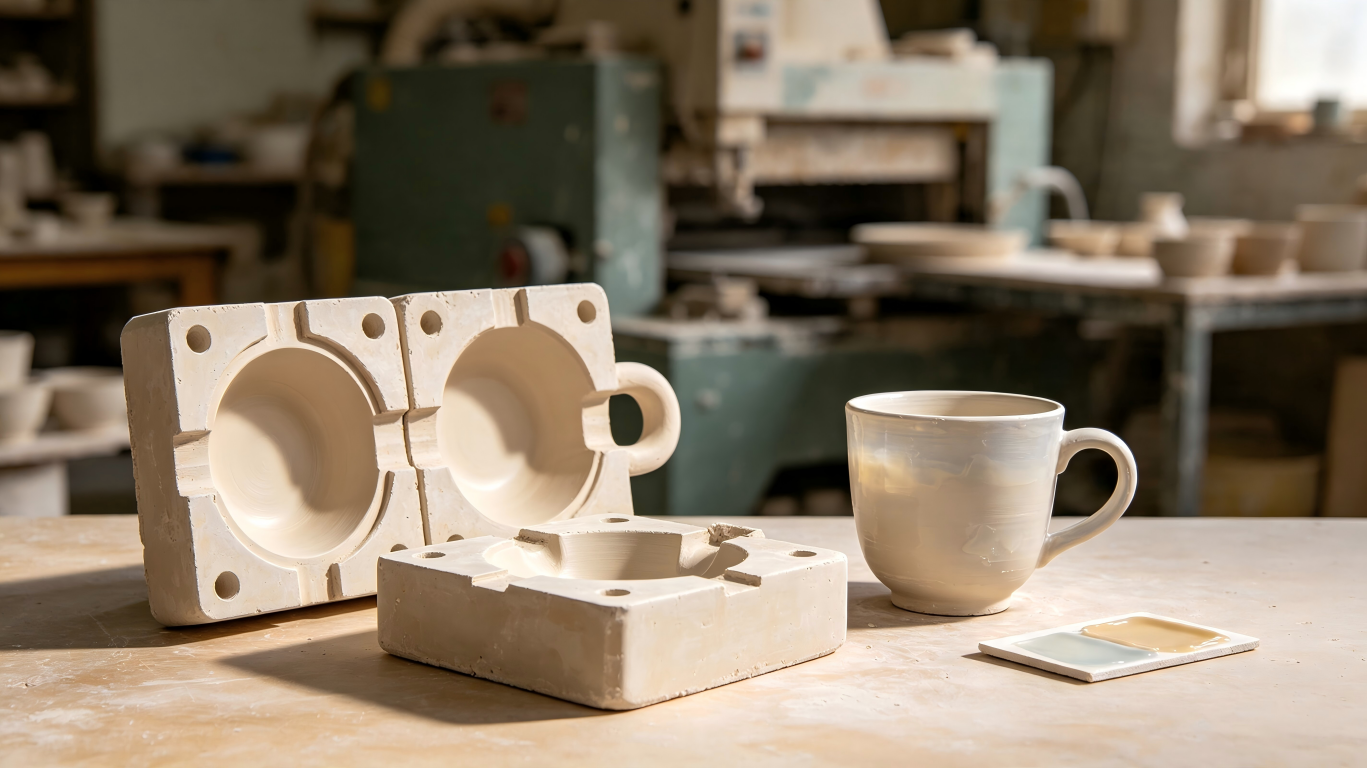
The primary reason a ceramic mug manufacturer sets an MOQ is to amortize inflexible, upfront costs across a viable number of units. Key expenses include creating molds, preparing custom glazes, setting up printing equipment, and the energy for kiln firing, all of which are incurred regardless of the order size.
Dive Deeper: Breaking Down the Upfront Investment
When you place an order for custom mugs, a series of industrial processes kick into gear long before the first mug is even formed. For a factory like ours, these initial steps represent a substantial, non-negotiable investment of time, materials, and energy.
H3: The Cost of Creating a New Mold
If your design requires a unique shape, we must first create a master mold, typically from steel or resin. This is a precision engineering task. From this master, we then create dozens or even hundreds of plaster production molds. This process involves significant skilled labor and material costs.
- Master Mold: Can cost hundreds to thousands of dollars depending on complexity.
- Production Molds: Each has a limited lifespan of about 80-100 uses before it degrades. For an order of 3,000 mugs, we need to prepare at least 30-40 production molds.
Whether you order 200 mugs or 5,000, the cost of creating that initial master mold is the same. Spreading that cost over a larger volume makes the per-unit price feasible.
H3: Glaze and Decal Preparation
Standard colors are one thing, but a specific Pantone color match requires a new glaze formulation. Our technicians must mix and test small batches, firing samples to ensure the color is perfect post-firing, as glazes can change dramatically in the kiln. This process is repeated for every unique color. Similarly, setting up screen printing or decal application machines for a new logo involves:
- Creating printing screens or printing decals.
- Calibrating machinery for the specific mug shape.
- Running test prints to ensure alignment and color accuracy.
This setup costs the same whether we're printing 300 units or 3,000.
H3: The Unforgiving Kiln
I often tell clients that firing a half-empty kiln is like running a 50-seater bus for a single passenger—the fuel cost is the same. Our industrial tunnel kilns are massive and consume an enormous amount of energy to reach temperatures over 1200°C (2200°F). To be efficient, they must be run at near-full capacity. A small order would either have to absorb the entire energy cost of a firing cycle, making each mug prohibitively expensive, or wait weeks to "piggyback" with another order, delaying production.
| Order Size | Mold Cost (Example) | Cost per Unit |
|---|---|---|
| 200 units | $1,000 | $5.00 |
| 1,000 units | $1,000 | $1.00 |
| 5,000 units | $1,000 | $0.20 |
As you can see, the MOQ ensures your per-unit cost remains competitive by distributing these fixed expenses effectively.
Does Production Volume Affect the Quality of Wholesale Ceramic Mugs?
Are you worried that a large order might lead to sloppy work and inconsistent quality? It's a valid concern, but in a professional ceramic mug factory, the opposite is often true. Small, disjointed production runs are where mistakes are most likely to happen.
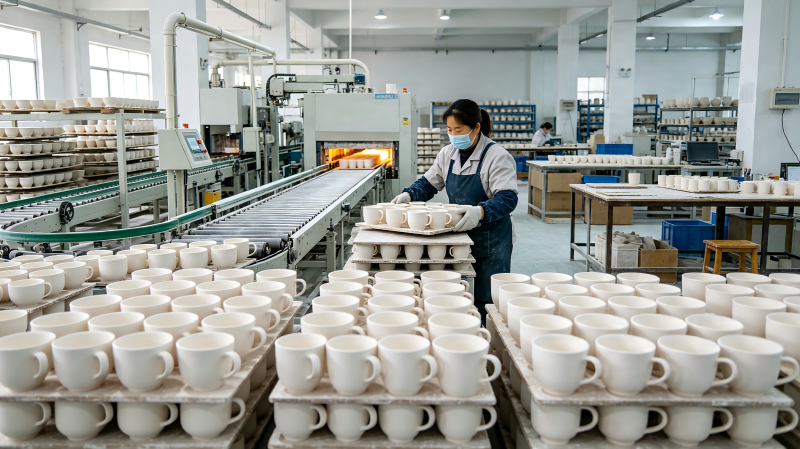
Yes, a sufficiently large production run is critical for achieving high and consistent quality. Mass production lines are designed for continuous, rhythmic operation. A proper MOQ ensures the run is long enough for machinery and workers to stabilize, minimizing defects and reducing the higher per-unit labor costs associated with frequent stops and starts.
Dive Deeper: How Scale Creates Consistency
From my 15 years of experience exporting to Europe and the Americas, I've seen firsthand that production efficiency is directly linked to quality assurance. A stable process is a predictable process, and predictability is the foundation of quality control.
H3: The Rhythm of the Production Line
Think of a production line as a symphony. Every section—from slip casting and handle-attaching to glazing and firing—is timed to work in harmony. A small order of, say, 300 pieces disrupts this flow.
- Setup vs. Run Time: The time spent setting up and calibrating machines can be longer than the actual production time for a small batch. This frequent changeover introduces opportunities for error.
- Process Stabilization: It takes time for processes to stabilize. For example, the viscosity of the glaze might need minor adjustments in the first hour of operation. In a short run, a larger percentage of the products are made during this "warm-up" phase, increasing the chance of defects like pinholes or uneven coating.
A large run allows the entire system to hit its stride and operate in a steady state, where quality is highest.
H3: Labor Efficiency and Skill
Workers become more efficient and precise when performing the same repetitive task. For a large order of 5,000 identical mugs, a worker attaching handles develops a smooth, consistent rhythm. For five different orders of 500 mugs each, that same worker must constantly readjust their technique, slowing down and increasing the likelihood of misplaced or poorly attached handles. This inefficiency not only increases the labor cost per unit but also the defect rate.
H3: Effective Quality Control
As a wholesale ceramic mug manufacturer, our quality control relies on statistical sampling methods like AQL (Acceptable Quality Limit). These methods require a minimum batch size to be statistically valid. It's not practical to inspect every single mug in a 10,000-unit order. Instead, we inspect a statistically significant sample. For a tiny order of 200 mugs, this sampling model breaks down, forcing a much higher percentage of inspection, which again drives up labor costs, or risking that a batch-wide issue goes unnoticed.
The MOQ ensures your order is large enough to be produced efficiently and validated by professional quality assurance systems.
How Does Customization Complexity Change the MOQ from a Custom Mug Supplier?
Have you ever gotten two different MOQs from the same supplier for two different designs and wondered why? You're seeing a direct link between the complexity of your request and the production setup required. A simple logo print is a world away from a completely new mug shape.
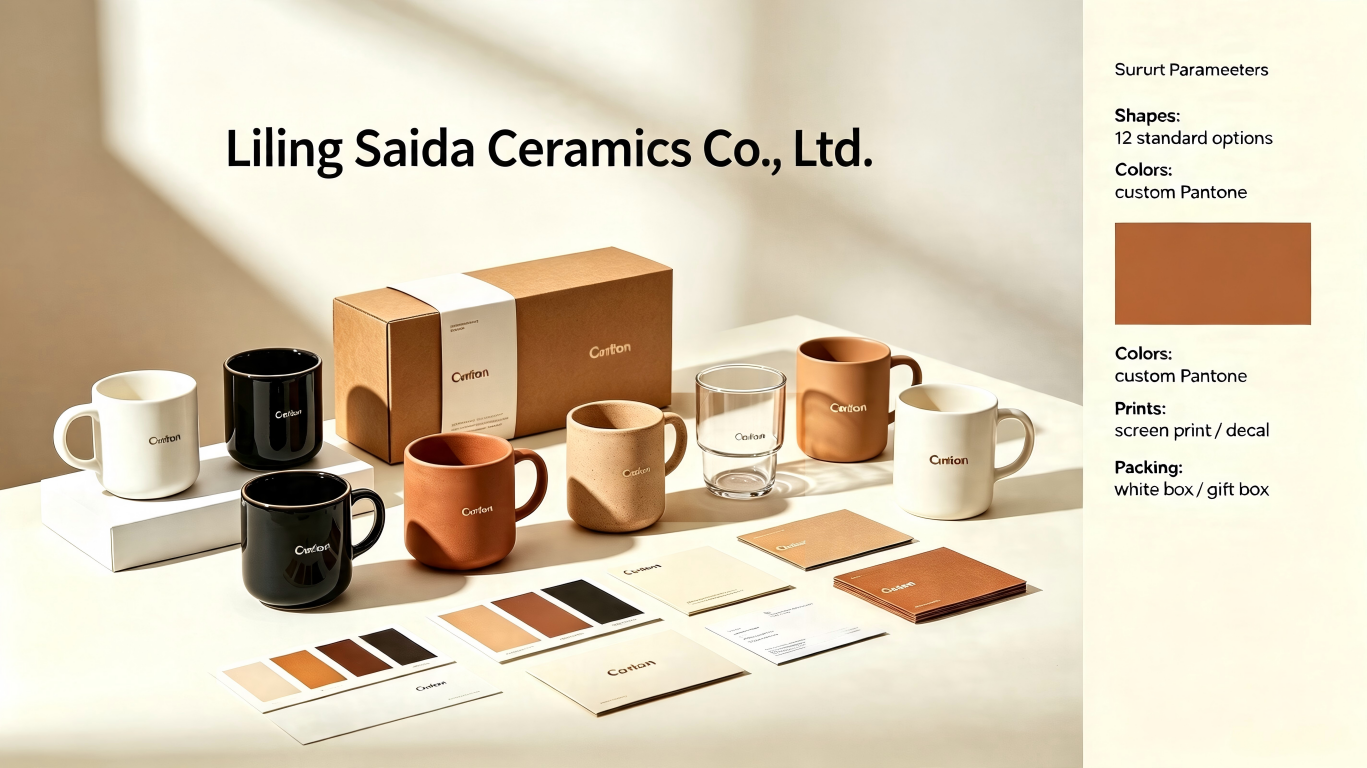
The more complex and unique your customization is, the higher the MOQ will be. A simple one-color logo on a stock mug involves minimal setup, resulting in a lower MOQ. In contrast, a custom-shaped mug with a reactive glaze and multi-color decal requires significant investment in new molds and specialized processes, necessitating a higher MOQ to be financially viable.
Dive Deeper: A Tale of Two Mugs
To illustrate, let's compare two hypothetical projects. As an experienced OEM ceramic mug producer, we handle both types regularly, and the difference in upfront effort is immense.
Project A: The Simple Logo Mug
- The Request: 1,000 white ceramic mugs with a one-color black logo printed on the side.
- Our Process: We use a standard, in-stock mug body that we produce by the tens of thousands. The only custom step is creating a single screen for the black logo. The setup is fast, and the risk is low.
Project B: The Fully Custom Mug
- The Request: 1,000 uniquely shaped mugs with a two-tone reactive glaze and a gold-rimmed decal.
- Our Process: This project is far more involved. We must design and create a new master mold, develop dozens of production molds, formulate and test the reactive glaze (a notoriously tricky process), develop and print a precious metal decal, and add an extra, lower-temperature firing cycle for the gold.
Here’s how the requirements break down:
| Customization Feature | Project A: Simple Logo | Project B: Fully Custom | Impact on MOQ |
|---|---|---|---|
| Mug Shape | Use existing stock mold | Design & create new molds | High. New molds are a major fixed cost requiring a high volume to amortize. |
| Glaze Type | Standard white glaze | Develop new reactive glaze | High. Reactive glazes have high R&D costs and lower success rates, requiring larger batches to get enough A-grade units. |
| Decoration | 1-color screen print | Multi-step decal + gold rim | Medium. Precious metal decals and extra firings add significant material and energy costs. |
| Overall MOQ | Lower (e.g., 1,000-1,500 pcs) | Higher (e.g., 3,000-5,000 pcs) | The cumulative setup costs demand a much larger order. |
A good custom mug supplier will be transparent about these factors. When you receive a high MOQ, ask which elements of your design are driving it. Sometimes, a small tweak—like switching from a custom shape to a similar stock shape—can significantly lower the required minimum order.
Frequently Asked Questions
Can I negotiate the MOQ with a ceramic mug manufacturer?
Yes, negotiation is sometimes possible, but it often involves trade-offs. You might be able to get a lower MOQ if you simplify your design, choose an in-stock mug body and glaze, or agree to pay a higher per-unit price to help the factory cover its fixed costs on a smaller run.
What is a typical MOQ for wholesale ceramic mugs in China?
It varies greatly depending on the factory and customization. For a simple design on a stock mug, MOQs might start around 1,000 to 1,500 pieces. For a fully custom shape or a complex glaze, the MOQ from a large ceramic mug factory can easily be 3,000 to 5,000 pieces or more.
Why can't I just order a few production samples to test the market first?
Production samples are different from pre-production samples. Pre-production samples are often made by hand or in a lab setting to approve a design, and their cost is high. Starting a full production line for just a few pieces is not feasible due to the immense setup costs (molds, kiln firing, etc.) we've discussed.
If I place a reorder, will the MOQ be the same?
For an identical reorder, the MOQ is often lower or more flexible. Since the molds are already made and the glaze formulas are established, the factory's fixed costs are significantly reduced. This is a great advantage of building a long-term relationship with your supplier.
Conclusion
Understanding the "why" behind an MOQ transforms it from a frustrating barrier into a valuable business signal. It's not an arbitrary rule designed to exclude smaller buyers; it's a reflection of the fundamental economics of manufacturing. A ceramic mug manufacturer's minimum order is rooted in covering high fixed costs, maximizing production line efficiency to ensure consistent quality, and aligning with a specific business model. Recognizing this allows you to assess if a supplier is the right fit for your scale and to collaborate with them more effectively.
If you are a wholesaler or e-commerce seller looking for a transparent and reliable partner to guide you through this process, our team is here to help. With 15 years of export experience, we understand your challenges and can work with you to find the most efficient solution for your project. Contact us today to discuss your ceramic mug needs.