Choosing between factory direct pricing and distributor pricing is one of the most important sourcing decisions for ceramic mug buyers. A lower factory quote may look attractive, but the real question is whether your business can manage production, logistics, quality control, and import responsibilities. You know that factory direct pricing seems lower on paper, but you've heard horror stories of unexpected costs and logistical nightmares that wipe out those savings. Choosing the wrong sourcing model can tie up your cash flow, delay your launch, and ultimately hurt your profitability. This guide will help you understand the total cost of each option and make the right strategic decision for your business.
Factory Direct vs Distributor Pricing: Quick Answer
| If you are... | Best Choice |
|---|---|
| Ordering 3,000+ custom mugs | Factory Direct |
| Creating a private label product | Factory Direct |
| Testing a new product idea | Distributor |
| Need delivery within weeks | Distributor |
| Want unique shapes or glaze designs | Factory Direct |
| Need small quantities | Distributor |
The best choice between factory direct pricing and distributor pricing depends on your business model. Factory direct is often better for high-volume, experienced importers who can manage logistics and quality control to get the lowest unit cost. Distributor pricing is better for smaller businesses or those new to importing who value convenience, lower risk, and a simplified supply chain over the absolute lowest price.
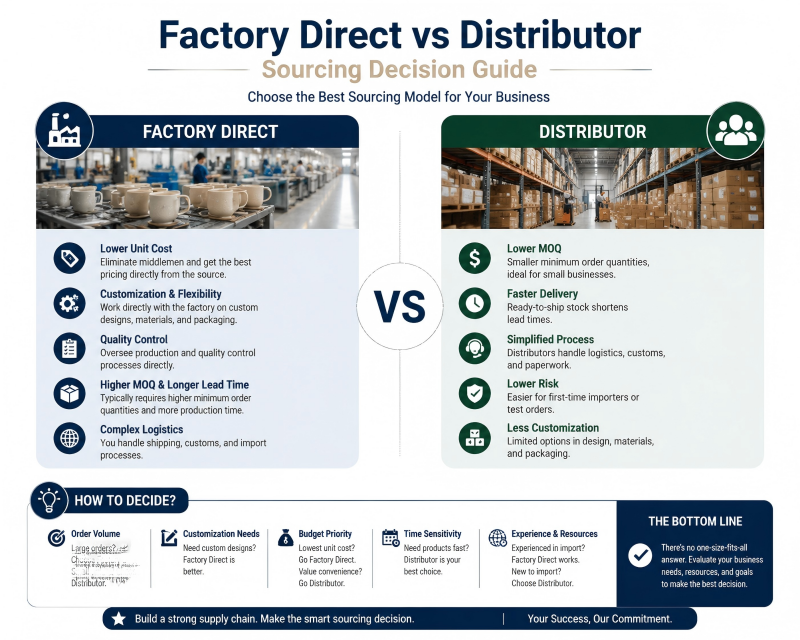
Now that you have the short answer, you're probably wondering what goes into that calculation. It's not just about comparing two price tags. The real difference lies in who manages risk, logistics, and customization. Let's break down the components of each model so you can see which one truly aligns with your company's goals and capabilities.
Factory Direct vs Distributor Pricing: A Quick Comparison?
Choosing a supplier can feel overwhelming. Do you go straight to the source for a better price, or work with a local partner for convenience? This choice impacts everything from your profit margins to your inventory management.
The key is to compare the two models across multiple factors, not just the unit price. This comparison reveals the trade-offs you are making between cost, control, and convenience.
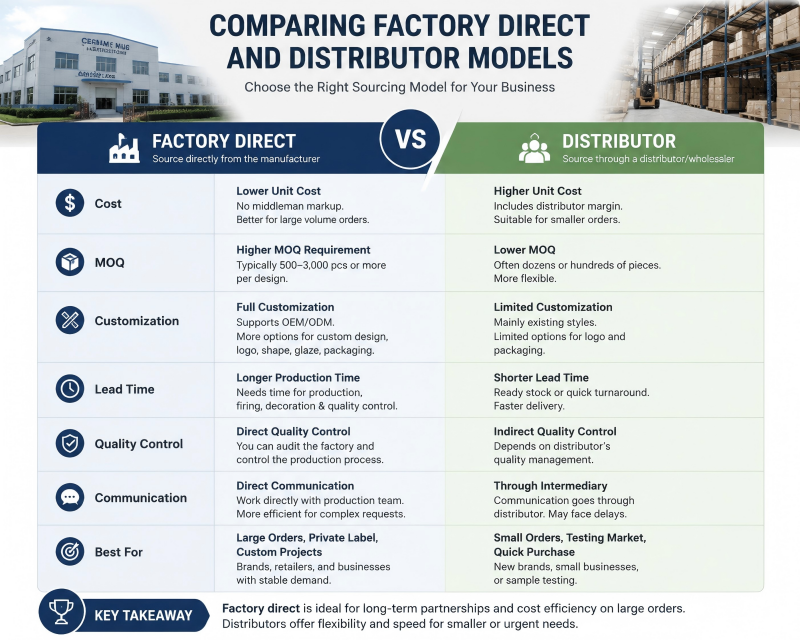
To make this clearer, let's look at a direct comparison. From my 15 years of exporting ceramic mugs, I've seen buyers succeed with both models. The difference was that they understood this table and chose the path that fit their operational strengths.
Factory vs. Distributor: Key Differences
Here is a breakdown of what you can expect from each sourcing model:
| Factor | Factory Direct | Distributor |
|---|---|---|
| Unit Price | Lower | Higher |
| MOQ | Higher (often 3,000+ pcs) | Lower (can be by the case) |
| Customization | Excellent (shapes, glazes, decals) | Limited to stock items |
| Lead Time | Longer (production + shipping) | Faster (from local stock) |
| Logistics | Buyer manages & pays separately | Distributor manages & includes in price |
| Quality Control | Buyer supervises or hires 3rd party | Distributor manages |
| Communication | Direct with factory (potential time/language barrier) | With local sales representative |
| Best For | Experienced importers, large brands, wholesalers | Startups, small businesses, retailers needing quick replenishment |
As you can see, the lower unit price from a factory comes with greater responsibility. You are not just buying a product; you are managing a project. Conversely, the higher price from a distributor is a fee for their service in managing that project for you. Neither is inherently better—it depends entirely on your business's scale, expertise, and strategic priorities.
What’s Really Included in Factory Direct Pricing?
Many buyers get excited by a low ex-factory (EXW) price, only to be surprised by the total cost to get the product to their warehouse. The challenge with factory direct pricing is that the initial quote is just the beginning of the cost calculation.
The "factory price" is just for manufacturing the product. It doesn't include shipping, insurance, customs duties, or final delivery. The additional costs in factory-direct sourcing are not hidden; they are simply responsibilities that move from the supplier to the buyer.
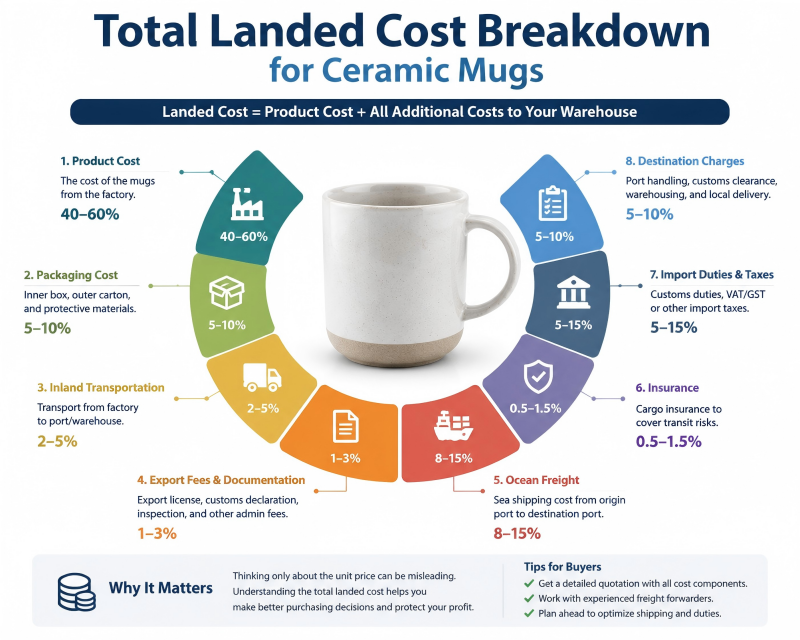
When a buyer asks us for a quote, we always try to clarify what they are really asking for. Are they asking for the price to make the mug? Or the price to get the mug to their door? These are two very different numbers. The first is the factory direct pricing, and the second is the total landed cost. Successful importers focus on the second number.
The Nine Elements of Your Total Landed Cost
To calculate your true cost, you must account for all expenses from our factory floor in Liling, China, to your warehouse in the US, EU, or South America.
- Product Cost (EXW or FOB): This is the base price per mug. FOB (Free On Board) is more common, as it includes the cost of transporting the goods to the departure port.
- Tooling/Mold Fees: For a custom mug shape, there is a one-time cost to create the production mold. This can range from a few hundred to several thousand dollars.
- Customization & Decoration: The cost of applying your logo via decal, screen printing, or using a special reactive glaze is added here.
- Compliance Testing: Your mugs must meet safety standards like FDA or California Prop 65. The cost for this FDA Requirements for Ceramic Drinkware is your responsibility.
- Quality Control Inspection: While we have our own internal QC, many buyers hire a third-party inspection service to perform a Ceramic Mug Inspection Checklist check before shipment. This costs several hundred dollars per day.
- Ocean/Air Freight: The cost to transport a container from China to your destination port. This is highly volatile and can be a significant portion of your landed cost.
- Insurance: Protects your investment against loss or damage during transit.
- Customs Duties & Tariffs: Taxes imposed by your country's government on imported goods. For ceramic mugs, this can be a substantial percentage of the value.
- Domestic Delivery: The final cost to move the container from the destination port to your warehouse, also known as drayage.
Depending on order volume, destination country, freight rates, and tariffs, the final landed cost can be 30%-100% higher than the initial factory quotation.
Example: Custom Ceramic Mug Project
Let's imagine a US-based coffee brand orders 10,000 custom mugs from our factory.
- Product: 11oz stoneware ceramic mugs
- Quantity: 10,000 pieces
- Decoration: Custom logo decal
- Packaging: Standard export cartons
Here is a sample breakdown of the factory direct landed cost:
| Cost Component | Amount | Notes |
|---|---|---|
| Mug Production (FOB) | $18,000 ($1.80/pc) | Includes transport to Shanghai port |
| Prop 65 Testing | $400 | Required for sale in California |
| Ocean Freight | $4,500 | One 40ft container to Long Beach, CA |
| Customs Duty (Tariff) | $1,800 | Example rate, subject to change |
| Port Fees & Delivery | $1,300 | From Long Beach port to a local warehouse |
| Total Landed Cost | $26,000 | --- |
| Final Landed Cost/Mug | $2.60 | This is your true cost per unit |
In this scenario, the initial $1.80 factory price becomes a $2.60 landed cost, a 44% increase. This is the number you must use for your profitability calculations.
When Does Distributor Pricing Make More Sense for Ceramic Mug Buyers?
While factory direct pricing is attractive, it’s not always the smartest financial move. Are you a startup or a growing e-commerce brand that needs to focus on marketing and sales, not logistics? You may find that the higher unit price from a distributor is a worthwhile investment in simplicity and speed.
Distributor pricing bundles the product and all associated services into a single, predictable price. You are paying a premium for convenience, risk mitigation, and the ability to order in smaller quantities.
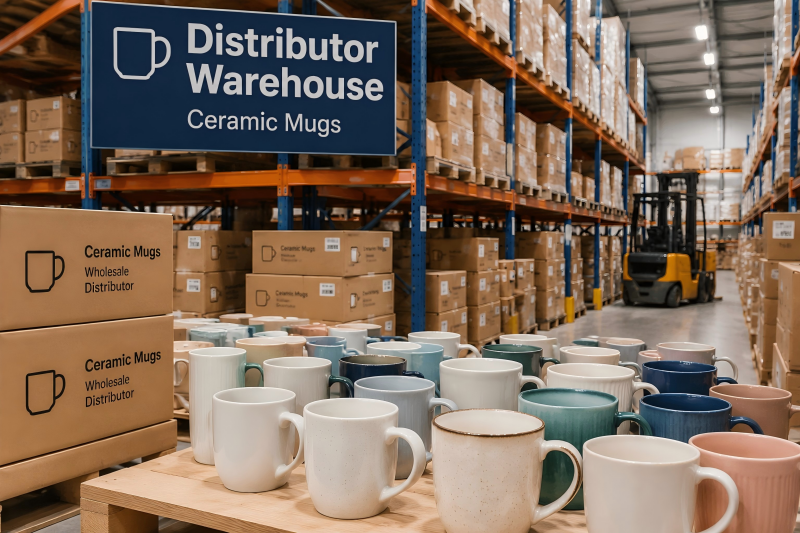
For many of our clients' customers—smaller retailers and online sellers—the distributor model is a lifeline. It allows them to access professionally sourced products without the high capital investment and operational complexity of international importing. Let's explore when this path is the superior choice.
The Value Proposition of a Distributor
Working with a distributor simplifies your supply chain dramatically. You are no longer managing an international project; you are simply placing a domestic order.
- Lower Minimum Order Quantities (MOQ): Distributors buy containers from factories like ours and then sell the product by the case. Instead of meeting a factory's What Is MOQ for Custom Ceramic Mugs? of 3,000+ pieces, you can often buy as few as 72. This drastically lowers your inventory risk and upfront cash investment.
- Faster Lead Times: The product is already in your country, sitting in the distributor's warehouse. Delivery can take days instead of the 3-4 months required for factory production and ocean freight. This is critical for reacting quickly to market trends or replenishing a best-seller.
- Simplified Pricing: The price you are quoted is the price delivered to your door (or close to it). The distributor has already handled the freight, customs, duties, and warehousing. Your landed cost is predictable and easy to calculate.
- Risk Mitigation: What happens if a container is delayed at port or if a batch has a quality issue? When you buy from a distributor, that is their problem to solve, not yours. They absorb the financial and logistical risks of importing.
Distributor Purchase Example
Let's revisit the coffee brand from our previous example. Instead of importing directly, they decide to buy a similar 11oz mug from a US-based drinkware distributor.
- Distributor Price: $3.20 per mug
- Minimum Order: 144 pieces
- Delivery Time: 5-7 business days
Advantages of this model: ✓ No import management: No need to communicate with an overseas factory. ✓ No customs paperwork: The distributor handled all import regulations. ✓ Lower inventory risk: They can test the market with a small order before committing to a larger volume. ✓ Faster replenishment: If the mugs sell out, they can reorder and have stock within a week.
While the $3.20 unit cost is higher than the $2.60 factory-direct landed cost, the business avoids tying up $26,000 for months. They can use that capital for marketing, website development, and other growth activities. For a new or small business, this trade-off is often the key to survival and success.
How Do You Choose Between Factory Direct Pricing and a Distributor?
You've seen the numbers, but the final decision still feels complex. How do you weigh a lower unit cost against a lower operational burden? The answer lies in a realistic assessment of your own business.
You must honestly evaluate your order volume, customization needs, and your team's capacity to handle global sourcing. This isn't just a financial decision; it's a strategic one about where to best invest your time and resources.

From our experience, the most successful importers are those who ask about these things beyond just the price. They create a simple decision framework. Let's walk through the questions you should ask yourself to determine the most profitable path for your ceramic mug business.
A Framework for Your Sourcing Decision
Use these five questions to guide your strategy. Be honest about your capabilities and constraints.
1. What is Your Realistic Order Volume?
If your monthly demand is consistently in the thousands of units per style, building a direct factory relationship is a powerful competitive advantage. The economies of scale on a container-load of mugs will significantly lower your landed cost. If you are ordering a few hundred pieces at a time, the high per-unit cost of shipping small quantities and meeting factory MOQs makes a distributor the clear winner.
2. How Much Customization Do You Need?
If your brand identity depends on a unique mug shape, a specific Pantone-matched glaze, or complex, multi-sided artwork, you need to work directly with a factory. Distributors primarily offer stock items with simple logo printing. A factory offers a full suite of OEM vs ODM Ceramic Mug Production, giving you complete control over the final product.
3. What is Your Team's Sourcing Expertise?
Do you have someone who understands international logistics, can vet a supplier, manage payments in different currencies, and navigate customs? If not, do you have the budget to hire a sourcing agent or a freight forwarder? If the answer to both is no, the convenience of a distributor is invaluable. They have entire teams dedicated to this. A good starting point is our supplier evaluation checklist.
4. How Sensitive is Your Business to Cash Flow?
Direct importing requires significant upfront capital. You often pay a 30-50% deposit to start production and the remainder before the goods ship. This means your cash is tied up for 90-120 days before you can even begin to sell the product. Buying from a distributor allows you to purchase inventory with much shorter payment terms (like Net 30) and convert it to revenue faster.
5. What is Your Appetite for Risk?
Sourcing directly means you own the risks of production delays, shipping issues, quality defects found too late, and regulatory changes. A container stuck at port can cost you thousands in demurrage fees. A distributor insulates you from these risks. For many businesses, this "insurance" is well worth the higher unit price.
About Our Ceramic Mug Manufacturing Experience
With 15 years of ceramic mug export experience, our factory in Liling, China—the ceramic capital—specializes in helping global brands bring their ideas to life. Our expertise includes:
- OEM ceramic mugs
- Private label drinkware for retailers
- Durable stoneware mugs for the food service industry
- Unique reactive glaze mugs
- High-quality custom logo printing and decals
- Custom retail packaging solutions
We work directly with wholesalers, importers, coffee brands, and promotional product companies worldwide, shipping primarily to the US, EU, and South American markets. We are ISO9001 and BSCI certified, ensuring our operations meet the highest global standards.
Frequently Asked Questions
What is a typical MOQ when buying directly from a ceramic mug factory?
For a standard stoneware mug, a typical Minimum Order Quantity (MOQ) is between 3,000 and 5,000 pieces per design. For more complex shapes or special glazes, the MOQ might be higher to make the production setup cost-effective.
How much higher is the landed cost than the factory price?
The final landed cost is often 30% to 100% higher than the quoted EXW (ex-works) or FOB (Free On Board) factory price. This variance depends heavily on volatile factors like ocean freight rates, customs tariffs for your country, and required compliance testing.
Can I get a sample before placing a large order?
Absolutely. We always recommend getting a pre-production sample. Factories typically provide samples for a fee that covers the cost of materials and express shipping. This fee is often credited back to you once you place the bulk order.
What compliance standards are important for ceramic mugs?
For ceramic mugs sold in the US, the most important standard is FDA testing for lead and cadmium leaching. If you sell in California, you must also meet Proposition 65 requirements. For the EU, mugs must comply with Regulation (EC) No 1935/2004.
Conclusion
The debate over factory direct pricing versus distributor pricing is not about finding which is universally "cheaper." It’s a strategic choice about aligning your supply chain with your business model. Factory direct offers the lowest possible unit cost and maximum customization, but it transfers the operational burden of logistics, quality control, and import risk directly to you. It's the right path for experienced, high-volume buyers. Distributors offer convenience, speed, and lower risk for a higher unit price, making them the smarter choice for startups, smaller businesses, and anyone prioritizing operational simplicity.
By analyzing your order volume, customization needs, and internal capabilities, you can confidently choose the model that will build the most reliable and profitable supply chain for your ceramic mug business.
Need Factory Direct Ceramic Mug Pricing?
Get a transparent quotation for your next project, including:
✓ Product Cost: Per-unit pricing at scale. ✓ MOQ Options: Flexible solutions for your volume. ✓ Customization Details: Glaze, decal, and shape possibilities. ✓ Production Timeline: From deposit to shipment. ✓ Packaging Solutions: From bulk cartons to retail-ready boxes. ✓ Shipping Options: Estimated logistics costs.
Our team helps global buyers compare factory-direct sourcing with distributor alternatives to choose the most profitable model for their business.