Struggling to compare quotes for your next big order? The low unit price from one ceramic mug factory can seem incredibly tempting, but there's often a nagging feeling that it’s too good to be true. You worry that surprise fees, quality nightmares, or shipping delays will emerge later, completely wiping out your initial savings and hurting your bottom line. Successful ceramic mug sourcing requires looking beyond the price tag to understand the total landed cost.
The true hidden costs in ceramic mug sourcing go far beyond the unit price. They include unexpected fees for product customization (like new molds or complex decals), variable logistics expenses (inland transport, port fees, custom packaging), the financial impact of poor quality (defective units, failed inspections), and the significant overhead caused by poor supplier communication.
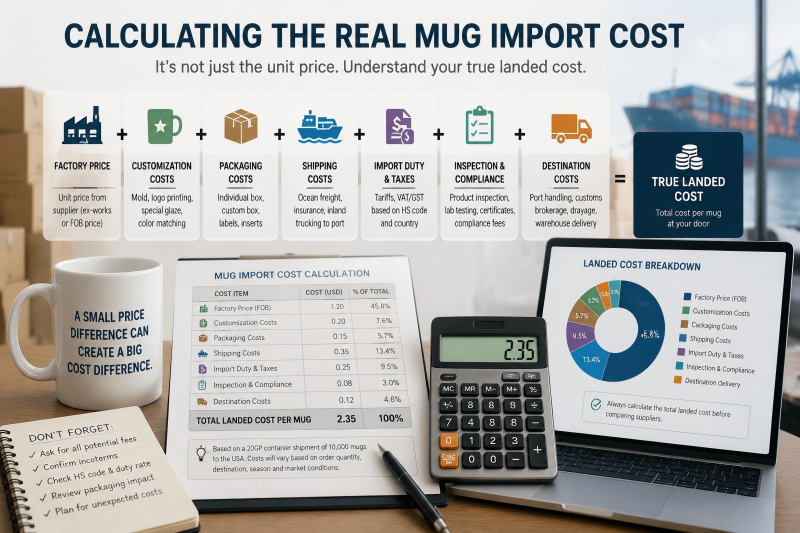
Now that you know the major categories of hidden costs, how can you proactively identify and manage them? It all comes down to asking the right questions. Let's break down what you need to ask a potential supplier to uncover these expenses before you commit to an order.
Does the Unit Price Include All Customization Costs?
You've designed a beautiful, unique mug that you know your customers will love. But you must recognize that a standard quote from a factory rarely covers specific, non-standard design elements. This disconnect can lead to frustrating budget overruns and delays down the line.
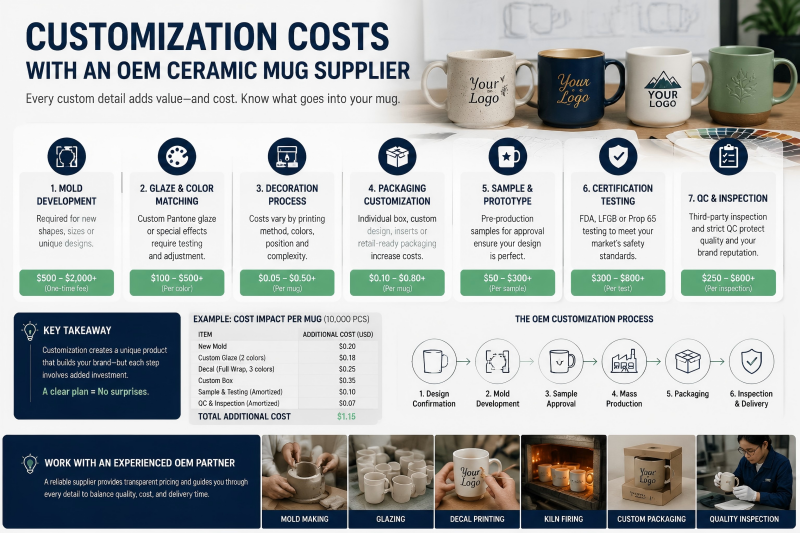
The initial unit price almost never includes all customization costs. Expenses for creating new molds, applying complex multi-color decals, developing special glazes, or adding unique handle shapes are typically quoted as separate line items by any experienced custom mug manufacturer.
In my 15 years of exporting mugs from our factory in Liling, I’ve seen many first-time importers get tripped up here. They fall in love with a low price, only to find out it was for a basic, undecorated white mug from the factory's existing catalog. True partnership with an OEM ceramic mug supplier involves transparently discussing how your design choices impact the final price.
The Cost of a Unique Shape: Mold Fees
Factories maintain a large catalog of existing mug shapes, each with its own production mold. Using one of these existing shapes is the most cost-effective option. However, if your brand requires a completely unique silhouette that isn't in their catalog, you will need to fund the creation of a new production mold.
This is a one-time Non-Recurring Engineering (NRE) cost. The cost can range from $500 to over $2,000, depending on the complexity of the shape. A simple, cylindrical shape will be on the lower end, while an intricate, ergonomic design will be more expensive. While this is a significant upfront investment, it gives you a proprietary product that competitors cannot easily replicate. A good supplier will be upfront about this cost and explain the process clearly.
The Complexity of Decoration
The method used to apply your logo or design has a huge impact on the per-unit cost. A simple one-color logo is far cheaper to produce than a full-wrap photographic image. It's critical to understand these differences when evaluating quotes.
Here’s a quick breakdown of common decoration methods:
| Decoration Method | Typical Cost | Complexity | Best For |
|---|---|---|---|
| Pad Printing (1-2 color) | Low | Simple logos, small designs | Promotional wholesale ceramic mugs |
| Decal Application | Medium-High | Full-wrap graphics, multi-color, photos | Retail products, complex branding |
| Reactive Glaze | High | Unique, non-uniform color patterns | High-end, artisanal-look mugs |
| Hand Painting | Very High | One-of-a-kind artistic details | Premium, limited edition collections |
In our experience, a supplier quoting an unusually low price may be assuming the simplest decoration method. When you send your detailed artwork, you suddenly get an updated quote that's 30-50% higher. Always provide your final artwork upfront and ask for a line-item quote that specifies the cost for the mug body, the decoration, and any other special finishes.
How Will Logistics and Packaging Impact My Total Mug Import Cost?
You’ve calculated your potential profit based on the unit cost and a rough shipping estimate. The problem is that logistics are a massive variable, and choices made at the factory can dramatically inflate your final mug import cost. Underestimating this is one of the most common and costly mistakes in sourcing.
Logistics and packaging are critical variables that will significantly impact your total landed cost. Your decision between bulk industrial packing versus individual retail boxes, the agreed-upon shipping terms (like FOB vs. EXW), and your final destination all drastically alter the per-unit shipping expense.
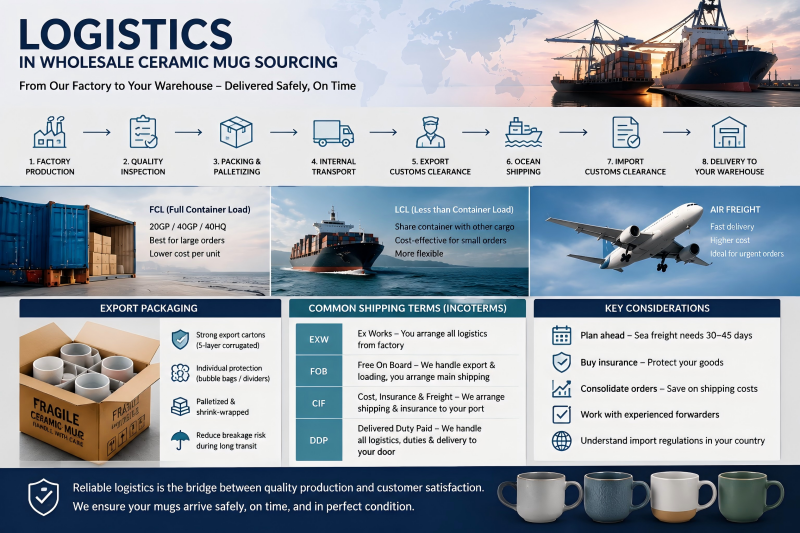
When sourcing wholesale ceramic mugs, especially from an inland production hub like Liling, the journey from our factory door to your warehouse is a multi-stage process, with costs accumulating at every step. A transparent supplier will help you forecast these costs accurately.
Understanding Incoterms: EXW vs. FOB
The shipping terms in your contract determine who is responsible for which part of the journey. The two most common are:
- EXW (Ex Works): The price quoted is for the product sitting at the factory door. You, the buyer, are responsible for arranging and paying for everything else: trucking from the factory to the port, export customs clearance, ocean freight, and all destination charges. This price looks the lowest but carries the most responsibility.
- FOB (Free On Board): The supplier is responsible for getting the goods from the factory to the designated port of departure in China (e.g., FOB Shanghai) and clearing them for export. The price includes the product, inland transportation, and port handling fees. You are responsible for the ocean freight and destination charges.
Since our factory is in Liling, an inland city, the cost of trucking a container to a major port like Shanghai or Shenzhen is significant. An EXW price might seem cheaper, but once you add the $500-$800 cost for inland trucking, the FOB price is often more straightforward and predictable.
The Hidden Cost of Packaging
This is a big one. How your mugs are packed has a direct and dramatic effect on shipping volume.
- Bulk Packing: This is the most space-efficient method. Typically, 36 or 48 mugs are placed in a large, heavy-duty carton with cardboard dividers separating each mug. This maximizes the number of units you can fit in a shipping container.
- Retail Packing: If each mug is placed in its own printed gift box, the amount of space required increases substantially due to the extra packaging material and air inside the boxes.
Let's use a real-world example. A 40-foot container can hold approximately 60,000 mugs when bulk-packed. That same container might only hold 25,000-30,000 mugs if they are in individual retail boxes. Your total ocean freight cost for the container remains the same, but your per-unit shipping cost has just doubled. Always ask your supplier to quote shipping volume estimates for different packing options.
What Is the Real Cost of a Low-Quality Ceramic Mug Sourcing Partner?
A supplier's quote comes in 15% lower than all the others, and it feels like a huge win. But what if that low price comes with a high defect rate, inconsistent quality, and failed compliance tests? The "savings" can quickly evaporate, leaving you with unsellable inventory and a damaged brand reputation.
The cost of a low-quality ceramic mug sourcing partner is much greater than a few broken items. It encompasses the direct financial loss from unsellable inventory, fees for failed third-party inspections, project delays, potential legal action from non-compliant products, and long-term damage to your brand's credibility.
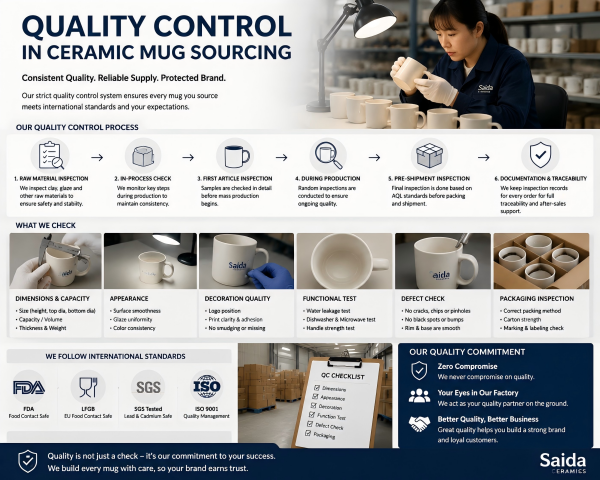
A commitment to quality is an investment, not an expense. Reputable factories with certifications like ISO9001 (for quality management) and BSCI (for social compliance) have systems in place to ensure consistency. These systems have a cost, which is factored into the unit price, but they provide invaluable risk mitigation.
Defect Rates: The Unsellable Inventory Tax
In manufacturing, quality is often measured by an Acceptable Quality Limit (AQL). This standard dictates how many defective units are considered "acceptable" in a batch. A budget supplier might operate on a looser AQL, meaning more flawed products could end up in your shipment.
Common ceramic defects to watch for include:
- Pinholes: Tiny holes in the glaze surface.
- Color Inconsistency: Variations in shade between mugs in the same batch.
- Glaze Flaws: Drips, bare spots, or uneven application.
- Crooked Handles: Handles that are not aligned vertically.
- Decal Misalignment: Logos or designs that are off-center, tilted, or wrinkled.
- Chips and Cracks: Physical damage from poor handling or firing.
In my experience, a 10% price reduction from a low-tier factory can easily correlate with a 15-20% defect rate on Grade-A products. When you do the math, you've actually paid more for your usable inventory than if you had gone with the slightly more expensive, higher-quality supplier.
The High Stakes of Compliance Testing
This is a non-negotiable aspect of ceramic mug sourcing for Western markets. Products sold in the United States and Europe must be tested to ensure they are safe for food contact, specifically for lead and cadmium levels.
- USA: FDA regulations and California's Proposition 65 have strict limits.
- Europe: The framework regulation (EC) 1935/2004 governs food contact materials.
A budget supplier may try to cut corners by using cheaper, untested raw materials for their glazes or decals. If you commission a third-party lab test and the products fail, the entire order is compromised. You can't legally sell it. The cost is not just the lost inventory; it's the lab fees (hundreds of dollars), the lost sales, and the massive delay as you are forced to re-run production. Always ask a potential supplier for their existing compliance test reports.
Can Poor Communication Really Be a Hidden Cost?
You're trying to get a simple question answered about a design detail, but the back-and-forth emails are getting you nowhere. The supplier contact doesn't seem to understand your request, leading to immense frustration and project delays. This communication friction isn't just an annoyance; it's a real business expense.
Yes, poor communication is a very real and significant hidden cost in international sourcing. Language barriers, cultural misunderstandings, and inexperienced sales staff lead to production mistakes, missed deadlines, and countless hours of your time spent on clarification and damage control, all of which directly impact your profitability.
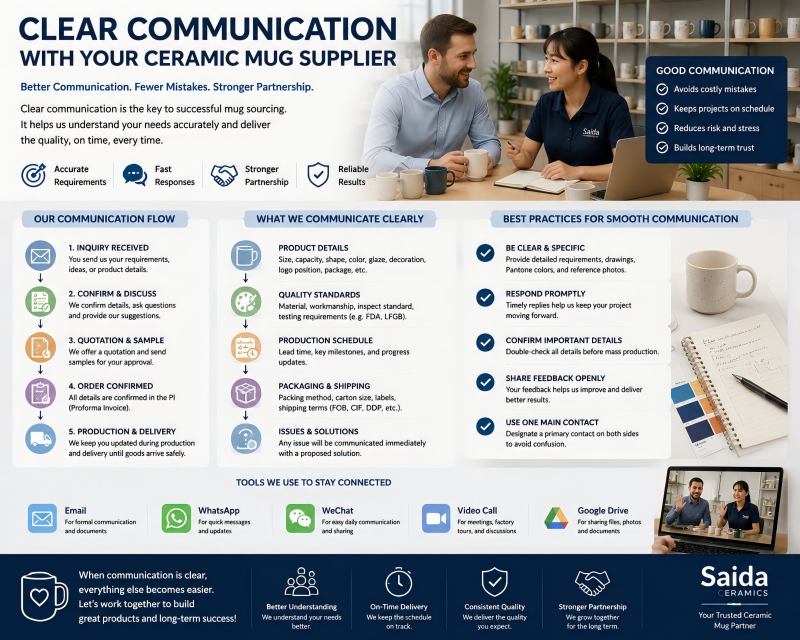
A key part of successful ceramic mug sourcing is vetting a supplier's communication capabilities just as thoroughly as you vet their products. An experienced sales team is a critical part of the service you are paying for.
The Cost of Misinterpretation
A simple misunderstanding can have catastrophic financial consequences. I once worked with a new American client who was at their wit's end with a previous supplier. They had meticulously specified a "matte black" finish in their tech pack. Due to a combination of language barriers and inexperience, the factory produced 10,000 mugs with a "satin black" finish, which has a slight sheen. The products did not match the rest of their product line, and the entire order was unsellable for their brand. The error delayed their product launch by over three months and soured the relationship completely. The "cost" was the lost revenue, the wasted time, and the stress of managing the crisis.
Vetting a Supplier's Communication Skills
Before you place an order, test their communication.
- Clarity and Detail: How detailed are their quotes? Do they break down costs or just give you a single number?
- Proactive Questions: Do they ask clarifying questions about your design to prevent errors? Or do they just say "yes" to everything? An experienced rep from a reliable OEM ceramic mug supplier will often point out potential production issues with your design before they become problems.
- Responsiveness and Professionalism: Do they respond in a timely manner? Is their English clear and professional? Can they provide a detailed production schedule?
Think about the cost of your own time. If you spend an extra 10-15 hours managing a difficult, unresponsive supplier on a single order, what is that time worth? Often, paying a slightly higher unit price for a supplier with a professional, experienced English-speaking team saves you money in the long run.
Frequently Asked Questions
How much are mold fees for a custom ceramic mug?
The cost to create a new production mold for a custom mug shape typically ranges from $500 to over $2,000. The final price depends on the size and complexity of the design. This is a one-time fee that gives you a proprietary mug shape for your brand.
What is the difference between FOB and EXW shipping terms?
EXW (Ex Works) means the price is for the product at the factory door; the buyer is responsible for all shipping costs. FOB (Free On Board) means the supplier's price includes transporting the goods to the port of origin in China and clearing them for export.
What are the most common quality defects in ceramic mugs?
The most common defects include pinholes (tiny holes in the glaze), glaze drips or inconsistencies, color variations, crooked handles, misaligned or flawed decals, and physical damage like chips or cracks that can occur during firing or packing.
Why is BSCI certification important for a mug factory?
BSCI (Business Social Compliance Initiative) is an audit that verifies a factory's adherence to ethical and social standards, including fair labor practices and workplace safety. Sourcing from a BSCI-certified factory helps protect your brand's reputation and mitigates supply chain risks.
Conclusion
Effective ceramic mug sourcing is not about chasing the absolute lowest unit price. It's about finding the best overall value and de-risking your investment. The initial quote is merely the starting point. The true cost of your product is a combination of the unit price plus the costs of customization, logistics, quality assurance, and communication overhead. By asking detailed questions about mold fees, packaging options, quality control processes, and compliance, you can build a comprehensive budget and avoid costly surprises. A transparent, experienced manufacturing partner will guide you through these variables, ensuring a predictable and profitable outcome.
If you're looking for a transparent partner to help you navigate these complexities, our team has been helping wholesalers and e-commerce brands successfully source wholesale ceramic mugs for over 15 years. Contact us today to get a detailed, all-inclusive quote for your next project.