Struggling to calculate the total landed cost for your wholesale ceramic mugs? You keep asking suppliers for a shipping price, but the vague or shifting numbers make budgeting feel like guesswork, putting your profits at risk. To truly understand how shipping impacts mug costs, you need to stop asking for a simple price and start making strategic business decisions about how your mugs get from our factory to your warehouse.
The final shipping cost for your mugs is determined by a combination of your packaging choices, order quantity, and selected shipping terms (Incoterms). These three factors create a cost-versus-risk tradeoff, meaning the per-unit shipping price is a direct result of your business strategy, not a fixed number a factory can provide without context.
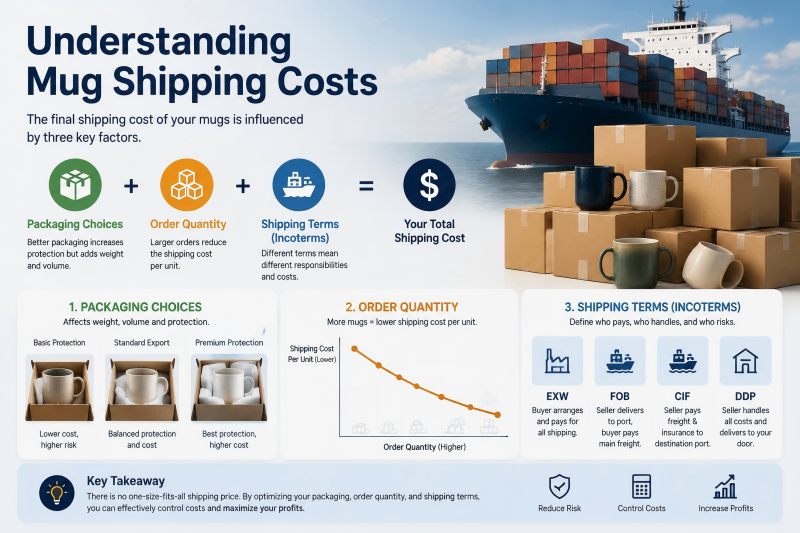
Moving beyond the simple question of "how much is shipping?" is the first step toward building a profitable import business. Each variable is a lever you can pull. In this article, I'll draw on my 15 years of experience exporting mugs to show you how each decision affects your final cost, so you can make the smartest choice for your business.
How Does Packaging Affect Your Mug Shipping Costs?
You want the lowest possible shipping price, so you might assume that basic, bulk packing is always the best choice. But what if those initial "savings" lead to higher damage rates, unexpected labor costs, and unhappy customers, ultimately erasing your profits?
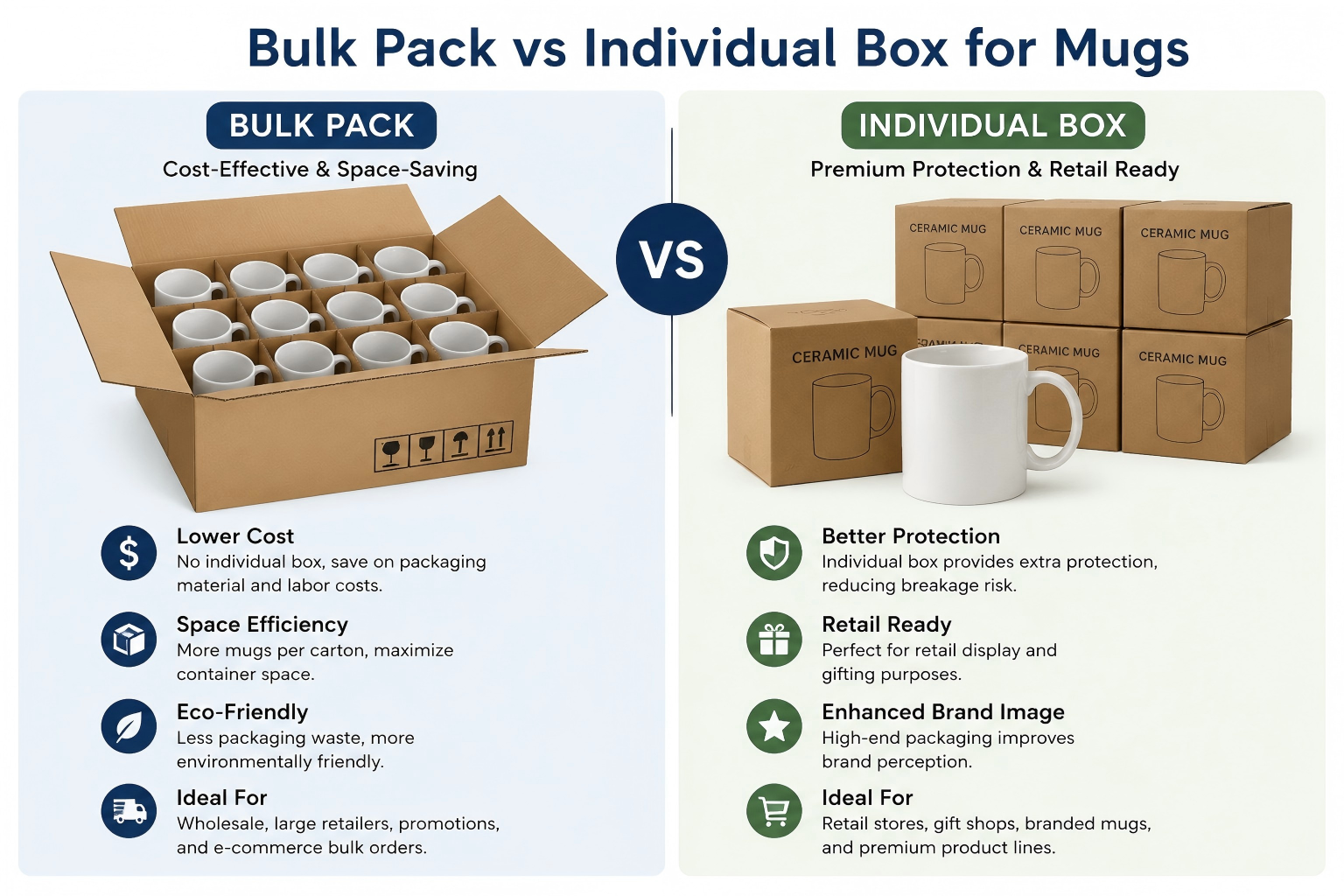
Packaging directly affects your mug shipping costs by changing the carton's final dimensions and weight. This determines how many units can fit into a shipping container. Bulk packaging is cheaper to ship per unit but carries a higher risk of damage, while individual retail-ready packaging costs more in freight but protects the product and saves on downstream labor.
H3: Bulk Packaging: The Double-Edged Sword
Bulk packaging is the most basic and volume-efficient option. Typically, this means your mugs are placed in a large master carton, separated only by cardboard "egg-crate" style dividers.
- The Pro: Its primary advantage is density. By minimizing wasted space, we can fit the maximum number of mugs into a shipping container. This significantly lowers the per-unit freight cost, which is one of the key Factors That Affect Ceramic Mug Pricing. For a wholesaler selling to restaurants or other businesses that don't need retail presentation, this is often the most economical choice.
- The Con: This efficiency comes with two major risks. First, the risk of damage is higher. With less individual cushioning, bumps and drops during transit are more likely to cause chips or breakage. Second, these mugs are not retail-ready. You or your staff will have to unbox every single mug, inspect it for damage, and then repackage it for sale. This adds significant labor and material costs in your home country, which can often exceed the initial freight savings.
From my experience, I remember a new e-commerce client who insisted on bulk packing to save on freight. They saved about $0.15 per mug on shipping but were shocked to find they had to pay over $0.50 per mug in their home country for labor and materials to create individual boxes. On their next order, they happily paid for our factory-packed individual boxes.
H3: Individual Packaging: The E-commerce & Retail Standard
Individual packaging means each mug is placed in its own box right here at the factory. This can range from a simple white cardboard box to a custom-printed color retail box or a heavy-duty, drop-tested mail-order box.
- The Pro: The benefits are protection and convenience. Each mug is shielded, drastically reducing damage rates during transit. More importantly, the product arrives at your warehouse ready for sale or fulfillment. For an e-commerce seller, this is a non-negotiable. You can send the box directly to your customer or to an Amazon FBA center without any extra work. This saves enormous amounts of time and labor.
- The Con: The trade-off is higher freight costs. Individual boxes take up more space than bulk dividers, meaning fewer mugs fit into a container. This increases the per-unit shipping cost. However, experienced sellers understand that this is often cheaper overall than paying for labor and packaging materials locally.
Here is a simple breakdown of the trade-offs:
| Packaging Type | Freight Cost/Mug | Damage Risk | Downstream Labor Cost | Best For... |
|---|---|---|---|---|
| Bulk Pack | Low | High | High (Requires repacking) | Wholesalers selling B2B |
| Individual Box | High | Low | Low (Retail-ready) | E-commerce sellers, retailers |
Does Order Quantity Change the Shipping Impact on Mug Costs?
You've finalized your packaging, but now you need to decide on your order quantity. Does ordering a few thousand more mugs really make a significant difference in the per-unit shipping cost? The answer is a resounding yes.
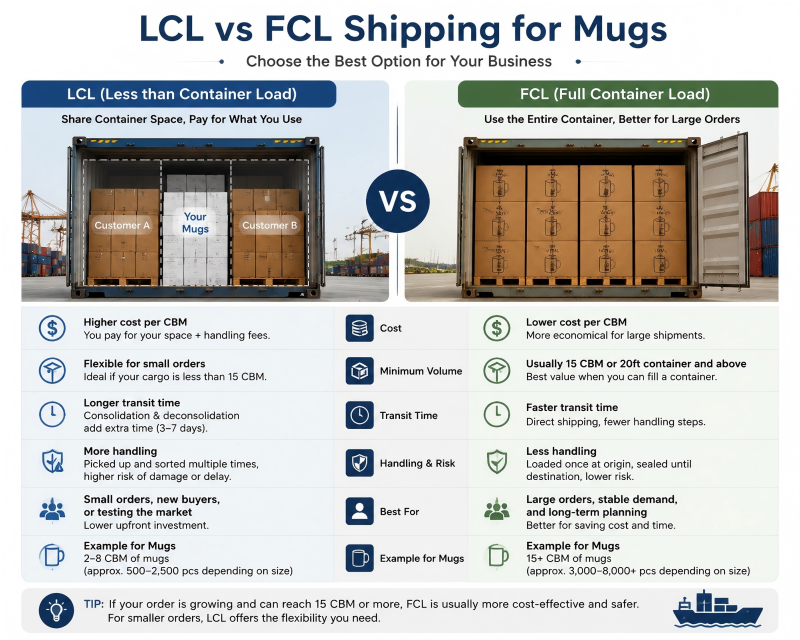
Your order quantity is a major factor because it determines whether your shipment is categorized as Less than Container Load (LCL) or Full Container Load (FCL). FCL shipping offers a much lower cost per cubic meter, which can drastically reduce the final shipping impact on mug costs compared to LCL for the same product.
H3: The LCL Scenario (Less than Container Load)
When your order isn't large enough to fill an entire shipping container, you use LCL. With LCL, your shipment is consolidated with goods from other companies to fill a container.
This is a common starting point for new importers or for testing a new product design, and it's closely related to our What Is the MOQ for Custom Ceramic Mugs? policies. The main advantage is that you can ship smaller quantities without paying for an entire empty container.
However, LCL has its downsides:
- Higher Cost: The price per cubic meter (CBM) for LCL is significantly higher than for FCL.
- More Handling: Your cartons will be loaded and unloaded multiple times as they are consolidated and later de-consolidated. This increases the chance of damage, making robust packaging even more critical.
- Longer Transit Times: The consolidation process can add time at both the departure and arrival ports.
H3: The FCL Scenario (Full Container Load)
Once your business scales, moving to FCL is the single biggest step you can take to How to Reduce Costs When Ordering Wholesale Mugs. With FCL, you pay a flat rate for an entire 20-foot or 40-foot container, and it is sealed at our factory and not opened again until it reaches you.
The benefits are substantial:
- Lower Cost: The cost per CBM is dramatically lower. The tipping point where FCL becomes cheaper than a large LCL shipment is usually around 15 CBM.
- Less Risk: Since your mugs are not handled between our factory and your warehouse, the risk of transit damage plummets.
- Faster & Simpler: FCL shipments move through ports more quickly than LCL shipments.
Many of our long-term clients start with a trial LCL order. Once they confirm market demand, they scale up to a 20ft or 40ft FCL order for their main stock. It's not uncommon for their per-unit shipping cost to drop by 30-50% when they make this jump. This is a fundamental part of the complete Ceramic Mug Cost Breakdown Explained. Understanding this transition is also key to seeing Why Do Ceramic Mug Manufacturers Require Minimum Orders?, as we structure MOQs to align with efficient shipping volumes.
How Do Incoterms Influence the Total Cost of Shipping Mugs?
You've seen acronyms like FOB, CIF, and DDP on quotes, and they might just seem like confusing jargon. These terms, called Incoterms, are critically important. They don't just define who pays for what; they define where risk and responsibility transfer from us, the seller, to you, the buyer. This choice fundamentally influences the total cost of shipping mugs.
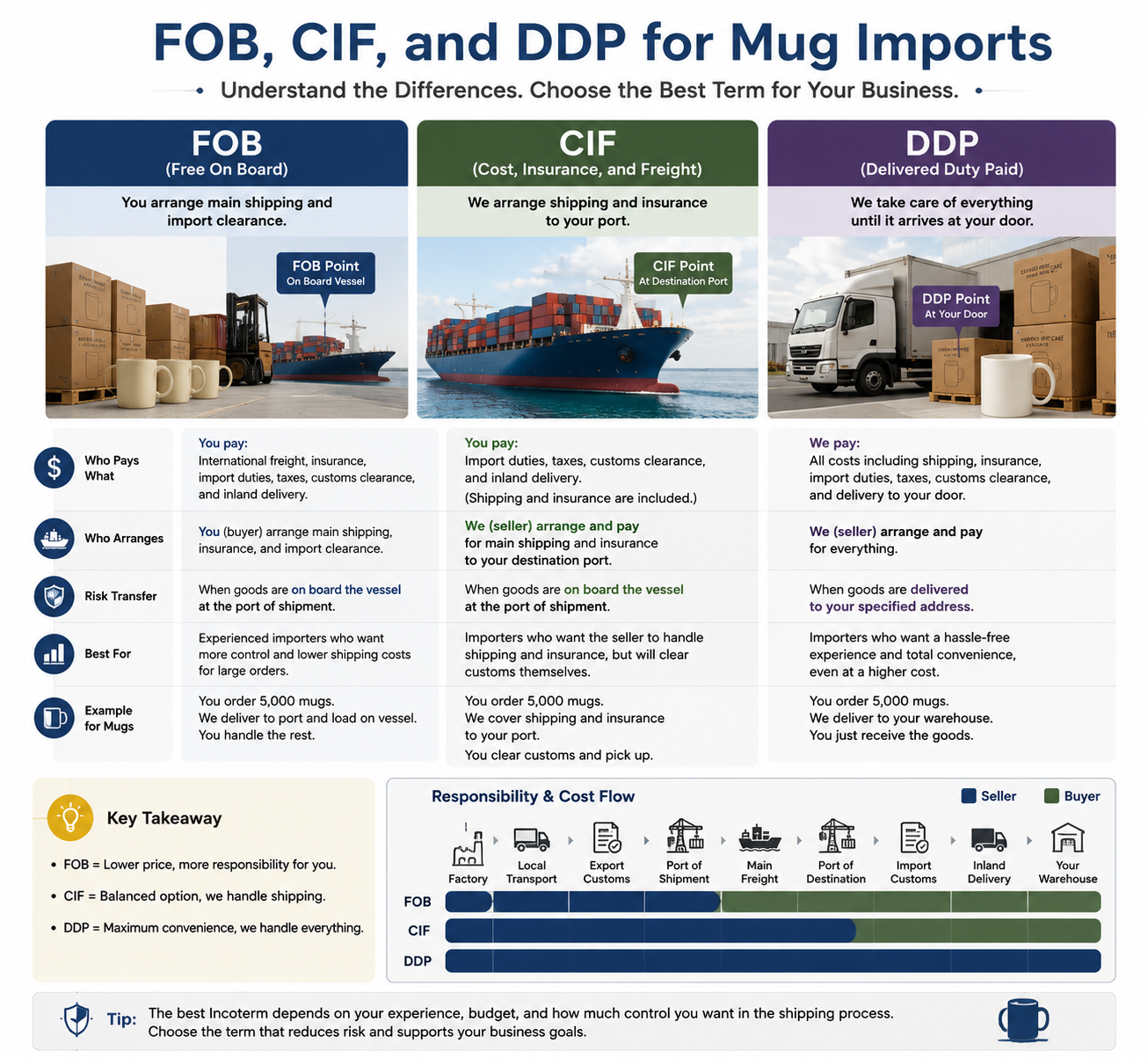
Incoterms define where our responsibility as the seller ends and your responsibility as the buyer begins. FOB (Free On Board) offers more control and potentially lower costs for experienced buyers with their own logistics partners. In contrast, CIF and DDP offer convenience at a higher bundled price, as we handle the shipping and insurance for you.
H3: FOB (Free On Board): The Control & Cost-Saving Option
FOB is the most common Incoterm used by experienced importers. With FOB, our factory is responsible for producing the mugs, packaging them, and delivering them to the designated port in China (e.g., FOB Shanghai). Once the goods are loaded "on board" the vessel, the responsibility and cost transfer to you.
- Pros: You are in complete control. You hire your own freight forwarder, which allows you to shop around for the best shipping rates and service. You have full visibility into the shipping schedule and can manage the process to fit your needs. This is the most transparent and often the cheapest method if you are willing to manage the logistics. This is the essence of sourcing direct and mimics the cost advantages seen in Factory Direct vs Distributor Pricing.
- Cons: It requires more work on your part. You need to find and vet a reliable freight forwarder to handle customs clearance, ocean freight, and final delivery.
H3: CIF & DDP: The Convenience Option
For buyers who are new to importing or who want a simpler, hands-off process, we offer CIF and DDP terms.
- CIF (Cost, Insurance, and Freight): We handle everything to get your mugs from our factory to the port in your destination country. The price we quote you includes the cost of the mugs, the insurance, and the ocean freight. Your responsibility starts when the goods arrive at your country's port; you still need to handle customs clearance and domestic transport.
- DDP (Delivered Duty Paid): This is the ultimate convenience. We manage the entire process from our factory door to your warehouse door, including all shipping, insurance, customs duties, and taxes. You get one all-inclusive price.
The trade-off for this convenience is cost. When you ask us for a DDP quote, we don't have our own ships; we go to a freight forwarder and get a quote from them. That forwarder adds their profit margin, and we add a small administrative fee for managing the process. It's a valuable service, but it will almost always be more expensive than if you arranged FOB shipping yourself. The learning curve to manage FOB shipping is a one-time investment that pays dividends on every single order you place in the future.
Frequently Asked Questions
What's the cheapest way to ship mugs from China?
The absolute cheapest way to ship mugs on a per-unit basis is by ordering a Full Container Load (FCL), using volume-efficient bulk packaging, and managing the logistics yourself under FOB (Free On Board) shipping terms. This combination provides the best economies of scale.
How many mugs fit in a 20ft container?
This depends entirely on the mug's size and, more importantly, the packaging. As a rough estimate, you can fit approximately 25,000–35,000 standard 11oz mugs in a 20ft container with bulk packaging. If you use individual retail boxes, that number drops to around 12,000–18,000 mugs. We will always provide an exact calculation for your specific order.
Should I use the factory's shipping service or find my own freight forwarder?
For maximum convenience, especially on your first order, using our CIF or DDP service is a great option. For maximum cost savings and control, especially on larger FCL orders, you will benefit from finding your own freight forwarder and ordering on FOB terms. We are happy to support you either way.
Does air freight make sense for mugs?
For bulk commercial orders, almost never. Mugs are heavy and have a relatively low unit value, making air freight prohibitively expensive. The cost of air shipping can often be many times the cost of the mug itself. Air freight is only a viable option for very small, urgent shipments of high-value samples.
Conclusion
Understanding how shipping impacts mug costs is not about finding a single magic number. It's about seeing shipping as a series of strategic choices. The right answer for an e-commerce startup will be different from that of an established national wholesaler. By making informed decisions on packaging (bulk vs. individual), volume (LCL vs. FCL), and Incoterms (FOB vs. DDP), you move from being a price-taker to a strategic buyer. You take control of your landed costs and, ultimately, your profitability.
Stop asking for a generic shipping cost. Instead, tell us about your business. Are you selling online directly to consumers? Supplying local coffee shops? Let's work together to build the most profitable and efficient shipping strategy for your next ceramic mug order. Contact us today to get a quote that's tailored to your business needs.