Struggling to make sense of the wide range of quotes you receive for custom ceramic mugs? The price variations can feel random, making it difficult to budget and identify a trustworthy ceramic mug supplier. To make a smart, profitable sourcing decision, you need to look beyond the final price and understand the complete ceramic mug cost breakdown.
The cost of a ceramic mug is a direct result of your sourcing choices. A full ceramic mug cost breakdown typically includes raw materials (15-25%), mold development (a one-time fee), manufacturing labor (25-40%), decoration (10-30%), quality control, packaging, and logistics. Understanding these components transforms you from a price-taker into a strategic buyer who can balance cost, quality, and risk.
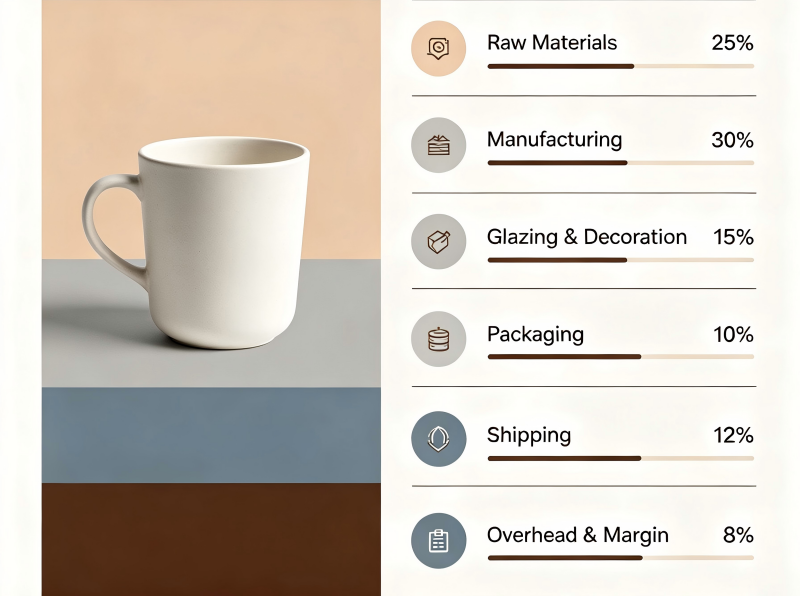
Now that you have the basic formula, let's explore what these numbers actually mean for your business. Each percentage represents a decision point, a trade-off, and an opportunity for you to optimize your procurement for maximum value.
What Are the Biggest Drivers of a Ceramic Mug's Cost?
Wondering why two seemingly similar mugs have drastically different prices? The most significant cost fluctuations often come from choices in the manufacturing process and decoration complexity, not just the raw materials.
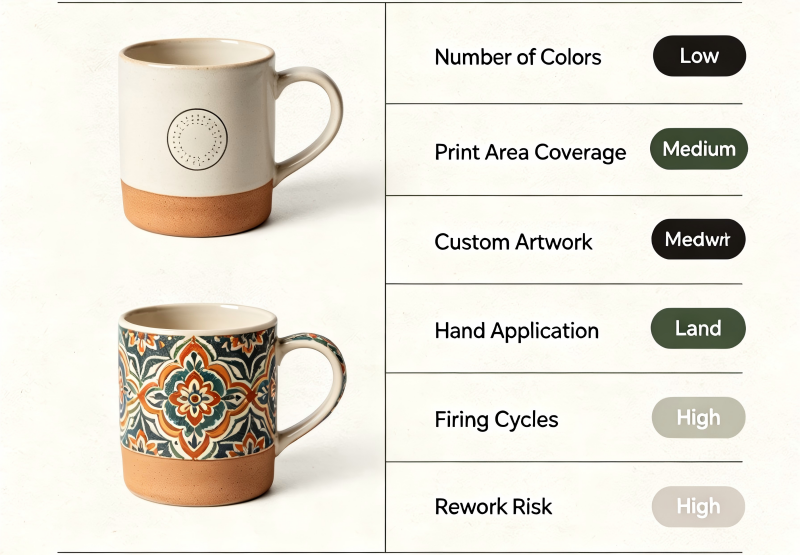
The biggest drivers of a mug's final cost are the manufacturing complexity and the type of decoration applied. A simple, single-color mug will always be cheaper to produce than a mug with a complex handle and a multi-colored, full-wrap decal. These aren't just expenses; they are strategic trade-offs between production cost and potential retail value.
Dive Deeper
In our 15 years as a ceramic mug manufacturer, we've seen many buyers focus solely on getting the lowest price, only to realize they've sacrificed the very features that make the mug desirable to their end customers. Understanding these drivers is key to avoiding that mistake.
H3: The Manufacturing Process Trade-off
The journey from clay to a finished mug involves several steps: slip casting or pressing, fettling (smoothing the seams), handle application, firing, and glazing. The complexity at each stage impacts the mug manufacturing cost.
- Shape & Handle: A standard cylindrical mug is efficient to produce. A mug with a unique, ergonomic shape or a hand-applied, detailed handle requires more skilled labor and time, increasing the unit cost. From my experience, a complex handle alone can add 10-15% to the labor cost.
- Firing Cycles: Most mugs are bisque-fired and then glaze-fired. However, certain glazes or decoration techniques, like those requiring precious metals (gold, platinum), need an additional, lower-temperature firing. Each trip to the kiln adds energy and labor costs.
This is where you must ask: Does the unique shape justify the higher cost? For a premium brand, the answer is often yes. For a promotional giveaway, perhaps not. It’s about aligning the product with its market purpose.
H3: Decoration: Cost vs. Perceived Value
Decoration is where a simple mug becomes a unique product. It's also a major cost variable. The key is to see this not as an expense, but as an investment in perceived value. A question we often ask our clients is, "Will this decoration allow you to command a higher retail price?"
Here’s a quick comparison of two common methods we use, which you can learn more about in our guide on Screen Printing vs Decal Printing on Ceramic Mugs.
| Feature | Screen Printing | Decal Application |
|---|---|---|
| Best For | Simple, 1-2 color logos | Complex, multi-color, full-wrap designs |
| Cost | Lower per unit | Higher per unit |
| Setup Fee | Low | Moderate (for printing the decals) |
| Durability | Very high | High (when fired correctly) |
| Application | Directly onto mug surface | Water-slide transfer applied by hand |
A complex decal might add $0.30 to the cost of factory direct mugs, but if it elevates the design to something that can sell for $5 more at retail, it’s a brilliant investment. Conversely, over-decorating a simple promotional mug can inflate costs without adding any real value.
How Do Raw Materials Influence the Ceramic Mug Cost Breakdown?
Are you assuming that all ceramic is the same? The type and grade of clay and glaze used are foundational to the mug's quality, durability, and safety, and they represent a significant part of the ceramic mug cost breakdown.
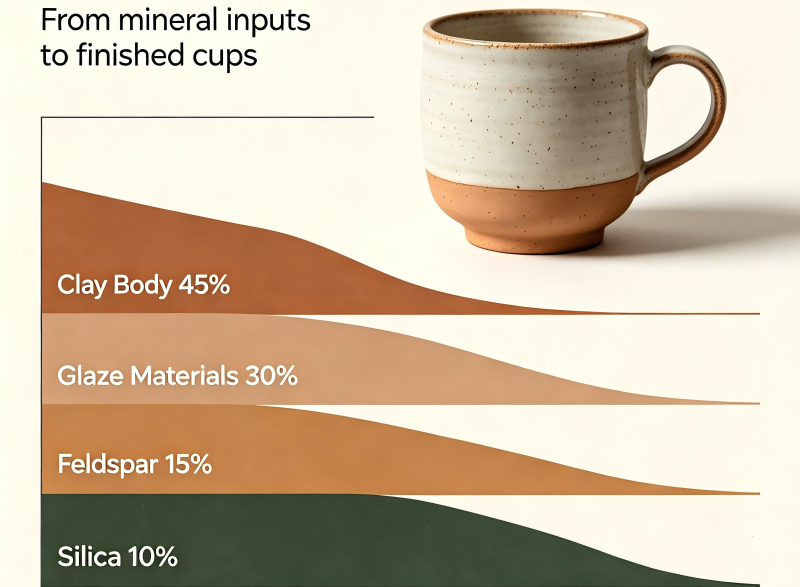
The raw materials—primarily clay and glaze—account for roughly 15-25% of a mug's production cost. The specific grade of ceramic (e.g., stoneware, porcelain) and the quality of the glaze directly impact the final price, durability, and safety compliance of the product.
Dive Deeper
Instead of just accepting the material cost percentage, a smart buyer digs deeper. The real power comes from asking your supplier the right questions. This shifts the conversation from "why the price?" to "what am I getting for the price?"
Based on our experience with European and American buyers, focusing on material specifications is a hallmark of a professional importer. It shows you're concerned with long-term quality, not just the initial invoice for wholesale ceramic mugs.
H3: Clay Grades and Their Impact
Not all "ceramic" is created equal. The choice of clay body is a fundamental decision that affects everything from the mug's look and feel to its durability.
- Stoneware: A popular and durable choice. It's relatively thick, opaque, and has a satisfying heft. It's a great mid-range option for everyday use and is what we most commonly use for bulk ceramic mugs.
- Porcelain: More refined and expensive. It's fired at a higher temperature, making it less porous and more durable than stoneware, despite often being thinner. It has a smoother, more elegant finish.
- Bone China: The premium option. It contains cow bone ash, which gives it a distinctive translucent quality and superior strength. It's lightweight and chip-resistant but comes at a significantly higher cost.
Actionable Question for Your Supplier: "What grade of stoneware are you using (A, B, C)? Can you explain how its durability and water absorption rate compare to porcelain, and what the cost difference per unit would be?"
H3: Glaze Quality and Safety
The glaze is the glassy layer that makes the mug waterproof and gives it its color and finish. But more importantly, it's the surface that comes into contact with the beverage.
- Safety First: Ensuring the glaze is lead and cadmium-free is non-negotiable. Reputable factories will provide testing reports to certify compliance with regulations like California Prop 65 and FDA Requirements for Ceramic Drinkware. Cheaper glazes may cut costs but pose a massive business risk.
- Finish and Durability: The quality of the glaze also affects the aesthetic. A high-quality glaze results in a smooth, even finish with no pinholes or blemishes. It’s also more resistant to crazing (fine cracks) and dishwasher/microwave damage, leading to better customer reviews.
Actionable Question for Your Supplier: "Can you provide the testing reports for lead and cadmium for the specific glaze you plan to use? Is the glaze formulated for high dishwasher durability?"
Why Is Mold Cost a Separate Part of the Mug Cost Breakdown?
Have you been quoted a "mold fee" and wondered why it's a separate line item? This one-time cost can seem intimidating, especially for smaller orders, causing confusion about the true unit price.
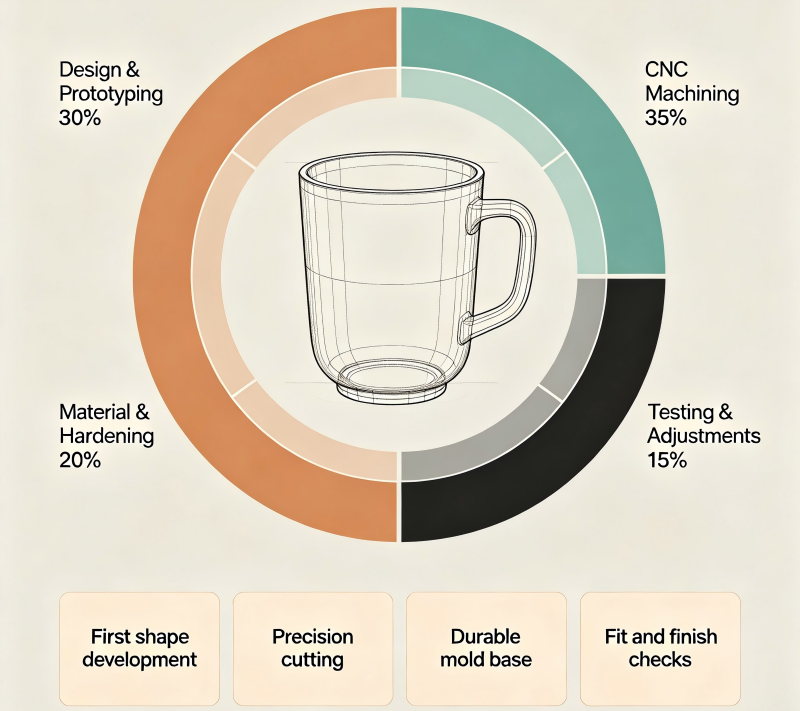
The mold cost is a one-time development fee for creating the unique shape of your custom ceramic mugs. Because it is amortized over the entire production run, it is separated from the per-unit manufacturing cost. This explains why small custom orders have a much higher effective cost per mug.
Dive Deeper
Understanding the role of the mold fee is crucial for grasping the economics of scale in custom mug production. It's not just an expense; it's the investment that brings your unique design to life. Treating it as such helps you make smarter decisions about order volume and design.
H3: The Economics of Mold Amortization
Let's use a simple example to illustrate how mold cost amortization works.
Assume a new mold for your custom design costs $500.
- Order of 500 mugs: The mold cost adds $1.00 to each mug's price ($500 / 500).
- Order of 5,000 mugs: The mold cost adds only $0.10 to each mug's price ($500 / 5,000).
- Order of 50,000 mugs: The mold cost becomes negligible at $0.01 per mug ($500 / 50,000).
This is the principle of economies of scale in action. The larger the order, the less impact the initial mold investment has on your final unit cost. This is also why the ceramic mug MOQ (Minimum Order Quantity) exists. Factories set an MOQ to ensure that the production run is large enough to make the setup process (including mold creation) economically viable. You can learn more in our detailed article, What Is the MOQ for Custom Ceramic Mugs?.
H3: OEM vs. ODM: When Do You Pay for a Mold?
Understanding whether you need a new mold often comes down to the difference between OEM and ODM production.
- ODM (Original Design Manufacturer): If you select a mug from our existing catalog of shapes, you are using an ODM approach. The molds already exist, so you pay no mold fee. You can still customize these mugs with your own colors and logos. This is the fastest and most cost-effective way to get started.
- OEM (Original Equipment Manufacturer): If you provide a completely new design with a unique shape, handle, or size, we need to create a new mold. This is an OEM project, and you will be charged the one-time mold fee. This gives you a completely exclusive product but requires a larger initial investment.
For a deeper dive, read our comparison of OEM vs ODM Ceramic Mug Production. A common mistake we see is buyers requesting a fully custom shape for a small test order, leading to a prohibitively high per-unit cost. A better strategy is often to start with an ODM shape to test the market before investing in a custom mold.
How Do QC and Packaging Affect Your Overall Mug Cost?
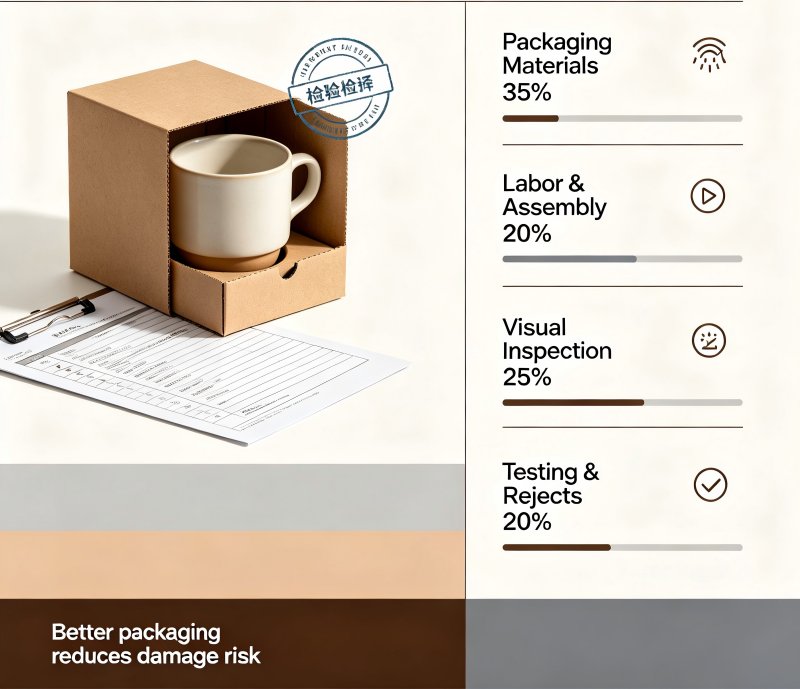
Do you view Quality Control (QC) and packaging as just another expense to be minimized? In reality, these components are your insurance policy, protecting your investment, your brand reputation, and your profit margin from the risks of damage and defects.
Quality control and packaging are critical parts of the ceramic mug cost breakdown that directly impact your net profit. A lower upfront cost on QC can lead to a higher rate of defective products, while inadequate packaging results in breakage during transit, ultimately costing you more in lost goods and customer complaints.
Dive Deeper
In our 15 years of exporting to demanding markets, we've learned that cutting corners on QC and packaging is the most expensive mistake a buyer can make. The few cents saved per unit are quickly erased by the cost of one damaged shipment or a batch of products your customers can't accept. When you evaluate a ceramic mug factory, their approach to these two areas speaks volumes.
H3: Quality Control: An Insurance Policy, Not an Expense
Quality control isn't just a final check. It's a system of inspections woven throughout the production process to catch issues early.
- Incoming Material Inspection: Checking clay and glazes to ensure they meet specifications.
- Greenware Inspection: Inspecting mugs after they are formed but before the first firing to catch cracks or deformities.
- White Body Inspection: Checking after the first firing for any flaws before glazing.
- Final Inspection: A comprehensive check for glaze defects, color consistency, decal alignment, and physical imperfections before packing.
A robust QC process adds a small percentage to the labor cost. However, it's what prevents a 10% defect rate from reaching your warehouse. Imagine ordering 5,000 mugs and 500 are unsellable. The effective cost of your "good" mugs just went up by over 11%. A reputable ceramic mug supplier will have a clear QC protocol and should be transparent about their AQL (Acceptable Quality Level) standards.
H3: Packaging: Protecting Your Investment
Mugs are fragile. Shipping them from our factory in China to a warehouse in Europe or the Americas is a long journey. The packaging has one job: to get them there safely.
- Standard Packaging: Typically, this involves individual dividers in a master carton. For low cost wholesale mugs, this might be sufficient.
- Enhanced Packaging: For more expensive or irregularly shaped mugs, we might use egg-crate-style cartons, individual boxes, or even molded pulp inserts. This costs more but drastically reduces the breakage rate.
- Retail-Ready Packaging: If you're an e-commerce seller, you may want packaging that can be shipped directly to the end consumer (an "ISTA-3A" certified box, for example). This adds cost but saves you time and money on repacking.
Actionable Question for Your Supplier: "What is your standard packaging for this mug, and what is your average damage rate for shipments to my region? What are the options and costs for enhanced packaging to reduce the damage rate below 1%?"
Frequently Asked Questions
What is a reasonable MOQ for custom ceramic mugs?
A typical MOQ (Minimum Order Quantity) for custom ceramic mugs ranges from 500 to 1,200 pieces per design. This number allows the factory to run production efficiently, covering the costs of setup, machine calibration, and labor. For simpler ODM designs, the MOQ may be lower.
How long does custom mug production take?
Standard custom mug production takes approximately 45-60 days. This includes 7-10 days for mold development (if needed), 30-40 days for mass production, and 5-10 days for final inspections and packaging. This timeline does not include shipping, which varies by destination.
Are cheaper wholesale ceramic mugs lower quality?
Not always, but often yes. Cheaper wholesale ceramic mugs may use a lower grade of stoneware (B or C grade), simpler glazes, or have less rigorous quality control. This can lead to higher rates of cosmetic defects, lower durability, and potential safety concerns. It's crucial to clarify material and QC specs, not just the price.
Do I need to pay for a mold if I use your existing mug shape?
No. If you choose a design from our existing catalog (an ODM product), there is no mold fee. The molds are already owned by us. You only pay a mold fee if you require a completely new, unique shape that we don't currently produce (an OEM product).
How does shipping impact the final cost of bulk ceramic mugs?
Shipping is a significant part of the final landed cost, especially for heavy items like ceramics. The cost depends on the volume, weight, and shipping method (sea vs. air). We always advise clients to get a comprehensive quote that includes shipping (CIF or DDP terms) to avoid surprises and accurately calculate the total cost per unit.
Conclusion
Understanding the ceramic mug cost breakdown is about more than just numbers; it's about empowerment. It transforms you from a price shopper into a strategic partner who can work with a manufacturer to create the best possible product for your budget and market. By seeing costs as trade-offs—complexity for value, QC for risk reduction, and mold fees for exclusivity—you can make informed decisions that protect your brand and boost your profitability. The true cost of a mug isn't what you pay for it, but the value it delivers over its entire lifecycle.
As a ceramic mug manufacturer with 15 years of experience exporting to the EU and Americas, we believe in transparency. If you're looking for a partner to help you navigate these choices, we're here to help.