Struggling to make sense of the wide range of quotes you receive for ceramic mugs? You might get one price that seems too high and another that feels suspiciously low, making it difficult to budget and trust your sourcing partners. The reality is that the final price reflects your entire procurement strategy, not just the physical mug. Understanding the key factors behind ceramic mug pricing is the first step to making an informed decision that balances quality, risk, and your budget.
The price of a ceramic mug is primarily determined by four key factors: the choice of material and decoration complexity, the balance between your order quantity (MOQ) and customization level, overlooked costs like compliance testing and export packaging, and the experience and certifications of the manufacturer. Your final unit cost is a direct result of the trade-offs you make across these areas.
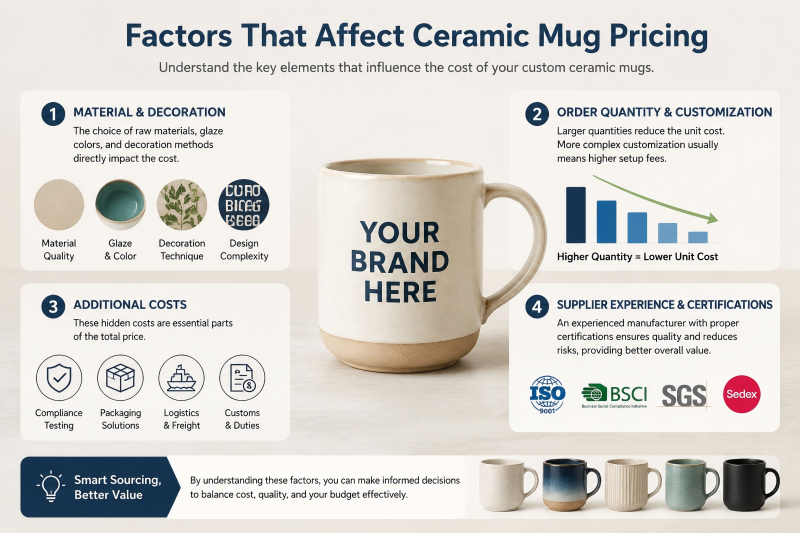
Now that you have the short answer, you're already ahead of most first-time buyers. But why do these factors have such a big impact? Let's dive deeper into each one. As a representative from a factory with 15 years of export experience, I want to pull back the curtain and show you how to analyze a quote like a seasoned professional.
How Do Material and Decoration Influence Ceramic Mug Pricing?
You've found a mug design you love, but you're not sure if it fits your budget. The small aesthetic choices you make can create a huge variance in price, and it's frustrating when you don't know why. The key is to understand that what seems like a simple visual difference often involves entirely different raw materials and production processes.
The base material (like stoneware or porcelain) and the type of decoration (from a simple logo to a full-wrap reactive glaze) are the two biggest variables that drive the initial cost. Each choice has a direct impact on raw material expense, the number of firing cycles, and the amount of skilled labor required.
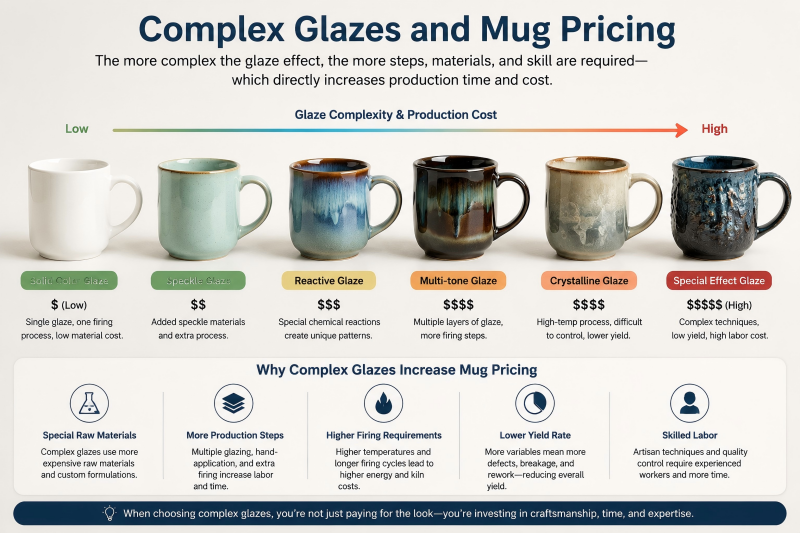
As a ceramic mug manufacturer China with over a decade of experience, one of the most common discussions I have with clients involves breaking down these choices. It’s not about "good" vs. "bad" materials, but about finding the right fit for your target market, brand identity, and price point.
H3: Choosing Your Ceramic Base: Stoneware vs. Porcelain vs. Bone China
The clay body you choose is the foundation of your mug's cost, feel, and perceived value. While all are "ceramic," they have distinct properties.
- Stoneware: This is often the most cost-effective option. It's opaque, sturdy, and has a rustic, earthy feel. It fires at a lower temperature than porcelain, which saves energy costs. It’s an excellent choice for promotional mugs or café-style drinkware where durability and value are priorities.
- Porcelain: A step up in price and refinement. Porcelain is fired at a higher temperature, making it less porous, lighter, and more durable than stoneware. It has a smooth, white finish that provides a great canvas for detailed decorations. This is a popular choice for retail and high-end
private label ceramic mugs. - New Bone China / Bone China: This is the premium option. Traditionally, bone china contains actual bone ash, giving it incredible strength, a lightweight feel, and a signature translucency. "New Bone China" is a modern, animal-free alternative that achieves a similar look and feel. The higher cost reflects the more expensive raw materials and more delicate manufacturing process.
Here’s a quick comparison from a buyer’s perspective:
| Feature | Stoneware | Porcelain | Bone China |
|---|---|---|---|
| Cost | $ | $$ | $$$ |
| Feel | Heavy, thick, rustic | Smooth, refined | Lightweight, delicate, translucent |
| Color | Opaque, often earthy tones | Bright white | Warm, milky white |
| Best For | Promotional items, cafes, value-focused brands | Retail, corporate gifts, e-commerce | High-end retail, luxury gift sets |
H3: The Decoration Dilemma: From Simple Logos to Full Wraps
After the material, the decoration method is the next major factor in ceramic mug pricing. A common question we get is, "Why does this full-color mug cost almost double the one with a simple logo?" The answer lies in the labor, materials, and production steps involved.
- Decal Printing: This is the most common method for complex, multi-color logos. The design is printed on special paper, applied to the mug by hand, and then fired to fuse it to the glaze. The cost is driven by the size of the decal and the number of colors, as each color may require a separate screen in the printing process.
- Pad Printing: Excellent for simple, one or two-color logos on curved surfaces. A silicone pad picks up ink and stamps it onto the mug. It's fast and cost-effective for large runs of
bulk ceramic mugswith simple branding. - Reactive Glaze: This creates a unique, often variegated, and artisanal look where no two mugs are exactly alike. This effect is achieved by using special glazes that react to the heat during firing. It's a highly skilled process that often requires an extra firing cycle, significantly increasing labor and energy costs. It is, however, fantastic for creating premium products that stand out.
- Sublimation: This digital printing process is best for small-batch, full-color photographic images. However, it requires a special polyester coating on the mug and is generally less durable than fired decals. We typically recommend it for promotional items rather than high-end retail.
When you request a quote, an experienced wholesale ceramic mugs supplier will help you weigh the visual impact you want against the cost implications of each method.
Does Order Quantity Affect Ceramic Mug Pricing More Than Customization?
Have you ever been shocked by the high per-unit cost for a small order of custom mugs? You might think a 500-piece order is substantial, but in the world of large-scale manufacturing, it can be prohibitively expensive if the design is complex. This is perhaps the most common misconception we encounter from new importers.
Yes, the balance between your Minimum Order Quantity (MOQ) and customization complexity often has a greater impact on unit ceramic mug pricing than the base material itself. High setup costs for molds and printing equipment must be amortized over the entire production run, so a smaller run means a higher cost per mug.
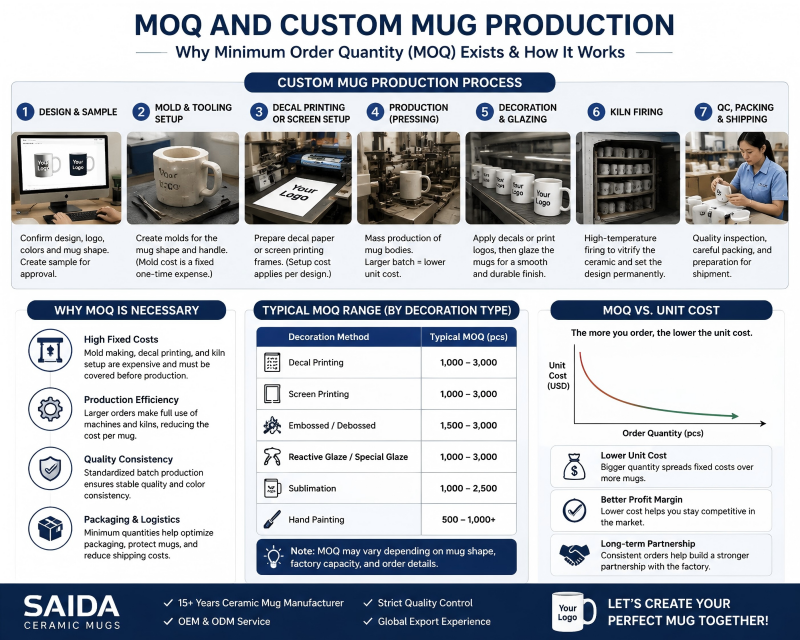
Understanding this trade-off is crucial when you buy mugs directly from manufacturer. It’s not about the factory being inflexible; it’s about the fundamental economics of mass production. A good partner will work with you to find a sweet spot that meets both your design goals and your budget.
H3: The Economics of the Mold and Production Line
Every custom manufacturing process begins with a setup phase, and these initial costs are significant.
- Mold Creation: If you want a unique mug shape that isn't in our existing catalog, we need to create a new production mold. This process involves design, prototyping, and tooling, which can cost several thousand dollars. That cost is divided by the number of mugs you order. For a 1,000-unit order, that's a significant addition per piece. For a 50,000-unit order, it becomes almost negligible.
- Printing Setup: Setting up a printing line, especially for a multi-color decal, is a labor-intensive process. Each color requires its own screen to be made and aligned perfectly on the machine. The calibration, test runs, and materials used before the first "good" mug is produced are all part of the setup cost. Whether we're printing 500 mugs or 5,000, this setup cost remains the same.
This is why a standard-shape mug from our existing collection with a one-color logo will always be cheaper at a low quantity than a custom-shaped mug with a four-color wrap.
H3: A Common Scenario for a Custom Ceramic Mug Factory
Let me share a real-world example. A new e-commerce seller approached us wanting to launch a line of private label ceramic mugs. They had a beautiful, eight-color artistic design and wanted to start with an order of just 500 units to test the market.
When we provided the quote, they were surprised by the per-unit price. We explained that the high cost was driven almost entirely by the eight-screen setup for such a small run. After a brief consultation, we proposed a solution: we modified their artwork to use only four colors, which retained the spirit of the design but cut the printing setup cost in half. This small change brought the unit price down into their target range.
As a custom ceramic mug factory, our goal is to be a partner, not just a vendor. We use our experience to guide clients toward solutions that are commercially viable. Sometimes, this means simplifying a design for a first order; other times, it means recommending a larger order quantity to unlock better economies ofscale.
What Hidden Costs Affect the Final Ceramic Mug Pricing for Importers?
You’ve received a fantastic FOB (Free On Board) price from a supplier, and it fits perfectly within your budget. But is that the real final cost? For a ceramic mug importer, the factory quote is just the beginning. Failing to account for "hidden" costs like compliance testing and proper packaging can turn a profitable order into a financial loss.
The true landed cost of your mugs must include crucial, non-negotiable expenses for testing and durable export packaging. While they add to the unit price, they are essential investments in risk management that protect your business, your customers, and your bottom line.
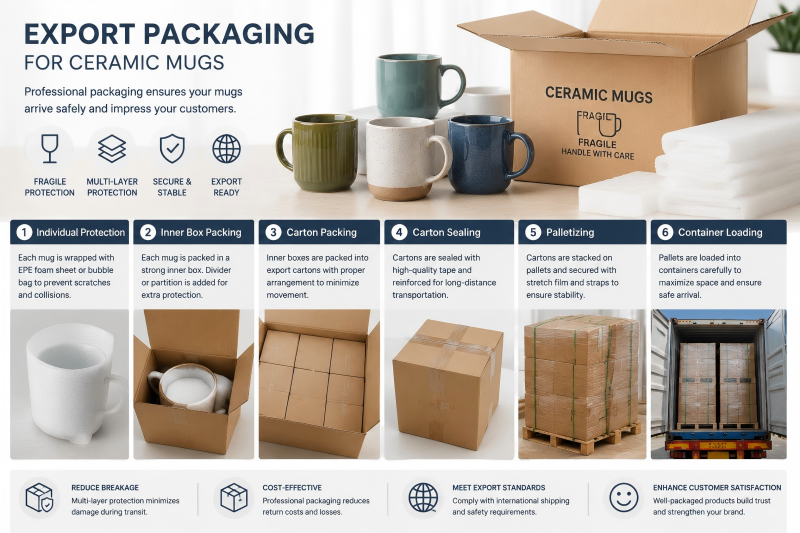
Over my 15 years in this business, I’ve seen importers try to cut corners here, and it rarely ends well. A reliable China ceramic mug supplier will be transparent about these costs and explain why they are necessary, especially for Western markets.
H3: Navigating Compliance and Testing
When you import products intended for contact with food, you are responsible for ensuring they are safe. Major markets have strict regulations that are not optional.
- Food-Grade Safety: For both the U.S. (FDA) and European markets, ceramicware must be tested for lead and cadmium leaching. Reputable factories conduct these tests to ensure their glazes and decorations are safe. The cost of this testing is often built into the price from an experienced exporter. A suspiciously cheap quote might come from a factory that skips this step, putting you at enormous risk.
- California Proposition 65: If you plan to sell in California, you must comply with Prop 65, which requires warnings for products containing certain chemicals. This often requires separate testing and specific labeling. As an
OEM mug manufacturerthat frequently ships to the US, we are well-versed in these requirements and can advise on the most cost-effective way to comply.
These testing costs are a small price to pay for market access and avoiding a disastrous product recall.
H3: Packaging Isn't Just a Box
The journey from our factory in Liling to a warehouse in Ohio or a distribution center in Germany is a rough one. Mugs will be loaded, unloaded, stacked, and potentially dropped. Domestic packaging is not designed to withstand the rigors of international freight.
- Standard Export Packaging: We use a 5-layer, reinforced corrugated carton for
bulk ceramic mugs, which is significantly stronger than a standard 3-layer box. - Internal Dividers: Each mug is separated by cardboard dividers to prevent them from colliding and chipping.
- Drop Tests: We perform drop tests on our packaged cartons to simulate rough handling and ensure the packaging provides adequate protection. A common standard is the ISTA 1A test.
- Palletizing: For large orders, cartons are stacked securely on pallets and shrink-wrapped, which minimizes handling of individual boxes and reduces the risk of damage.
I once worked with a client who insisted on using cheaper, thinner boxes to save about $0.10 per mug. Their shipment arrived with over 20% of the mugs broken. The loss far exceeded the small amount they "saved." Investing in proper packaging is one of the smartest decisions you can make in your ceramic mug sourcing process.
How Does Supplier Experience Impact Your Ceramic Mug Pricing?
You're comparing two quotes. One is from a new, unknown factory and is 15% cheaper. The other is from an established factory with 15 years of export experience and certifications like ISO9001 and BSCI. It can be tempting to go with the lower price, but what does that higher price actually buy you?
A slightly higher price from an experienced, certified ceramic mug manufacturer China is not just for the mug itself. It’s a premium for reliability, quality assurance, and risk reduction. This "experience factor" embedded in the ceramic mug pricing can be the difference between a smooth, profitable transaction and a costly logistical nightmare.
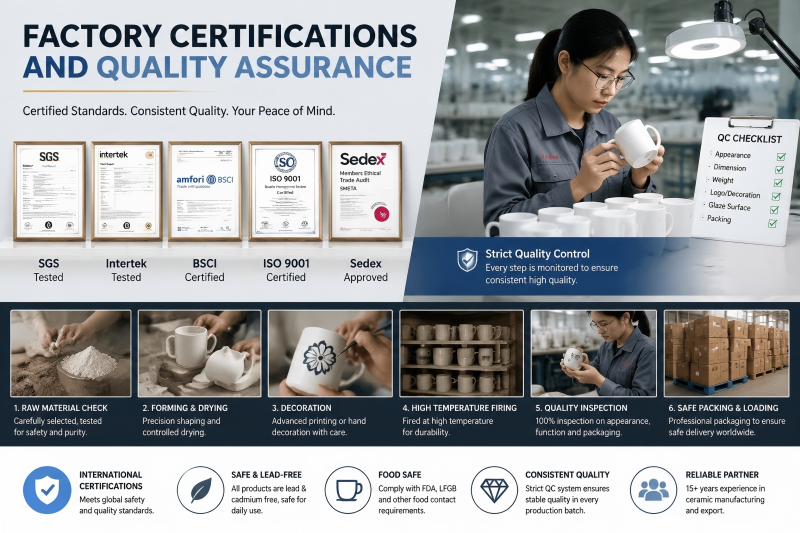
When you choose an established partner, you're investing in a smoother supply chain. You're paying for the peace of mind that comes from knowing your supplier understands international trade and is committed to quality and ethical standards.
H3: The Value of Certification (ISO9001 & BSCI)
Certifications aren't just logos on a website; they are proof of a factory's commitment to professional operations.
- ISO 9001: This is a global standard for Quality Management Systems. For you as a buyer, it means the factory has documented, repeatable processes for everything from raw material inspection to final quality control. This leads to greater consistency and fewer defects in your order of
factory direct ceramic mugs. - BSCI (Business Social Compliance Initiative): This focuses on ethical and social responsibility. A BSCI-audited factory is committed to fair labor practices, safe working conditions, and environmental protection. For many retailers in Europe and North America, sourcing from BSCI-compliant suppliers is a non-negotiable requirement that protects their brand reputation.
Maintaining these certifications requires ongoing investment in training, documentation, and audits. This overhead is factored into our pricing, but it guarantees a level of professionalism and accountability that uncertified factories cannot offer.
H3: Experience Means Fewer Surprises
After 15 years of exporting to Europe, North America, and South America, we've learned how to anticipate and solve problems before they impact our clients. This experience is an intangible but invaluable part of what we offer.
- Clear Communication: We understand the nuances of communicating with Western buyers. We can provide clear answers, manage expectations, and offer proactive solutions.
- Logistical Expertise: We know the paperwork, customs requirements, and shipping lanes for major markets. We can help you avoid costly delays at the port. I've seen a shipment get held in customs for weeks due to incorrect paperwork from an inexperienced supplier—a delay that can cost thousands in lost sales.
- Cultural Understanding: We understand the quality expectations and market trends in your region. We can provide better advice on materials and designs that will resonate with your customers.
Ultimately, choosing an experienced OEM mug manufacturer is a strategic decision. The lowest quote isn't the best value if it comes with poor quality, shipping delays, or communication barriers. The right supplier protects your investment and helps your business grow.
Frequently Asked Questions
What's the cheapest type of ceramic mug?
The most cost-effective option is typically a standard-sized white stoneware mug with a simple, one-color logo applied via pad printing. This combination uses the most affordable material, an existing mold (no tooling costs), and the quickest, most automated decoration method for large quantities.
Why is my small custom order so expensive per unit?
A small custom order has a high per-unit price because significant fixed setup costs—for creating a new mold or configuring a multi-color printing line—are spread across a very small number of units. The bulk of the cost is in the setup, not the raw materials for each individual mug.
Is it cheaper to buy mugs directly from a manufacturer in China?
Yes, when you buy mugs directly from manufacturer, you cut out intermediary costs like traders and agents. However, you must be prepared to manage international shipping, import duties, and communication. The best approach is to partner with an experienced China ceramic mug supplier who can guide you through this process, ensuring your total landed cost is still lower.
What is a reasonable MOQ for custom ceramic mugs?
A reasonable Minimum Order Quantity (MOQ) depends heavily on the complexity of the customization. For a standard mug with a simple logo, the MOQ might be around 1,000 units. For a custom shape requiring a new mold or a mug with a complex reactive glaze, the MOQ could be 3,000 units or more to make the production economically viable.
Conclusion
Understanding ceramic mug pricing is about more than just comparing numbers on a spreadsheet; it's about making a strategic sourcing decision. The final cost of your product is a reflection of your choices in four key areas: the material and decoration that define your brand's aesthetic, the crucial balance between order quantity and customization, the often-overlooked costs of compliance and packaging, and the invaluable experience of your manufacturing partner. By analyzing quotes through this framework, you can move from simply hunting for the lowest price to building a resilient, high-quality supply chain.
As a wholesale ceramic mugs supplier with 15 years of experience helping importers in Europe and the Americas succeed, we believe an empowered buyer is our best customer. If you're ready to source high-quality factory direct ceramic mugs with confidence and transparency, contact our team. We’re here to help you navigate these factors and build a product that delights your customers and grows your business.