Struggling to get a fair price from your suppliers? You might feel that every negotiation is an uphill battle, where you are constantly trying to haggle down a price that feels arbitrarily high. The truth is, if you want to negotiate better pricing with manufacturers, you need to stop thinking like a haggler and start acting like a partner.
To negotiate better pricing with manufacturers, you must shift your approach from adversarial haggling to collaborative problem-solving. Understand that a factory's price is not a fixed number but an output based on variables like order quantity, material quality, design complexity, and payment terms. By presenting a clear, professional inquiry that demonstrates you understand these variables, you signal that you are a low-risk, high-value partner, which inherently unlocks better pricing and terms.
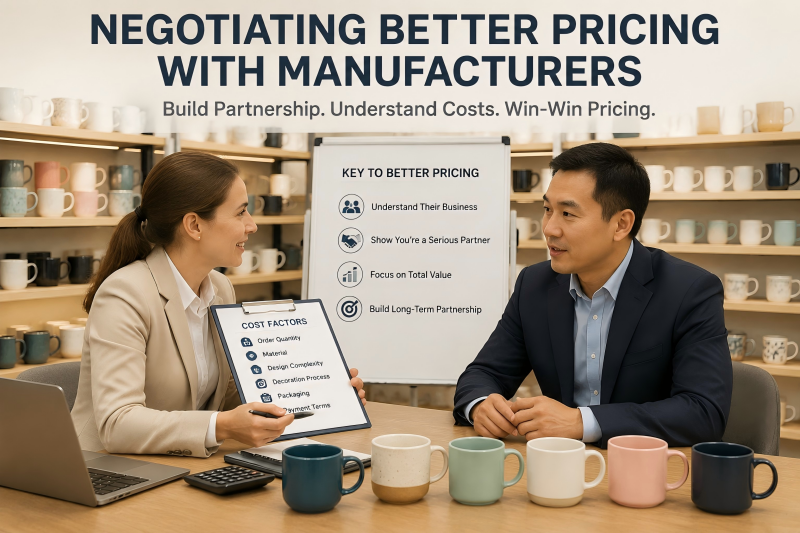
But what does it actually mean to be a "high-value partner"? It's less about the size of your purchase order and more about the quality of your communication and your understanding of the manufacturing process. Let's dive into the perspective we've gained over 15 years of producing ceramic mugs for international buyers.
Why is Your Price Quote a Set of Variables, Not a Single Number?
Have you ever received a price quote and immediately tried to knock 10% off, only to be met with a firm "no"? This is a common frustration for buyers, and it stems from a fundamental misunderstanding of factory pricing. The good news is that you have more control over the price than you think.
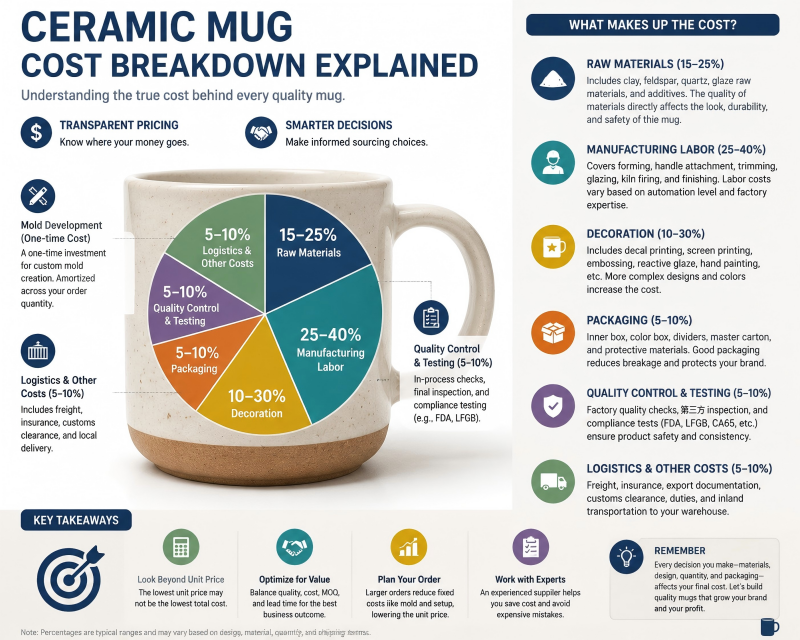
A factory's price isn't arbitrary; it's the result of a cost-plus calculation. We take the cost of raw materials, labor, energy, and overhead, then add a margin to get the final price. Therefore, to change the price, you must work with us to change one of the underlying cost variables.
Dive Deeper: The Levers You Can Actually Pull
From our perspective as a manufacturer, the most productive negotiations happen when a buyer understands the components of our pricing. When you ask, "How can we work together to meet a target price of $X?" instead of "Can you do it for $X?", you open a door to a collaborative discussion. This is the core of an effective wholesale mug pricing strategy.
Here are the primary variables that determine your final price:
H3: Order Quantity and The MOQ
This is the most obvious factor. Larger orders allow us to buy raw materials in bulk at a lower cost, optimize kiln space, and reduce the setup time per unit.
- Below MOQ (Minimum Order Quantity): Ordering below our MOQ is often possible, but it carries a significant price premium. This is because the setup costs (e.g., creating a new mold, preparing a custom glaze, printing setup) are spread across fewer units.
- At MOQ: This is the baseline price.
- Above MOQ: This is where price breaks begin. We can provide a tiered pricing structure (e.g., for 5,000, 10,000, and 25,000 units) so you can see the direct savings from ordering more.
H3: Material Quality and Glaze Selection
Not all ceramics are created equal. A buyer who just asks for a "ceramic mug" leaves too much to interpretation. A professional buyer specifies their needs, which directly impacts the ceramic mug factory pricing.
| Feature | Standard Option (Lower Cost) | Premium Option (Higher Cost) |
|---|---|---|
| Ceramic Body | Standard stoneware or mid-grade porcelain. | High-grade porcelain or new bone china for strength and translucency. |
| Glaze | Factory-standard white or black glaze. | Custom Pantone-matched color, reactive glaze, or matte finish. |
| Durability | Standard food-safe, may not be rated for extensive dishwasher use. | Restaurant-grade, certified lead & cadmium free (Prop 65), dishwasher/microwave safe. |
A simple change, like moving from a custom Pantone-matched glaze to one of our standard colors, can sometimes reduce the unit cost by 5-10% because it eliminates the cost and labor of developing and testing a new formula.
H3: Customization and Complexity
The more complex your design, the more labor and machine time it requires.
- Printing: A simple one-color logo on one side is the cheapest. A full-wrap, multi-color decal that requires precise, manual application will be significantly more expensive.
- Shape: Using one of our existing molds is always the most cost-effective option. Requesting a custom shape requires us to design, create, and test a new production mold, a cost that is amortized into your unit price.
- Special Features: Adding a gold rim, an unglazed bottom, or a special texture all require extra production steps and quality control checks, increasing the cost.
By understanding these trade-offs, you can make informed decisions. Maybe that full-wrap design isn't essential, and a two-sided logo will achieve the same branding effect while saving you 15% on the final cost. That's a smart way to reduce manufacturing costs.
How Can You Negotiate Better Pricing with Manufacturers Beyond Just a Large Order?
Many small to mid-sized e-commerce sellers feel they have no leverage because they can't place a 50,000-unit order. This makes them feel stuck with standard pricing, unable to compete. From our factory floor, I can tell you that volume is not the only thing we value. Predictability and efficiency are just as important.
You can often negotiate better pricing with manufacturers by offering value that reduces our operational costs and risks. A smaller, well-organized partner can be more profitable for us than a large, chaotic one. Your goal is to make yourself the easiest customer to work with.
Dive Deeper: Become a Low-Friction Partner
As a manufacturer with ISO9001 and BSCI certifications, we have highly structured production processes. A partner who understands and works within these processes is incredibly valuable. Here are some non-obvious negotiation points that can give you leverage.
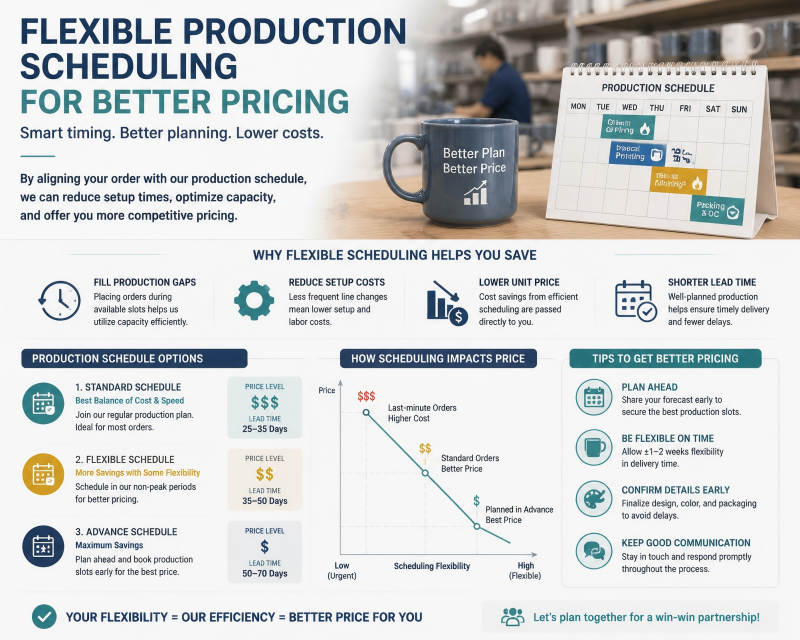
H3: Offer Lead Time Flexibility
Our production schedule is a complex puzzle. We have kilns to fill, workers to schedule, and raw materials arriving daily. Sometimes, there are unexpected gaps—a large order gets delayed, or a material shipment is late. A buyer who says, "My delivery window is flexible, you can produce my order anytime in Q3 to fill a gap in your schedule," is offering us a massive benefit.
- How it helps us: This flexibility allows us to optimize our kiln capacity and labor, ensuring we don't have expensive downtime. We can run your products when it's most efficient for us.
- How it helps you: In exchange for this flexibility, we can often offer a small discount. You are helping us solve a logistics problem, and that value can be reflected in the price. This is one of the most underrated China manufacturer negotiation tips.
H3: Streamline Your Quality Control (QC) Process
Quality control is essential, but an inefficient QC process can be a major cost driver for both parties. We've seen buyers who insist on overly complex, multi-stage inspection processes that differ wildly from industry standards. This forces us to add buffer time and labor, which increases the price.
A better approach is to work with us.
- Align Early: Discuss and agree upon the QC standards and inspection points before production begins.
- Trust Our Process: As a BSCI-audited factory, we have robust internal QC at every stage. Ask for our internal QC reports first.
- Consolidate Inspections: Instead of inspecting raw materials, then semi-finished goods, then final products, consider a single, thorough final random inspection based on AQL standards. This is efficient and effective.
When you show that you trust our certified processes and want to create an efficient QC plan together, you reduce our administrative burden and risk, creating a new avenue for price negotiation.
H3: Commit to a Long-Term Forecast
Even if your individual orders are small, providing a reliable 6- or 12-month forecast is incredibly valuable. For example, if you can commit to ordering 2,000 units every quarter for a year, that's an 8,000-unit annual commitment.
- How it helps us: This allows us to plan our raw material purchasing more effectively and lock in better prices. It also helps us with labor forecasting, ensuring we have the right staff available.
- How it helps you: This predictability reduces our risk, and we can often offer you pricing based on your total annual volume, not just the individual order size. This is a powerful strategy for growing businesses looking for ways to get how to get better factory prices.
Why Does the Lowest Price Often Carry the Highest Risk?
You've sent out five RFQs and one quote comes back 30% lower than the rest. It's tempting to declare victory and sign the contract. However, after 15 years in this business, I can tell you with certainty: an abnormally low price is not a deal, it's a warning sign.
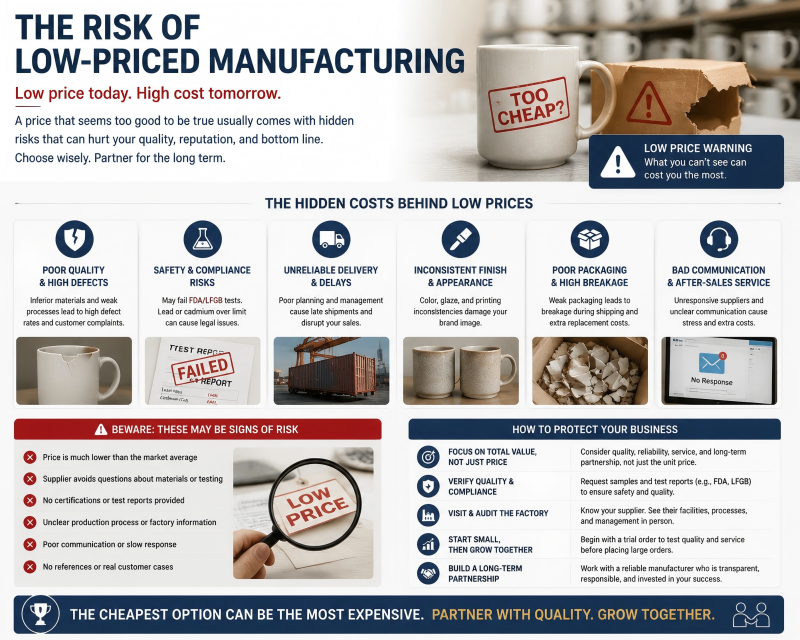
The lowest price often carries the highest risk. A rock-bottom quote almost always means corners were cut in critical areas like material safety, quality control, or ethical labor practices. The "true cost" of this deal will eventually surface in the form of product recalls, negative reviews, shipping delays, or even legal trouble.
Dive Deeper: Assessing the True Cost of a Deal
A successful business is built on a reliable supply chain, not on one-time savings. Your goal in OEM mug supplier negotiation should be to find the best value, which is the optimal balance of price, quality, and reliability. This is especially true when sourcing from overseas, where you must trust your partner to protect your brand.
H3: The Material & Glaze Compromise
The easiest way for a factory to cut costs is to use cheaper, lower-grade materials.
- Unsafe Materials: Some cheap glazes can contain unsafe levels of lead or cadmium. If these products enter markets like the US or EU, they can fail testing (like California's Prop 65), leading to forced recalls and immense brand damage.
- Poor Durability: A cheaper ceramic body might be more prone to chipping. A low-quality glaze might fade or scratch after just a few dishwasher cycles, leading to customer complaints and returns.
What to ask: "Can you provide a material specification sheet for the porcelain and glaze? Can you provide recent lead and cadmium test reports from a third-party lab?" A reputable supplier will have this information readily available.
H3: The Hidden Cost of Poor Compliance
Certifications like ISO9001 and BSCI are not just logos on a website; they are proof of a manufacturer's commitment to quality systems and ethical standards.
- ISO9001 (Quality Management): This certification means the factory has a documented, audited process for everything from raw material intake to final packing. This ensures consistency and traceability. A factory without it may have chaotic, undocumented processes, leading to inconsistent quality.
- BSCI (Business Social Compliance Initiative): This audit ensures the factory adheres to ethical labor standards, including fair wages, safe working conditions, and no child labor. Partnering with a non-compliant factory exposes your brand to significant reputational risk.
What to ask: "Are you BSCI audited and ISO9001 certified? Could you share a copy of your most recent audit summary?" A refusal or hesitation to share this is a major red flag. This step is crucial when you evaluate a ceramic mug factory before ordering.
H3: The "Yes to Everything" Supplier
A common tactic of low-quality suppliers is to say "yes" to every request without hesitation—yes to a lower price, yes to a faster timeline, yes to complex features. They do this to win the contract, knowing they will likely fail to deliver. Over my career, I've learned that the best partners are the ones who are honest about their limitations. If a manufacturer says, "We can't meet that timeline without compromising quality, but here's what we can do," they are being a responsible partner, not an uncooperative one.
Frequently Asked Questions
What's a good first email to a manufacturer?
Your first email should be concise, professional, and detailed. Instead of "How much for mugs?", try: "We are sourcing for a 5,000-unit order of your Model #123 white ceramic mug. We require a two-color logo on one side and individual box packaging. Can you please provide a quote and lead time?" This shows you are a serious buyer.
Is it rude to ask for a ceramic mug cost breakdown?
It's not rude, but it's often more productive to ask about cost drivers. A factory won't share its exact margins. Instead, ask, "What are the main factors driving the cost on this quote? If we changed the glaze from custom Pantone to your standard white, how much would that impact the price?" This focuses the conversation on actionable changes.
How much can I realistically negotiate off the price?
Don't focus on a percentage. Focus on the value you can create. If your order is simple and you offer flexibility, you might see a 5-10% cost improvement compared to a complex, demanding order. The biggest "savings" come from designing a product that is efficient to manufacture from the start.
What's the difference between factory-direct vs. distributor pricing?
Factory-direct pricing, which is what we offer, eliminates the middleman. You are negotiating directly with the source of production. Distributor pricing includes the distributor's markup for their services (stocking, marketing, smaller order fulfillment). Factory-direct is usually lower per unit but requires higher MOQs and more logistics management on your part.
Conclusion
Ultimately, learning how to negotiate better pricing with manufacturers is about shifting your mindset from an adversary to a partner. The best price isn't the lowest number on a quote sheet; it's the price that comes with a high-quality, reliable, and compliant product from a partner you can trust. By understanding the variables that make up factory pricing, offering value beyond just volume, and prioritizing a healthy balance of cost and risk, you can build a resilient supply chain and a more profitable business. This collaborative approach is the secret to unlocking long-term success.
If you are a wholesaler or e-commerce seller looking for a transparent, high-quality partner for your ceramic product needs, our team is ready to help you build a successful product line. With 15 years of experience and a commitment to quality backed by ISO9001 and BSCI certifications, we know what it takes to succeed. Contact us today to discuss your project and see how a true manufacturing partnership works.