Sourcing ceramic mugs seems straightforward, but are you asking the right questions? Many buyers focus only on the final price, overlooking the critical production choices that dictate quality, safety, and durability. This knowledge gap can lead to costly defects, unhappy customers, and a damaged brand reputation, turning a promising product line into a logistical nightmare.
The ceramic mug manufacturing process is a multi-stage journey that transforms raw clay into a finished product. It begins with preparing the clay body, followed by forming the mug's shape (slip casting, jiggering, or pressing). The mug is then fired in a kiln (bisque firing), glazed, decorated, and fired a second time at a higher temperature (glost firing) to achieve its final, vitrified state.
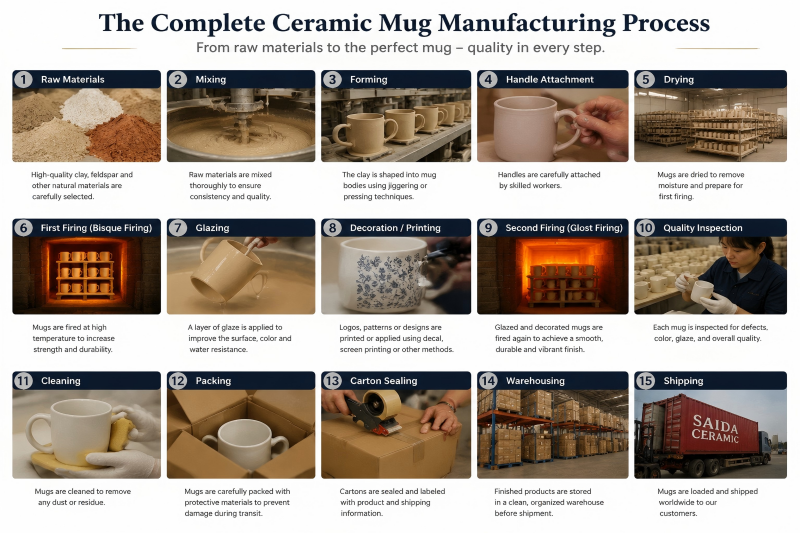
This overview is just the beginning. Each step is a decision point with direct consequences for your business. Let's break down the ceramic mug production process from a buyer's perspective, revealing how each choice impacts your cost, quality, and supply chain.
What Type of Clay Is Used When Ceramic Mugs Are Manufactured?
Choosing the right material is the foundation of a good product, but many buyers simply ask for a "ceramic mug." This can lead to a product that feels cheap, chips easily, or doesn't meet market expectations. You need to understand the material's impact on the final look, feel, and performance.
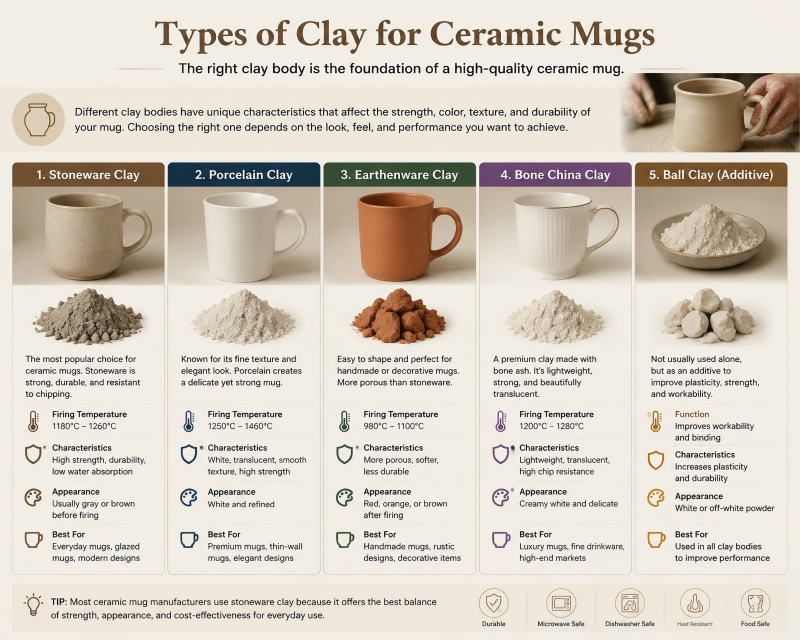
The type of clay used is the single most important factor determining a mug's durability, appearance, and cost. The three main types are earthenware, stoneware, and porcelain, with stoneware being the most common choice for its excellent balance of properties.
Dive Deeper: Clay's Impact on Your Bottom Line
As a ceramic mug manufacturer with 15 years of export experience, we've seen firsthand how clay selection affects a product's market success. It's a conversation that goes far beyond simple material names; it's about matching the product to the end-user's expectations and your brand's quality standards.
H3: Earthenware: The Budget-Friendly Option (and Its Risks)
Earthenware is fired at the lowest temperatures (around 1000-1150°C or 1832-2102°F). This makes it cheaper to produce but leaves it porous and less durable. If the glaze chips, the earthenware body underneath can absorb water, leading to staining and bacteria growth. It's often thicker and heavier to compensate for its inherent weakness. While suitable for some decorative items, we generally advise our wholesale and e-commerce clients against it for everyday drinkware due to the higher risk of customer complaints and returns.
H3: Stoneware: The Industry Standard for a Reason
This is the workhorse of the mug world, and for good reason. Fired at higher temperatures (1150-1300°C or 2102-2372°F), stoneware becomes vitrified—meaning it turns dense, glass-like, and non-porous. This makes it incredibly durable, chip-resistant, and ideal for daily use. It holds heat well and provides a satisfying, substantial feel without being overly heavy. For most of our clients in Europe and the Americas, stoneware offers the best combination of quality, performance, and price. Understanding this is a key part of our guide on the Ceramic Mug Cost Breakdown Explained.
H3: Porcelain & New Bone China: The Premium Choice
Porcelain is fired at the highest temperatures (up to 1400°C or 2552°F), resulting in a product that is exceptionally strong, brilliantly white, and can be made very thin and translucent. New Bone China is a type of porcelain that offers a similar delicate appearance and strength but is formulated without bone ash, making it a more accessible premium option. These materials are perfect for higher-end restaurant lines or retail brands that want to convey elegance and quality.
| Clay Type | Firing Temperature | Durability | Porosity (Unglazed) | Typical Use Case |
|---|---|---|---|---|
| Earthenware | Low (1000-1150°C) | Low | High | Decorative, low-cost items |
| Stoneware | Medium (1150-1300°C) | High | Low | Everyday mugs, dinnerware |
| Porcelain | High (1200-1400°C) | Very High | Very Low | Fine dining, premium retail |
How Does the Forming Method Affect My Custom Mug Design?
You have a unique mug design, but you're worried about the high costs and minimum order quantities. Many buyers believe complex shapes are automatically expensive, causing them to simplify their designs prematurely. The real issue is matching the design's complexity to the most efficient forming method.
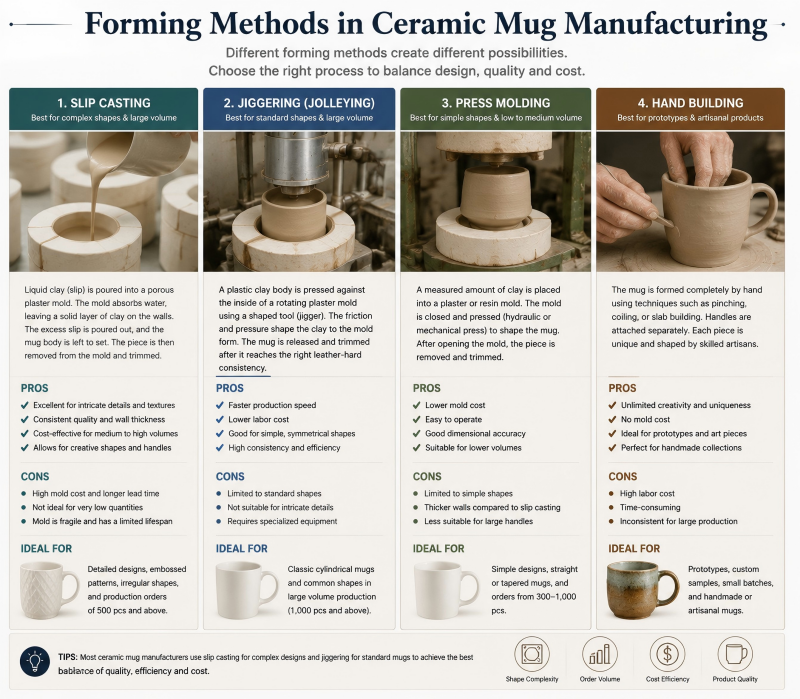
The forming method chosen in the ceramic mug factory process directly impacts design possibilities, tooling costs, and production speed. Slip casting is best for complex or non-symmetrical shapes, jiggering is ideal for high-volume symmetrical mugs, and ram pressing is for uniform, stackable designs.
Dive Deeper: From Design to Reality
The question isn't just "can you make this shape?" The question a professional buyer should ask is, "what is the most cost-effective method to produce this shape at my required volume?" This is a core topic we discuss when clients are deciding between OEM vs ODM Ceramic Mug Production.
H3: Slip Casting: For Unique Shapes and Handles
Slip casting is the go-to method for irregular shapes, intricate textures, and mugs with unique, integrated handles. In this process, liquid clay (slip) is poured into a multi-part plaster mold. The plaster absorbs water, forming a clay shell. Once the wall reaches the desired thickness, the excess slip is poured out.
- Pros: High design flexibility. Allows for complex, non-symmetrical shapes.
- Cons: Slower production cycle. Molds have a limited lifespan and require a higher initial tooling investment.
- Best For: E-commerce sellers with a unique branded shape, character mugs, or designs with sculptural elements.
H3: Jiggering & Jolleying: For High-Volume, Symmetrical Mugs
This is the most common and efficient method for producing classic, cylindrical, or tapered mugs. A lump of plastic clay is placed on a rotating mold, and a shaped tool (the "jigger" for the outside or "jolley" for the inside) presses against it, forming the mug body. The handle is attached separately in a later step.
- Pros: Very fast, efficient, and cost-effective for large runs. High consistency.
- Cons: Limited to radially symmetrical shapes.
- Best For: Wholesalers needing large quantities of standard-shaped mugs, promotional product suppliers, and restaurant chains. The efficiency of this process is a major factor in determining the MOQ for Custom Ceramic Mugs.
H3: Ram Pressing: For Uniformity and Speed
In ram pressing, a slice of clay is placed between two mold halves, and a hydraulic press forces it into the desired shape. This method is excellent for creating very uniform pieces and is often used for stackable mugs or other dinnerware like plates and bowls.
- Pros: High speed and excellent uniformity. Creates dense, strong pieces.
- Cons: Tooling can be expensive. Best suited for simpler, robust shapes.
- Best For: Institutional buyers (hotels, canteens) who need durable, stackable mugs.
Why Are There Two Firing Stages in the Ceramic Mug Production Process?
Buyers often see "firing" as a single step, but they get concerned when they hear about potential defects like cracks or crazing. This can lead to anxiety about the quality of their shipment. The reality is that a controlled, two-step firing process is the key to preventing these very issues.
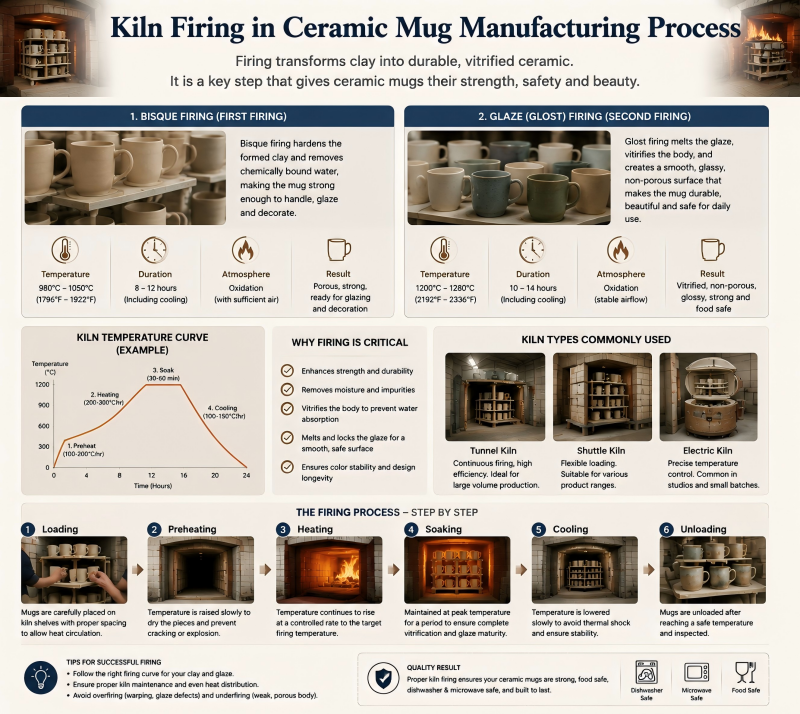
The ceramic mug production process uses two distinct firings to ensure durability and quality. The first, a low-temperature bisque fire, hardens the clay for safe handling and glazing. The second, a high-temperature glost fire, vitrifies the clay and melts the glaze into a seamless, non-porous surface.
Dive Deeper: The Science of Durability
Understanding the "why" behind the two firings is crucial when you Evaluate a Ceramic Mug Factory. A reputable manufacturer will have precise control over this process, which is fundamental to product quality and safety. As an ISO9001 certified factory, our kilns are computer-monitored to ensure every batch meets exact temperature curves.
H3: The Bisque Firing: Creating a Porous "Canvas"
After a mug is formed and dried to a "greenware" state, it is extremely fragile. The first firing, or "bisque firing," heats the mugs to around 1000°C (1832°F). This firing does several important things:
- It burns off any remaining organic materials in the clay.
- It permanently hardens the clay, making it strong enough to be handled without breaking.
- Crucially, it leaves the clay body porous. This porosity is essential for the next step, as it allows the mug to absorb the water-based glaze evenly, creating a uniform coat.
Without a proper bisque fire, applying glaze would be nearly impossible, and the risk of cracking during the final firing would be immense.
H3: The Glost Firing: The Moment of Truth for Quality
After the glaze is applied, the mugs go back into the kiln for the "glost" or glaze firing. This time, the temperature is much higher, corresponding to the maturation point of the clay body (e.g., 1200°C+ for stoneware). This critical firing accomplishes two goals simultaneously:
- Vitrification: The clay particles melt and fuse together, eliminating porosity and making the mug impervious to water. This is what gives a stoneware mug its strength and durability.
- Glaze Maturation: The glaze coating melts and flows into a smooth, glass-like layer that fuses chemically with the clay body.
Improper control during the glost fire is the source of many defects. If cooled too quickly, the glaze can shrink at a different rate than the clay body, causing "crazing"—a network of fine cracks in the glaze. While sometimes used as a decorative effect, unintentional crazing is a serious defect that compromises hygiene and durability.
How Are Glaze and Decorations Applied When Ceramic Mugs Are Manufactured?
A great design is your goal, but you're worried about it fading, chipping, or containing harmful substances. Buyers often ask "is it dishwasher safe?" but they should be asking how the decoration and glaze are applied, as this determines both durability and food safety.
The methods used for glazing and decoration are critical for the mug's final appearance, safety, and longevity. Glaze can be applied by dipping or spraying, while decorations are typically added via screen printing, hand painting, or decal application before the final glost fire to ensure they are permanently sealed.
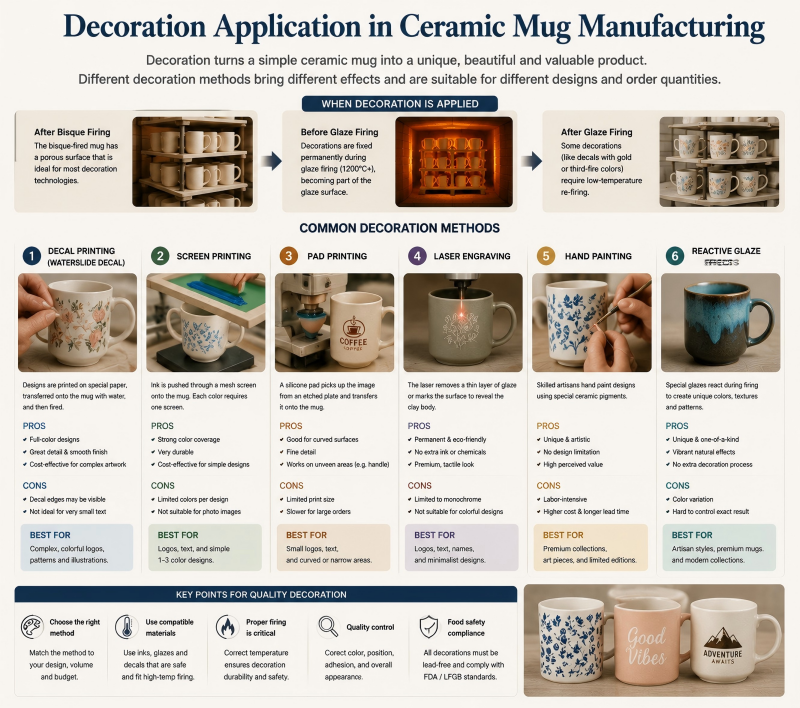
Dive Deeper: Ensuring Beauty, Safety, and Durability
For over 15 years, we've helped e-commerce sellers and wholesalers navigate the complexities of decoration. A common concern is creating a product that is both beautiful and compliant with strict international standards like California Prop 65. This is where a manufacturer's expertise and certifications, like our BSCI and ISO9001, become invaluable. It’s a key part of our service for clients seeking Private Label Ceramic Mug Manufacturing Explained.
H3: Glazing: More Than Just Color
The glaze is a liquid suspension of glass-forming minerals. Its application is a crucial step in the ceramic mug factory process.
- Dipping: The entire mug is dipped into a vat of glaze. This is a fast and efficient method for applying a uniform, all-over color.
- Spraying: Glaze is sprayed onto the mug. This allows for more control, enabling effects like gradients, partial glazing, or applying a different color to the interior versus the exterior.
The most important aspect of glazing is its composition. We exclusively use lead-free and cadmium-free glazes to ensure all our products are food-safe and meet the stringent requirements of our European and American clients.
H3: Decoration Techniques and Their Business Impact
How your logo or design is applied affects its cost, appearance, and durability.
| Decoration Method | Durability | Cost | Design Complexity | Best For |
|---|---|---|---|---|
| Underglaze Printing/Decal | Highest (Permanent) | Medium-High | High (Full color) | Premium retail, long-lasting branding |
| In-glaze Decoration | High | Medium | Medium | Restaurant/hotel use, durable logos |
| Overglaze (Enamel) Decal | Medium | Low-Medium | High (Bright colors) | Promotional items, requires care |
| Sublimation | Low | Low | Highest (Photographic) | Personalized gifts, not dishwasher safe |
For most commercial applications, we recommend underglaze or in-glaze decoration. A decal printed with ceramic pigments is applied to the bisqued mug or the unfired glaze. During the glost fire, the design permanently fuses with the mug, making it impossible to scratch off and completely dishwasher and microwave safe. This is how ceramic cups are made to last.
Frequently Asked Questions
What is the difference between ceramic and porcelain mugs?
Ceramic is a broad category that includes earthenware, stoneware, and porcelain. The main difference lies in the clay composition and firing temperature. Porcelain is made from a finer clay (kaolin) and fired at very high temperatures, making it stronger, less porous, and more translucent than stoneware or earthenware.
How long does the ceramic mug manufacturing process take?
From raw clay to a packed, finished product, the entire ceramic mug manufacturing process typically takes 7 to 10 days. This includes time for forming, drying (which can take 24-48 hours alone), two separate firings (each taking over 12 hours including cooling), glazing, and decoration. Rush jobs are not possible without compromising quality.
Why do some mugs have a small unglazed spot on the bottom?
This unglazed ring, known as the "dry foot," is a necessary part of the manufacturing process. During the high-temperature glost firing, the glaze melts into a glass-like state. If the bottom of the mug were glazed, it would fuse permanently to the kiln shelf. The dry foot prevents this from happening.
Are all custom ceramic mugs dishwasher and microwave safe?
Not necessarily. It depends entirely on the materials and decoration methods used. Mugs made from vitrified stoneware or porcelain with underglaze decorations are almost always dishwasher and microwave safe. Mugs with overglaze metallic elements (like gold or platinum) are not microwave safe. Mugs decorated via sublimation are often not dishwasher safe. Always confirm this with your manufacturer.
Conclusion
Understanding how ceramic mugs are manufactured is more than a matter of curiosity—it's a critical component of successful sourcing. The process is not a monolithic assembly line but a series of crucial decisions. The choice of clay dictates durability, the forming method determines design feasibility, and the firing and glazing techniques ensure the final product is safe, beautiful, and built to last. By grasping these key stages of the ceramic mug manufacturing process, you move from being a price-taker to a strategic partner, empowered to make informed decisions that protect your investment and build your brand.
As an experienced ceramic mug manufacturer, we believe a transparent process leads to a better product. If you're looking for a partner to help you navigate these choices and produce high-quality ceramic mugs for your business, we're here to help. Contact us today to discuss your project, and let our 15 years of expertise work for you.