Sourcing ceramic mugs can feel like navigating a minefield of potential risks. You worry about inconsistent quality, questionable safety compliance, and receiving a shipment that doesn't match the perfect sample you approved. A minor error on the factory floor can cascade into cracked handles, failed lab tests, or an entire batch of off-color products, hurting your brand and your bottom line. Understanding the ceramic mug production process is not just for factory insiders; it's the most powerful tool a B2B buyer has to vet suppliers, mitigate risks, and make informed purchasing decisions. This knowledge transforms you from a price-taker into a strategic sourcing partner.
The complete ceramic mug production process is a multi-stage manufacturing sequence that transforms raw clay into a finished, durable, and decorated product. It begins with raw material preparation and forming, followed by controlled drying and a two-step firing process (bisque and glost). The critical stages of glazing and decoration are next, which determine the mug's final appearance and branding. The entire line is interwoven with quality control checkpoints, concluding with final inspection and packaging before shipment. Each step presents trade-offs that directly impact the mug's cost, durability, safety, and customization potential.
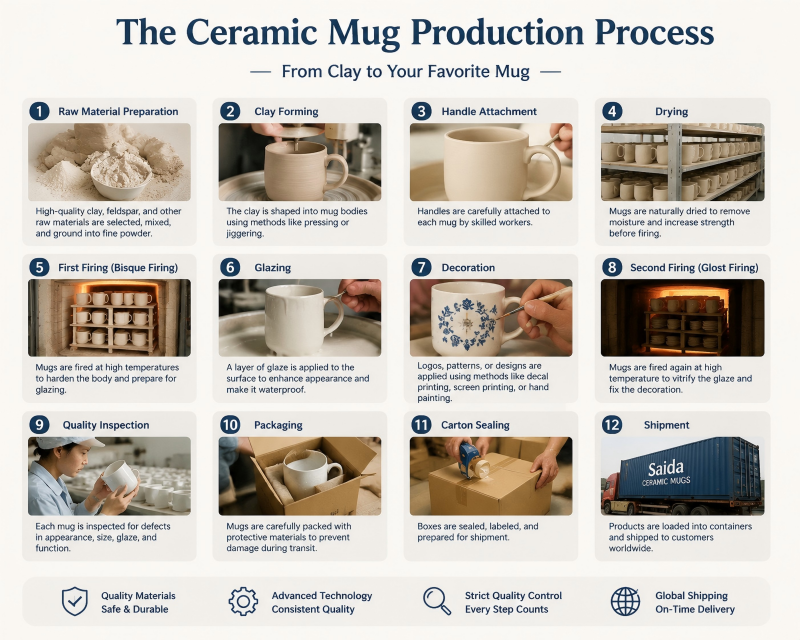
Now that you have a high-level overview, you can see the process is more than a simple list of steps. Each stage is a decision point where a good supplier makes choices that lead to a quality product, and a bad supplier cuts corners. Let's break down each phase to reveal how these decisions impact your business and what questions you should be asking.
How Do Clay and Forming Affect Your Mug's Quality and Cost?
Have you ever wondered why two seemingly identical mugs from different suppliers have vastly different prices and levels of durability? It often feels like a shot in the dark, and you're left questioning if their "high-quality" materials are genuinely better or just marketing buzzwords. The secret lies in the very first stage: the raw materials and forming methods, which create the foundation for either a premium, long-lasting product or a cheap, brittle one.
The specific blend of clays and minerals, along with the method used to shape the mug, directly determines its final weight, strength, heat retention, and unit cost. These initial choices are arguably the most critical in the entire ceramic mug manufacturing process.
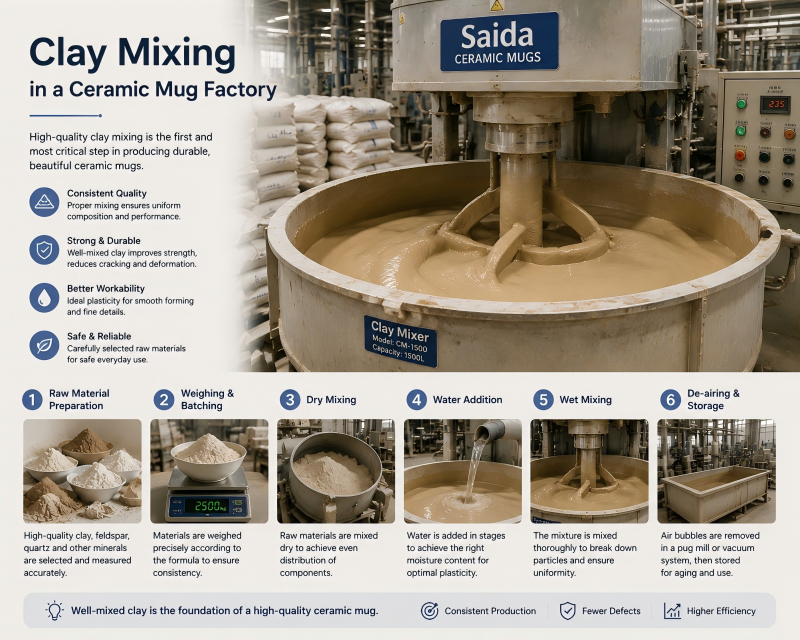
Choosing the Right Clay: A Trade-off Between Cost and Performance
Not all ceramic is created equal. The type of clay used is the single biggest factor in a mug's durability and price point. As an importer, knowing the difference helps you match the product to your market's expectations.
- Earthenware: Fired at the lowest temperatures (around 1000°C), earthenware is porous, less durable, and more prone to chipping. It's often thicker and heavier to compensate but allows for vibrant colors. It is the most affordable option but generally not recommended for heavy daily use.
- Stoneware: This is the workhorse of the mug world. Fired at higher temperatures (1150-1280°C), stoneware is dense, strong, and chip-resistant. It has excellent heat retention. Based on our 15 years of experience exporting, our clients in South America often prefer the heft and durability of stoneware for everyday coffee mugs.
- Porcelain: Fired at the highest temperatures (up to 1300°C), porcelain is made from fine kaolin clay, making it extremely durable, non-porous, and lightweight. Its smooth, white surface is perfect for elegant designs. While it carries a higher cost, it delivers a premium look and feel that is often demanded by our European wholesale clients.
Here is a simple breakdown for B2B buyers:
| Feature | Earthenware | Stoneware | Porcelain |
|---|---|---|---|
| Durability | Low (Prone to chipping) | High (Very durable) | Very High (Strong and chip-resistant) |
| Firing Temp. | ~1000°C | ~1200°C | ~1300°C |
| Porosity | High (Absorbs water if unglazed) | Low / Non-porous | Non-porous |
| Best For | Decorative items, low-cost promos | Everyday use, cafe/restaurant ware | Premium retail, corporate gifts |
| Cost | $ | $$ | $$$ |
Forming Methods: How Shape Dictates Scale and Cost
Once the clay is prepared, it must be shaped. The method used affects not only the shape but also production speed, consistency, and cost.
- Slip Casting: This technique is used for complex or non-symmetrical shapes. Liquid clay (slip) is poured into plaster molds; the plaster absorbs water, leaving a firm clay shell. This is a more labor-intensive process, making it ideal for unique designs but often resulting in a higher unit cost and potentially a higher MOQ to justify the custom mold creation.
- Jiggering & Jolleying: This is a mechanized process used for creating uniform, symmetrical shapes like classic mugs and bowls at high volume. It involves pressing clay against a rotating mold, ensuring high consistency and faster production. This is the go-to method for large orders where consistency is key. An OEM ceramic mug factory China with a modern ceramic mug production line will rely heavily on this for standard shapes.
Your supplier's capabilities in these forming methods will determine the design complexity they can handle and the price they can offer for bulk orders.
What Are the Hidden Risks in the Firing Stage of the Ceramic Mug Production Process?
You've received a large shipment, but upon inspection, you discover a significant percentage of mugs are cracked, warped, or have glaze imperfections. This loss eats directly into your profit margins and creates inventory nightmares. Your supplier might blame shipping, but the real culprit is often hidden much earlier in the ceramic mug manufacturing process: the drying and firing stages.
Improper drying can cause stress fractures that only appear after firing, while incorrect firing cycles can lead to poor durability, glaze defects, and even serious food safety failures. Understanding these risks helps you ask your supplier the right questions to prevent these costly problems before they start.
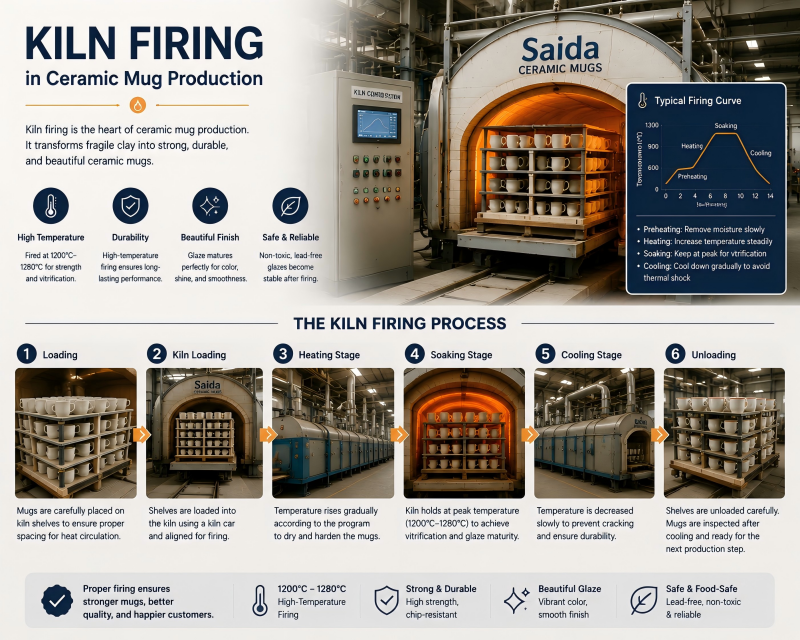
The Critical Drying Phase: Patience Prevents Cracks
Before a mug can be fired, the water added during forming must be removed slowly and evenly. Rushing this stage is a common corner-cutting tactic, but it’s a huge business risk for the buyer. If the outside of the mug dries faster than the inside or the handle, internal stresses develop. These might not be visible on the "greenware" (unfired clay), but they will reveal themselves as cracks during the intense heat of the kiln.
A reliable supplier will have dedicated drying rooms with controlled humidity and airflow, ensuring each mug dries uniformly over several hours. This prevents future losses and is a hallmark of a quality-oriented process.
Bisque Firing vs. Glost Firing: What Buyers Need to Know
Most quality ceramic ware is fired twice. This two-step process is a key indicator of a supplier's commitment to quality.
- Bisque Firing: This is the first firing, typically to a lower temperature of around 950-1060°C. This initial firing transforms the fragile clay into a hard, porous ceramic state called "bisque." The porosity is crucial, as it allows the piece to properly absorb the glaze in the next step.
- Glost Firing (or Glaze Firing): After the glaze is applied, the mug is fired a second time at a higher temperature (up to 1300°C). This melts the glaze into a hard, vitreous, and non-porous layer, giving the mug its glossy finish and durability.
Some low-cost producers use a single-firing process to save time and energy. While cheaper, this method carries a higher risk of defects and can compromise the durability and safety of the final product.
For our clients in the European Union, compliance with food safety regulations like (EC) No 1935/2004 is non-negotiable. This regulation governs materials that come into contact with food, setting strict limits on the migration of lead and cadmium. Proper glost firing is essential to vitrify the glaze fully, locking these heavy metals in and ensuring the mug is safe for daily use. This is a critical QC checkpoint in our ISO9001-certified process.
How Do Decoration Methods Impact Your Custom Mug's Design and Durability?
You’ve developed a beautiful, multi-colored logo that perfectly represents your brand. But when you approach suppliers, you're met with conflicting information: it’s too complex, the cost is too high, or worse, the print will fade or wash off after a few dishwasher cycles. For B2B buyers, the decoration stage is where your brand vision meets manufacturing reality, and making the wrong choice can be a costly mistake.
The decoration method you choose directly impacts your custom mug's durability, color accuracy, final cost, and the Minimum Order Quantity (MOQ). A professional custom ceramic mug manufacturer should be able to guide you through these trade-offs to find the perfect match for your project.
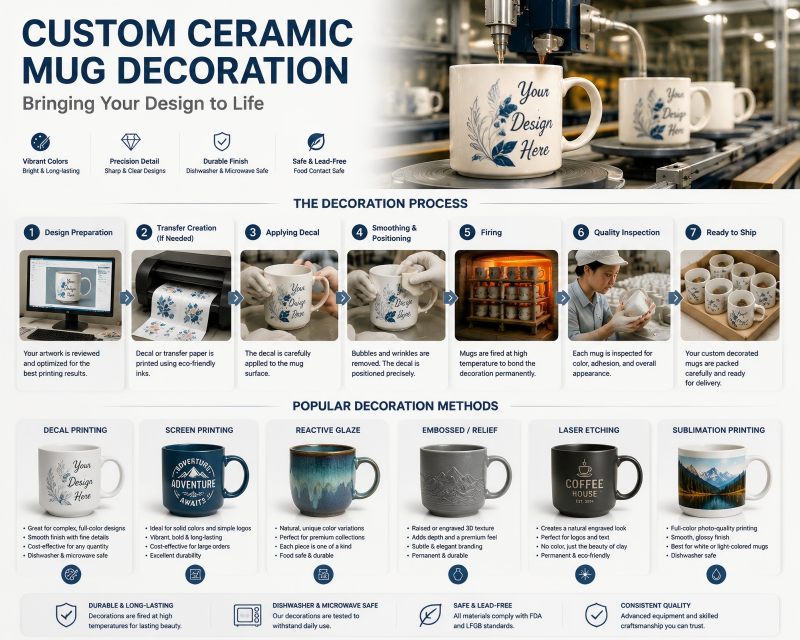
The Foundation: Glazing for Safety and Finish
Before any decoration, the bisque-fired mug is glazed. Glaze is essentially a layer of liquid glass that serves three purposes:
- Waterproofing: It seals the porous ceramic body, making it food-safe.
- Aesthetics: It provides the base color and the smooth, glossy finish.
- Safety: A correctly formulated and fired glaze is critical for food safety.
As a BSCI and ISO9001 certified factory, our number one priority here is safety. We exclusively use lead-free and cadmium-free glazes and conduct regular batch testing to comply with strict EU and US standards. This is a question every importer must ask: "Can you provide recent lead and cadmium test reports for your glazes?"
Comparing Decoration Techniques for B2B Buyers
Choosing the right decoration technique is a balance of durability, design complexity, and cost. Here’s a breakdown of the most common methods:
| Technique | Durability | Best For | Cost/MOQ |
|---|---|---|---|
| Decal Printing | Excellent (Dishwasher/Microwave Safe) | Full-color, photographic images, complex logos. | Higher per unit, often requires 500-1000+ MOQ. |
| Sublimation | Good (Dishwasher safe, but can fade over time) | Full-color prints on specially coated mugs. | Excellent for small runs and personalization. |
| Screen Printing | Good | Simple, bold logos with 1-4 spot colors. | Very cost-effective for large bulk orders. |
| Laser Engraving | Permanent (Indestructible) | Premium, single-color branding on glazed mugs. | Mid-to-high cost, suitable for lower MOQs. |
From my experience, the durability of the decoration is a primary concern for wholesalers. A German client once shared a story about receiving complaints from retailers because the logo on mugs from a previous supplier was peeling after a few months. For this reason, we almost always recommend decal printing for complex, multi-color logos. The decal is applied and then fired onto the mug at high temperatures, fusing it into the glaze for maximum permanence. While sublimation offers vibrant colors, the print sits on a surface coating and can be more susceptible to fading over the product's lifetime. This is the kind of insider knowledge a true OEM ceramic mug factory China partner should provide.
Why Is Continuous Quality Control More Important Than Final Inspection?
Every importer has heard the horror story: the "golden sample" you approved was perfect, but the bulk order that arrived was a mess of inconsistent colors, varying sizes, and unacceptable defects. This inconsistency doesn't just represent a financial loss; it damages your brand's reputation and leads to a wave of customer complaints and returns.
The solution isn't a more rigorous final inspection. The solution is a supplier that integrates quality control throughout the entire ceramic mug production line. A true quality system is a process, not a single event, designed to catch and correct issues at every stage.
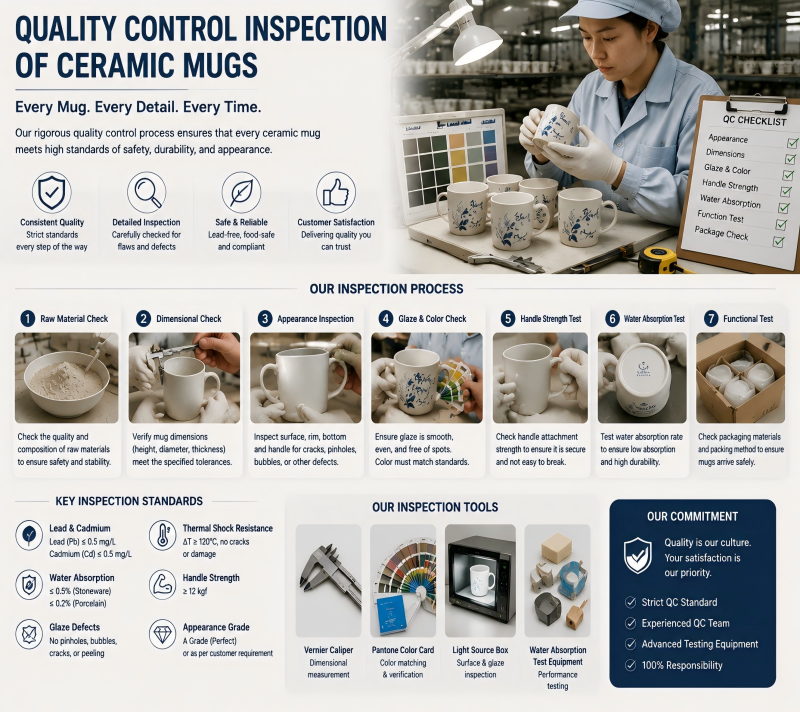
Key QC Checkpoints in the Ceramic Mug Production Process
A reliable factory doesn't wait until the end to find mistakes. At our facility in Liling, our ISO9001 certification mandates a series of checks that are woven into the manufacturing flow. This proactive approach is the only way to ensure consistency across an order of 10,000 units or more.
- Raw Material Inspection: Before a single mug is made, we test incoming batches of clay and glaze. We check for impurities (like iron particles that cause black spots), and ensure particle size and chemical composition are consistent. This prevents batch-to-batch color variation.
- Greenware & Bisque-ware Check: After forming and drying, each "greenware" piece is inspected for shape defects, cracks, or improper handle attachment. Another check occurs after the first bisque firing to catch any stress fractures that have appeared.
- Glaze & Decoration Check: QC technicians monitor glaze viscosity and application thickness to prevent drips or pinholes. For decorated mugs, logo placement and color accuracy are checked against the approved sample before the final firing.
- Final Product Inspection: This is the last line of defense. Every single mug is inspected for cosmetic defects like pinholes, glaze crawling, cracks, or color mismatch. We also perform functional tests, checking for stability and handle strength.
- Compliance Testing: For every major production run, we send samples to an independent lab to test for lead and cadmium release, ensuring compliance with standards like California Prop 65 and EU regulations. This documentation provides the assurance you and your customers need.
Questions Every Buyer Should Ask Their Supplier
To gauge a potential supplier's commitment to quality, move beyond "do you have QC?" and ask specific, process-oriented questions:
- "Can you walk me through your QC checkpoints, from raw materials to packaging?"
- "What is your process for ensuring color consistency across a large and complex decal order?"
- "What is your standard procedure if a defect is found at the bisque-ware stage?"
- "Can you provide your most recent third-party lab reports for lead and cadmium testing?"
- "What is your acceptable quality limit (AQL) for final inspection, and how is it documented?"
Our 15 years of experience exporting to demanding markets in Europe and North America have taught us that this level of process control is not optional—it is the foundation of a reliable sourcing partnership.
Frequently Asked Questions
How long does the ceramic mug manufacturing process take?
The entire process, from preparing the clay to packaging the final product, typically takes between 30 and 60 days. This timeline depends on the complexity of the design, the chosen decoration method, and the order quantity. The drying and firing stages alone require several days of carefully controlled conditions to ensure durability and prevent defects.
What is the MOQ for custom ceramic mugs?
The Minimum Order Quantity (MOQ) for custom mugs varies significantly based on the factory and the level of customization. For standard shapes with a simple printed logo, MOQs can range from 500 to 3,000 pieces. For fully custom shapes or complex decal decorations that require new molds and specialized setups, the MOQ is often higher, typically starting around 1,000 to 3,000 units.
What's the difference between stoneware, porcelain, and earthenware mugs?
The main differences are durability, porosity, and cost, which stem from the type of clay used and the firing temperature. Earthenware is fired at the lowest temperature, making it the most porous and least durable. Stoneware is fired at a higher temperature, resulting in a dense, durable, and non-porous mug ideal for daily use. Porcelain is fired at the highest temperature, making it extremely strong, lightweight, and non-porous with a premium feel.
Are all ceramic mugs microwave and dishwasher safe?
Not necessarily. A mug's safety in the microwave and dishwasher depends on the type of ceramic and the decoration method. Most stoneware and porcelain mugs are inherently microwave and dishwasher safe. However, mugs with metallic decorations are not microwave safe. The durability of printed designs varies; decals fired into the glaze are very durable, while some sublimation or on-glaze prints may fade with repeated harsh dishwasher cycles. Always confirm these specifications with your manufacturer.
Conclusion
Understanding the ceramic mug production process is far more than an academic exercise; it's a strategic framework for making better sourcing decisions. As we've seen, every stage—from the choice of clay and forming method to the intricacies of firing and decoration—is a trade-off between cost, durability, aesthetics, and safety. A cheap mug is often the result of cutting corners in unseen steps like slow drying or proper glaze firing, leading to business risks like cracked inventory and compliance failures down the line. By knowing what happens on the ceramic mug production line, you can move from discussing price to discussing value.
The key is to partner with a manufacturer who is transparent about their processes and invested in quality at every step. A supplier should be able to explain why they recommend stoneware over earthenware for your specific market, detail the dishwasher-safe durability of their decal printing, and provide the certification to prove their products are food-safe. This insight empowers you to ask the right questions, identify potential risks, and build a resilient supply chain.
As an OEM ceramic mug factory China with 15 years of experience helping wholesalers and e-commerce sellers in Europe and South America navigate these complexities, we believe in building partnerships through transparency and expertise. If you're looking to source high-quality ceramic mugs with confidence, contact us today to discuss your next project.