The first step to understanding how ceramic mugs are made is realizing you are navigating trade-offs, not a fixed recipe. Buyers often feel overwhelmed by jargon and hidden risks. Costs creep, finishes vary, and compliance can derail timelines. I will map the manufacturing choices to business outcomes so you can buy with confidence.
Ceramic mugs are made through a controlled sequence of clay body selection, forming, drying, bisque firing, glazing/decoration, and high-temperature firing, followed by inspection and packing. Each choice—material, forming method, glaze, kiln schedule—changes unit cost, durability, appearance, and compliance. Ask targeted questions at each stage to manage quality, MOQs, and timelines.
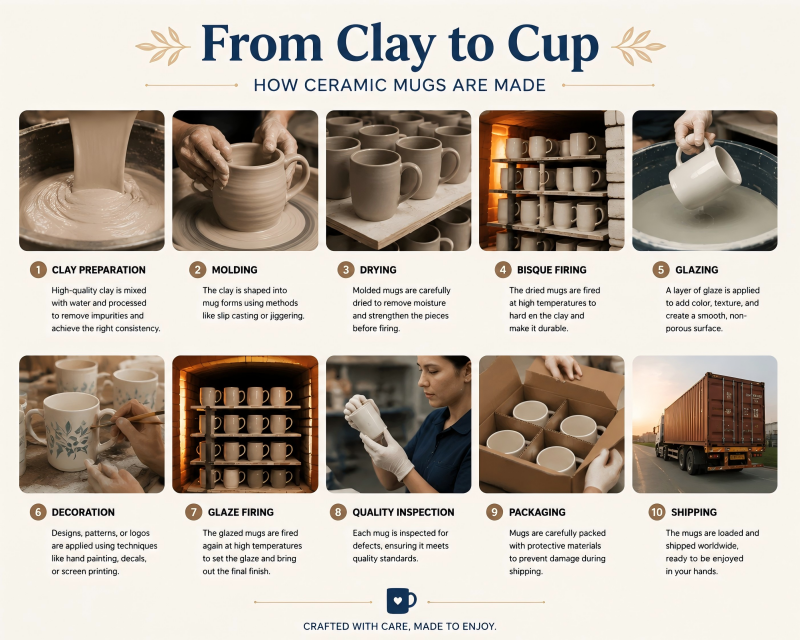
If you just need a quick overview, the snippet above is the 10,000-foot view. But the real leverage comes from knowing which dials to turn—and what to ask suppliers—at each step. Let me show you where buyers win or lose in the ceramic mug production process.
Which clay body choice shapes how ceramic mugs are made and priced?
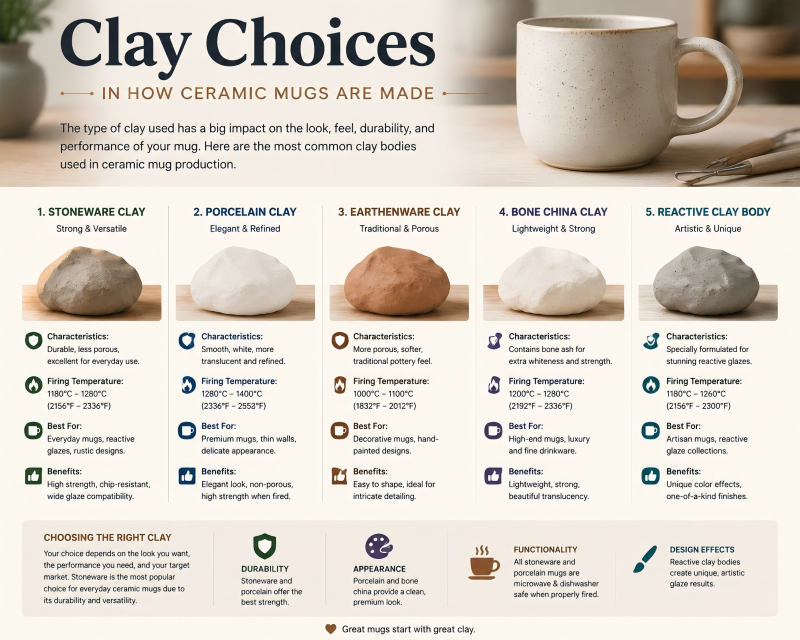
Buyers often assume “ceramic is ceramic.” The problem is that clay bodies behave differently in the kiln and on your balance sheet. If you ignore clay choice, you risk stains, chipping, or higher returns. The solution is to align clay chemistry with your market—porcelain for premium, stoneware for durability, or hybrid blends for cost.
A practical answer: porcelain offers high whiteness and a premium feel but costs more; stoneware offers strength and a handcrafted look with lower cost; earthenware lowers cost further but increases porosity and chipping risk. Choose the clay body based on your brand position, expected use, and claims like dishwasher/microwave safe.
Dive deeper: translating clay chemistry into business outcomes
- Clay body determines firing temperature, vitrification (how non-porous the mug becomes), weight in hand, and achievable whites.
- In our ceramic mug manufacturing process in Liling, we mainly run stoneware and porcelain for export orders because they meet durability and safety expectations in the US, EU, and South America.
Key comparison:
| Clay body | Typical firing peak | Whiteness | Durability | Porosity | Unit cost impact | Typical use cases |
|---|---|---|---|---|---|---|
| Porcelain | 1280–1320°C | High | High | Very low | +$0.20–$0.40 vs stoneware | Premium retail, corporate gifts |
| Stoneware | 1200–1260°C | Medium | High | Low | Baseline | Coffee shops, private label ceramic mugs |
| Earthenware | 1040–1140°C | Low–Med | Medium–Low | Medium–High | -$0.10–$0.20 vs stoneware | Promo giveaways, short-life campaigns |
Business translations:
- Vitrification = non-porous and stain-resistant. Stoneware/porcelain reduce coffee/tea staining and improve dishwasher durability.
- Whiteness affects color accuracy for pad prints and decals. Porcelain is best if brand color matching is critical.
- Cost deltas look small per unit, but at 10,000 units, a $0.25 difference is $2,500. Decide early.
Questions to ask your ceramic mug supplier:
- Which clay body will you use and why for my application?
- What water absorption rate do you guarantee after final firing (<0.5% for stoneware is common for better durability)?
- Can I see third-party test reports for absorption and lead/cadmium migration on that clay+glaze system?
Anecdote: A European café chain asked us for “porcelain” for look and feel, but dishwasher tests showed our high-white stoneware performed the same for their needs and saved €0.22 per unit. We documented water absorption and thermal shock to give them confidence.
How do forming methods decide how ceramic mugs are made at scale?
Even with the right clay, the forming method can make or break your budget and lead time. Poor choices lead to warped rims, heavy mugs, or slow output. The simple fix is to match forming technology to your target volume, tolerance needs, wall thickness, and handle style.
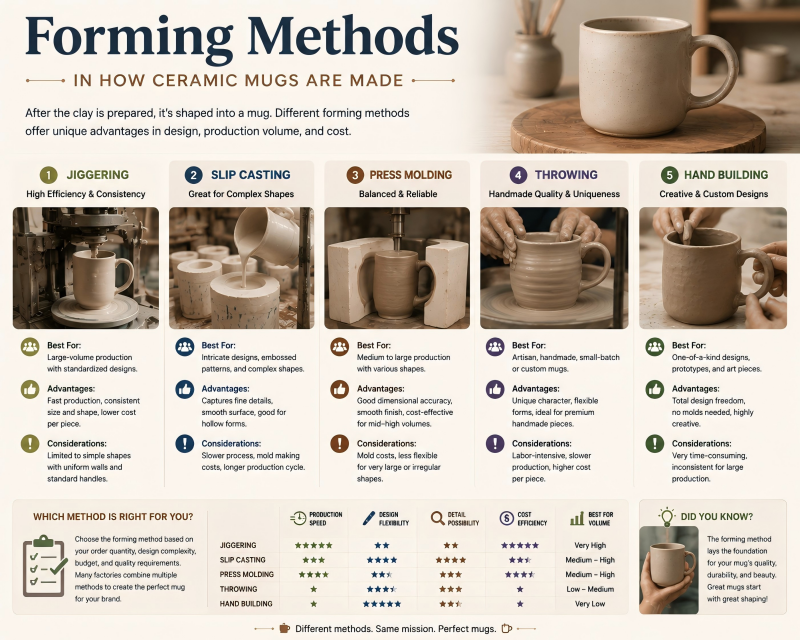
Slip casting suits complex shapes and small to medium MOQs but is slower; jiggering/roller forming excels at round mugs with tight tolerances and high throughput; pressure casting bridges the gap for certain shapes. For 3,000+ units of a classic 11–15 oz mug, jiggering is usually the best value.
Dive deeper: slip casting vs. jiggering vs. pressure casting
- Slip casting: liquid clay poured into plaster molds; good for complex geometries, handles with intricate profiles, and lower tooling costs per new shape.
- Jiggering/Roller forming: a rotating mold shapes the inside while a tool shapes the outside; highly efficient for standard round mugs and consistent wall thickness.
- Pressure casting: resin molds under pressure; faster than slip casting, higher tooling cost, excellent consistency for certain designs.
Forming method comparison:
| Method | Best for | Typical MOQ | Speed | Tolerances | Unit cost | Notes |
|---|---|---|---|---|---|---|
| Slip casting | Complex shapes, low volume | 500–1,500 | Slow | Medium | Higher | Flexible, but drying time adds variability |
| Jiggering | Round mugs 11–16 oz | 2,000+ | Fast | Tight | Lower | Ideal for wholesale ceramic mugs factory runs |
| Pressure casting | Specialty shapes | 2,000–5,000 | Medium | Tight | Medium | Higher tooling, good repeatability |
Buyer signals:
- New custom shape? Ask for a one-time tooling quote and sample timeline. Tooling for jiggering might be $800–$1,500, amortized over volume.
- Weight targets matter. If your Amazon reviews complain about “too heavy,” request weight and capacity SPC charts from sample to pilot run.
- For OEM ceramic mug manufacturing, confirm whether the supplier owns the forming equipment in-house or outsources. In-house usually means better control and shorter lead times.
Related reading: compare development models in OEM vs ODM Ceramic Mug Production.
What firing schedule ensures how ceramic mugs are made to be durable?
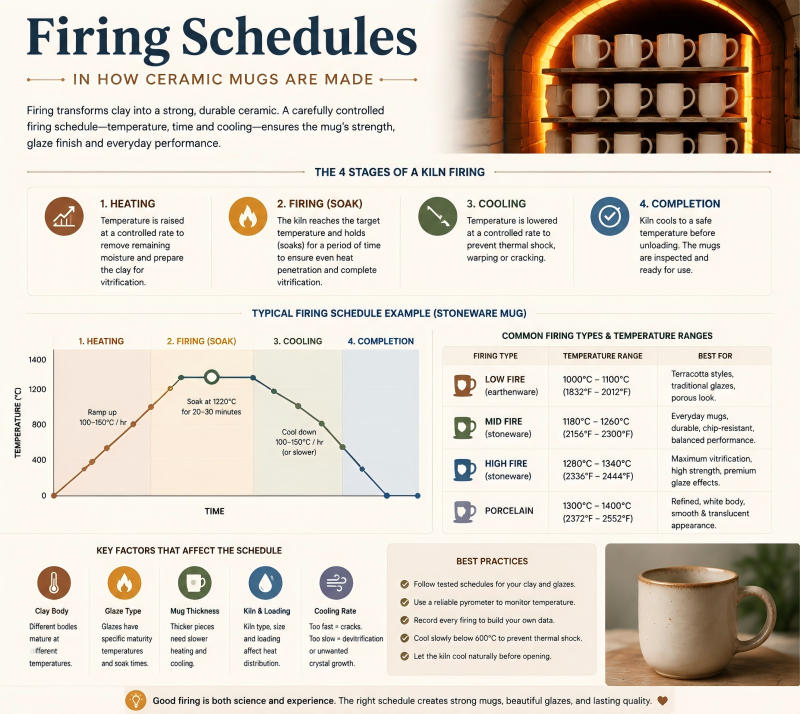
Firing is where many quality issues are baked in—literally. Under-fired mugs absorb water and stain; over-fired mugs can warp or pinhole. You need the right bisque and glaze firing profile for dimensional stability and glaze fit.
A two-stage firing is standard: a bisque firing (to drive off moisture and strengthen the body for glazing) and a glaze firing (to mature the body and fuse the glaze). For stoneware, a final peak of 1200–1260°C usually delivers a non-porous, chip-resistant result suitable for daily use.
Dive deeper: from bisque to vitrification, in buyer language
- Bisque firing: typically 950–1060°C. Business outcome: easier to handle in glazing and better decal adhesion later. Think of it as “prepping the surface” in the ceramic mug production process.
- Glaze firing: 1180–1320°C depending on body. Business outcome: vitrified structure (non-porous) and a smooth, sealed surface that resists stains and odors.
What to verify:
- Kiln data logs: ask for sample kiln charts (peak temp, soak time, cooling curve). A reliable ceramic mug manufacturer in China can provide real batch records.
- Water absorption test: demand <0.5% for stoneware if you want restaurant-grade durability.
- Thermal shock test: 180°C to 20°C water, 3 cycles without cracking is a good benchmark for café and home use.
A practical check: run your own QA on first shipment. We pull random mugs, weigh dry, boil for 2 hours, cool, reweigh, and calculate absorption. Simple, reproducible, and a strong indicator of how mugs are manufactured in reality—not just on paper.
For more on how to assess plants, see How to Evaluate a Ceramic Mug Factory.
How do glaze and decoration choices affect how ceramic mugs are made and certified?
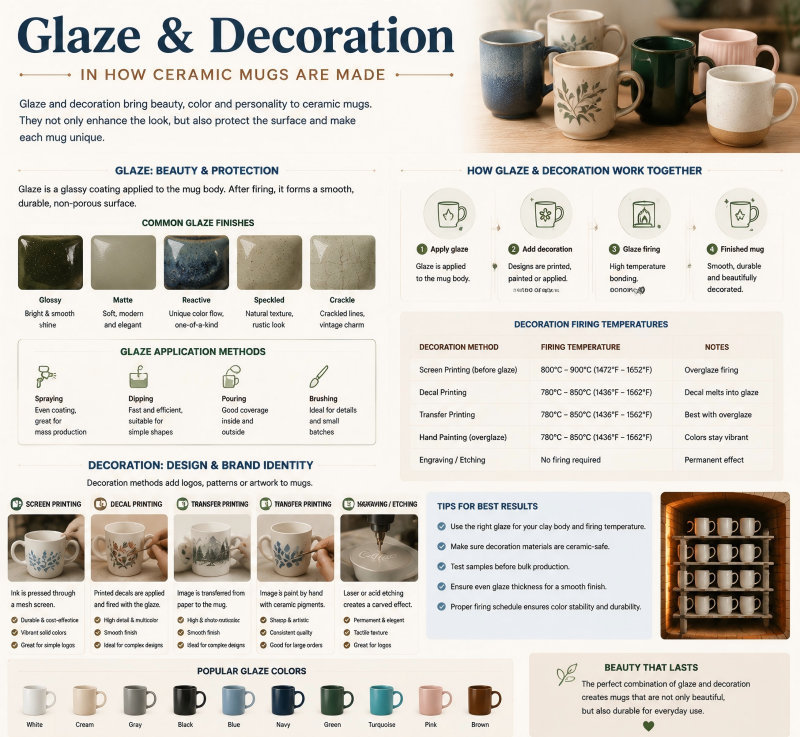
Glazes and graphics are not just aesthetics. The wrong system can fail dishwasher tests or trigger non-compliance on lead/cadmium migration. That risk grows when decoration approaches your “lip area.” The fix is to choose glaze systems and decoration methods that match your brand claims and legal requirements.
Reactive glazes look artisanal but vary batch-to-batch; solid glazes and pad printing are stable and low MOQ; decals offer full-color branding but require controlled firing and testing. For strict food-contact zones, keep decorations 20 mm below the rim unless you have proven migration results.
Dive deeper: aesthetic choices with compliance consequences
Decoration methods:
- Pad printing: cost-effective for 1–3 spot colors; good dishwasher resistance when cured properly; lower MOQs (often 300–1,000).
- Waterslide decals (on-glaze/in-glaze): full-color logos and photos; in-glaze firings embed color better; typical MOQs 500–3,000 depending on size/complexity.
- Heat transfer decals: efficient for large runs; consistent placement; similar compliance considerations.
- Sublimation-ready mugs: coated blanks for small-batch, late-stage customization; great for e-commerce, but note the polymer coating is different from standard glazes and has its own heat/dishwasher tolerances.
Compliance checkpoints:
- Food safety: US FDA, EU LFGB, and CA Prop 65 lead/cadmium migration tests. Ask for batch-specific or glaze-system-specific reports from SGS/Intertek/BV before mass production.
- Durability: Request dishwasher test results (e.g., 500-cycle simulation) and microwave safety statements validated by thermal shock tests.
- Rim distance: If your logo approaches the lip area, require a targeted migration test on a worst-case sample.
MOQs and cost cues:
- Pad printing adds ~$0.05–$0.15 per color per side.
- Decals can add $0.10–$0.25 per large placement, depending on color coverage and firing cycle.
- Reactive glaze often demands higher scrap allowances; confirm your supplier’s plan for yield and color variance tolerance.
Anecdote: An e-commerce client asked for a big wraparound decal including the rim. We advised moving the design 2 cm lower or switching to in-glaze decals with extra firing and testing. They chose the move-lower option, saved $0.10/unit, and passed EU LFGB on the first try.
If you are mapping brand pathways, see Private Label Ceramic Mug Manufacturing and MOQ for Custom Ceramic Mugs.
When should you inspect, and what data shows how ceramic mugs are made consistently?
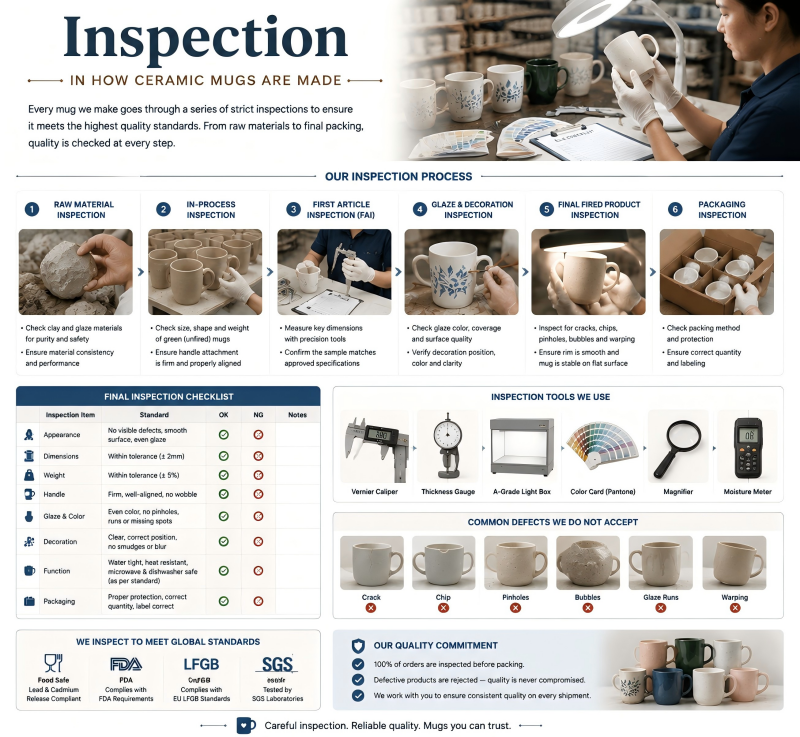
Many buyers trust a golden sample but skip process controls. The risk is shipment-to-shipment drift: weight, capacity, or color variation that triggers returns. The fix is to set checkpoints aligned to the ceramic mug factory process—clay prep, greenware dimensions, bisque, glaze, and post-firing QC.
Run pre-production approval, in-process checks, and final AQL inspection. Ask for SPC charts for weight and capacity, kiln batch logs, and glaze thickness checks. At final, use AQL 2.5/4.0 with functional tests: handle pull, thermal shock, and dishwasher cycles.
Dive deeper: a buyer’s QC roadmap
Three-stage control:
-
Pre-production
- Approve clay body, glaze swatches, and print colors (Pantone cards).
- Request sample with measured dimensions, weight, and capacity; confirm tolerance (e.g., ±20 g weight, ±30 ml capacity).
- For custom ceramic mug production, lock a tolerance table in your PO.
-
In-process (during ceramic mug manufacturing process)
- Greenware checks: rim roundness, handle alignment before bisque.
- Bisque spot checks: warpage gauge; dimensions often shrink 10–12%—confirm against your spec.
- Glaze: measure thickness and coverage; inspect foot ring smoothness to avoid table scratches.
-
Final inspection
- AQL: Common plan is II, Critical 0, Major 2.5, Minor 4.0.
- Handle pull: 10 kg for 10 seconds without crack.
- Thermal shock: 3 cycles 180°C to 20°C.
- Dishwasher test: accelerated 100 cycles minimum for everyday retail; cafés may request 500-cycle lab simulation.
- Migration tests: confirm report references your exact glaze/decal system and firing profile.
Data to request:
- Kiln log screenshot with peak, soak, and thermocouple locations.
- SPC charts (weight/capacity) from a 125-piece pilot run.
- Color delta E report if you need precise brand color control.
A reliable supplier can explain why each parameter matters for your use case—restaurant turnover, promotional gift, or long-life retail. In our ISO9001 and BSCI-audited plant in Liling, we use these same controls to keep Amazon return rates under 1.5% for our private-label partners.
What MOQ, lead time, and cost signals should buyers expect?
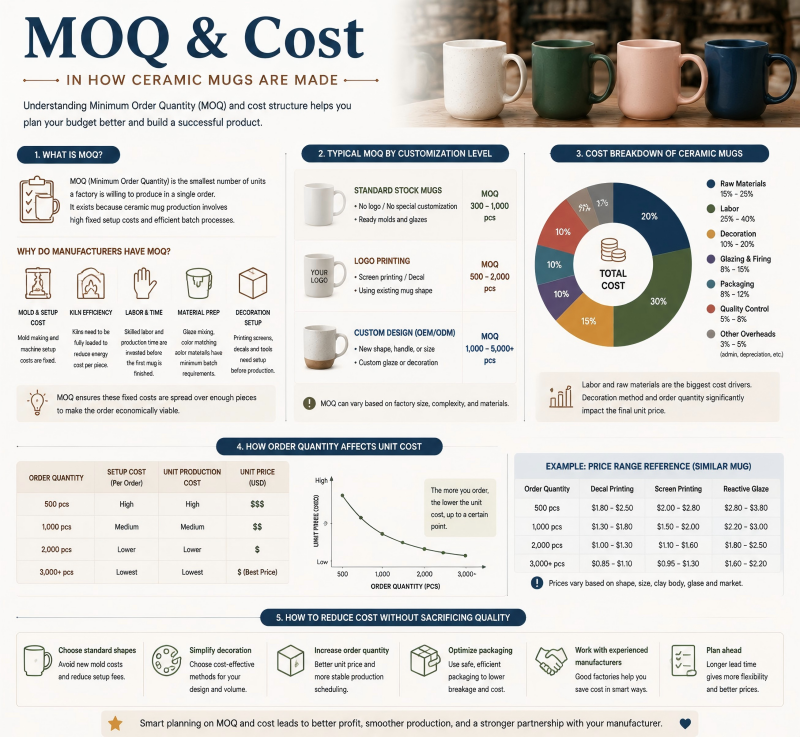
Even the best design fails if the economics do not work. Buyers often underestimate MOQs tied to forming, glaze, and decoration, or forget packaging and freight. The fix is to map each cost driver and lock a realistic timeline.
Standard white stoneware mugs can run at 500–1,000 MOQs; custom colors and decals usually start at 1,000–3,000. Typical lead time is 30–45 days after sample approval, longer in Q3–Q4. Total landed cost includes clay body, forming, decoration, packaging, and freight/duties.
Dive deeper: a practical cost and timeline model
Common MOQs:
- Stock white mugs: 500–1,000 units.
- Custom glaze color: 1,500–3,000 units (glaze batch minimums drive this).
- Decals/wraps: 1,000–3,000 units (print runs and setup).
- New shape (OEM ceramic mug manufacturing): 2,000+ plus tooling.
Typical timeline (working days):
- Tooling or custom shape: 10–15 days
- Samples: 7–10 days after tooling
- Production: 25–30 days
- Buffer for third-party tests: 5–7 days
Cost components (illustrative deltas vs a baseline stoneware white 11 oz mug):
- Clay body upgrade to porcelain: +$0.20–$0.40
- Reactive glaze: +$0.10–$0.25 and +1–3% scrap risk
- Pad print (per color/side): +$0.05–$0.15
- Full-wrap decal: +$0.10–$0.25
- Packaging (color box vs bulk): +$0.20–$0.40
- Ocean freight (volume-dependent): +$0.07–$0.20 per unit
- Duties/taxes: confirm with your broker under HS 6912; rates vary by market
To sharpen your pro forma, see our detailed guide: Ceramic Mug Cost Breakdown.
Negotiation tips:
- Ask for price breaks at 3k/5k/10k units; forming and firing efficiency improves with size.
- Confirm peak season capacity. A good ceramic mug supplier will be transparent about kiln space in Q3–Q4.
- If you need flexibility, consider a program with rolling POs against a blanket forecast, especially for private label ceramic mugs.
Anecdote: A South American wholesaler split a 12,000-unit plan into three releases. We pre-produced white bodies and fired in batches, then applied just-in-time decals. They gained flexibility without paying for expedited air shipments.
Frequently Asked Questions
Do I need porcelain, or is stoneware enough for a premium brand?
For most premium brands, high-white stoneware delivers comparable durability to porcelain with a friendlier cost. Choose porcelain if ultra-white color accuracy or translucency is vital. Otherwise, stoneware typically achieves <0.5% water absorption and excellent dishwasher performance at a lower unit cost.
What decoration holds up best in dishwashers and microwaves?
In-glaze decals and well-cured pad prints on mature stoneware glazes perform best. Keep designs away from the lip area if possible. Request 100–500 cycle dishwasher simulations and thermal shock tests. For microwave claims, ensure metal-free decorations and verify no arcing in real-use tests.
How can I control color variation with reactive glazes?
Set a tolerance with physical master tiles and agree on acceptable variance bands. Require kiln batch records and pre-shipment photos under D65 lighting. If strict consistency is essential, switch to solid glazes or decals. Reactive glazes are beautiful but inherently variable.
What MOQ should I expect for custom logo mug manufacturer projects?
For a custom logo on a standard shape, MOQs of 500–1,000 for pad print and 1,000–3,000 for decals are common. New shapes or special glazes push MOQs higher. If your volume is lower, consider sublimation blanks or pooled runs with a wholesale ceramic mugs factory.
How do I evaluate a ceramic mug manufacturer China for compliance?
Ask for ISO9001 and social audits like BSCI. Request recent FDA/LFGB/Prop 65 test reports matched to your exact glaze/decal system and firing schedule. Review AQL procedures, kiln logs, and SPC samples for weight/capacity. Visit if possible, or appoint a third-party auditor.
Conclusion
When you understand how ceramic mugs are made, you can turn technical choices into commercial advantages. Clay body, forming method, firing profile, and decoration all shape cost, durability, compliance, and brand feel. Use the checklists and questions above to de-risk your next order. If you want a second opinion on specs or testing plans, reach out—I am happy to review your brief and share sample QC templates.