The types of ceramic used in mug manufacturing determine your cost, durability, and customer perception more than any other variable. Many buyers chase the “best” material and get stuck. The real problem is matching ceramic choice to your target market and margins. I help customers balance those trade-offs every day.
The main types of ceramic used in mug manufacturing are stoneware, porcelain, bone china, new bone china, and earthenware. None is universally “best.” Each offers a distinct mix of cost, durability, weight, and look. Buyers should choose the material that aligns with their brand positioning, usage case, and price targets to minimize risk and maximize profit.
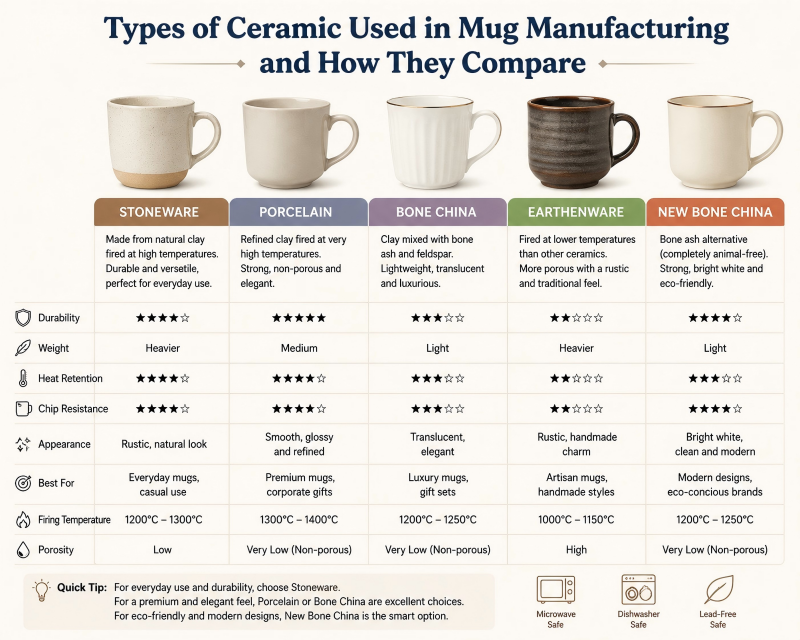
You will find a quick summary above, but the details matter. In the sections below, I explain how the types of ceramic used in mug manufacturing affect unit price, shipping weight, chip resistance, and brand feel—so you can ask suppliers smarter questions and avoid costly mistakes.
How do the types of ceramic used in mug manufacturing impact cost and margins?
You want a beautiful mug at the right landed cost. The concern is that a premium-looking finish can quietly inflate unit price, defect risk, and freight. The solution is to compare ceramics by their business impact—raw materials, firing energy, yield rates, and shipping weight—before you lock your spec.
A clear rule of thumb: stoneware offers the lowest entry cost and forgiving production; porcelain balances cost with a refined look; new bone china gives a premium feel without bone ash prices; traditional bone china signals luxury but raises cost and handling demands.
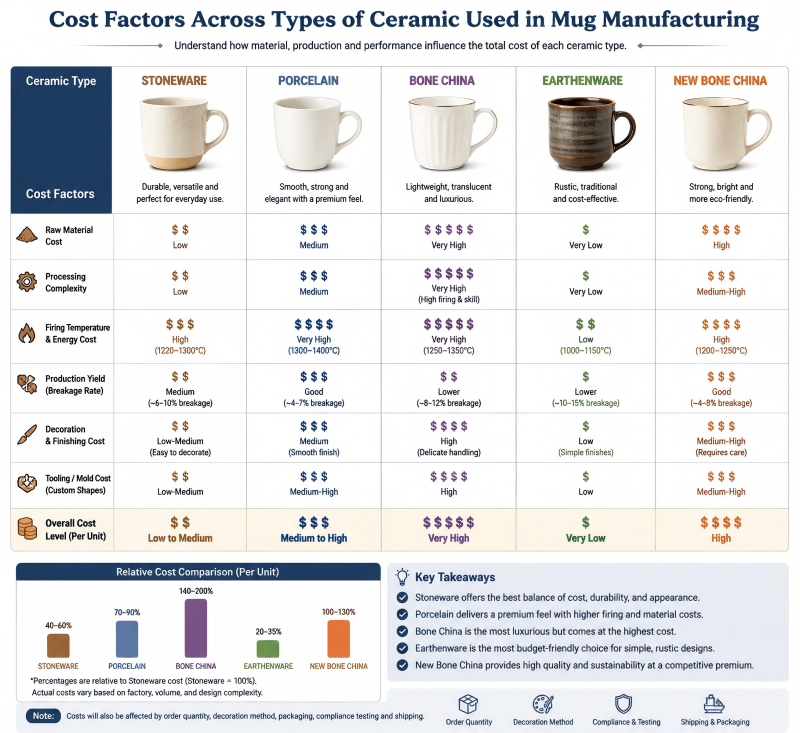
Cost drivers you can actually manage
When customers ask about “wholesale ceramic mug materials,” I walk them through the levers that hit margins:
- Raw material blend and price stability
- Firing temperature and fuel/electricity consumption
- Single-fire vs double-fire cycles (time and yield)
- Defect rates (warpage, pinholes, glaze crawl)
- Thickness and weight (affects freight and customer feel)
- Finishing complexity (matte glazes, decals, metallic rims)
- Packaging density and protection needs for each material
Below is a simplified range for a plain 11–12 oz white mug, ex-works, based on typical high-volume runs I’ve quoted. Prices vary by glaze, finish, and order size, but ranges illustrate the trade-offs:
| Material | Typical Firing Temp (°C) | Approx. Ex-Works Range (USD) | Weight (11–12 oz) | Look/Perception | Notes for Buyers |
|---|---|---|---|---|---|
| Earthenware | 1050–1150 | 0.70–1.10 | Heavier | Rustic, porous if under-fired | Budget promos; check water absorption |
| Stoneware | 1200–1300 | 0.95–1.60 | Medium–Heavy | Solid, cafe-style | Good chip resistance, versatile |
| Porcelain | 1250–1400 | 1.30–2.20 | Medium | Smooth, refined, less porous | Great for retail/e‑comm |
| New Bone China | 1200–1250 | 1.60–3.00 | Light–Medium | Creamy white, premium feel | Premium brand without bone ash |
| Bone China | 1200–1250 (dual-fire) | 2.50–5.00+ | Light | Translucent, luxury | Highest cost, careful handling |
Three margin tips I give first-time importers:
- If your business is promotional giveaways, stoneware usually wins on cost resilience and production speed.
- For retail brands that want upscale on Amazon, new bone china often reads as “premium” without traditional bone china margins.
- Watch shipping: heavier mugs increase ocean and last-mile cost by 5–15% versus lighter options at the same carton count.
Stoneware vs porcelain mugs: which fits your market positioning?
The question behind “stoneware vs porcelain mugs” is not chemistry—it is customer expectation. Buyers fear choosing a ceramic that feels “off” for their brand. The solution is to map the look and weight in-hand to your audience’s price anchor and taste.
If your customers want cafe solidity and matte textures, stoneware is a safe choice. If they want refined gloss, slimmer walls, and crisp white, porcelain aligns better. Both are durable for daily use if the glaze and firing are right.
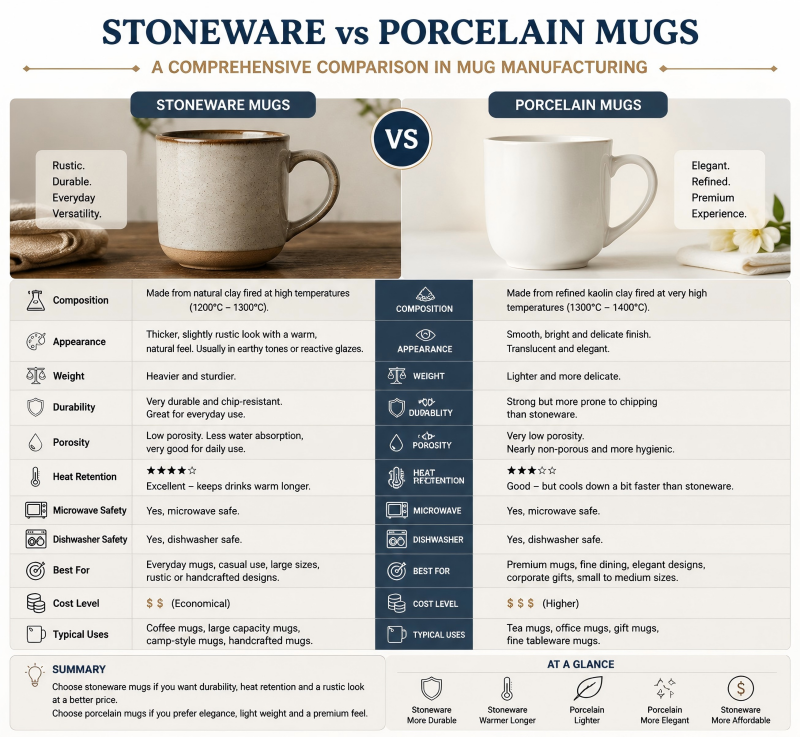
How I guide buyers on brand fit
I often ask two short questions: 1) Do you want the mug to feel substantial or refined in the hand? 2) Will your product photos rely on a bright white or a warm/earthy tone?
From there:
-
Choose stoneware when:
- Your audience loves the “coffee shop” vibe.
- You plan matte or reactive glazes that benefit from slightly thicker walls.
- You need robust chip resistance for daily banging around a sink.
- Your price point sits in entry to mid retail or promo.
-
Choose porcelain when:
- You want a smooth, high-gloss finish and a crisp white that photographs clean.
- Your brand voice leans minimal, Scandinavian, or modern.
- Your customers prefer a lighter, balanced feel over heft.
- You want consistent sizing for stackable cafe sets.
For “best ceramic for coffee mugs,” the honest answer is context. Café chains often pick stoneware for thermal mass and durability. Design-forward DTC brands lean porcelain for visual polish. Both can be microwave and dishwasher safe if properly vitrified and glazed.
Which types of ceramic used in mug manufacturing deliver durability for HoReCa buyers?
Hospitality buyers want mugs that survive years of dishwashers and clangs. The fear is that a beautiful mug chips fast or crazes under heat. The solution is to pick ceramics and designs that score well on real durability measures, not just names.
For HoReCa, high-fired stoneware and porcelain with low water absorption (<0.5%) and strong rims outperform in the long run. Look for rolled rims, thick handles, and stackable foot rings to resist edge chips and reduce breakage.
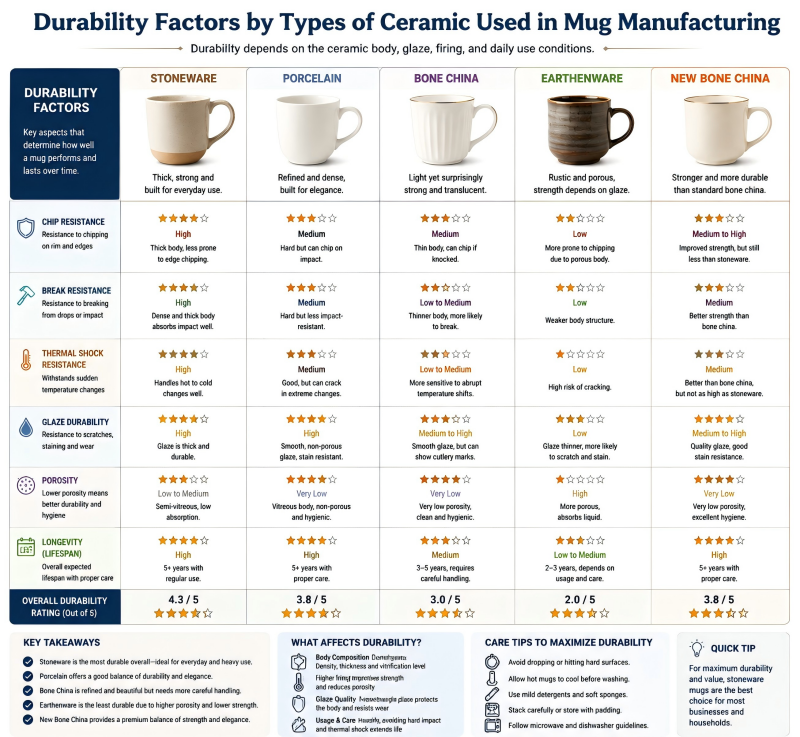
Durability metrics that matter (and why)
A common question we get from first-time importers is, “Is it dishwasher safe?” Here is the check-list I use for durability-focused orders:
- Water absorption: Aim for ≤0.5% to ensure vitrification. Why it matters: less odor absorption, fewer stains, lower microbial risk, and better freeze/thaw resistance for logistics.
- Edge chip resistance: Request edge-chip test results or at least rolled/strengthened rims. Why it matters: fewer chips mean fewer replacement cycles in cafes.
- Thermal shock resistance: Look for successful testing around ΔT 120°C or more. Why it matters: mugs go from hot rinse to room temp quickly.
- Dishwasher resistance: Ask for 500–1,000 cycle test outcomes to EN 12875 or similar. Why it matters: glaze and decals should not fade or roughen.
- Handle strength: ASTM/EN style handle pull tests. Why it matters: handles are the first failure point.
Design and material work together:
- Stoneware: Dense and forgiving; great for stackable mug lines with foot-ring geometry that reduces rim-to-rim impact.
- Porcelain: Slightly lighter with good chip resistance if rims are designed correctly. We often specify a subtle rolled rim for cafe sets.
- New bone china: Durable for home use; in heavy-duty HoReCa, it can work but usually needs thoughtful rim shaping and thicker walls.
Practical spec tips I share with HoReCa buyers:
- Target 3.0–3.5 mm rim thickness for daily service mugs.
- Choose glazes rated for industrial dishwashers; avoid soft matte glazes in heavy service unless tested.
- Use undecorated interior surfaces or high-grade underglaze decals to avoid wear in contact areas.
The result is fewer warranty claims and a lower total cost of ownership for your clients, which strengthens reorders and long-term contracts.
What should you verify beyond names when choosing ceramic mug materials?
Material labels can mislead. Buyers worry that “porcelain” from one factory does not match another’s. The solution is to verify process and performance, not just the name, and to request documentation that matches your market’s compliance requirements.
Ask for firing temperatures, absorption rates, and glaze compliance. Check lead/cadmium migration reports (FDA/Prop 65, EU) and dishwasher/microwave testing. Inspect for pinholes, crawling, crazing, and color consistency under D65 light.
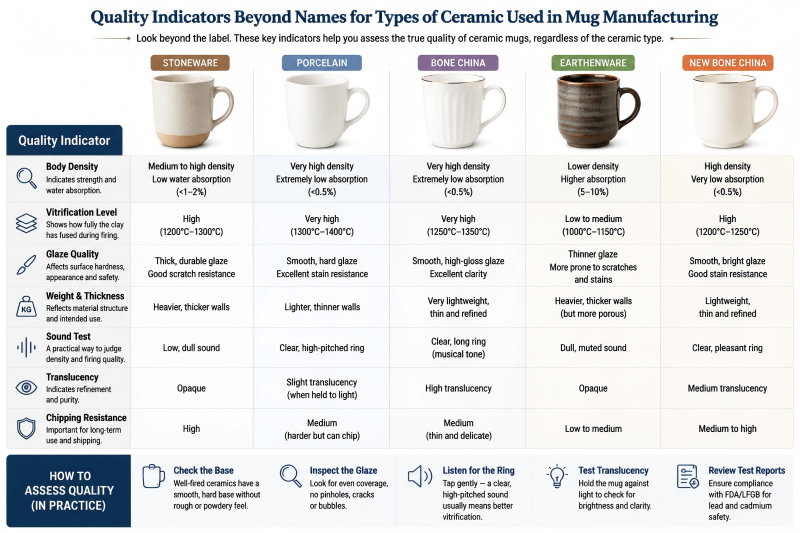
From label to evidence: what we show serious buyers
As an OEM ceramic mug supplier with ISO9001 and BSCI, I encourage buyers to frame requests around outcomes. Instead of asking “Do you have porcelain?”, ask:
- “What’s the firing temp and water absorption of this body?”
- “Can you share recent lead/cadmium migration test reports (FDA 21 CFR, California Prop 65, EU/LFGB)?”
- “Have these glazes passed 500+ dishwasher cycles?”
- “What is the AQL for visual defects and criticals (cracks, pinholes, glaze crawl)?”
Inspection checklist you can standardize:
- Vitrification: Supplier to report absorption; a simple boiling test on samples can screen for under-firing.
- Glaze quality: Check under raking light for pinholes and orange peel; verify no glaze pooling at the foot.
- Rim and handle: Run a cotton pad to catch burrs; stress test handles with a controlled weight.
- Microwave test: Heat water for 2–3 minutes; cup body should not overheat relative to water if glaze is microwave-safe.
- Color control: Request a master standard and ΔE target under D65; verify decals are consistent across lots.
Translate specs into business impact:
- Verified vitrification means fewer odor complaints and cleaner taste, especially important for coffee shops.
- Stable glaze systems reduce returns for surface roughness after dishwashing.
- Safety compliance lets you sell across US/EU without relabeling or recalls.
- Consistent sizing reduces carton breakage and improves stackability in retail displays.
How does the ceramic mug manufacturing process vary by types of ceramic used in mug manufacturing?
Buyers often assume one process fits all. The risk is timeline and defect surprises during peak season. The solution is understanding how the ceramic mug manufacturing process changes with the body type, firing schedule, and decoration choices.
Stoneware and porcelain commonly use high-pressure casting or jiggering with single-fire glaze cycles. Bone china typically uses biscuit firing, glazing, then a second fire, plus lower-temp decal fires, which lengthens lead time and raises yield risk.
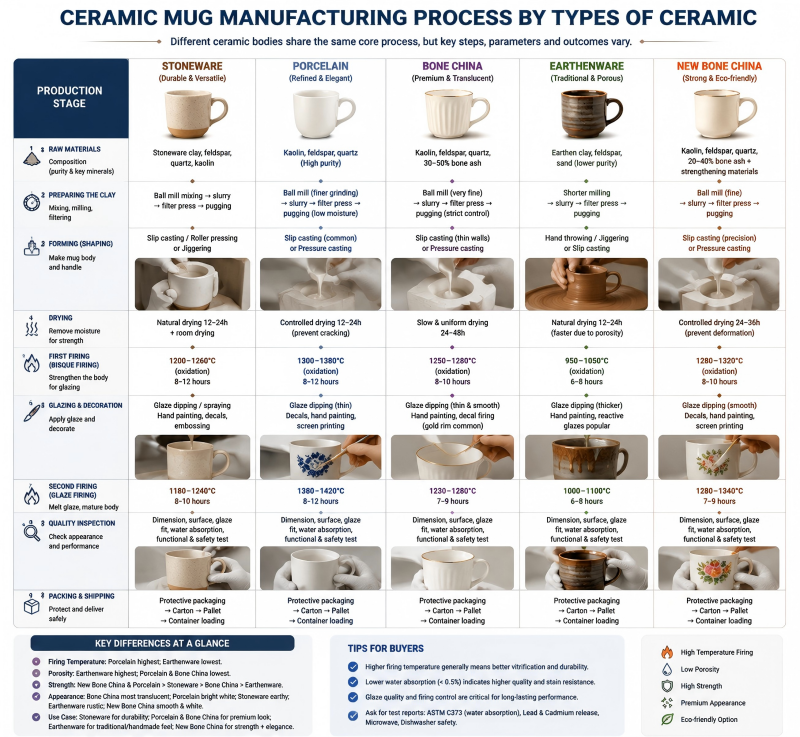
Process steps with real sourcing implications
Here is a simplified flow we share with procurement teams, noting where time and risk increase:
-
Body forming
- Slip casting, jiggering/roller-head, or pressure casting
- Business impact: High-pressure casting yields consistency at volume for standard shapes; slip casting is flexible for complex forms but slower.
-
Drying and trimming
- Control moisture to avoid warpage; attach handles at the correct leather-hard stage
- Business impact: Standardization here reduces handle failures and rework.
-
Biscuit firing (optional by body)
- Bone china typically: biscuit fire at ~1200°C for strength before glazing
- Business impact: Adds throughput time but stabilizes shape and improves glaze adhesion.
-
Glazing
- Dip or spray; matte vs gloss systems
- Business impact: Matte glazes are less forgiving; request known dishwasher-rated matte systems for HoReCa.
-
Glost firing (main high fire)
- Stoneware/porcelain often single-fired to 1220–1300°C; bone china glost around ~1050–1100°C after biscuit
- Business impact: Higher temp equals more energy cost but better vitrification; single-fire reduces lead time if shop control is strong.
-
Decoration
- Decals (on-glaze 780–820°C; in-glaze 950–1000°C), direct print, or hand-paint
- Business impact: On-glaze metallics look great but are not microwave-safe; disclose this in listings to avoid returns.
-
Final QC and packing
- AQL inspections, handle strength tests, dimension checks, and carton drop tests
- Business impact: Fewer transit damages and fewer bad reviews.
Lead-time signals I give buyers:
- Stoneware/porcelain, plain white: 25–35 days after sample approval for standard volumes.
- With decals: add 5–10 days for artwork, color proofing, and decal firing capacity.
- Bone china: 35–50 days, depending on two-fire capacity and yield.
Knowing which steps your chosen material requires helps you plan launches and avoid bottlenecks. It also informs the right MOQ: complex processes justify higher minimums to keep unit costs competitive.
Frequently Asked Questions
What is the best ceramic for coffee mugs?
There is no single best ceramic for coffee mugs. Stoneware suits cafes and promos thanks to durability and cost. Porcelain is ideal for refined retail aesthetics. New bone china offers a premium feel without bone ash costs. Choose based on budget, weight preference, and customer expectations.
Are stoneware mugs microwave and dishwasher safe?
Most high-fired stoneware mugs are microwave and dishwasher safe when properly vitrified and glazed. Always verify with supplier tests: water absorption ≤0.5%, dishwasher cycle results (e.g., 500+ cycles), and microwave heating checks. Beware of metallic decals or lusters, which are not microwave safe.
How do I compare stoneware vs porcelain mugs for my brand?
Think in outcomes. Stoneware feels substantial, supports matte/reactive glazes, and reads “cafe.” Porcelain is smoother, brighter white, and lighter in hand. For e-commerce photos and premium minimal branding, porcelain shines. For everyday, rugged use, stoneware is forgiving and cost-effective.
What documents should I ask from an OEM ceramic mug supplier?
Request material and process specs (firing temp, absorption), safety tests (FDA/Prop 65, EU/LFGB), dishwasher/microwave test results, and AQL inspection reports. For decorated mugs, get decal ink compliance. A supplier with ISO9001 and BSCI typically has organized documentation ready.
Does bone china justify the higher price in wholesale?
Bone china signals luxury with translucency and lightness. It can support higher retail margins if your brand can command the price. For wholesale volume to cafes or promo campaigns, the added cost and handling sensitivity often push buyers toward porcelain or stoneware instead.
Conclusion
Choosing among the types of ceramic used in mug manufacturing is not about a universal winner. It is about aligning ceramic mug materials to your audience, durability needs, and margin goals. If you want a practical recommendation tied to your budget and channel, contact me. As an OEM ceramic mug supplier in Liling, Hunan with ISO9001 and BSCI, I can help you spec, test, and deliver with confidence.