Struggling to decide on stoneware vs porcelain mugs for your inventory? You're not alone. The fear of choosing the wrong material can be paralyzing, as a bad decision can lead to chipped products, unhappy customers, and a mismatch with your brand's image. The key is to shift your focus from "which is better" to "which is the right fit for my specific business goals."
The best choice in the stoneware vs porcelain mugs debate depends entirely on your target market, brand identity, and budget. Porcelain offers superior durability and a refined, premium feel ideal for high-end markets. Stoneware provides a rustic, artisanal aesthetic at a more accessible price point, perfect for casual or value-focused brands.
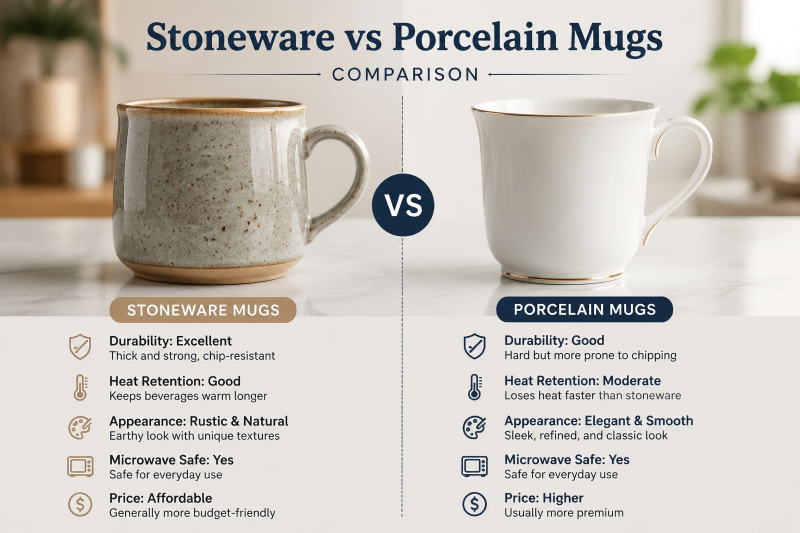
Now that you have the direct answer, let's explore the critical details that truly matter for a wholesale buyer. Making a profitable decision goes far beyond a simple material preference; it's about understanding how technical specs, aesthetics, and supplier quality impact your bottom line.
How Do Material Specs Impact Your Bottom Line?
Do you find yourself looking at spec sheets filled with terms like "vitrification" and "water absorption rate," wondering if they have any real-world impact? It can feel like you need a materials science degree to source a simple mug. These technical details are incredibly important, but only when you translate them into business risks and benefits.
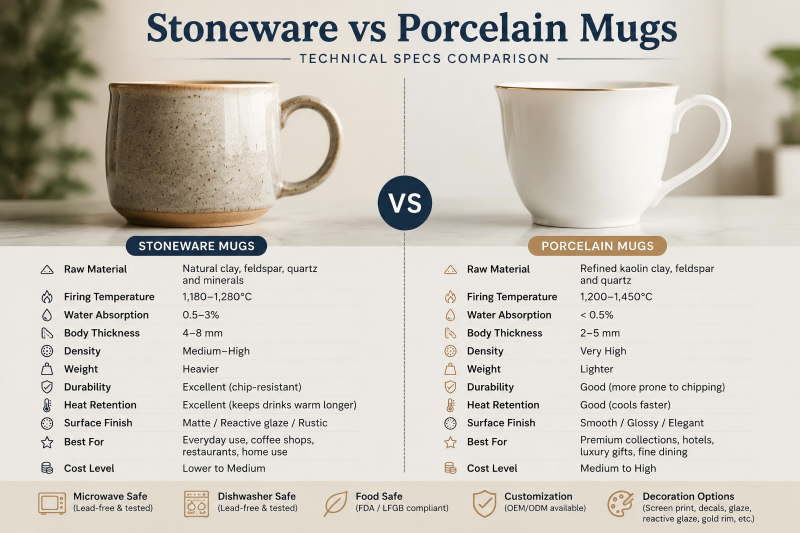
Material specifications are a direct forecast of your future costs and customer satisfaction. A higher firing temperature, typical of porcelain, results in a stronger mug, meaning lower rates of shipping damage and fewer replacements. Similarly, a lower water absorption rate means less staining, which leads to happier end-customers and protects your brand's reputation.
Dive Deeper
As a ceramic mug manufacturer with over 15 years of export experience, we've seen how these numbers play out in the real world for our wholesale clients. The spec sheet isn't just data; it's a roadmap to profitability.
H3: Firing Temperature and Durability
The single biggest technical difference is the firing temperature.
- Stoneware is typically fired at around 1150-1200°C (2100-2190°F).
- Porcelain is fired at a much higher temperature, often reaching 1300°C (2370°F) or more.
This extra heat does something critical: it causes the clay body to become vitrified, meaning it turns dense, glassy, and non-porous. For a business, this translates to:
- Higher Chip Resistance: A vitrified porcelain mug is significantly more resistant to chipping than a standard stoneware mug. This is a crucial selling point for B2B clients in the hospitality industry (cafes, restaurants, hotels) where mugs are subjected to constant use and industrial dishwashing.
- Lower Freight Damage: Stronger mugs mean fewer units arrive broken. While we pack all our wholesale ceramic mugs securely, the inherent strength of porcelain provides an extra layer of security, protecting your investment before it even reaches your warehouse.
- Increased Perceived Value: Customers can often feel the dense, solid nature of a well-made porcelain mug, which helps justify a higher retail price.
H3: Water Absorption and Long-Term Value
Water absorption rate is another spec that directly impacts the end-user experience.
- Stoneware has an absorption rate of about 1-5%.
- Porcelain has an absorption rate of less than 0.5%.
A common complaint we hear from buyers switching to us is that their previous mugs stained easily. This is almost always due to a higher absorption rate. Here’s the business impact:
- Stain Resistance: The near-zero porosity of porcelain coffee mugs means liquids like coffee, tea, and red wine cannot penetrate the surface. The mug looks new for longer, which drastically reduces customer complaints about "defective" products over time.
- Hygienic Properties: Lower absorption also means the mug is less likely to harbor odors or bacteria, a key consideration for health-conscious consumers and commercial environments.
While a well-glazed stoneware mug offers good protection, any chip in the glaze can expose the more porous body underneath. Porcelain's inherent non-porosity provides protection through and through.
| Feature | Stoneware | Porcelain | Business Implication |
|---|---|---|---|
| Firing Temp | ~1200°C | ~1300°C | Porcelain is stronger, reducing shipping/handling breakage. |
| Absorption Rate | 1-5% | <0.5% | Porcelain resists stains better, leading to fewer customer complaints. |
| Raw Material Cost | Lower | Higher | Stoneware coffee mugs are more affordable for mass-market buyers. |
| Density | Heavier, thicker | Lighter, thinner | Porcelain's premium feel can support a higher retail price. |
How Does the Stoneware vs Porcelain Mugs Choice Affect Your Brand?
You've sourced a mug that's technically perfect—it's durable and stain-resistant. But if the aesthetic doesn't connect with your target customer, it will gather dust in your warehouse. The look and feel of a mug aren't secondary features; they are a primary driver of purchasing decisions and brand identity.
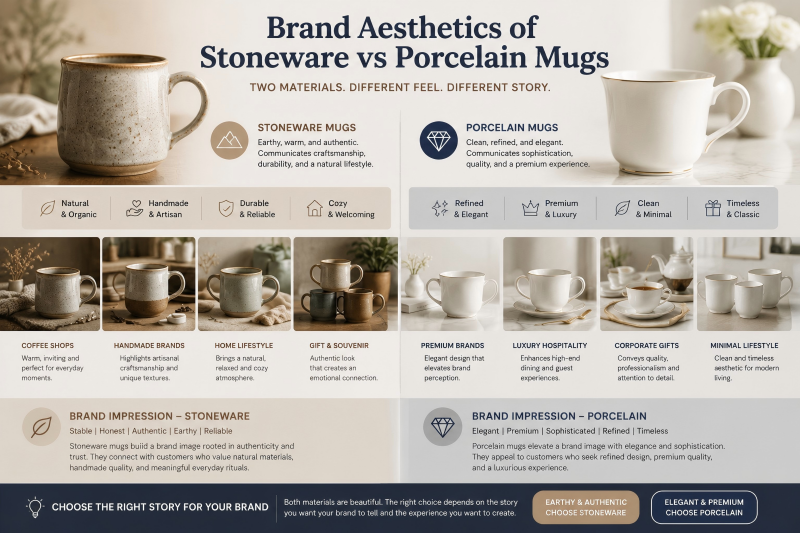
Your choice in the stoneware vs porcelain mugs discussion is a fundamental branding decision. Stoneware evokes feelings of warmth, authenticity, and handcrafted quality. Porcelain communicates elegance, precision, and luxury. The material you choose speaks to your customer before they even read your product description.
Dive Deeper
In my experience helping hundreds of international buyers develop their product lines, the most successful ones match the material to their brand's story perfectly.
H3: The Stoneware Aesthetic: Earthy, Rustic, and Authentic
Stoneware's appeal lies in its "perfectly imperfect" character. Its defining features include:
- Thicker Walls: This gives the mug a substantial, comforting weight and feel.
- Earthy Color Palettes: Often featuring reactive glazes that produce unique patterns, stoneware excels in muted tones like creams, deep blues, grays, and browns.
- Textured Surfaces: From smooth matte finishes to speckled "pottery" looks, stoneware feels more connected to the artisan's hand.
Who is this for? Stoneware is the ideal choice for brands that want to project a sense of authenticity and warmth. Think of:
- Independent Coffee Shops: The rustic feel complements the artisanal coffee narrative.
- Farm-to-Table Restaurants: The earthy aesthetic aligns with a natural, organic brand.
- Home Goods E-commerce Stores: Especially those targeting the "hygge," "cottagecore," or modern farmhouse trends.
For these businesses, the slight irregularities in a reactive glaze aren't a defect; they're a feature that says "handcrafted."
H3: The Porcelain Aesthetic: Refined, Elegant, and Premium
Porcelain is all about precision and purity. Its aesthetic is defined by:
- Thinner, Lighter Profile: Despite being stronger, porcelain can be formed into thinner, more delicate shapes that feel sophisticated.
- Bright White Body: The "true white" of a porcelain body is an unmatched canvas for decoration. It makes colors pop and logos look crisp and professional.
- Flawless, Smooth Surface: The finish is uniform and sleek, conveying a sense of high quality and luxury.
Who is this for? Porcelain is the go-to for brands that need to communicate premium quality and professionalism. For instance:
- Luxury Hotels and High-End Restaurants: The elegance of porcelain complements a fine dining experience.
- Corporate Gifting: A custom ceramic mug made of porcelain with a sharp company logo feels like a high-value gift.
- Premium E-commerce Brands: If you're selling a high-end coffee blend or tea, serving it in a porcelain mug reinforces the product's quality.
What the spec sheet for a porcelain mug doesn't tell you is how the handle feels or how the light reflects off its surface. These subtle cues are critical for creating a premium user experience and fostering the brand loyalty that leads to repeat purchases.
Why Can a Good Stoneware Mug Outperform a Bad Porcelain One?
Imagine this scenario: you decide to invest in "superior" porcelain mugs for your brand, only for the shipment to arrive with color inconsistencies, pinholes in the glaze, and a disappointingly cheap feel. You chose the right material on paper, but the result was a failure. The problem wasn't porcelain; it was the manufacturer.
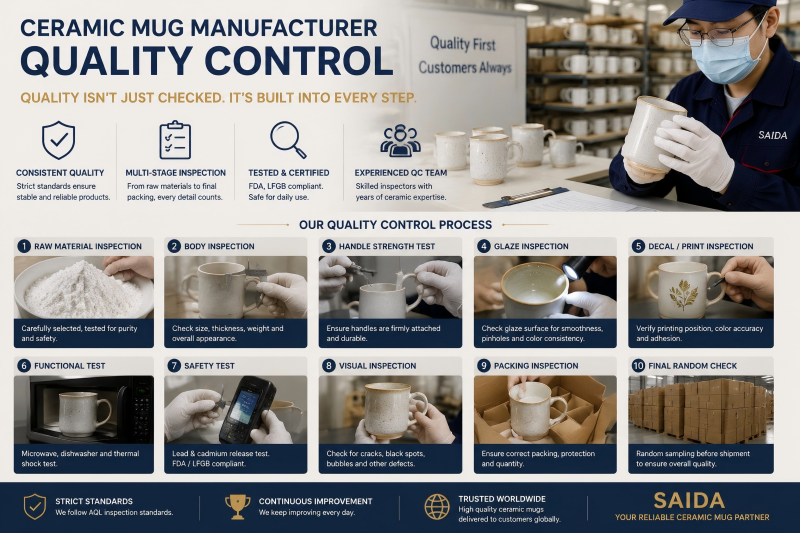
This is the most important lesson I've learned in 15 years: the quality commitment of your ceramic mug manufacturer is more critical than your choice in the stoneware vs porcelain mugs debate. A well-made stoneware mug from a factory with rigorous quality control will always be a better product than a poorly made porcelain mug from an unreliable one.
Dive Deeper
For wholesalers and e-commerce sellers, consistency is everything. Your brand's reputation depends on your customer receiving the exact same quality product every time they order. This is where your choice of supplier becomes the most important decision you'll make.
H3: The Hidden Risk of Inconsistency
A common problem we solve for new clients is batch-to-batch inconsistency from their previous suppliers. One order of 5,000 mugs might be perfect, but the next has slight color variations, a different weight, or a less durable glaze. This creates massive problems:
- Erodes Brand Trust: Customers who buy a second mug expecting it to match their first are left disappointed.
- Increases Returns: Mismatched sets or visibly lower-quality items lead to higher return rates.
- Complicates Inventory: You can't confidently merchandise new stock with old stock.
This is why vetting your custom mug supplier is non-negotiable. As a partner for OEM ceramic mugs, our reputation is built on delivering unwavering consistency, whether the order is for 1,000 units or 100,000 units.
H3: What to Look for in a Manufacturing Partner
When you evaluate a potential factory, look beyond the price per unit. Focus on their quality systems. Here’s what we've implemented that our clients value most:
- Certifications: Look for internationally recognized standards. For example, our factory is ISO 9001 certified for quality management and BSCI certified for social compliance. This is an external validation of our commitment to process and ethics.
- Raw Material Sourcing: Ask about where they source their clay and glazes. A reliable manufacturer has stable, long-term relationships with material suppliers to ensure the foundational elements of your mug never change.
- Kiln and Firing Control: Modern, well-maintained kilns with precise temperature controls are essential. This prevents warping, ensures uniform vitrification, and guarantees consistent glaze color across the entire production run.
- Multi-Point Inspection: Quality isn't just checked at the end. We inspect products at every stage: after forming (greenware), after the first firing (bisque), after glazing, and a final inspection before packing. This catches potential issues early and ensures only perfect products are shipped.
Ultimately, your mug is only as good as the factory that makes it. Choosing a partner who invests in quality is the best way to de-risk your sourcing decision.
Frequently Asked Questions
Is porcelain or stoneware better for retaining heat?
Generally, stoneware is slightly better at retaining heat due to its thicker walls, which provide more insulation. However, the difference is often marginal in real-world use. A well-designed porcelain mug with a lid or a shape that minimizes surface area can perform just as well. Design often matters more than material for heat retention.
Can you put both stoneware and porcelain mugs in the dishwasher and microwave?
Yes, for the most part. High-quality, modern stoneware and porcelain mugs from a reputable manufacturer are almost always dishwasher and microwave safe. The glazes are formulated to be durable and non-reactive. However, you should always confirm this with your supplier, especially if the mug has metallic decorations.
What is the wholesale cost difference between stoneware and porcelain?
Stoneware is typically more affordable to produce. The raw materials are less refined and the firing temperatures are lower, consuming less energy. As a wholesale buyer, you can expect stoneware coffee mugs to be roughly 15-30% less expensive than comparable porcelain coffee mugs. This cost difference can be significant when ordering thousands of units.
Which material is better for complex custom designs?
Porcelain is the superior choice for detailed or vibrant custom designs. Its smooth, non-porous, and typically bright white surface acts as a perfect canvas. Colors appear more vivid, and intricate logos or full-wrap patterns can be printed with greater precision. This makes it the go-to material for branded custom ceramic mugs.
Conclusion
The debate over stoneware vs porcelain mugs is not about finding a single "winner." It's about making an informed, strategic choice that aligns with your business. To summarize, your decision should be based on a balance of three factors: performance, branding, and budget. Porcelain offers unmatched durability and a premium feel for upscale markets, while stoneware delivers a cozy, artisanal aesthetic at a more accessible cost. However, the most critical element of all is the quality and reliability of your manufacturing partner. A great supplier ensures that whichever material you choose, the final product will be consistent, durable, and a true asset to your brand.
If you are looking for a reliable partner to help you navigate these choices and source high-quality wholesale ceramic mugs, our team is here to help. With 15 years of experience exporting to the Americas and Europe, we understand your business needs. Contact us today to discuss your next project.