The ceramic mug firing temperature matters, but not the way most buyers think. The real problem is assuming one number equals quality. That leads to wrong specs, higher costs, and inconsistent batches. The solution is to evaluate the entire firing process—temperature, glaze, body, design, and controls—so your mugs are strong, safe, and consistent.
Ceramic mugs are usually fired twice: a bisque firing around 900–1,000°C and a glaze firing typically between 1,180–1,280°C, depending on body (stoneware, porcelain, bone china), glaze maturity, and design. There isn’t a single “best” temperature. The correct range is the one that gives strength, low absorption, and stable glaze for your specific mug and market.
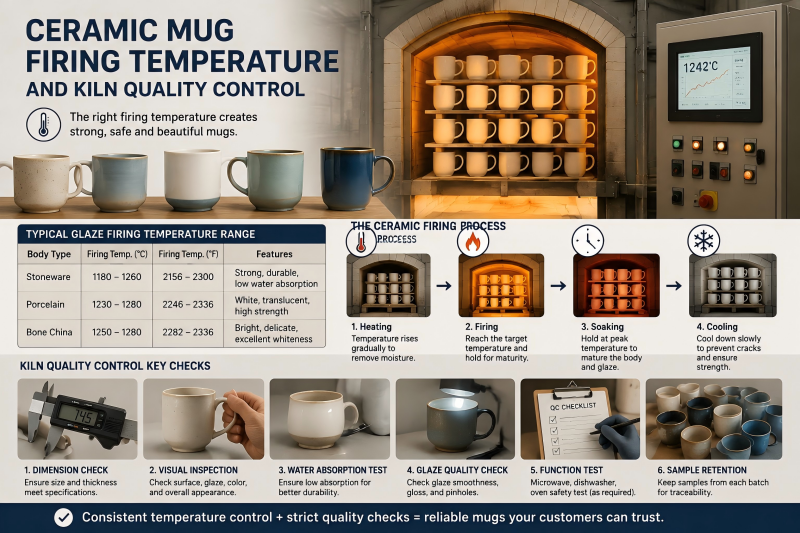
If you only ask for a single ceramic mug firing temperature, you risk over-firing or under-firing, which drives defects and returns. Below, I’ll show how we set the right range for stoneware, porcelain, and bone china, why glaze and shape matter, and the practical checks buyers can use to compare suppliers.
Is there one correct ceramic mug firing temperature?
Many buyers want one figure to compare factories. That is the problem. The agitation comes when that “high number” causes warping, pinholes, or sticky glaze. The fix is to ask how the supplier sets, tests, and controls ceramic mug firing temperature across materials, glazes, and shapes.
The short answer is no. A single ceramic mug firing temperature is not a quality score. Correct ranges differ by body and glaze. We set a bisque target for strength and machinability, then a glaze target for waterproofing and finish. The right range reduces defects and keeps dishwasher and microwave safety consistent.
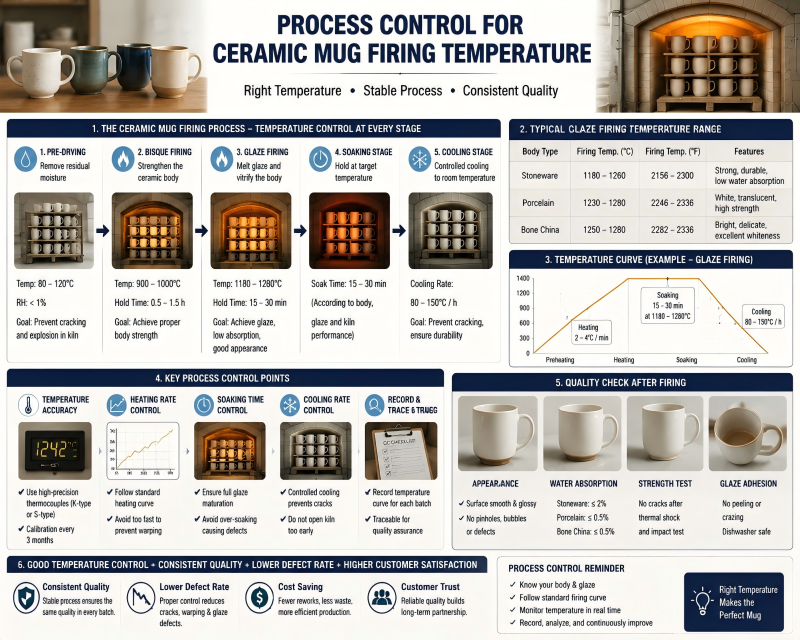
Why a single number misleads
- Material response is different. Stoneware, porcelain, and bone china each “mature” (become strong and waterproof) in different windows.
- Glazes mature at specific cones. If the glaze wants cone 6 and you push cone 8 “for quality,” you often get blistering or crawling.
- Shape and thickness change heatwork. A thick diner mug needs a longer soak than a thin promotional mug at the same kiln reading.
I learned this the hard way early on. We once tried to “improve” a stoneware line by pushing the glaze firing to about 1,240°C because a buyer asked for “the highest possible” temperature. The glaze was formulated for about 1,200–1,220°C (cone 6–7). Result: several hundred mugs with slightly oval rims and micro-bubbles on the inner wall. The cost wasn’t just scrap; it was two weeks of lost kiln time and a delayed shipment.
As a buyer, the business outcome you want is low absorption, tough glaze, and repeatable color—at the lowest stable ceramic mug firing temperature that achieves those results. That is how you keep costs under control and minimize defect risk.
How does ceramic mug firing temperature vary by material?
The problem: treating all clays as equal. The agitation: choose the wrong range and you get either a porous mug or a slumped shape. The solution: pick the correct ceramic mug firing temperature range by body type and verify it with simple tests and supplier data.
Ceramic mug firing temperature ranges differ by body. Typical glaze firing: stoneware around 1,180–1,230°C (cone 5–7), porcelain around 1,220–1,280°C (cone 6–10 depending on formulation), bone china around 1,200–1,250°C. These are starting points; your supplier should justify the exact range with absorption, glaze, and color tests.
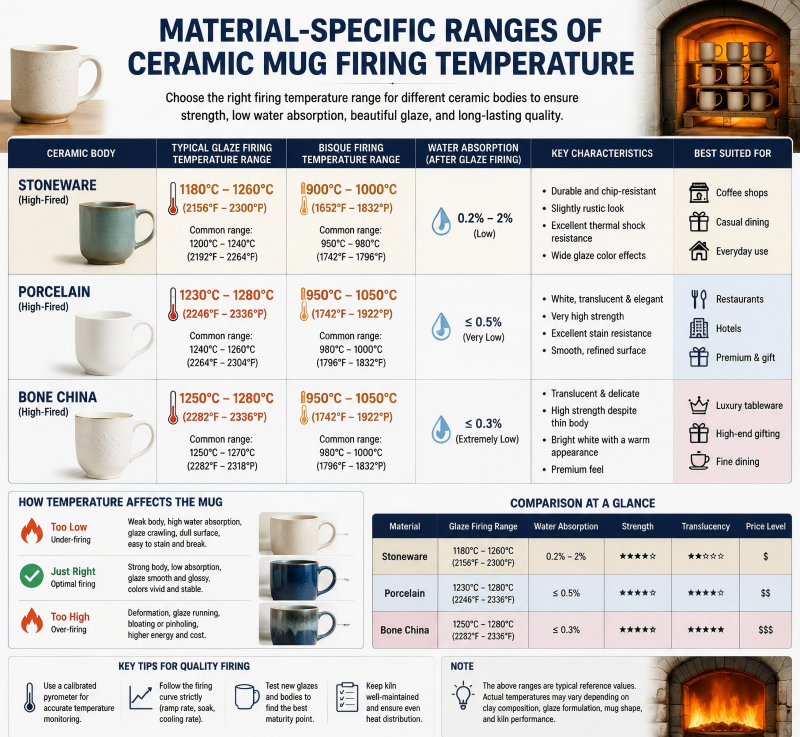
Material choices and business implications
| Body Type | Typical Bisque (°C) | Typical Glaze Fire (°C) | What You Get | Risks If Misapplied | Common Use Cases |
|---|---|---|---|---|---|
| Stoneware | 900–1,000 | 1,180–1,230 (cone 5–7) | Durable, dense, value-price | Underfire: absorption >3%; Overfire: warping, pinholes | Retail, promo, horeca |
| Porcelain | 900–1,000 | 1,220–1,280 (cone 6–10) | White, low absorption (<0.5%) | Overfire: glaze burn, stuck ware; Underfire: dull glaze | Premium retail, gifts |
| Bone China | 900–1,000 | 1,200–1,250 | Translucent, light weight | Overfire: deformation; Underfire: weak body | Premium gifting |
- Stoneware: Great for wholesalers balancing cost and durability. We usually target water absorption below 3%. This supports dishwasher use and reduces staining complaints. It sells well to cafés and ecommerce buyers who want value without feeling cheap.
- Porcelain: Strong selling point is whiteness and a very low absorption rate. When we export to North America and Europe, we market “chip resistance and color fidelity after 125 dishwasher cycles” alongside the ceramic mug firing temperature range to prove durability.
- Bone china: Lighter and more translucent. It commands a higher price point. Firing windows are narrower. We always run small test tiles per batch to confirm glaze maturity before full production.
Important: Verify claims. Ask for water absorption test results, glaze cut-and-boil tests, and dishwasher cycle test summaries. Certifications like ISO9001 and BSCI (which we hold) are a good sign of process control, but treat them as documents to verify, not a substitute for product testing.
What defects show when ceramic mug firing temperature is wrong?
The problem is defects that only show after you open the container. The agitation is refunds, 1-star reviews, and rework costs. The solution is knowing the defect signatures that indicate wrong ceramic mug firing temperature and asking suppliers how they prevent them.
Wrong ceramic mug firing temperature shows up as warping, pinholes, blistering, crawling, crazing, dull surfaces, or stuck foot rings. Underfiring causes higher absorption, weak glaze, and easy staining. Overfiring causes deformation and burnt glaze. The fix is a controlled temperature curve, correct soak time, and glaze-body fit.
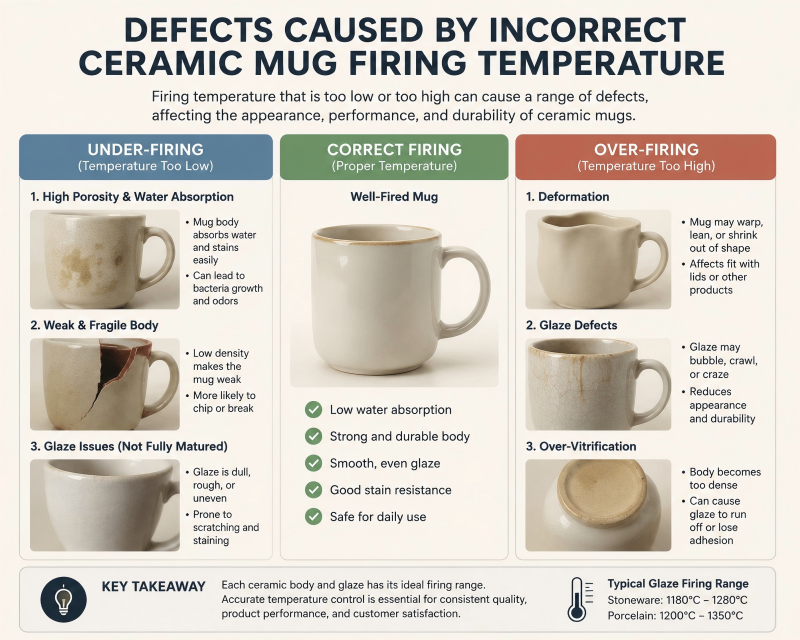
Defects and what they mean for your business
- Warping/elliptical rims: Overfire or excessive soak. Outcome: lids don’t fit, stackability fails, complaints from café buyers.
- Pinholes/blisters: Too hot, gas release mismatched to glaze maturity, or poor kiln ventilation. Outcome: rough surfaces that trap coffee oils; returns for “dirty-looking” mugs.
- Crawling (bare spots): Glaze pulls away due to over-maturation or application issues. Outcome: food safety risks if bare clay is exposed on inner surface; failed audits.
- Crazing (fine cracks): Glaze-body mismatch and thermal stress. Outcome: moisture ingress over time; stain lines; negative reviews after a few months in use.
- Dull or underdeveloped glaze: Underfire. Outcome: colors look wrong; brand designs don’t match proofs; chargebacks.
I still remember a promotional run with a red logo where the glaze bubbled on the inner wall. We traced it to pushing 1,230°C for a cone 6 glaze that needed 1,210–1,220°C plus a 15–20 minute soak. Dropping 10–15°C and increasing soak gave a smooth inner surface and stable color. Business translation: we saved two full kiln loads from scrap and hit the shipping window.
When you audit a supplier, ask for:
- A defect library with real photos (pinholes, crawling, crazing) and their documented countermeasures.
- Kiln logs with target vs. actual ceramic mug firing temperature, ramp rates, and soak times.
- First Article Inspection (FAI) reports from the last three production lots for similar mugs.
How do glaze and artwork change ceramic mug firing temperature?
The problem: picking a glaze because it looks nice in a catalog, then pushing the kiln to “make it tougher.” The agitation: bubbles, color shift, or hazing on decals. The solution is matching glaze maturity and artwork to the ceramic mug firing temperature range.
Glazes and decals have maturity windows. A glossy white might need 1,200°C, while a matte black needs 1,220°C. Decals and lusters often need third firing at 780–820°C. Your ceramic mug firing temperature must fit the glaze’s range and the artwork’s heat limits, or defects and color drift will occur.
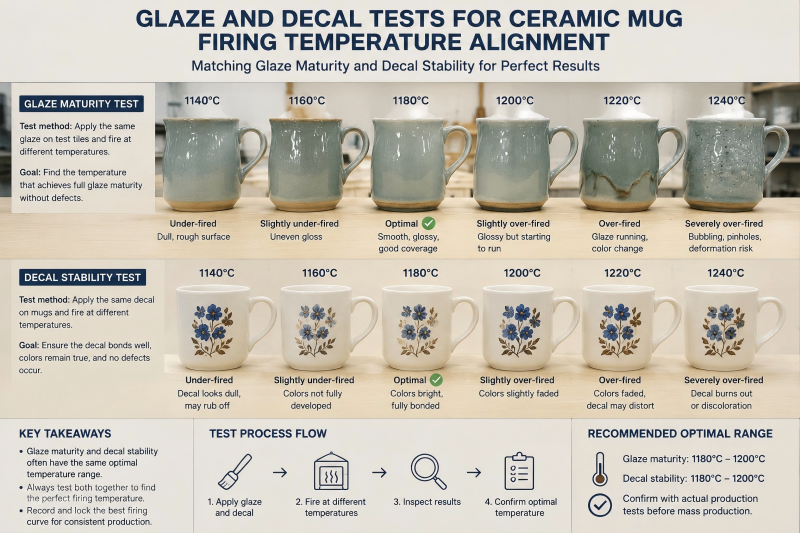
Glaze, decal, and luster controls buyers should ask about
- Glaze maturity data: What cone/°C, soak time, and cooling curve does the glaze need?
- Coefficient matching: How does the glaze expand compared to the body to avoid crazing?
- Artwork process: In-glaze, on-glaze, or underglaze? Do they use a third firing for decals, and at what temperature?
H3: Practical workflow we use
- Select the body and glaze pair, then run test tiles at three points (e.g., 1,200/1,210/1,220°C for stoneware glaze).
- Inspect with a 10x loupe for pinholes and gloss. Conduct a quick “boil and ice” thermal shock test to check crazing risk.
- For artwork, we run the decal firing separately (often 780–820°C) and test dishwasher resistance with 125 cycles, then a scrub test.
H3: Business impact of glaze fit
- Correct fit reduces warranty claims. Crazing can show up months later; prevention is cheaper than returns.
- Color stability protects your brand. We keep Pantone Lab* logs before and after firing; anything over ΔE 2.0 gets reformulated.
- Cost control: matching the glaze to a slightly lower ceramic mug firing temperature often saves energy and reduces kiln time without sacrificing performance.
Tip: Ask the supplier to send you three test tiles at the chosen temperature, plus one 10°C lower and one 10°C higher, so you can see the tolerance range on your actual glaze and logo color.
What kiln schedule and loading controls matter most?
The problem: the kiln reads the right number, but outcomes vary by batch. The agitation: inconsistent color and random defects. The solution is good heatwork control—ramp rates, soak, cooling, and loading density—around the chosen ceramic mug firing temperature.
Temperature is only part of heatwork. We control ramp rates (e.g., 80–120°C/hour), soak time at peak (often 10–30 minutes), and cooling profiles to match glaze needs. Even loading is crucial; overcrowding can cause micro-reducing zones that create pinholes and color shifts at the same ceramic mug firing temperature.
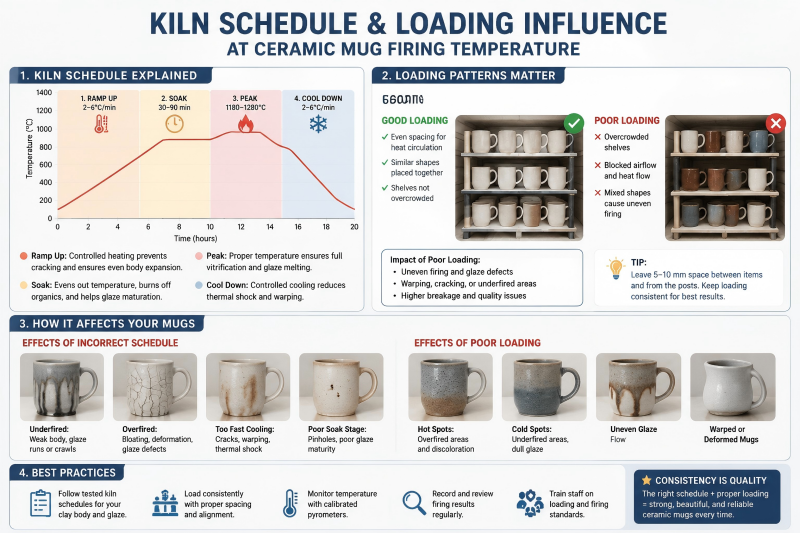
What to look for in a supplier’s controls
- Documented kiln schedules: ramp/soak/cool curves with acceptable tolerances.
- Load plans: diagrams for shelf spacing, cone placement, and airflow.
- Witness cones: physical proof of heatwork inside, not just a controller reading.
H3: Why this matters for your business
- Color consistency: Proper loading reduces shadowing and hot spots, so your ecommerce listings match the delivered product.
- Lower defect rates: Predictable heatwork keeps absorption and glaze gloss in the spec window.
- Scheduling reliability: When we unify schedules across similar products, we reduce changeovers and protect lead times.
We once had a container where only the back two kiln shelves showed pinholes. Controller temperature was perfect. The fix was not changing the ceramic mug firing temperature, but adding a small vent and widening shelf spacing by 5 mm on those levels. Defects dropped below 1.5%, and the schedule stayed on track.
How should buyers evaluate a supplier’s firing process?
The problem: asking “What temperature do you fire at?” and getting a confident but meaningless answer. The agitation: you still don’t know if your mugs will be strong, safe, and consistent. The solution is structured questions that reveal process control, not just a ceramic mug firing temperature.
Evaluate suppliers by their system, not the headline ceramic mug firing temperature. Ask for test data (absorption, dishwasher cycles), kiln logs, and corrective action records. Verify certifications and request real photos of controlled defects. A mature process shows stable quality at the lowest effective temperature for your product.
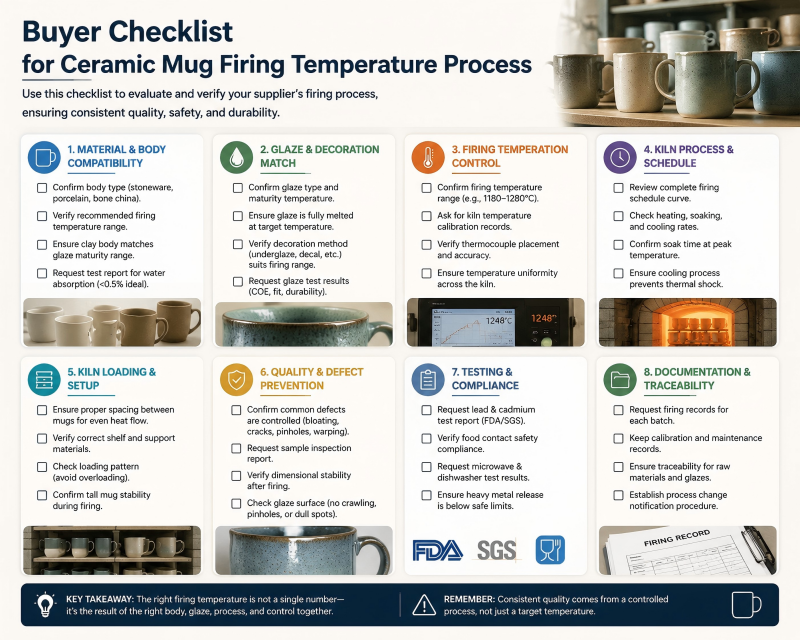
A buyer’s checklist you can copy
- What is your glaze firing window for my mug, and how did you determine it?
- Show last three kiln logs with ramp/soak and witness-cone photos.
- Provide water absorption results on my body/glaze: target and actual.
- Share dishwasher test results (e.g., 125 cycles) and microwave tests.
- How do you control loading density and airflow? Show a load plan.
- What are your top three firing defects last quarter and the countermeasures?
- Which certifications (ISO9001, BSCI) do you hold? May I verify documents?
I run a factory in Liling, Hunan, with 15 years of export experience to the Americas and Europe. We follow ISO9001 and BSCI systems, but I always tell buyers to verify documents and sample-test products. Your job is to reduce risk. The best ceramic mug firing temperature is the one that delivers the right results, proven by data.
Frequently Asked Questions
What is the typical bisque firing temperature for mugs?
Most bisque firing for mugs is around 900–1,000°C. This stabilizes the body, makes it easier to handle, and prepares it for glazing. Bisque is not about waterproofing; that comes from the glaze firing. As a buyer, ask for bisque hardness and dust control measures to protect decal quality.
Are higher firing temperatures always better for durability?
No. Higher is not automatically better. Over-firing can cause warping, glaze pinholes, or color shift, which drives scrap and returns. The best approach is to find the lowest ceramic mug firing temperature that achieves low absorption, stable glaze, and dishwasher safety for your exact product.
How can I confirm mugs are dishwasher and microwave safe?
Request test reports. For dishwasher safety, ask for at least 125-cycle tests with gloss and color measurements (ΔE). For microwave, confirm there is no metallic decoration and run a heat test with water in the mug. Ensure the supplier records results by lot and glaze.
What data should come with a production sample?
Ask for a small pack: kiln log (last firing), witness-cone photo, water absorption value, glaze maturity note (target °C/cone and soak), and any decal-firing data. These documents show how the ceramic mug firing temperature and process performed for your exact sample.
Can one factory produce both stoneware and porcelain consistently?
Yes, with separate formulations, glazes, and kiln schedules. The factory must show distinct ceramic mug firing temperature ranges, glazes tuned to each body, and different loading plans. Ask to see separate SOPs and test records. Mixing processes without controls raises defect risk.
Conclusion
There is no single magic number for ceramic mug firing temperature. Strong, safe, and consistent mugs come from a controlled system: the right material, glaze, ceramic mug firing temperature range, kiln schedule, and loading. To reduce risk, ask suppliers smarter questions, verify documents, and review test data. Start with this checklist: request kiln logs, witness cones, absorption results, dishwasher and microwave tests, and recent corrective actions.