Receiving a shipment of beautiful ceramic mugs only to find a significant percentage shattered is a profit-crushing experience. This breakage erodes your margins, damages your brand's reputation, and creates logistical nightmares with claims and replacements. The key to how to reduce breakage during shipping lies not in a thicker individual box, but in engineering a complete, system-wide packaging strategy.
To reduce breakage during shipping, you must adopt a systemic approach that protects the entire shipment, not just individual items. This involves using a robust master carton, proper internal separators, and a secure palletization strategy that is tested to withstand the compression, vibration, and shock of the entire international transit journey.
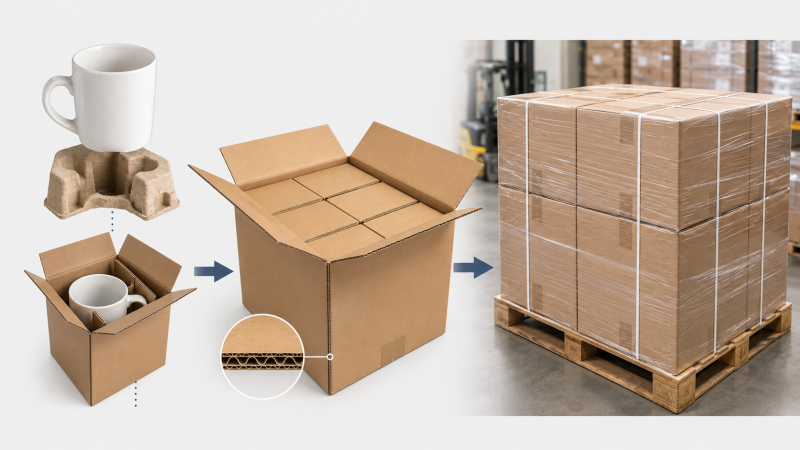
Now that you know the core principle, understanding the why behind this systemic approach is crucial. Let's explore the common failure points in transit and see how a holistic packaging philosophy is the only reliable way to protect your investment and your brand.
Why Does Individual Product Packaging Fail to Reduce Breakage During Shipping?
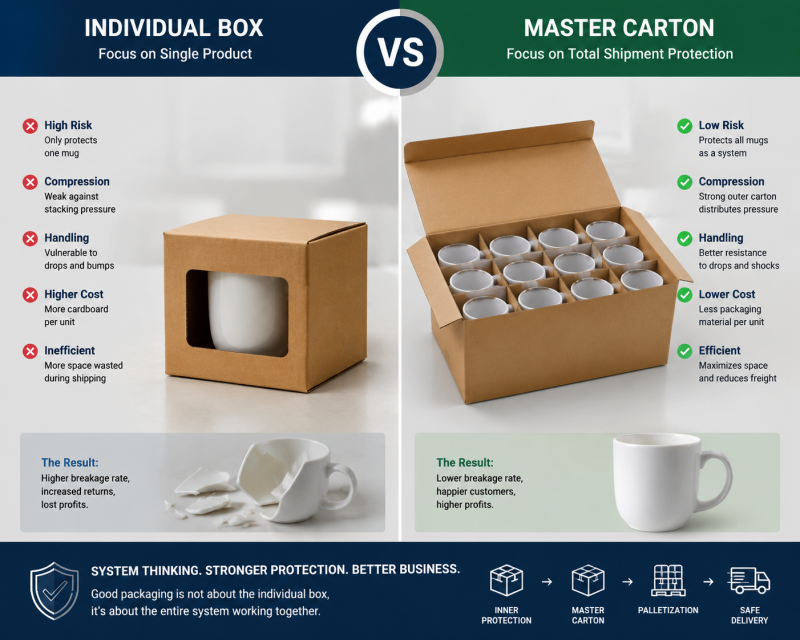
You specified a sturdy, attractive individual box for your ceramic mugs, believing it was enough protection. Yet, you're still facing unacceptable breakage rates upon delivery, leaving you frustrated and confused. This happens because the most damaging forces in shipping don't target a single box; they attack the entire pallet.
Individual packaging often fails because it's simply not designed to protect against the systemic forces of high-pressure compression, constant vibration, and severe shock that act upon the master carton and pallet throughout the long journey from the factory to your warehouse.
Dive Deeper: The Real Threats in Transit
After shipping millions of mugs over the past 15 years, I’ve learned that buyers often focus on the packaging they can see—the individual gift box. However, this is like reinforcing a single soldier's helmet while ignoring the armor on the vehicle carrying the entire platoon. The real points of failure are systemic.
H3: The Crushing Force of Compression
When your products are loaded into a sea container, pallets are often stacked two or even three high to maximize space. A pallet of ceramic mugs can weigh over 500 kg (1100 lbs). This means the master cartons on the bottom layer must support over 1000 kg of weight for weeks at a time.
- A standard 3-ply carton will begin to buckle and crush under this pressure.
- A reinforced 5-ply carton, which we use as our standard for export packaging for ceramic mugs, is engineered to withstand this vertical pressure. This simple upgrade prevents the entire bottom layer of your shipment from being compromised, saving you from a 33% loss before the ship even leaves port.
This is a core part of our ceramic factory packaging process. We don't just think about the mug; we think about its position in a 40-foot container halfway across the ocean.
H3: The Silent Destroyer: Vibration
A container ship or long-haul truck is a source of constant, low-level vibration. Over thousands of miles, this incessant shaking causes products to shift and rub against each other. For ceramics, this can lead to two major problems:
- Chipping and Scuffing: The constant friction can wear away at the glaze or print, especially around the rim and handle. These items aren't broken, but they are unsellable. This is one of the more subtle but Common Ceramic Mug Defects that proper packaging prevents.
- Stress Fractures: Vibration can create micro-fractures in the ceramic that aren't visible to the naked eye but dramatically weaken the mug, making it prone to breaking from a minor impact later on.
Effective fragile product packaging solutions must include high-density internal dividers that immobilize each mug, ensuring they don't touch during transit.
H3: The Inevitable Impact of Shock
Your shipment will be dropped. It's not a question of if, but when and how. A forklift operator might hit a pothole, a warehouse worker might handle a carton roughly, or a package may fall off a conveyor belt during last-mile delivery. The master carton is the primary shock absorber. A weak master carton will transfer that impact energy directly to the products inside, resulting in immediate breakage.
How Can a Systemic Approach to Packaging Reduce Breakage During Shipping?
It often feels like you're just gambling with every shipment, hoping it arrives safely. This feeling of helplessness comes from focusing on factors you can't control. A systemic approach to reduce breakage during shipping gives you back control by engineering a defense for every predictable stage of the product's journey.
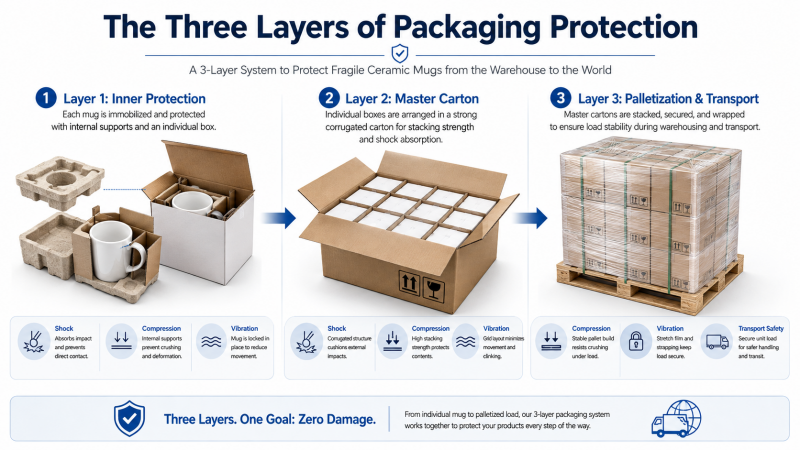
A systemic approach analyzes the entire journey from our factory floor to your final destination. It uses a calculated combination of a protective inner box, a robust master carton, and secure palletization to create a multi-layered defense system that works in unison.
Dive Deeper: Engineering a Multi-Layered Defense
A successful ceramic mug shipping packaging strategy is built on three pillars. Each layer has a specific job, and they are designed to work together. If one fails, the entire system is at risk.
H3: Layer 1: The Inner Box (Immobilization)
The primary job of the inner box or divider isn't to absorb a 5-foot drop; it's to immobilize the mug. It must hold the product tightly so it cannot shift, rotate, or touch other items.
- For individual gift boxes: The box should be sized correctly, with minimal empty space.
- For bulk wholesale packaging: We use corrugated dividers that create a snug cell for each mug. This prevents the handle of one mug from chipping the body of another during transit vibration.
This first layer is about preventing internal damage within the master carton. For custom products, this is a key discussion in our OEM Ceramic Mug Manufacturing Guide.
H3: Layer 2: The Master Carton (The Bodyguard)
This is the most critical element for breakage prevention packaging. The master carton is the primary barrier against external shock and compression. The ceramic export carton requirements we follow are strict. We insist on:
- Material: Minimum 5-ply corrugated board.
- Bursting Strength: Minimum 200 PSI (pounds per square inch) or 13.8 BAR. This rating measures the carton's ability to resist rupture from internal or external forces.
- Edge Crush Test (ECT): This measures the compressive strength of the cardboard, ensuring it can be stacked high without buckling.
A well-built master carton acts like a car's crumple zone, absorbing and dissipating impact energy before it can reach the precious cargo inside.
H3: Layer 3: The Pallet (The Foundation)
You can have the best master cartons in the world, but if they are not secured properly on a pallet, they become projectiles. Proper palletization turns 30 or 40 individual cartons into a single, stable, monolithic block.
| Feature | Basic Approach (High Risk) | Systemic Approach (Low Risk) |
|---|---|---|
| Focus | Individual product box | Entire system (Inner, Master, Pallet) |
| Master Carton | Standard 3-ply, low ECT rating | Reinforced 5-ply, 200+ PSI Burst Strength |
| Internal Packing | Loose fit, thin dividers | Custom-fit, high-density cell dividers |
| Palletizing | Simple column stack, light wrap | Interlocked stack, corner guards, heavy-duty wrap |
| Testing | None, or individual box drop | Full master carton drop & vibration tests |
This systemic method is the cornerstone of our wholesale ceramic mug packaging and ensures that what we produce through our rigorous Ceramic Mug Production Process arrives in the condition you expect.
How Do We Test Packaging to Ensure It Reduces Breakage During Shipping?
A supplier might tell you their packaging is "excellent" or "very strong." But these are just words. How can you be truly confident that their solution will protect your investment across thousands of miles? The only way is to demand proof derived from rigorous, real-world testing procedures.
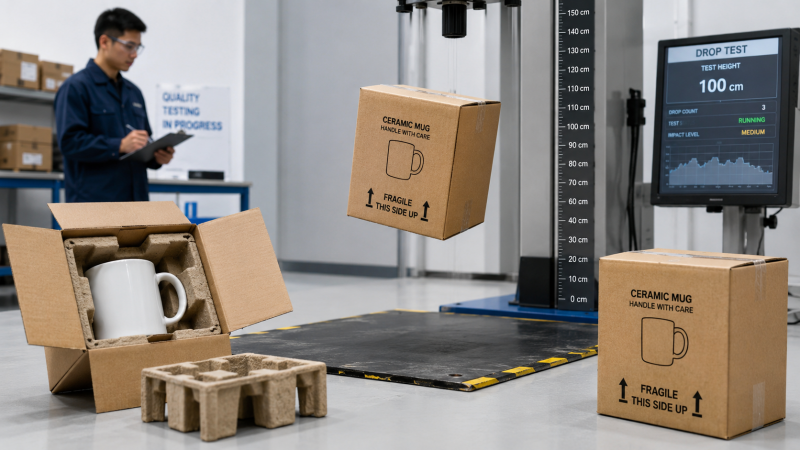
To ensure our systems reduce breakage during shipping, we utilize a series of internal "torture tests." These protocols were developed from analyzing our shipping data over 15 years and are specifically designed to simulate the worst-case scenarios for international shipping ceramic products.
Dive Deeper: Battle-Testing Your Shipment
Standard industry tests like those from ISTA (International Safe Transit Association) are a good starting point, but we found they didn't fully account for the unique combination of fragility and weight characteristic of ceramics on long sea journeys. So, we developed our own practitioner-led testing protocol. This is a non-negotiable step in our Ceramic Mug Quality Control process.
H3: The Master Carton Drop Test Protocol
A single, flat drop test is not enough. To truly vet a packaging system, we perform a sequence of drops on a fully packed master carton, simulating different types of mishandling.
- The Flat Drop (Base): Dropping the carton flat on its bottom from a height of ~76 cm (30 inches). This tests the carton's ability to absorb shock and protect against vertical impacts.
- The Edge Drop: Dropping the carton on one of its long edges. This tests the structural integrity of the carton's seams and corners.
- The Corner Drop: Dropping the carton directly onto one of its corners. This is the most destructive test, as it concentrates all the force of the impact onto a single point. It's the ultimate test of the carton's construction and the internal packaging's ability to brace the contents.
After the drop sequence, we open every single mug in the carton to inspect for any damage, no matter how minor.
H3: The Long-Haul Vibration Simulation
To mimic the weeks-long journey on a container ship and subsequent truck transport, we place a fully packed and sealed master carton onto a vibration table. The table is calibrated to simulate the frequency and amplitude of motion experienced during transit.
We run this test for several hours. Afterwards, our inspection goes beyond just looking for broken pieces. We check for:
- Glaze Scuffing: Caused by products rubbing against dividers.
- Print Wear: A sign that the mugs are not properly immobilized.
- Carton Fatigue: Are the corners softening? Are the seams holding?
- Dusting: Fine powder from the corrugated material breaking down indicates excessive internal movement.
This provides safe packaging for ceramic products by ensuring they not only survive the journey but arrive in pristine, sellable condition. For buyers who require third-party validation, we fully support and can facilitate official SGS Testing for Ceramic Mugs.
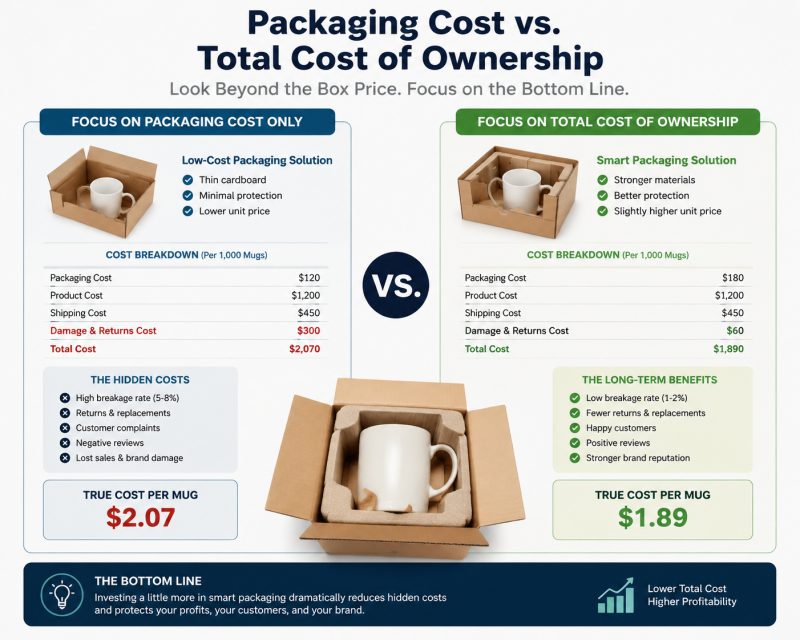
How Does Better Packaging Impact Your Total Cost of Ownership?
You're under constant pressure to keep costs down, so opting for the cheapest packaging seems like a smart financial move. However, this often proves to be a false economy, leading to higher damage rates, angry customer reviews, and lost inventory—all of which cost you far more in the long run.
A well-engineered packaging system may add a few cents to the upfront unit cost, but it dramatically lowers your Total Cost of Ownership (TCO). It does this by minimizing direct breakage costs, reducing the labor spent on returns, protecting your valuable brand reputation, and ensuring your inventory is 100% sellable upon arrival.
Dive Deeper: Calculating the True Cost of "Cheap"
Focusing only on the line-item cost from your supplier is a narrow view. A true business partner helps you see the bigger picture. After 15 years of exporting, I've seen firsthand how a small investment in packaging delivers outsized returns by eliminating the many hidden costs of breakage.
H3: The Direct Costs of Breakage
When a mug breaks, you lose more than just the mug. The real financial loss includes:
- Cost of Goods Sold (COGS): The money you paid for the broken item is gone forever.
- Pro-rated Shipping Costs: You paid to ship that item across the world, only for it to be unsellable.
- Replacement Costs: If you have to send a replacement to an end consumer, you pay for a new product and a second shipping fee, often at a much higher per-piece rate.
- Disposal Costs: You may have to pay to dispose of the damaged goods.
Let's use a simple example. A carton contains 36 mugs that cost you $2.00 each. The superior packaging adds $1.80 to the carton cost, or $0.05 per mug. If this better packaging prevents just one mug from breaking, you have saved $2.00 at a cost of $1.80. The investment has already paid for itself. If it saves two mugs, you're now ahead.
H3: The Catastrophic Indirect Costs
The indirect costs are often far greater and can do long-term damage to your business.
- Brand Reputation Damage: An e-commerce customer receiving a broken mug is highly likely to leave a 1-star review. For wholesalers, repeated issues with damage will destroy trust and lead them to find a more reliable supplier.
- Opportunity Cost: If 5% of your shipment arrives damaged, you have 5% less inventory to sell. This can lead to stock-outs on popular items, costing you sales and search ranking momentum.
- Administrative Overhead: Think of the hours your team spends photographing damage, filing claims with carriers, processing returns, and responding to unhappy customers. This is time and money that could be spent on growing your business.
Investing in a supplier with proven ceramic mug supplier packaging standards is not a cost; it's a form of insurance for your inventory and your brand's reputation. It's as important as ensuring your products meet FDA Requirements for Ceramic Drinkware.
Frequently Asked Questions
What is a good breakage rate for shipped ceramics?
While the goal is always zero, a breakage rate below 1% for international container freight is considered excellent in the industry. If you consistently experience rates of 3% or higher, it is a clear sign of a systemic problem with your ceramic packaging for export that needs immediate attention.
Does air freight require different packaging than sea freight?
Yes. While both require robust protection, the primary risks differ. Sea freight's long duration emphasizes defense against compression (from stacking) and constant vibration. Air freight is faster but typically involves more manual handling and transfers, so the packaging must prioritize superior shock absorption to protect against drops and impacts.
What are the best ceramic export carton requirements?
As a baseline, we recommend a 5-ply corrugated master carton with a bursting strength of at least 200 PSI (13.8 BAR). The specific Edge Crush Test (ECT) rating needed depends on the weight of the mugs and how high the pallets will be stacked in the container. Always demand these specs from your supplier.
How much does good ceramic mug shipping packaging add to the cost?
Typically, a comprehensive, system-based packaging solution might add 3-5% to the product's unit cost. However, by preventing damage, returns, and reputation loss, it can easily reduce your Total Cost of Ownership by 10-15% or more, delivering a significant positive return on investment.
Conclusion
The most effective way to reduce breakage during shipping is to stop thinking about individual boxes and start evaluating your supplier's entire packaging system. True protection comes from a holistic strategy that accounts for compression, vibration, and shock across the entire supply chain. This requires robust master cartons, secure internal immobilization, and stable palletization, all validated by rigorous, real-world testing. Shifting your focus from the upfront packaging price to the Total Cost of Ownership will save you money, protect your brand, and ultimately make your business more profitable.
When you evaluate your next supplier, don't just ask about the price per mug. Ask them: "What is your systemic protection plan for master cartons and pallets, and can you show me your test data?" This single question will tell you more about their reliability than anything else. If you're looking for a partner who has already solved this problem, let's talk.