Struggling to figure out the true cost of shipping ceramic mugs from China to USA? You've found a great factory and a good product price, but the logistics feel like a black box filled with financial risk. You worry that hidden fees will evaporate your profit margin before your products even land. The solution is to shift your focus from the low initial freight quote to calculating your total, all-inclusive "landed cost."
The real cost of shipping ceramic mugs from China to USA is the "total landed cost"—a single figure that includes the product's factory price, all transportation fees from China to your US warehouse, customs duties, taxes, and insurance. Focusing only on ocean freight is a mistake, as it ignores the significant destination charges that can easily double the initial shipping quote.
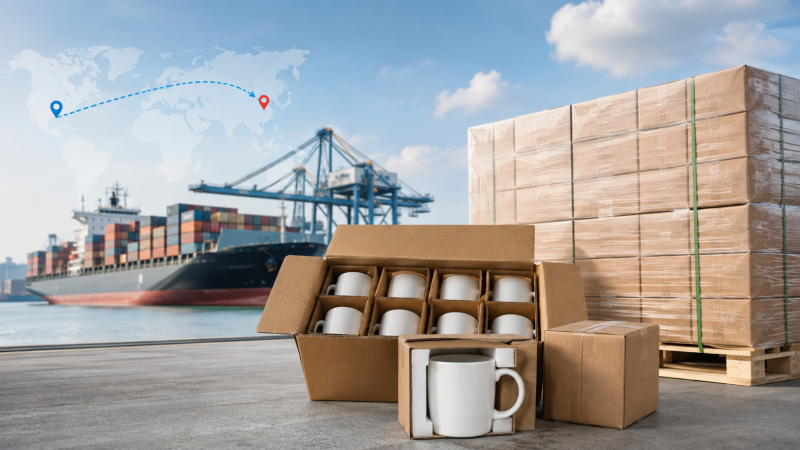
Now that you know the key metric is "landed cost," how do you actually calculate it? It's not as complex as it seems. We're going to break down the process step-by-step, showing you how to turn a risky import into a predictable and profitable business decision.
Why Is Focusing on Ocean Freight a Costly Mistake?
You get a quote for ocean freight and it looks incredibly low, maybe just a few hundred dollars. It feels like a bargain. However, you're only seeing the tip of the iceberg, and what's hidden underwater can sink your entire budget. The real profit-killers are the surprise fees at the destination port.
Focusing solely on a low ocean freight rate is a classic mistake for first-time importers because it typically only covers the port-to-port journey. It completely omits the mandatory—and often expensive—charges required to get your goods from the US port to your actual warehouse.
Dive Deeper: The Hidden Costs in LCL Shipping
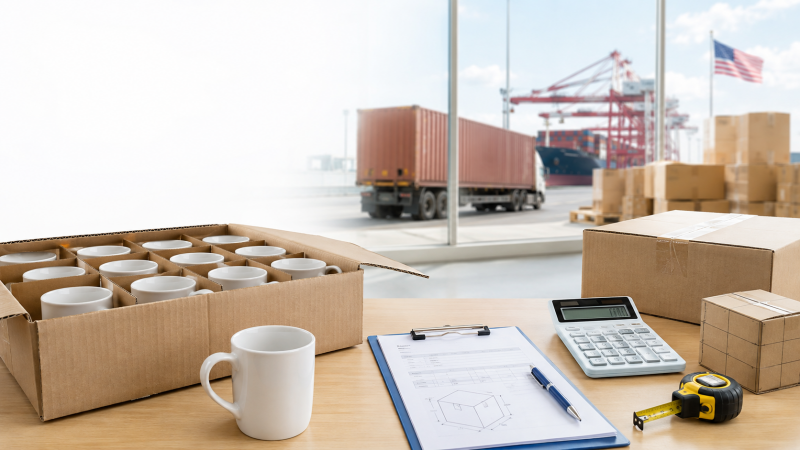
Most new importers start by shipping Less than a Container Load (LCL). This means your goods share space inside a container with shipments from other companies. While cost-effective for smaller volumes, LCL freight has a notorious number of associated fees that are bundled together at the destination.
In my 15 years helping US-based wholesalers and e-commerce sellers import ceramic mugs from China, I've seen promising ventures derailed by these "surprise" costs. An initial $400 ocean freight quote can easily balloon into a $1,500+ final bill.
Here are the costs your cheap ocean freight quote is likely hiding:
- Destination Port & Terminal Fees: Once the ship arrives, the container has to be unloaded, moved to a warehouse (a Container Freight Station or CFS), and "de-stuffed" (unpacked). You pay for all of it. These fees have names like Terminal Handling Charges (THC), CFS fees, and various document processing fees.
- Customs Clearance & Duties: Your goods must be formally declared to U.S. Customs and Border Protection (CBP). This involves:
- Customs Broker Fee: You need a licensed broker to file the paperwork. This is their service fee.
- ISF (Importer Security Filing) Fee: This must be filed before the ship leaves China. Late or incorrect filings result in a $5,000 penalty.
- Customs Bond: A type of insurance policy that guarantees CBP you will pay all duties and taxes. You'll need either a single-entry or continuous bond.
- Import Duties: This is the tax levied on your goods, calculated as a percentage of their value. Ceramic mugs (under HTS code 6912.00) have specific duty rates that must be paid.
- Last-Mile Delivery: This is the final, and often most expensive, leg of the journey. It's the cost of a truck picking up your pallet of mugs from the CFS warehouse and delivering it to your business address or Amazon FBA center. This fee can vary dramatically based on distance and whether the delivery address is commercial or residential.
A lowball freight quote conveniently leaves all these variables for you to solve, creating enormous financial uncertainty.
How Does Packaging Impact Your Ceramic Mugs Landed Cost?
You might think of packaging as just a way to prevent your mugs from breaking. That's its primary job, but for bulky items, packaging is also a critical cost-control lever. Inefficient, oversized boxes are silently inflating your ceramic mugs landed cost and eating into your profit margin with every shipment.
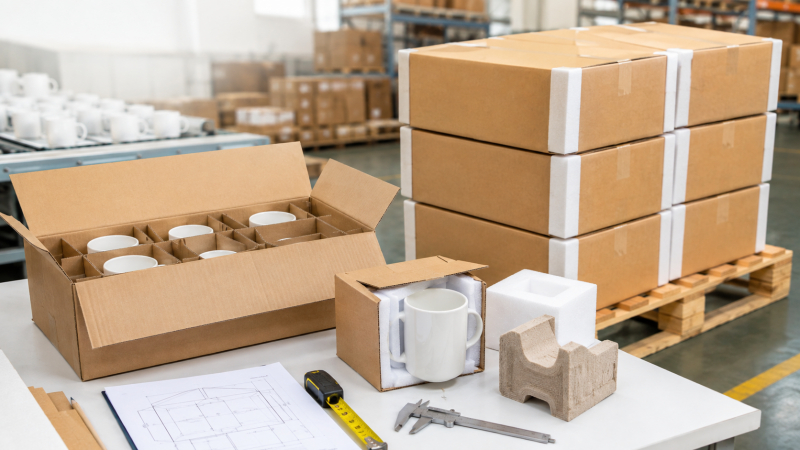
Sea freight for voluminous products like mugs is almost always calculated by volume, not weight. This volume is measured in Cubic Meters (CBM). Therefore, a smarter, more compact packaging design directly reduces your CBM, which in turn lowers your total shipping bill.
Dive Deeper: Using CBM to Your Advantage
A Cubic Meter (CBM) is the standard unit of volume in international shipping. Imagine a box that is 1 meter long, 1 meter wide, and 1 meter high—that's 1 CBM. Your freight forwarder will measure your total shipment and charge you based on the total CBM it occupies.
As a factory, this is one of the most important value-adds we provide beyond just manufacturing. We work with clients to design packaging that is both protective and space-efficient. A few centimeters saved on each master carton can translate into hundreds of dollars in savings.
H3: A Real-World Packaging Comparison
Let's look at a simple example for an order of 1,200 standard 11oz ceramic mugs.
-
Scenario A: Standard, Un-optimized Packaging
- Mugs are packed 36 per carton.
- Carton dimensions: 45cm x 35cm x 41cm.
- Total cartons: 1200 / 36 = 34 cartons (rounding up).
- Volume per carton: 0.45m 0.35m 0.41m = 0.064 CBM.
- *Total Shipment Volume: 34 0.064 CBM = 2.18 CBM.**
-
Scenario B: Optimized Packaging
- By slightly rearranging the mugs and using custom dividers, we get the same 36 mugs into a smaller carton.
- Carton dimensions: 41cm x 29cm x 38cm.
- Total cartons: 34 cartons.
- Volume per carton: 0.41m 0.29m 0.38m = 0.045 CBM.
- *Total Shipment Volume: 34 0.045 CBM = 1.53 CBM.**
Here is the impact in a table:
| Metric | Scenario A (Un-optimized) | Scenario B (Optimized) | Impact |
|---|---|---|---|
| Carton Volume | 0.064 CBM | 0.045 CBM | -30% |
| Total Volume | 2.18 CBM | 1.53 CBM | -0.65 CBM |
| Potential Savings | Baseline Cost | ~30% Lower Shipping Cost | Significant |
A 30% reduction in volume translates directly to a roughly 30% reduction in your LCL freight bill. Over multiple shipments, this adds up to thousands of dollars in pure profit, all achieved before the goods even leave our factory. This is why a good factory partner is also a logistics partner.
What is a DDP Quote and How Does It De-risk Shipping Ceramic Mugs from China to USA?
You're trying to add up quotes from a factory, a Chinese trucker, a freight forwarder, a customs broker, and a US trucking company. It's confusing, time-consuming, and you're terrified you've missed a crucial fee. A Delivered Duty Paid (DDP) quote eliminates this chaos and risk by consolidating everything into one transparent price.
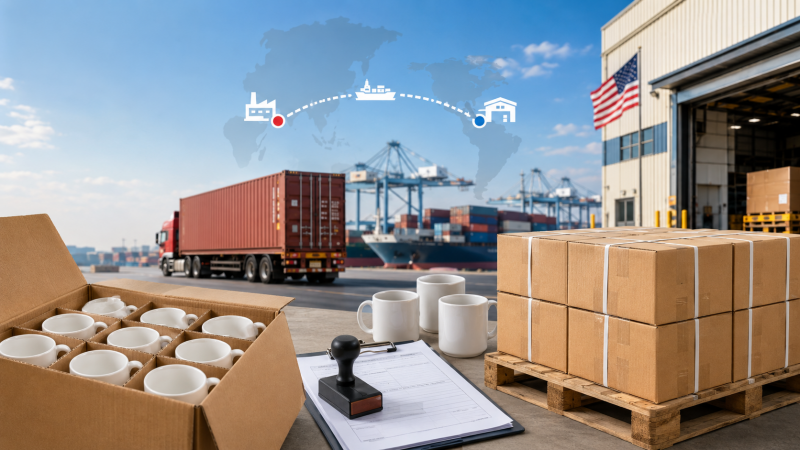
DDP shipping ceramic mugs is a specific Incoterm where we, the seller, take on the full responsibility and cost of transporting the goods all the way to your specified US address. This all-inclusive price covers manufacturing, shipping, insurance, customs clearance, and all duties, giving you a precise landed cost per unit.
Dive Deeper: Deconstructing a DDP Quote
A DDP quote is the "Rosetta Stone" for understanding your total costs. It forces all potential fees out into the open. It’s important to clarify that as a factory, we are not a logistics company. We achieve this by partnering with a trusted, vetted freight forwarder who specializes in the China-US trade lane. This partnership allows us to provide you with a seamless, all-in-one quote.
Let's break down an anonymized DDP quote I recently prepared for a client importing 1,200 mugs to their warehouse in California. This is the ultimate tool for calculating your ceramic mugs landed cost.
H3: Sample DDP Quote Breakdown (for 1,200 mugs / 1.53 CBM)
| Line Item | Description | Sample Cost (USD) | What It Covers |
|---|---|---|---|
| Product Cost (EXW) | 1,200 mugs @ $1.50/unit | $1,800.00 | Cost of manufacturing the mugs. |
| Origin Charges | Trucking to Port, Export Customs | $150.00 | Getting goods from our factory to the port in China. |
| Ocean Freight | LCL Sea Freight (1.53 CBM) | $380.00 | The actual cost of sea transport from China to the US. |
| Destination Charges | Port Fees, CFS, ISF, Bond | $450.00 | All the "hidden fees" at the US port. |
| Customs Duty | (e.g., 10% of Product Value) | $180.00 | The tax paid to US Customs (rate varies). |
| Last-Mile Delivery | Trucking from CFS to Client's Door | $350.00 | Final delivery to your specified address. |
| TOTAL DDP COST | All-Inclusive Price | $3,310.00 | The total cost to get the goods to you. |
With this DDP quote, the client knows their total cost is exactly $3,310.00.
- Total Landed Cost: $3,310.00
- Number of Units: 1,200
- Landed Cost Per Unit: $3,310 / 1,200 = $2.76
Now, the client can make a confident business decision. They know that if they can sell each mug for more than $2.76, they will make a profit. The risk of surprise fees is eliminated. This is the power of demanding a DDP quote when shipping ceramic mugs from China to USA.
Frequently Asked Questions
How long does it take to ship ceramic mugs from China to the US by sea?
Door-to-door, LCL sea freight from our factory in China to a US warehouse typically takes between 35 and 55 days. This includes production time, inland trucking in China, ocean transit (20-30 days), customs clearance (3-7 days), and final-mile delivery in the US.
What is an HTS code for ceramic mugs?
The Harmonized Tariff Schedule (HTS) code is used by customs to classify goods and apply the correct duty rate. For common ceramic mugs, the code is often under heading 6912.00. However, specific materials and designs can change the code. It is essential to verify the correct HTS code with a licensed customs broker.
Can I use my own freight forwarder instead of DDP?
Absolutely. If you use your own forwarder, you would ask us for a quote based on FOB (Free On Board) Incoterms. This means our responsibility ends once we deliver the goods to the designated port in China. This gives you more control but also means you are responsible for arranging and paying for everything from that point onward.
What is the minimum order quantity (MOQ) for importing ceramic mugs?
Our typical MOQ for custom mugs is around 1,000 to 1,200 units. This quantity is not just for manufacturing efficiency; it also helps create a cost-effective shipment. Shipping a very small quantity (e.g., 200 mugs) via sea freight can result in a very high per-unit shipping cost, as many of the base fees are fixed.
Conclusion
The anxiety around the ceramic mug shipping cost from China can be completely managed with the right approach. Stop fixating on misleadingly low ocean freight rates. Instead, make your entire importing strategy about determining your total ceramic mugs landed cost. You achieve this by partnering with a factory that helps you optimize packaging to reduce shipping volume and by demanding a comprehensive DDP quote that leaves no room for surprises. This turns shipping ceramic mugs from China to USA from a gamble into a predictable, data-driven part of your business.
If you are ready to get a clear, all-inclusive DDP quote for your next ceramic mug order, contact our team. With 15 years of experience exporting to the US, we're here to help you import with confidence and clarity.