Struggling with the classic sea freight vs air freight dilemma for your ceramic mug restock? You know sea freight seems cheaper, but the 30-50 day transit time could mean costly stockouts. Air freight is fast, but you worry the high cost will destroy your profit margins. The solution is to look beyond the basic freight quote and calculate the true landed cost.
For small, urgent restock orders of ceramic mugs (typically under 2 cubic meters), air freight is often more profitable than Less-than-Container-Load (LCL) sea freight. This is because the high, fixed destination fees of sea LCL can erase initial savings, while the speed of air freight prevents lost sales from stockouts, improving your overall ROI.
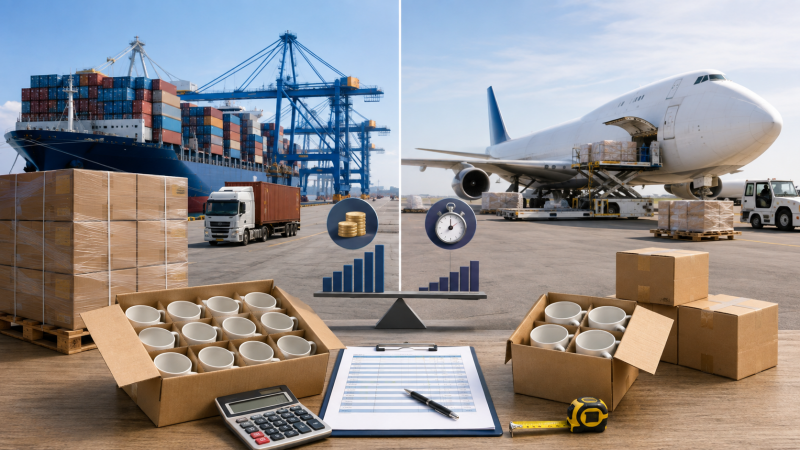
This might seem counterintuitive. As a sales advisor at a Chinese ceramic factory for over 15 years, I've guided hundreds of e-commerce sellers through this exact decision. Let's break down the real numbers and explore the factors beyond the freight quote so you can make the smartest choice for your business.
What Are the Hidden Costs of Sea Freight for Small Orders?
You've received a sea freight quote that looks incredibly low, making it seem like the obvious choice. But you're worried about surprise charges when the shipment arrives. What are these "hidden fees" and can they really make sea freight more expensive than air?
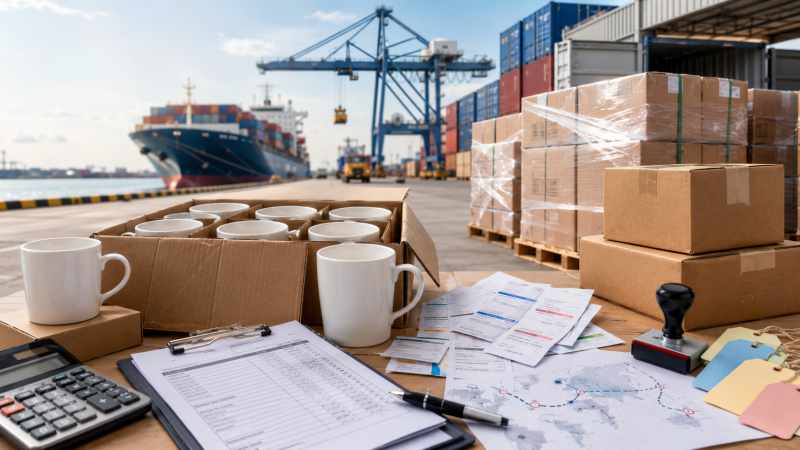
The primary hidden costs are the fixed destination fees associated with LCL sea shipments. Unlike a simple air freight quote, an LCL quote often separates the ocean transit cost from the significant handling, customs, and port charges you'll pay upon arrival.
Dive Deeper: The LCL Cost Breakdown
When you ship via LCL, your small shipment is consolidated into a large container with goods from other importers. The initial freight cost you're quoted only covers the ocean journey. The real financial surprise comes at the destination port.
Here’s why: the container must be moved from the vessel, taken to a warehouse, deconsolidated (unpacked), and your specific pallet must be processed. Each of these steps has a fee, and they are largely fixed costs, regardless of whether your shipment is 0.5 CBM or 5 CBM.
Common destination fees for LCL shipments include:
- Terminal Handling Charges (THC): Fees charged by the port for handling the container.
- Deconsolidation Fee: The cost for the warehouse to open the container and separate your goods.
- Customs Brokerage: The fee paid to a broker to clear your shipment through customs.
- Duties and Taxes: Calculated based on your product's value and HS code.
- Warehouse Fees: Storage fees if your shipment isn't picked up immediately.
- Drayage/On-Carriage: The cost to transport your shipment from the port or warehouse to its final destination (e.g., your FBA warehouse).
Let's look at a real, anonymized cost comparison I recently prepared for a client ordering 500 mugs (about 1.5 CBM) to a US West Coast address.
| Cost Component | Sea Freight (LCL) Example | Air Freight Example |
|---|---|---|
| Origin Charges + Freight | $250 | $1,500 |
| Customs Clearance | $150 | $150 |
| Port/Terminal Handling | $200 | $0 |
| Deconsolidation Fee | $120 | $0 |
| Drayage (Port to Warehouse) | $300 | $150 (included in door-to-door) |
| Total Landed Cost | $1,020 | $1,650 |
| Cost Per Mug | $2.04 | $3.30 |
| Transit Time | ~40 days | ~7 days |
As you can see, the initial $250 sea freight quote balloons to over $1,000 once the destination fees are added. While air freight is still more expensive in this scenario, the gap is much smaller than the initial freight quote suggests. For a slightly smaller shipment, say 300 mugs, the fixed sea freight fees would remain nearly the same, making the per-unit cost even higher and potentially equal to air freight.
Where is the "Tipping Point" for Choosing Air Freight Over Sea Freight?
You understand that small sea shipments have high fixed costs, but you're still not sure when it makes financial sense to switch to air. You need a clear rule or "tipping point" to guide your decision-making process for urgent restocks.
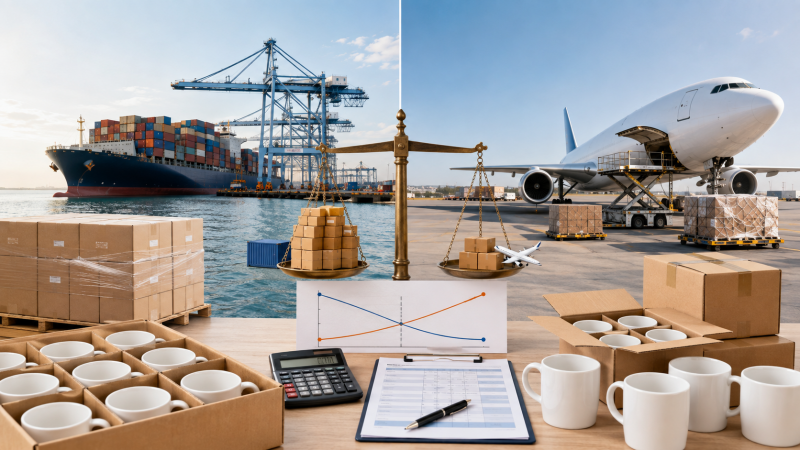
The tipping point between sea freight vs air freight is the volume at which the total landed cost of air freight becomes competitive with, or even cheaper than, LCL sea freight. For fragile, bulky items like mugs, this point is generally for shipments under 2 cubic meters (CBM).
Dive Deeper: Calculating the True Value of Speed
The "tipping point" isn't just a cost calculation; it's an ROI calculation. For e-commerce sellers, the biggest risk is stocking out of a popular item. Let's imagine your best-selling mug generates $50 in profit per day.
- Sea Freight Scenario: A 40-day transit time means 40 days of no sales if you're stocked out. That's $2,000 in lost profit.
- Air Freight Scenario: A 7-day transit time means you're back in stock in a week. You only lose 7 days of sales, or $350 in lost profit.
In this case, the extra cost of air freight is easily justified by the $1,650 in profit you saved by avoiding a prolonged stockout. This lost revenue is a real cost that must be factored into your sea freight vs air freight decision.
From my experience, the tipping point is most relevant for:
- Urgent Restocks: When you've had an unexpected sales spike and need inventory now.
- Seasonal Peaks: Getting mugs in stock for Christmas or Mother's Day a month late means you've missed the entire sales window. A client of mine nearly missed the Q4 holiday rush. We split their order, sending a small batch by air to get them selling immediately while the larger portion followed by sea.
- Test Orders: When launching a new design, air freighting a small batch allows you to test the market quickly without committing a large amount of capital to a slow-moving sea shipment.
The volume where this makes sense is usually between 1-2 CBM. To give you a concrete idea, a standard 11 oz mug in a simple mail-order box is about 0.003 CBM.
- 1 CBM ≈ 330 mugs
- 2 CBM ≈ 660 mugs
If your order is in this range, you should always request a fully-landed cost comparison for both air and LCL sea freight. Don't let a low initial sea freight quote trick you into a decision that costs you more in the long run.
How Does Mug Packaging Impact Shipping Costs in Sea Freight vs Air Freight?
You've got your quotes, but now you're being asked about packaging choices. Does putting your mugs in a fancy gift box versus a simple bulk tray really change the shipping cost that much?
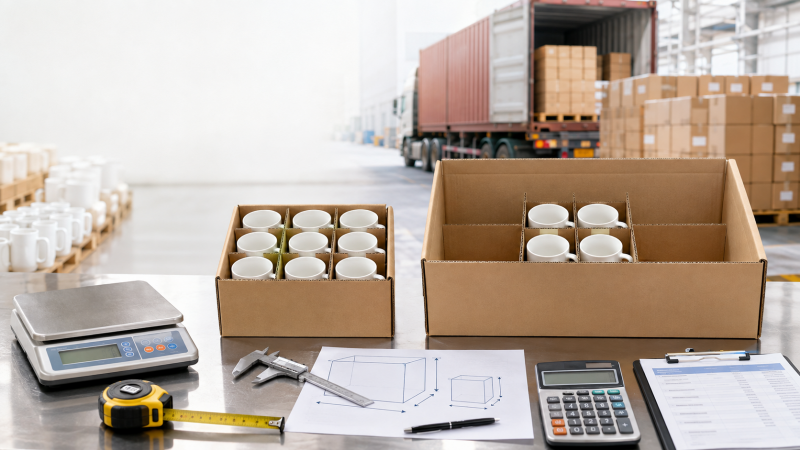
Yes, packaging dramatically affects shipping costs because both air and sea freight are priced based on whichever is greater: the actual weight or the volumetric weight. As a factory specializing in mugs, we know that bulky packaging can easily double your chargeable weight, significantly altering your sea freight vs air freight calculation.
Dive Deeper: The Power of Volumetric Weight
Freight carriers have to account for the space a shipment takes up in a plane or container, not just how heavy it is. This is called volumetric weight (or dimensional weight). Mugs are a classic example of a product where volume, not weight, is the primary cost driver. They are relatively light but take up a lot of space, especially with protective packaging.
The formula is generally:
(Length x Width x Height in cm) / Divisor = Volumetric Weight in kg
- The divisor is typically 6000 for air express and 5000 for standard air freight.
- For sea LCL, the cost is simply per cubic meter (CBM).
Let's see how this plays out with two common packaging options for an 11 oz mug:
- Bulk Packaging: Mugs are placed in cardboard trays with dividers. This is the most space-efficient method.
- Dimensions per mug (effective): 12cm x 9cm x 10cm
- Volume: 0.00108 CBM
- Individual Gift Box: Each mug is in its own retail-ready box, often with a foam insert for protection.
- Dimensions per mug: 15cm x 13cm x 12cm
- Volume: 0.00234 CBM
The individual gift box takes up more than double the space of the bulk-packed mug. For a 500-mug order, this is the difference between a 0.54 CBM shipment and a 1.17 CBM shipment.
This has a huge impact on your costs:
- For Sea LCL: Your shipping cost will more than double because you are paying per CBM.
- For Air Freight: Your volumetric weight will more than double. An air freight quote that seemed manageable for a bulk-packed order can become astronomical for a gift-boxed one.
This is where working directly with an experienced factory adds value. We don't just sell you mugs; we advise on packaging. We can help you find a solution that offers enough protection for transit while minimizing volumetric weight. For example, we might recommend a custom-designed, compact box that provides better protection than a standard gift box but takes up 30% less space. This product-specific expertise is something a general freight forwarder simply cannot offer.
Why Is Air Freight Better for Your Cash Flow?
You're focused on the per-unit cost, trying to get it as low as possible. But have you considered how your shipping choice affects your company's most important resource: cash?
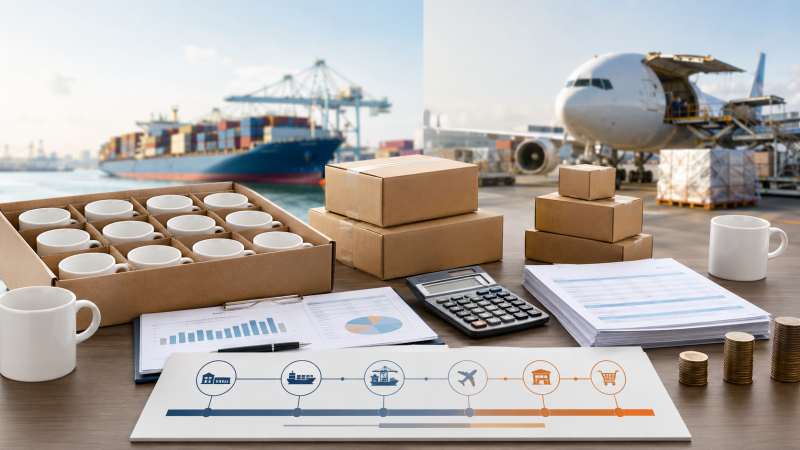
Choosing air freight over sea freight is often a strategic decision to improve cash flow. While the per-unit shipping cost may be higher, the faster transit time means your capital isn't tied up in inventory on a boat for over a month. You can convert your products back into cash much more quickly.
Dive Deeper: Inventory as an Investment, Not Just a Cost
For an e-commerce business, inventory is your primary investment. The goal is to turn that investment back into cash (with a profit) as quickly as possible. This is called inventory turnover. The choice between sea freight vs air freight directly impacts this cycle.
Let's consider a $5,000 order of mugs.
-
Sea Freight Cycle:
- Day 1: You pay for your inventory ($5,000).
- Day 1-40: Your $5,000 is unavailable, sitting on a ship in the middle of the ocean. You can't sell the product or reinvest the cash.
- Day 41: The goods arrive.
- Day 45: The goods are checked into your warehouse and are available for sale.
- Result: Your capital was tied up for 45 days before you could even begin to earn it back.
-
Air Freight Cycle:
- Day 1: You pay for your inventory ($5,000).
- Day 1-7: Your inventory is in transit.
- Day 8: The goods arrive and are available for sale.
- Result: Your capital was tied up for only 8 days. You can start selling and recouping your investment 37 days earlier than with sea freight.
This 37-day advantage is massive. It means you can:
- Reinvest Faster: Use the cash from sales to place your next order sooner.
- React to Market Trends: Quickly pivot to a new, popular design without waiting a month and a half for your old stock to arrive.
- Reduce Risk: You have less capital at risk at any given time. If a product turns out to be a slow seller, you found out faster and with a smaller initial order.
For many small to medium-sized e-commerce sellers, the improved cash flow and business agility offered by air freight for small, regular restocks far outweigh the higher sticker price. It's a strategic investment in the speed and health of your business.
Frequently Asked Questions
Is sea freight always cheaper for mugs?
No. For large, planned orders (e.g., a full container), sea freight is almost always cheaper on a per-unit basis. However, for small LCL (Less-than-Container-Load) shipments, typically under 2 CBM, the high fixed destination fees can make the total landed cost of sea freight surprisingly close to, or even more expensive than, air freight.
What is LCL shipping?
LCL stands for Less-than-Container-Load. It's a sea shipping method where your goods, which are not enough to fill a full container, are consolidated with goods from other shippers into one container. While the initial freight cost is low, you share the costs of deconsolidating the container at the destination port, which can be expensive.
How long does sea vs. air freight take from China to the US?
This can vary greatly. Typically, sea freight from China to the US West Coast takes about 30-40 days, including port handling and customs. To the East Coast, it can be 40-50 days. Air freight is much faster, usually taking 5-10 days from our factory door in China to your door in the US.
Can you mix air and sea freight for a large order?
Yes, this is a very smart strategy that we often recommend. If you have a large order but need some inventory urgently, we can ship a small portion (e.g., 10-20%) by air to get you back in stock quickly, while the rest of the shipment follows by the more economical sea freight.
Conclusion
Choosing between sea freight vs air freight is more than a simple cost comparison; it's a strategic business decision. While sea freight offers the lowest per-unit cost for large, planned shipments, it's not always the right answer for smaller, urgent restock orders. By looking beyond the initial freight quote to the total landed cost—including hidden destination fees—you'll see that air freight can be surprisingly competitive. When you also factor in the cost of lost sales from stockouts and the negative impact of slow-moving capital on your cash flow, air freight often emerges as the most profitable choice for keeping your e-commerce business agile and in stock.
As your manufacturing partner, our goal is to help you make the most profitable decision for your specific situation. We provide transparent, fully-landed cost comparisons and advise on packaging to optimize your shipping. If you're planning your next ceramic mug order, contact us. Let's build a logistics strategy that works for you.