Staring at a calendar, trying to figure out when your shipment will arrive? The success of your entire season can hinge on the timing of your international mug shipping. Many importers focus only on the time a vessel spends at sea, leading to stockouts during peak season and frustrated customers. The real solution lies in understanding the entire journey, not just one part of it.
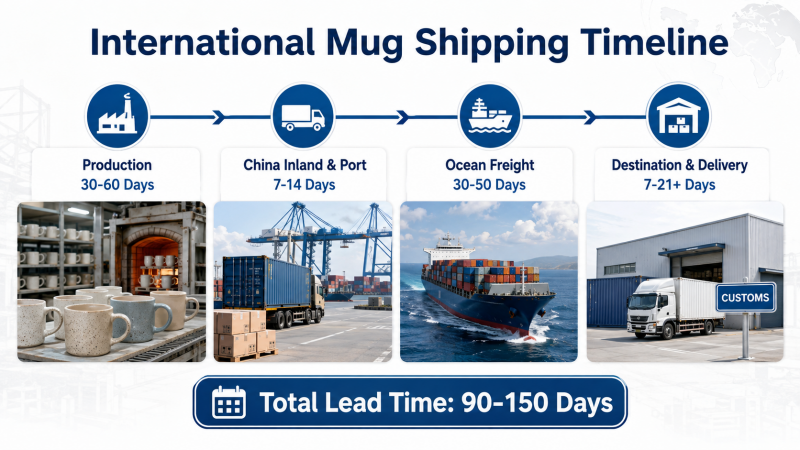
While the ocean transit portion of international mug shipping typically takes 30 to 50 days, the total procurement lead time from placing your order to receiving the goods in your warehouse is often 90 to 150 days. This complete timeline includes production, inland transit in China, port procedures, ocean freight, and final customs clearance and delivery at your destination.
That 30-50 day transit time is just one piece of a much larger and more complex puzzle. As an export manager who has overseen this process for 15 years, I want to pull back the curtain and show you the full picture. Let's break down the hidden stages and variables that can make or break your import schedule.
Why Is "Total Lead Time" More Important Than Shipping Time?
You've found the perfect mug design and calculated your profit margins. It feels like the hard part is over. But a costly mistake I often see importers make is focusing only on the 30-50 days at sea. This oversight can sink an entire sales season. What are you missing?
"Total lead time" is the complete duration from the moment you confirm your order to when the mugs are physically in your warehouse, ready to sell. It includes production, inland logistics, ocean freight, and destination logistics. Ignoring the stages before and after the ship leaves port is the single most common reason for import delays and stockouts.
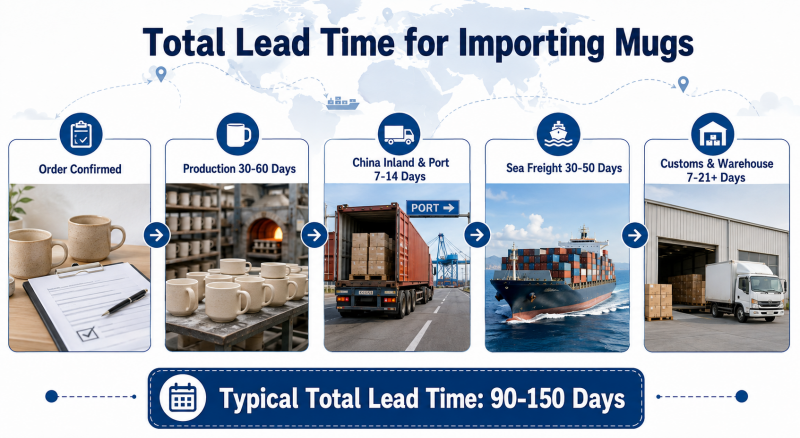
Let's dive deeper into what this really means for your business. For a typical order of ceramic mugs from our factory in Liling, China, the timeline is a multi-stage process. I've seen countless new importers get this wrong by simply adding 40 days to their order date and expecting a delivery. The reality is far more involved.
H3: The Four Critical Phases of Your Order
To truly manage your inventory and sales calendar, you need to understand each phase of the journey.
Phase 1: Pre-Production & Production (30–60+ days) This is where your mugs are born, and it's often the longest part of the process.
- Confirmation & Materials: Once you approve the sample and place the deposit, we procure the raw clay, glazes, and any specific materials needed for your design.
- Molding & Forming: The mugs are shaped from clay. If you have a custom shape, this phase is preceded by a 20-30 day mold development process. This is a critical detail many forget.
- Firing & Glazing: The mugs go through multiple firings in the kiln, a process that cannot be rushed.
- Decoration & Quality Control: Decals are applied, handles are attached, and every single piece is inspected for defects. Our ISO9001 certification means we have strict quality gates here.
Phase 2: China Inland & Port Operations (7–14 days) Your mugs are finished, but they are still deep inside China.
- Inland Trucking: Your order is carefully packed and trucked from our factory in Hunan to a major port like Shanghai or Shenzhen. This can take several days.
- Export Customs & Warehousing: The goods must be cleared by Chinese customs. They are then consolidated at a port warehouse and booked onto a specific vessel.
Phase 3: Ocean Freight (30–50 days) This is the part everyone thinks of as "shipping."
- Sea Transit: The container ship travels from China to your destination country. The time varies greatly:
- To West Coast USA/Canada: ~30-35 days
- To East Coast USA/Canada: ~40-45 days
- To Europe (e.g., Rotterdam, Hamburg): ~35-45 days
- To South America (e.g., Brazil): ~40-50 days
Phase 4: Destination Port & Final Delivery (7–21+ days) Your mugs have arrived in your country, but they're not in your hands yet.
- Unloading & Port Handling: The container is offloaded from the ship.
- Customs Clearance: This is a major variable. Your shipment must be cleared by your country's customs agency. It can be quick, or it can be selected for a physical inspection, adding days or even weeks.
- Inland Delivery: Once released, the container is trucked from the port to your final warehouse.
| Phase | Typical Duration | Key Activities |
|---|---|---|
| Production | 30–60 days | Molding, firing, glazing, QC. Add 30 days for new custom molds. |
| China Inland/Port | 7–14 days | Trucking to port, export customs, container booking. |
| Ocean Freight | 30–50 days | The actual time the vessel is at sea. |
| Destination/Final Mile | 7–21 days | Import customs clearance, port handling, trucking to warehouse. |
| Total Estimated Time | 74–145 days | Your true planning window. |
What Hidden Factors Can Delay Your Mug Order?
You've built a buffer into your timeline, but your shipment is still late. You're frustrated, and your freight forwarder is giving you vague answers. What's really going on behind the scenes that only a factory insider would know?
Beyond the standard timeline, delays in international mug shipping are often caused by "insider variables" like production complexity, supply chain shocks, and peak season congestion. For instance, a complex decal can add a week to production, while pre-Christmas port congestion can double the time it takes to get your container on a ship.
These factors are rarely discussed by shipping companies, but they have a massive impact on your delivery date. Understanding them is the key to protecting your business from costly surprises.
H3: The Cost of a Miscalculation: A Cautionary Tale
I once worked with a client, an ambitious e-commerce seller in the US, who learned this the hard way. He had a fantastic design for a Christmas-themed mug and planned to launch it for the Q4 holiday season. He contacted us in late August, looked up the 35-day shipping time to California, and figured an October delivery was a sure thing.
He was focusing on just one number. What he didn't factor in was:
- Our 45-day production queue at that time of year.
- The pre-Golden Week holiday rush at the port, which added 10 days just to book a container.
We did everything we could, but production wasn't finished until early October. The mugs didn't get loaded onto a vessel until the third week of October. They finally arrived at his warehouse in the first week of December, missing Black Friday, Cyber Monday, and most of the Christmas shopping window. A potential bestseller became dead stock he had to liquidate in January at a steep loss.
H3: Insider Variables You Need to Plan For
My client's story is a common one. It's almost always a result of these hidden variables:
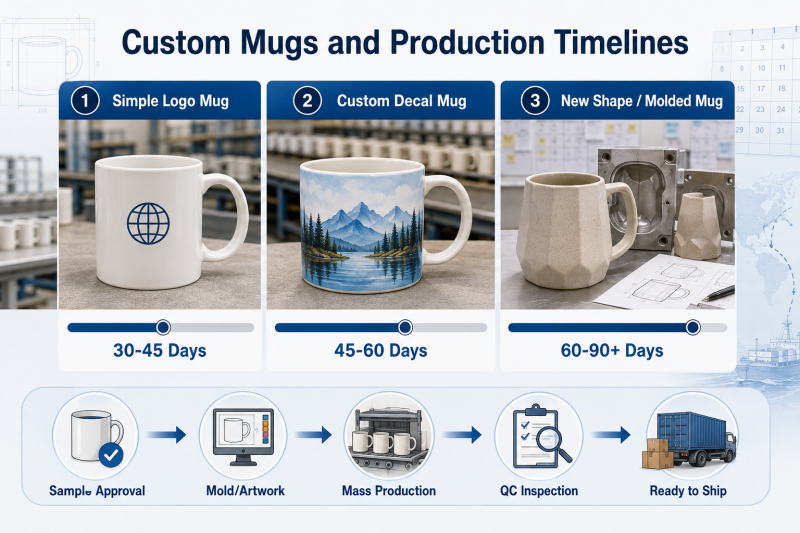
- Customization Complexity: The more unique your mug, the longer it takes. A simple white mug with a one-color logo is fast. A custom shape requiring a new mold adds 30 days before mass production even begins. A complex, wrap-around decal that requires manual application takes longer than a simple print. Special reactive glazes need more rigorous testing.
- Supply Chain Shocks: The world is unpredictable. I remember a few years ago when new local environmental policies required us to upgrade our kilns, causing an unexpected two-week production halt for an audit. Another time, a global shortage of a specific cobalt pigment used in a popular blue glaze delayed a client's order by three weeks while we sourced an alternative. These aren't daily events, but they happen.
- Peak Season Squeeze: This is the most predictable "unpredictable" factor. The global logistics network is stretched to its breaking point during certain times of the year.
- Pre-Chinese New Year (Dec-Jan): Everything accelerates as businesses rush to ship before the country shuts down for 2-3 weeks.
- Post-Chinese New Year (Feb-Mar): A massive backlog of orders floods out of factories, creating huge port congestion.
- Pre-Christmas Rush (Aug-Oct): This is the big one for Western importers. Factories are at max capacity, container space is scarce and expensive, and ports on both ends of the journey are jammed. Waiting until September to ship for Christmas is a recipe for disaster.
How Can You Manage Timelines for International Mug Shipping?
Knowing all the potential delays can feel overwhelming. Does this mean importing mugs is just a gamble you have to accept? Not at all. How can you shift from being a reactive victim of delays to a proactive manager of your supply chain and protect your business?
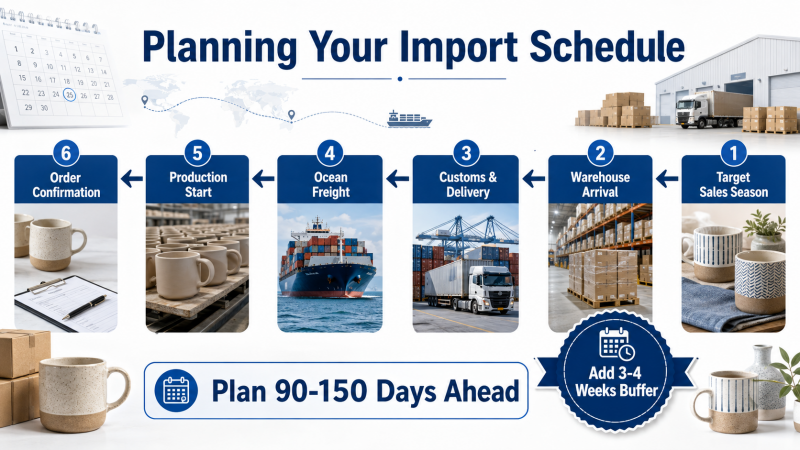
The key is to proactively manage your timelines through clear communication, strategic planning, and building an intelligent buffer. For example, our most successful clients confirm their Q4 holiday orders with us in May or June, not August. This allows them to avoid the peak season rush and guarantee their products are on shelves, not on a boat.
Let's turn this knowledge into an actionable strategy. Here are the steps I recommend to every client to ensure a smooth and predictable import process.
H3: Your Proactive Planning Checklist
Follow this checklist to take control of your international mug shipping timeline.
-
Communicate Early and Often: Before you even place an order, have a detailed conversation with your supplier. Don't just ask for the price. Ask the right questions:
- "What is your current production lead time for an order of this size and complexity?"
- "Are there any upcoming factory or national holidays I should be aware of?"
- "Based on everything, what is your realistic 'ready-to-ship' date from the factory?" A good partner will give you honest, detailed answers.
-
Build Your Buffer: Never plan your marketing or sales calendar based on the best-case-scenario timeline. I always advise clients to add a 3-4 week buffer to the total estimated lead time. Think of it as business insurance. It’s far better for your mugs to be sitting in your warehouse a few weeks early than to arrive a day late for a major holiday.
-
Order Off-Season: This is the biggest secret of successful importers. They work backward from their "in-warehouse" date. To have stock for the November/December holiday rush, they ensure their order is on the water by August. This means they are finalizing designs and placing orders with us in May and June. They avoid the production queues, port congestion, and inflated shipping rates of the Q3 peak season.
-
Understand Shipping Terms (Briefly): Know what you're responsible for. Most factories, including ours, quote prices on FOB (Free On Board) terms. This simply means our price includes manufacturing the product and handling all the logistics to get it loaded onto the ship at the Chinese port. From that point forward, the shipment is managed by your chosen freight forwarder. Clarifying this helps you understand who is responsible at each stage.
-
Choose a Reliable Partner: Your factory is more than a vendor; we are your partner in production. And your freight forwarder is your partner in logistics. A good supplier will be transparent about production timelines. A good forwarder will give you realistic transit estimates and help you navigate the complexities of customs. Don't choose partners based on the lowest price alone; experience and reliability are worth their weight in gold.
Frequently Asked Questions
What's the difference between LCL and FCL shipping?
FCL (Full Container Load) means you book and pay for an entire shipping container for your goods. LCL (Less than Container Load) means your goods share space in a container with shipments from other companies. LCL is often more cost-effective for smaller orders but can sometimes take a few days longer due to the extra time needed to consolidate and then deconsolidate the container at both ports.
Does air freight make sense for mugs?
Almost never. Mugs are dense and heavy relative to their value, which makes air freight prohibitively expensive. It can cost more to fly a mug than it did to manufacture it. Air freight is typically reserved for very small shipments of high-value samples or as a costly, last-resort emergency measure to fix a major planning mistake.
How does Chinese New Year affect shipping times?
Chinese New Year (CNY), which falls in January or February, is the single largest disruption to the supply chain. Most factories and businesses close for 2-4 weeks. This creates a huge rush to ship goods out before the holiday and a massive backlog when work resumes. We advise clients to plan for a 6-week "blackout" period and place orders months in advance to avoid it.
Can you guarantee a final delivery date?
No reputable factory or freight forwarder can guarantee a final delivery date. There are too many variables outside of our direct control, such as customs inspections, weather delays at sea, or port congestion. What we can do is provide a reliable "ready to ship" date from our factory. Your success depends on using that date and planning with a smart buffer.
Conclusion
The most important takeaway is to shift your focus from the simple question of sea transit time to the more strategic question of total procurement lead time. Successful international mug shipping is not about luck; it's about smart, proactive planning. By understanding the full timeline—from our factory floor in Liling to your warehouse door—and accounting for the hidden variables of production, customs, and peak seasons, you can transform importing from a source of anxiety into a predictable and profitable part of your business. Building in a buffer and communicating clearly with your partners are the best tools you have to protect your revenue and keep your customers happy.
As a ceramics factory with 15 years of export experience to Europe and the Americas, we've helped hundreds of wholesalers and e-commerce sellers navigate this process. If you're planning your next collection and want a reliable partner who understands the full picture, contact us today. We'll help you build a realistic timeline for success.