Importing ceramic mugs seems like a straightforward way to build a profitable business, but many entrepreneurs get a nasty surprise when the final bill arrives. Hidden costs and unexpected fees can quickly erode your margins, turning a promising venture into a financial headache. The key to protecting your profit is understanding that calculating import duties on ceramic mugs isn't about a single percentage; it's a detailed process that starts with the product itself.
To calculate import duties on ceramic mugs, you must first identify the correct Harmonized System (HS) code for the specific product. This code is determined by the mug's material (e.g., earthenware, stoneware, porcelain), which has a corresponding tariff rate in your country's customs schedule. The total duty is this rate applied to the customs value of the goods (often the cost, insurance, and freight), plus any applicable anti-dumping or countervailing duties.
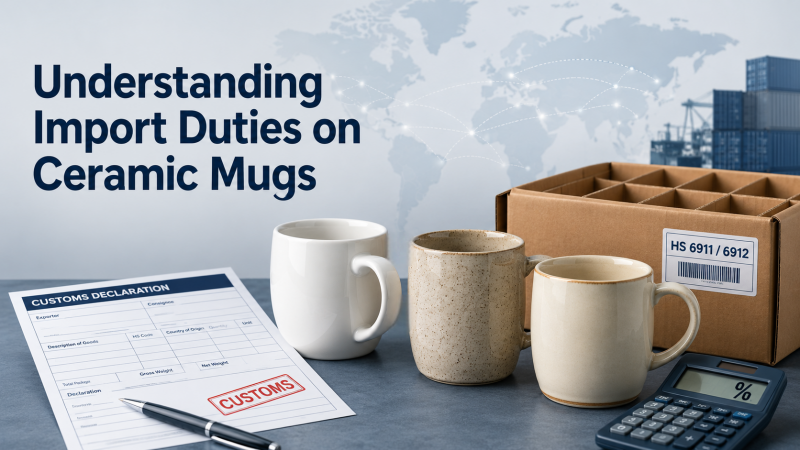
Now that you have the direct answer, you might be wondering why the material matters so much and what other hidden costs could be lurking. Understanding these details is the difference between a successful import business and one that struggles with unexpected expenses. Let’s dive deeper into the process.
Why Does the Mug's Material Change the Import Duty?
You've found a supplier with fantastic prices on beautiful dolomite mugs and you're ready to place a large order. You look up a generic duty rate for "ceramic products" and factor it into your costs. The problem is, if customs classifies your product under a more specific—and higher-taxed—HS code, you could be facing a surprise bill that jeopardizes your entire shipment. The specific type of ceramic is the single most important factor in your duty calculation.
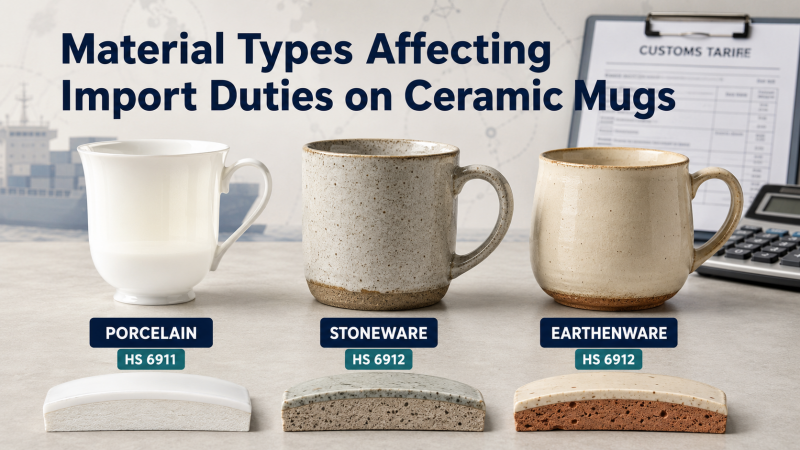
Different ceramic materials like earthenware (which includes dolomite), stoneware, and porcelain have distinct physical properties and are produced using different methods. Because of this, customs authorities worldwide classify them under separate Harmonized System (HS) codes, and each code can have its own unique tariff rate. A porcelain mug is not the same as a stoneware mug in the eyes of customs.
The Harmonized System (HS) Code Explained
The Harmonized System is a global standard used by over 200 countries to classify traded goods. It’s a numerical language that helps customs authorities identify products and apply the correct duties and taxes. A full HS code is typically 8 to 10 digits long, but the first 6 digits are standardized internationally. These first 6 digits are what a knowledgeable supplier should be able to provide.
The key takeaway here is that "ceramic mug" is a commercial term, not a customs classification. From my 15 years of experience exporting from our factory in Liling, this is the most common point of confusion for new importers. They ask for a duty rate on "mugs," but I have to ask, "Which kind?"
Here’s a simplified breakdown of how different ceramic types might be categorized:
| Ceramic Type | Common Properties | Potential HS Code Chapter/Heading |
|---|---|---|
| Porcelain/China | Fired at high temperatures, non-porous, translucent | 6911 (Tableware...of porcelain or china) |
| Stoneware | Fired at mid-high temperatures, durable, opaque | 6912 (Ceramic tableware...other than of porcelain) |
| Earthenware/Dolomite | Fired at low temperatures, porous, less durable | 6912 (Ceramic tableware...other than of porcelain) |
Important Note: This table is for illustrative purposes only. The final HS code depends on the specific product and the importing country's regulations.
We once had a client in the European Union who assumed all our mugs would fall under the 6912.00 code. However, the order they placed was for a premium line of fine porcelain mugs. We explained that these mugs are correctly classified under HS code 6911.10. After confirming with their customs broker, they found this classification actually carried a lower duty rate in their country. This simple clarification saved them a significant amount on their first order and solidified our relationship. It’s a perfect example of how product expertise from your supplier is a direct financial asset for your business.
How Can You Avoid Underestimating Import Duties on Ceramic Mugs?
Your initial spreadsheet looks great. You’ve calculated the cost of goods, shipping, and a standard 5% duty, leaving you with a healthy 30% profit margin. The shipment arrives, and you get an invoice from your customs broker that includes a sudden 25% anti-dumping duty. Your entire profit is gone, and you may even lose money on the deal. This is a nightmare scenario, but it is avoidable. The best way to avoid underestimating import duties on ceramic mugs is by performing a thorough landed cost calculation before you ever sign a purchase order.
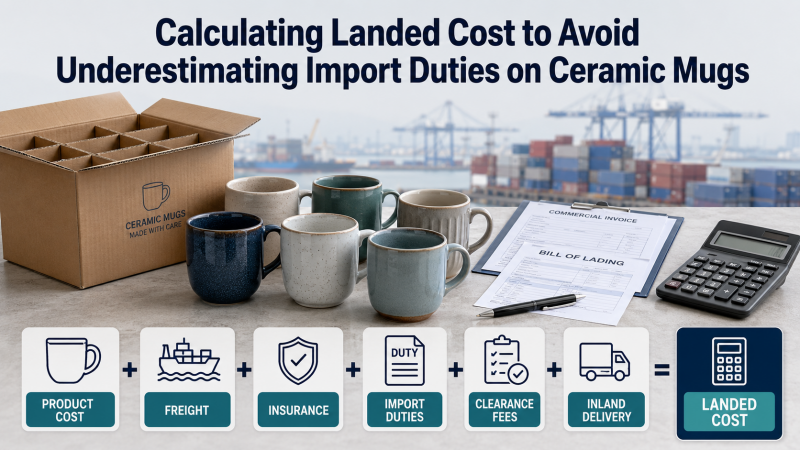
To avoid nasty surprises, you must calculate your total landed cost, not just the supplier's price plus a generic duty percentage. A true landed cost includes the product cost, freight, insurance, standard customs duties, any potential anti-dumping duties, and all local clearance fees. It is the only number that tells you the true cost of getting a product from the factory to your warehouse.
What is a Landed Cost Calculation?
A landed cost calculation is a formula that sums up all the costs associated with an international shipment. It gives you a clear picture of your per-unit cost, which is essential for accurate pricing and profit forecasting.
Here are the critical components you must include:
- Product Cost (FOB Price): This is the price you pay the factory for the goods. "FOB" (Free On Board) means the supplier is responsible for getting the goods to the departure port.
- Freight & Insurance (CIF Value): This is the cost of shipping the goods from the origin port to your destination port, plus insurance. Your customs duty is typically calculated on the CIF value (Cost + Insurance + Freight).
- Standard Customs Duty: This is the base tariff calculated using the product's HS code.
Standard Duty = CIF Value x Tariff Rate - Anti-Dumping and Countervailing Duties (ADD/CVD): This is the most dangerous hidden cost. These are extra tariffs imposed by a country to protect its domestic industries from imports that it deems are unfairly priced or subsidized. These duties can be extremely high (sometimes over 100%) and are specific to the product and its country of origin. For example, both the US and the EU have had anti-dumping measures on certain ceramic products from China in the past. It is absolutely critical to check for these with your broker.
- Other Fees: This includes customs brokerage fees, port handling charges, inspection fees, and inland transportation from the port to your warehouse.
A few years ago, a new e-commerce seller from the United States contacted us. They were comparing our stoneware mug prices to a domestic supplier and were only adding basic shipping costs to our quote. I felt it was my responsibility to advise them to check for any applicable ADD/CVD. I suggested they speak with a customs broker before committing. They discovered that while some ceramic items faced steep duties, the specific type of stoneware mug they wanted was not subject to them. By doing their due diligence, they confidently placed a large order and built a profitable business line, a partnership that continues to this day.
What Is Your Supplier's Role in Calculating Import Duties on Ceramic Mugs?
You're busy and just want a simple, all-inclusive price. It's tempting to ask your supplier for a DDP (Delivered Duty Paid) quote, where they handle everything. However, this approach often hides significant markups for the service and leaves you powerless and uninformed about your true cost structure. A truly professional supplier doesn't just give you a price; they empower you with the correct information so you can manage your costs effectively.
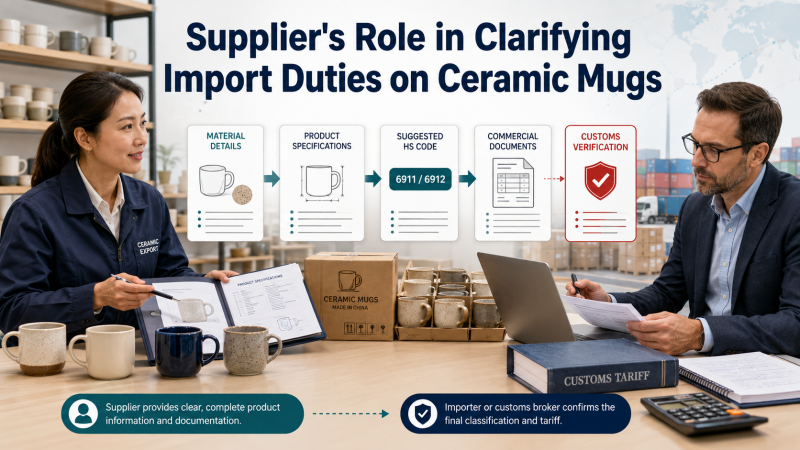
A responsible supplier's role is not to be your customs broker or legal advisor. Instead, their job is to be a product expert who provides the precise, verifiable information you need. For us, this means giving you a full technical sheet with the material composition (e.g., "high-fired stoneware, >3% water absorption"), intended use, and the 6-digit HS code we use for export. You can then take this information to your own customs broker to confirm the final classification and duty rate in your country.
Why FOB/CIF + HS Code is Better Than DDP
Many new importers are drawn to DDP shipping terms because it seems to remove the complexity of customs. While it can be convenient for small, low-value shipments, it's a risky strategy for wholesale B2B orders.
- DDP (Delivered Duty Paid): The supplier arranges and pays for everything: shipping, insurance, and all import duties and taxes. The downside is a total lack of transparency. The supplier's DDP price will include a buffer to cover any potential customs issues, and you'll never know the true cost of each component. If they misclassify the goods, you could still be held liable by your country's customs authority down the line.
- FOB (Free On Board) or CIF (Cost, Insurance, Freight): Under these terms, you (the importer) take control of the shipment once it arrives in your country. This might seem like more work, but it gives you complete visibility and control over the most unpredictable costs. You work with your own customs broker, someone who is legally representing your interests, to ensure the goods are classified correctly and the duties are paid accurately. This is how you build a scalable, predictable, and resilient supply chain.
As a manufacturer with BSCI and ISO9001 certifications, we believe in transparency. Our process is clear: we provide a detailed quote on FOB or CIF terms. With that quote, we provide a product specification sheet and the 6-digit HS code based on our material expertise. We always end our emails with the same advice: "Please share this information with your customs broker to verify the accurate duty rate for your import." This collaborative process has been the foundation of our long-term partnerships with wholesalers and e-commerce sellers across the Americas and Europe for over 15 years.
Frequently Asked Questions
What is an HS code?
An HS (Harmonized System) code is an international standard for classifying goods. It's a number that tells customs officials exactly what a product is so they can apply the correct taxes, duties, and regulations. The first six digits are generally the same worldwide.
Can my supplier guarantee the import duty rate?
No, and you should be wary of any supplier who says they can. The duty rate is set and enforced by the government of the importing country. A good supplier provides the accurate product information and HS code needed for you or your broker to determine the official rate.
What are anti-dumping duties?
Anti-dumping duties are extra tariffs that a country's government can place on imported goods that it believes are being sold for less than fair market value. They are designed to protect domestic industries and can be very high, making them a critical risk to assess before importing.
Is a DDP price better for a new importer?
While it appears simpler, DDP (Delivered Duty Paid) often leads to higher costs and a lack of control. You pay a premium for the convenience and have no visibility into the actual duty and shipping costs. For building a sustainable business, we recommend learning the process with FOB or CIF terms.
Conclusion
Successfully importing products is about managing details, and few details are as financially important as customs classification. Remember that there is no single magic number for import duties on ceramic mugs. The final cost is a direct result of the mug’s specific material—be it dolomite, stoneware, or porcelain—which dictates its HS code. Underestimating these costs by ignoring nuances like anti-dumping duties is one of the biggest risks to your profitability. The best strategy is to partner with a supplier who values transparency and provides you with the detailed product information you need. By requesting an FOB or CIF price along with the HS code, you empower yourself to work with your own customs broker to calculate your true landed cost and build a resilient, profitable business.
If you are looking for a reliable manufacturing partner that understands the importance of clear documentation for calculating your landed cost, please reach out. We have helped hundreds of importers in Europe and the Americas build successful businesses, one well-documented shipment at a time.