Are you an importer constantly under pressure to reduce costs, often starting with your product's packaging? It seems like a quick win, but this approach is a trap. The small amount you save on a cheaper box can lead to catastrophic losses from breakage, customer complaints, and brand damage, quietly destroying your profit margin. Understanding the right export packaging standards for your specific needs is the real key to protecting your products, your reputation, and your bottom line.
Export packaging standards are not a single, universal rulebook. Instead, they are a customized set of requirements designed to ensure a product arrives safely to its final destination. These standards must account for the product's fragility, the entire supply chain journey, and the specific sales channel, from factory pallet to a customer's doorstep.
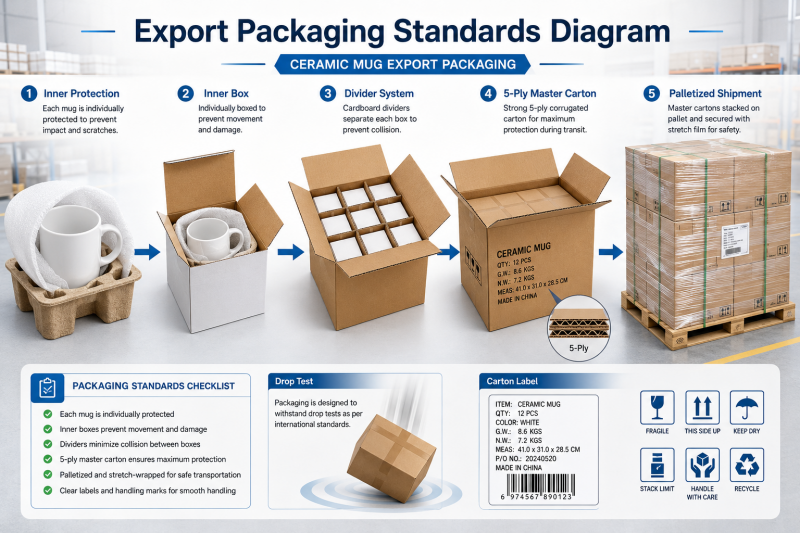
These standards are far more than just technical specifications for cardboard thickness or foam density. They represent a series of strategic business decisions. Getting them right protects your investment, while getting them wrong can turn a profitable shipment into a financial disaster. Let's explore how to make the right choices and avoid the costly mistakes I've seen so many importers make.
Why is "What's the Cheapest Box?" the Wrong Question?
You need to keep your costs in check to remain competitive, so looking at packaging prices seems logical. But when your first question to a supplier is "What's your cheapest box?", you're setting yourself up for failure. This question frames the entire project around a single, misleading metric and ignores the much bigger picture.
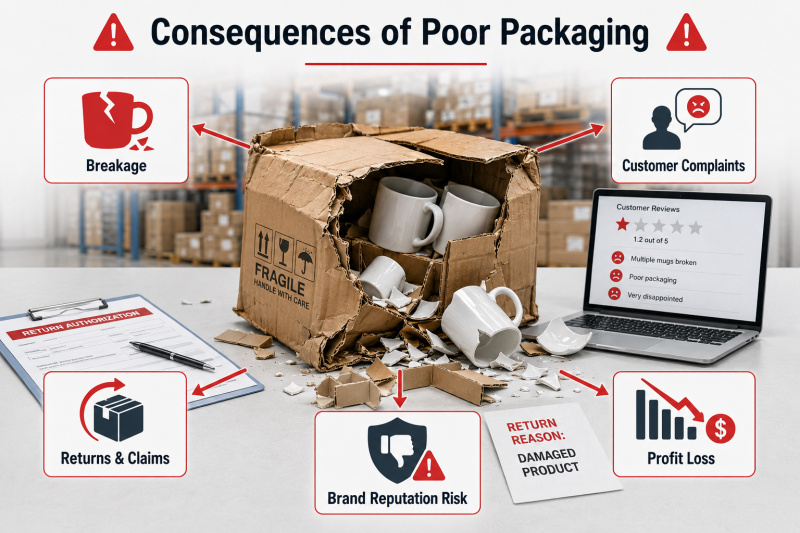
The question "What is the cheapest box?" focuses solely on unit cost. It dangerously ignores the total cost of ownership, which includes hidden expenses like product damage, freight for replacements, customer refunds, and the irreversible harm to your brand's reputation from negative reviews.
Dive Deeper: A Case Study in the True Cost of "Saving"
Over my 15 years of exporting ceramics, I’ve seen this scenario play out many times. I once worked with a new client in Europe who was importing a container of 10,000 custom-printed ceramic mugs for a promotional campaign. They were laser-focused on minimizing upfront costs.
During our consultation, they pushed back hard on my packaging recommendation. My proposed solution, a durable box with custom EPE foam inserts, cost about $0.10 more per unit than the basic cardboard divider they wanted. "It's just a mug," they argued, "we don't need a fortress." Against my advice, they insisted on the cheaper option. They "saved" $1,000 on the total order.
The result was a textbook disaster. Their shipment arrived with a damage rate of nearly 20%. That's 2,000 mugs—shattered, chipped, and completely unsellable. The initial $1,000 "saving" evaporated instantly.
Calculating the True Cost of "Saving" $0.10
Let's break down the real financial impact of their decision. This is a conversation I have with importers to shift their focus from unit price to total business cost.
| Cost Item | Amount | Notes |
|---|---|---|
| Initial "Saving" on Packaging | -$1,000 | The perceived benefit. |
| Direct Losses | ||
| Value of Lost Goods | +$4,000 | 2,000 broken mugs at a $2 cost per unit. |
| Wasted International Freight | +$1,200 | 20% of a $6,000 container freight cost. |
| Indirect & Opportunity Costs | ||
| Air Freight for Replacements | +$2,500+ | The cost to rush a partial re-order to meet their deadline. |
| Customer Refunds & Penalties | +$??? | Their B2B client was unhappy with the partial delivery. |
| Damaged Brand Reputation | +$???? | The stress and reputational risk with their end client. |
| Total Net Loss | ~$6,700+ | A nearly 7x greater loss than the initial "saving". |
This client learned a hard lesson: the right starting question is not "How can I pay less per box?". The right question is, "Who is my final customer, what is their expectation, and what is the total business risk I'm willing to accept?". Answering this shifts the focus from cost to value, and from a gamble to a strategic investment.
How Do Proper Export Packaging Standards Protect Your E-commerce Business?
You’re selling fragile products like ceramic mugs directly to consumers online. Your product survives the long journey from my factory in Hunan across the ocean. But then it enters the "last mile"—a chaotic gauntlet of conveyor belts, sorting machines, and delivery trucks that can destroy your product and your customer reviews with it.
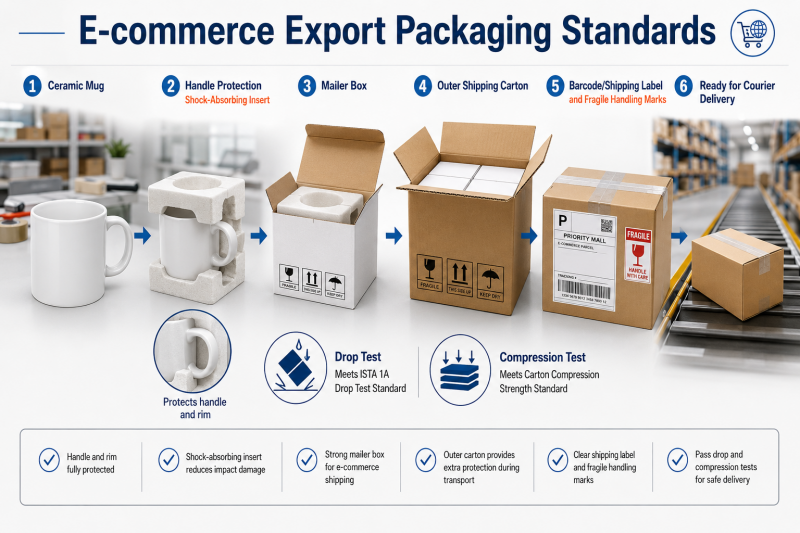
For e-commerce, proper export packaging standards mean the individual product box must be a self-contained fortress. It must be designed and tested to survive the specific, harsh environment of single-parcel shipping networks. This often involves passing rigorous third-party tests, like the ISTA-6A standard required by Amazon, which simulates the entire journey to a customer's door.
Dive Deeper: The Two Worlds of Packaging—Wholesale vs. E-commerce
The biggest mistake I see importers make is applying wholesale packaging logic to an e-commerce sales model. They are completely different worlds with different risks.
Wholesale Packaging: A wholesaler typically buys in bulk. We load products onto a pallet, shrink-wrap it tightly, and load it into a container. In this model, the pallet is the primary protective unit. It provides rigidity and stability. The individual boxes just need to be strong enough to handle stacking pressure within the pallet. They are rarely handled individually until they reach the final distribution center or retail store. Damage rates are often low because the shipment moves as a single, stable block.
E-commerce Packaging: An e-commerce order is the polar opposite. Your single ceramic mug is plucked from a warehouse shelf and sent on a solo journey. The individual box is the only protective unit. It will be dropped, thrown, tumbled with heavier packages on automated sorting lines, and vibrated for hours in the back of a delivery van. The "unboxing experience" is a direct reflection of your brand, and "arrived broken" is the fastest way to get a 1-star review.
What is the ISTA-6A Drop Test, and Why Should You Care?
To combat the high rate of damage in e-commerce, major platforms like Amazon have established specific packaging requirements. The most well-known is the International Safe Transit Association's ISTA-6A standard. This is not a theoretical lab test; it's a brutal, real-world simulation. A package undergoing this test is subjected to:
- Atmospheric Conditioning: Pre-conditioning to test performance in different humidity and temperature environments.
- Vibration Tests: Simulating the vibrations from both truck and airplane transport.
- Drop Tests: A sequence of 17 different drops onto its corners, edges, and faces from a specified height (e.g., around 1 meter or 3 feet).
- Compression Test: Simulating the weight of other packages being stacked on top of it.
As a manufacturer, my role is to help you, the importer, design packaging that can pass this test before your products ever ship. Passing ISTA-6A is your insurance policy. It's the difference between a thriving online store and a business bogged down by returns, refunds, and a reputation for selling broken goods. It proves your packaging meets the necessary export packaging standards for the demanding world of e-commerce.
What Goes into Designing Custom Export Packaging Standards?
So, you understand that "one-size-fits-all" packaging doesn't work and that you need something better. But the world of packaging materials—different foam types, cardboard grades, molded pulp, air pillows—can seem complex and overwhelming. Where do you even begin?
The process becomes simple when you start by answering a few key business questions first, before ever looking at materials. Designing custom export packaging standards is a consultative process. It involves analyzing your product, your market, and your business goals to engineer a solution that is both cost-effective and highly protective.
Dive Deeper: The Four Questions I Ask Every Client
When a client wants to discuss packaging, I don't start by showing them boxes. I start by asking questions to define the problem we're trying to solve.
- Who is your final customer? Is it a procurement manager for a large hotel chain who will receive a pallet? Or is it a student in a dorm room ordering a single mug for their morning coffee? The expectations and handling are vastly different.
- What is your exact sales channel? Are you selling B2B wholesale? Stocking retail shelves? Or selling direct-to-consumer (DTC) via Amazon FBA or your own website? The answer dictates the required level of individual item protection.
- What is your brand's unboxing experience? Do you want a premium, gift-like experience that feels special? Or is the goal purely functional, protective, and as eco-friendly as possible? This influences material choice and design.
- What is your acceptable damage rate? This is a crucial business metric. Is a 1% damage rate acceptable? 0.5%? 0.1%? A lower target requires a more robust—and potentially more expensive—solution. Defining this number helps calculate the ROI of investing in better packaging.
Only after we have clear answers to these questions can we begin to engineer the right solution. The answers guide our material choices.
Material Choices and Their Business Impact
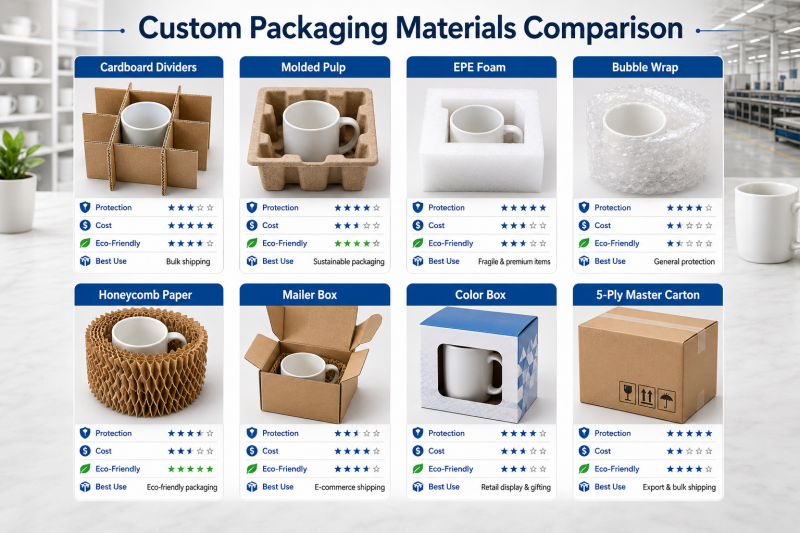
Here’s how those answers translate into practical material decisions for a product like a ceramic mug:
| Material | Pros | Cons | Best For... |
|---|---|---|---|
| Molded Pulp | Very eco-friendly (recyclable, compostable), excellent for custom shapes. | High initial tooling cost, can be brittle. | High-volume, eco-conscious brands where the one-time tooling cost can be amortized. |
| Expanded Polyethylene (EPE) Foam | Excellent shock absorption, resilient (doesn't break), flexible. | Petroleum-based, not easily recyclable for consumers. | E-commerce and DTC channels requiring high drop protection (e.g., passing ISTA-6A). |
| Corrugated Cardboard Inserts | Inexpensive, recyclable, lightweight. | Offers less shock absorption than foam; can crush under impact. | Wholesale shipments where boxes are palletized; for lighter, less fragile items. |
| Air Pillows / Bubble Wrap | Very lightweight (saves freight costs), good for filling empty space. | Can pop and deflate, offers poor protection against sharp impacts. | Use as void-fill in addition to primary protection, not as the main protective element. |
For example, if a client says their brand is built on sustainability (question #3) and they have a high order volume, I might recommend molded pulp despite the upfront tooling cost. If another client is launching on Amazon FBA (question #2) and their top priority is avoiding breakage (question #4), EPE foam is the most reliable choice to pass the required drop tests. The export packaging standards are defined by the business strategy.
Frequently Asked Questions
What is the difference between inner and outer packaging?
Inner packaging is what directly touches and protects the product, like a foam insert or bubble wrap. The outer packaging, or "master carton," is the main shipping box that holds one or more units. For e-commerce, the outer box must be strong enough for individual shipping. For wholesale, the master carton is designed for pallet stacking.
How much does custom packaging for fragile goods typically cost?
The cost varies widely based on material, complexity, and volume, from as little as $0.20 for a simple cardboard insert to over $1.50 for a multi-part foam and box solution designed for ISTA-6A tests. However, the focus should be on the return on investment (ROI) from preventing damage, not just the unit cost.
What is a reasonable damage rate for exported ceramics?
For well-packaged wholesale shipments on pallets, the damage rate should be well below 1%. For e-commerce shipments using packaging designed and tested to ISTA standards, the target should also be below 1%. If your damage rate is consistently above 2-3%, your packaging is failing and costing you money.
Are there eco-friendly packaging options that are still protective?
Yes. Molded pulp is an excellent, highly protective option made from recycled materials. Corrugated cardboard inserts are also fully recyclable. We can even design "frustration-free" packaging that uses clever folds and fewer components. The key is to balance your brand's eco-goals with the required level of protection for your sales channel.
How do I verify a supplier's packaging claims?
Ask for specifics. Instead of accepting "high-quality packaging," ask "What drop test height is this box designed to pass?" or "Can you provide a certificate for the ISTA-6A test for this packaging design?". A good partner should be able to provide data, test reports, or videos of their testing process to validate their claims. You can also order samples to perform your own crude drop tests.
Conclusion
Choosing the right export packaging standards is one of the most critical business decisions an importer of fragile goods can make. It is not a task to be delegated or an expense to be minimized at all costs. Approaching packaging as a strategic investment to reduce your total cost of ownership—including the hidden costs of damage, returns, and reputational harm—is what separates successful importers from those who are always fighting fires.
The key takeaway is to change your starting question. Stop asking "What's the cheapest box?" and start asking "Who is my final customer, what is my sales channel, and what level of risk am I prepared for?". This simple shift in perspective will guide you toward a solution that protects your product, your customers, and your profit. With 15 years of experience shipping ceramics from our factory in Liling to wholesalers and e-commerce sellers in Europe and South America, I've helped countless partners navigate these choices. If you’re looking for a supplier who understands that total cost matters more than unit price, let's discuss your next project.