Struggling to compare quotes from different mug suppliers? You might see a low price from one factory and a higher price from another, making the choice seem obvious. However, this discrepancy often hides unexpected costs that can completely erase your profit margin. The solution is to learn how to accurately calculate the landed cost for mug imports, starting with the crucial first step of getting all your quotes to an "apples-to-apples" baseline.
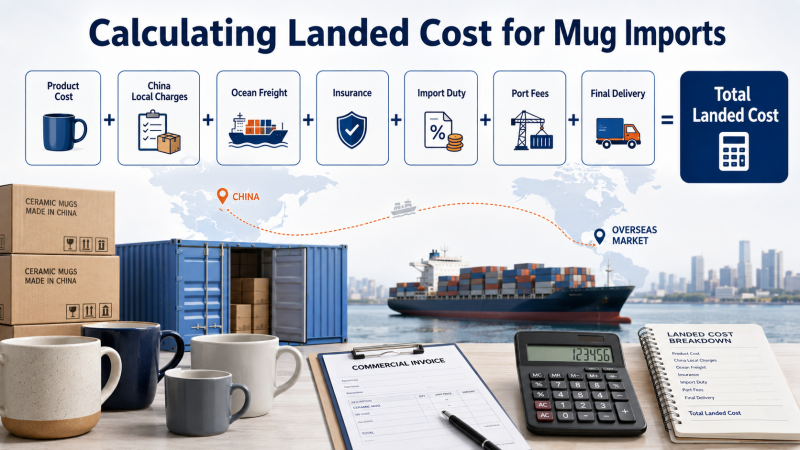
To calculate the landed cost for mug imports, you must first establish a common baseline for all supplier quotes, typically by converting all prices to a Free On Board (FOB) equivalent. This involves adding local Chinese costs—like inland trucking, customs fees, and port charges—to any Ex Works (EXW) price. This ensures you are comparing the true cost of getting the goods onto the ship, preventing unexpected expenses before they even leave the port of origin.
Now that you know the basic principle, let's explore why it's so critical. In my experience, the single biggest financial mistake new importers make is misunderstanding two small acronyms: EXW and FOB. Getting this wrong can turn a promising venture into a losing one before your mugs even set sail.
How Do Incoterms Affect the Landed Cost for Mug Imports?
Are you feeling confused by trade terms like EXW, FOB, and CIF? These aren't just logistical jargon; they define who pays for what and when. Misinterpreting them can easily lead to thousands of dollars in surprise bills from freight forwarders or customs agents.
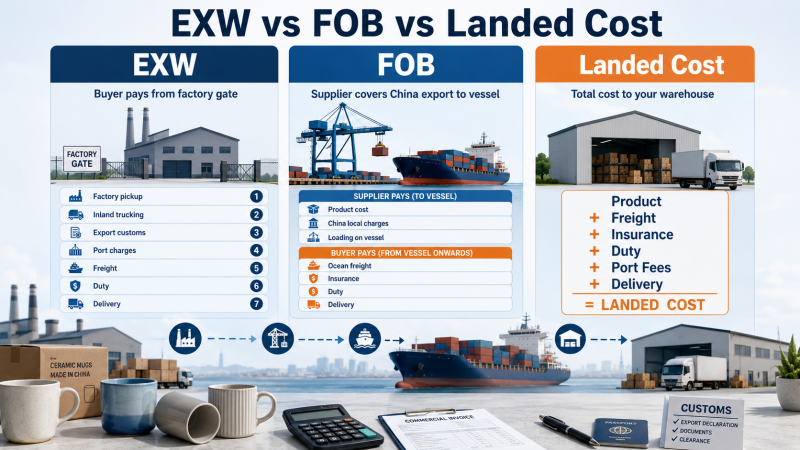
The key terms to understand at the start are EXW and FOB. EXW (Ex Works) is the price for the mug at the factory gate. FOB (Free On Board) is the price for the mug loaded onto the ship at the port. The full landed cost for mug imports includes every expense from the factory floor in China to your warehouse door, but the EXW-to-FOB step is where most comparison errors happen.
To make this clearer for my clients, I often use a simple grocery shopping analogy.
H3: EXW (Ex Works): The "Farm Gate" Price
Imagine you're buying apples directly from a farm. The EXW price is the cost of the apples right there at the farm. The price is low, but the responsibility is all yours. You have to arrange a truck to pick them up, handle all the paperwork to get them out of the farming district, and transport them to the city's main distribution hub.
For mug imports, EXW means the price only covers the finished, packaged mugs sitting at our factory in Liling. The buyer is responsible for arranging pickup, handling Chinese customs export procedures, and getting the goods to the port. For a new importer, managing these steps from overseas can be complex and risky.
H3: FOB (Free On Board): The "City Hub" Price
Now imagine the farmer offers you an FOB price. This price includes the apples plus the service of delivering them to the main distribution hub in the city. The farmer handles the local trucking and any local checkpoint fees. Your responsibility begins once the apples are at the hub, ready for long-haul shipping.
For mug imports, FOB is the most common term for new buyers. An FOB quote from us includes:
- The price of the ceramic mugs themselves.
- The cost of trucking from our factory to the port (e.g., Shanghai or Shenzhen).
- All China-side charges, such as the customs declaration fee and local port handling charges (often called Terminal Handling Charges or THC).
Your responsibility starts once the container is loaded onto the vessel. This is often the simplest and most predictable starting point for first-time buyers.
H3: The Full Landed Cost: The "Kitchen Table" Price
The final landed cost is the total price to get those apples from the farm all the way to your kitchen table. This includes the FOB cost, plus ocean freight, insurance, destination port fees, import duties and taxes in your country, and final delivery to your home.
Calculating this full cost is the job of a freight forwarder. My expertise, and the focus of this article, is ensuring you get the first part of the calculation right: the factory-to-port cost. This is where you compare suppliers, and it's where an accurate understanding of your costs begins.
Why Does Comparing EXW and FOB Prices Lead to Mistakes?
You've found a supplier whose mug price is 20% cheaper than everyone else's. It feels like you've hit the jackpot. But is it a truly great deal, or is it a financial trap disguised as a low price?
Comparing a low EXW price directly against a higher FOB price is a critical and frequent error. The EXW price is artificially low because it excludes several hundred dollars in necessary local charges. You will inevitably be billed for these costs later, completely erasing your perceived savings and potentially turning your profit into a loss.
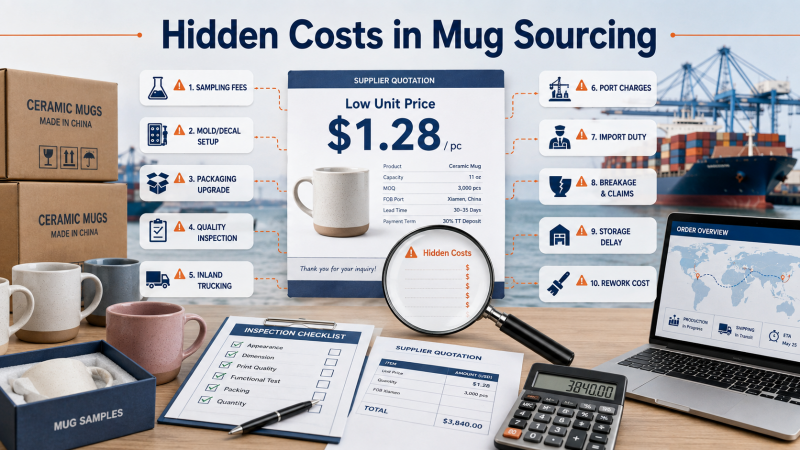
As a frontline sales representative at our factory for over a decade, I can tell you that this is the most common source of frustration for new importers. They'll see a quote for a mug at $1.50 EXW and compare it to our quote for a similar mug at $1.80 FOB. They anchor on that $0.30 difference per unit, thinking they've found a massive saving.
The reality is that the $1.50 price is an incomplete number. It's the tip of the cost iceberg. Underneath the surface are several mandatory fees that must be paid to get those goods onto a ship.
What's missing from an EXW price?
- Inland Trucking: The cost to transport your container from the factory (in our case, in an inland city like Liling) to a major seaport like Shanghai or Shenzhen. This can be a significant cost.
- China Customs Declaration: A fee paid to a broker to file the export paperwork with Chinese customs. This is mandatory for all exports.
- Terminal Handling Charges (THC): These are fees charged by the port for handling the container, moving it from the truck to the yard, and eventually loading it onto the ship.
- Documentation Fees: Small fees associated with issuing the Bill of Lading or other required documents.
For a typical Less-than-Container-Load (LCL) or full container (FCL) shipment, these local costs can easily add up to $300–$800 or more. When you spread that fixed cost over your order, it can dramatically change the per-unit price, especially for smaller test orders. The "cheaper" supplier wasn't really cheaper; they just presented their price differently.
How Can You Convert an EXW Price to an FOB Equivalent?
So, how do you avoid this common trap and make a true apples-to-apples comparison? You don't want to dismiss a potentially great supplier just because they quoted you an EXW price. The key is to empower yourself to see the full picture.
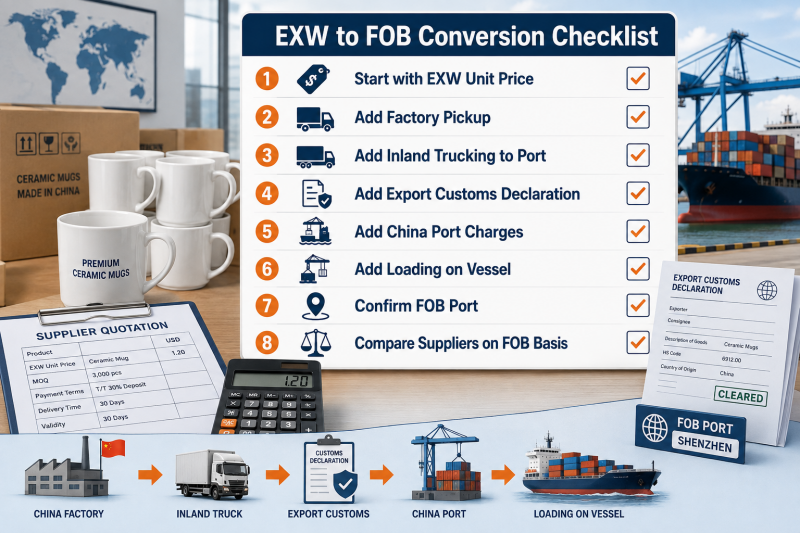
To accurately convert an EXW price to a comparable FOB price, you must ask the supplier for a detailed, itemized breakdown of all local charges required to get the goods from their factory gate to "on board" the vessel. By adding these fixed costs to your total EXW order value, you reveal the true FOB equivalent cost.
This isn't a complex academic exercise; it's a practical business tool I encourage all my clients to use. By taking control of the calculation, you protect your profit margins and make sourcing decisions based on data, not on misleading initial prices.
H3: Your EXW-to-FOB Conversion Checklist
When a supplier gives you an EXW price, use these steps to normalize it for comparison against an FOB quote.
- Confirm the Total EXW Value: Calculate this by multiplying the EXW unit price by the number of units in your order.
- Request a List of Local Charges: Send your supplier a clear email. You can use this template:
"Thank you for the EXW quote. To accurately calculate our landed cost for mug imports, could you please provide an itemized list of all local China-side fees to get an order of [Your Order Quantity] units to the port of [e.g., Shanghai]? Specifically, please provide costs for:
- Inland trucking from your factory to the port.
- China customs declaration fee.
- Port terminal handling charges (THC).
- Any other documentation or local handling fees."
- Sum All Costs: Add the total EXW value to the sum of all the local charges they provide. The result is the FOB Equivalent Value.
- Calculate the FOB Equivalent Unit Price: Divide the FOB Equivalent Value by your total number of units.
Now you have a true per-unit cost that you can fairly compare to other FOB quotes.
H3: Example Calculation
Let's see this in action. Imagine you're ordering 5,000 mugs and have two quotes.
| Cost Component | Supplier A (Quotes FOB) | Supplier B (Quotes EXW) | Calculation Details |
|---|---|---|---|
| Unit Price | $1.80 | $1.50 | - |
| Total Mugs Value | $9,000 | $7,500 | Unit Price x 5,000 |
| Inland Trucking | Included in Price | $350 | You must ask Supplier B for this cost |
| Port & Customs Fees | Included in Price | $150 | You must ask Supplier B for this cost |
| Total FOB Equivalent | $9,000 | $8,000 | Total Mugs Value + Local Costs |
| Effective FOB Unit Price | $1.80 | $1.60 | Total FOB Equivalent / 5,000 |
In this scenario, after doing the conversion, you can see that Supplier B is still cheaper, but only by $0.20 per unit, not the $0.30 you initially thought. This realistic $0.20 figure is the number you should use for your profit forecasting. This simple calculation gives you clarity and prevents a nasty surprise when your freight forwarder's invoice arrives.
Frequently Asked Questions
What is a good FOB price for a standard ceramic mug?
This price varies widely based on the mug's size, material quality, glaze complexity, decoration, and order quantity. A simple 11oz white mug will be much cheaper than a large, custom-shaped mug with a reactive glaze. Instead of seeking a single "good" price, focus on getting 3-4 FOB-equivalent quotes to establish a competitive market baseline for your specific project.
Should I always ask for an FOB quote?
For new importers, FOB is often the simplest and safest option because the factory, with its local knowledge and relationships, handles all the complex pre-shipping logistics in China. However, if you are a large-volume importer or work with a trusted agent in China, using EXW terms can sometimes provide more control and potential cost savings on local transport. The key is never to assume, but to always calculate the comparable cost.
Does FOB include ocean freight and insurance?
No. FOB stands for "Free On Board," which means the seller's responsibility and cost obligation end once the goods are loaded onto the shipping vessel at the designated port of origin. From that point forward, the buyer is responsible for arranging and paying for ocean freight, cargo insurance (highly recommended), and all subsequent costs.
How do I find the final landed cost for mug imports after the FOB stage?
To get the full picture, you must engage a freight forwarder. Provide them with your FOB cost, order volume (in cubic meters), total weight, port of origin, and final delivery address. They will provide a comprehensive quote that includes ocean/air freight, insurance, destination port fees, customs brokerage in your country, import duties/taxes, and final "last-mile" delivery to your warehouse.
Conclusion
The path to a profitable import business begins with accurate cost analysis. The most critical first step is to avoid the common pitfall of comparing dissimilar quotes. Never take a low EXW price at face value and compare it to a higher FOB price. By using the simple checklist provided, you can convert any quote into a true FOB equivalent, giving you the power to make an informed, data-driven sourcing decision. Mastering this initial step in the landed cost for mug imports calculation is fundamental to protecting your profits and building a sustainable business.
As a factory with over 15 years of experience exporting ceramic mugs worldwide, we've helped countless first-time buyers navigate this process. We believe in transparency and provide clear, all-inclusive FOB quotes to ensure you have no surprises. If you are looking for a reliable partner for your next ceramic project, contact us for a comprehensive quote today.