Packaging for fragile ceramic products becomes a real business issue when one broken mug turns into a refund, a bad review, and a damaged customer relationship. Many buyers focus only on carton cost, but that can hide bigger losses. The better solution is a packaging strategy that reduces risk without wasting money.
The best packaging for fragile ceramic products is a cost-effective system that matches the ceramic item, shipping route, sales channel, and damage risk. It should protect weak points like handles, rims, and corners while controlling carton size, weight, labor cost, and return risk. The goal is lower total cost, not simply thicker packaging.
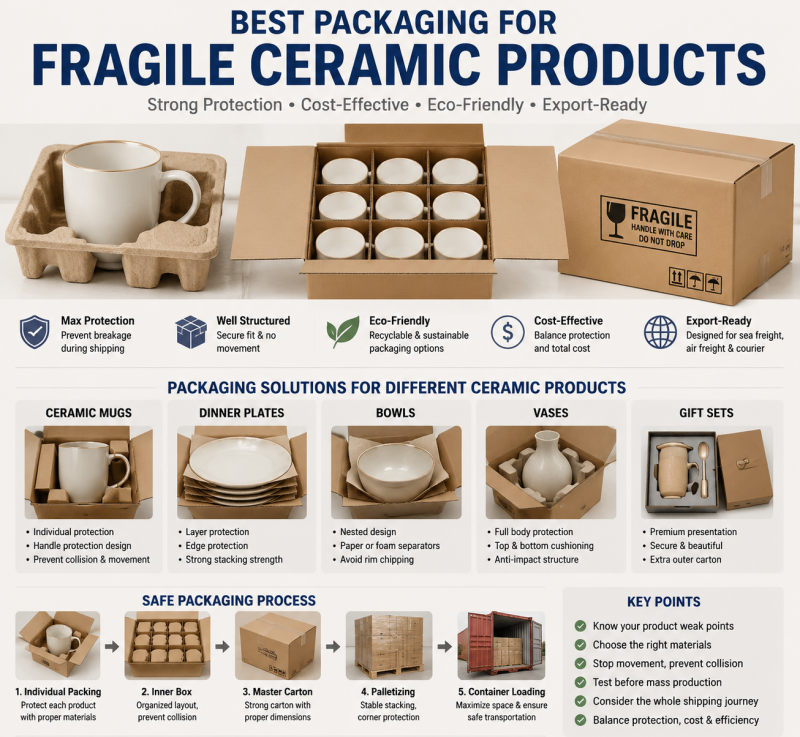
In my 15 years exporting ceramics from LiLing, Hunan, I have learned that packaging is not just a box. It is part product protection, part freight planning, and part brand protection. The right ceramic packaging solutions depend on what you ship, how you ship, and who receives it.
Why Is Packaging for Fragile Ceramic Products a Total Cost Decision?
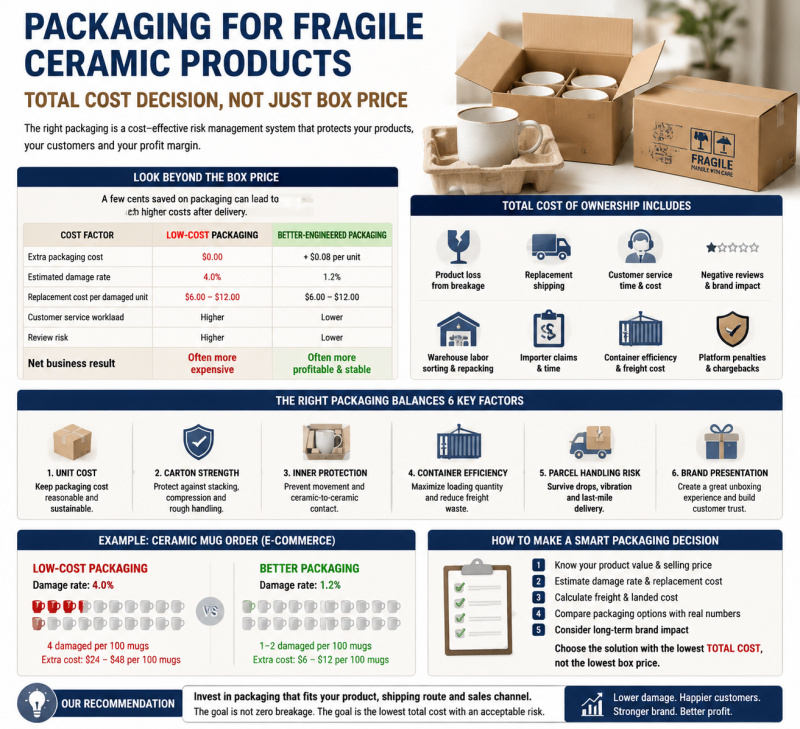
A common problem I see is that buyers compare packaging only by unit price. That feels logical at first. However, a cheaper box can create expensive problems later. Breakage, replacement freight, customer service time, marketplace refunds, and negative reviews can quickly cost more than the packaging savings.
The best way to choose packaging for fragile ceramic products is to evaluate total cost of ownership, not only the packaging unit price. A slightly more expensive but better-engineered package can reduce damage rates, lower return costs, protect reviews, and sometimes even reduce shipping fees through smarter carton design.
Packaging Cost Is Only One Line in the Real Cost Sheet
When I calculate ceramic mug packaging for international buyers, I usually separate the cost into two parts:
-
Visible cost
- Inner box cost
- Outer carton cost
- Divider or insert cost
- Foam, paper, or molded pulp cost
- Packing labor cost
-
Hidden cost
- Broken item replacement
- Refunds and returns
- Extra customer service work
- Reshipping cost
- Marketplace penalties
- Damaged brand reputation
- Lost repeat orders
For B2B buyers, especially wholesalers and e-commerce sellers, the hidden cost often matters more. A wholesale buyer may receive a full container of ceramic mugs. If the damage rate rises from 1% to 5%, that difference can affect the buyer’s profit margin on the whole shipment.
For e-commerce sellers, one broken mug may create a bigger problem. A customer does not see the factory, the container, or the courier. The customer sees the seller’s brand. If the mug arrives broken, the review is usually about the seller, not the packaging supplier.
In my factory, I treat packaging as a form of insurance. I do not aim for the most expensive option. I aim for the most cost-effective protection for the specific product journey.
Simple TCO Example for Ceramic Mug Export Packaging
Here is a simplified example. The numbers will vary by product, destination, and sales model, but the logic is useful.
| Packaging Option | Packaging Cost Per Mug | Estimated Damage Rate | Hidden Cost Impact | Best Use Case |
|---|---|---|---|---|
| Basic carton only | Low | Higher | More claims and returns | Low-risk local delivery |
| Inner box + master carton | Medium | Lower | Better for pallet/container shipping | Wholesale ceramic mug packaging |
| Inner box + insert + master carton | Medium-high | Much lower | Better review protection | E-commerce and mixed handling |
| Over-packed heavy solution | High | Lower, but costly | Higher weight and dimensional freight | Only for very delicate shapes |
A buyer may save a few cents per mug with basic packing. However, if the mug has a thin handle, irregular shape, or premium glaze, that saving may disappear after one damage claim.
Ceramic Product Features Change the Packaging Decision
Ceramic is strong under compression but weak under sudden impact. That is why good fragile product packaging must consider the product’s weak points.
For ceramic mugs, I usually check:
- Handle shape: Thin handles need more side protection.
- Rim thickness: Fine rims need separation from carton walls.
- Body shape: Tall mugs may tip or stress one edge.
- Weight: Heavy mugs can crush neighboring mugs if inserts are weak.
- Surface finish: Matte, reactive glaze, metallic decals, and embossed designs may need scratch protection.
- Set configuration: A 4-piece or 6-piece set needs different internal bracing from a single mug.
When buyers ask for ceramic mug export packaging, I always ask about the sales channel. A mug shipped in a full container to a warehouse faces different risks from a mug sent one by one through parcel delivery. The “best” solution is not universal. It must match the business model.
Is Thicker Cardboard Always Better for Packaging for Fragile Ceramic Products?
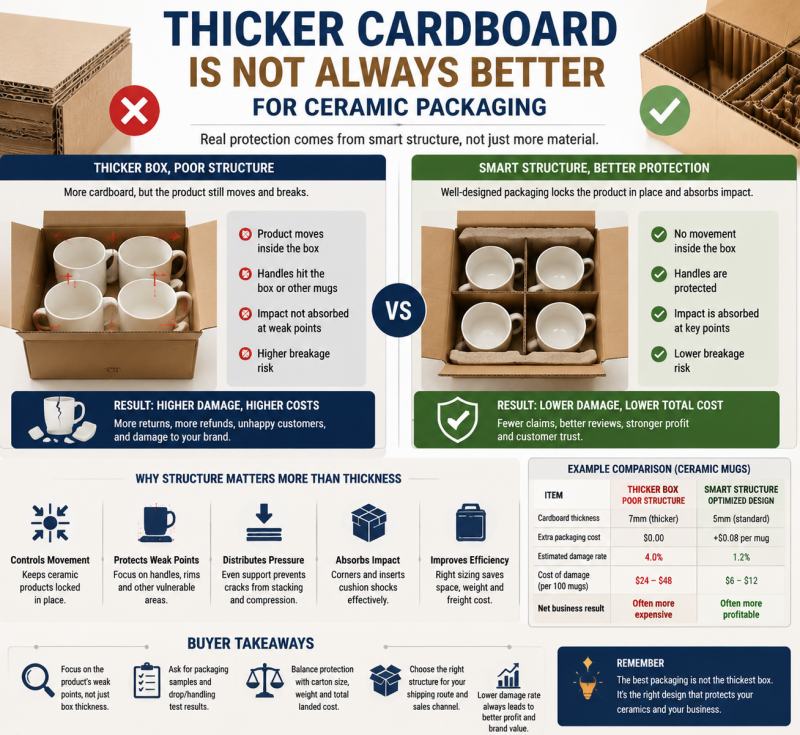
Many buyers believe thicker cardboard automatically means safer packaging. I understand why. It feels more protective in the hand. However, this idea can be misleading. If the internal structure is weak, thick cardboard may still allow the mug to move, hit the wall, or break at the handle.
Thicker cardboard is not always better for packaging for fragile ceramic products. Structural design often matters more than material thickness. Good protection comes from controlled movement, corner strength, separation between items, and support around weak points. Over-packing can also increase shipping weight and dimensional cost without improving real protection.
What Our Internal Handling Tests Have Taught Me
In my 15 years exporting ceramics, I have seen many buyers request “the thickest carton.” I respect the concern, but I usually explain the same thing: a strong wall does not help enough if the product can move inside the box.
At our factory, we use practice-based simulation tests during packaging development. These are not official lab certifications. They are internal checks that mimic rough handling, such as drops, shaking, stacking pressure, and carton corner impact. Buyers should still request qualified professional testing when their application requires formal validation.
In one internal comparison, we tested two styles of ceramic shipping box for a ceramic mug with a delicate handle:
| Test Packaging | Material Approach | Structural Design | Result in Internal Drop Handling |
|---|---|---|---|
| Option A | Thicker outer carton | Loose inner space | Handle impact risk remained high |
| Option B | Standard carton strength | Better insert and spacing | Lower movement and better handle protection |
The second option performed better because the mug did not move freely. The insert created distance between the mug and the carton wall. The handle had support. The rim did not directly hit the box edge.
This is why I often say: movement is the enemy.
Where Ceramic Mugs Usually Break
A ceramic mug does not break randomly. In many claims I have handled, damage happens in predictable areas.
Common breakage points include:
- Handle joint: The handle works like a lever during impact.
- Rim edge: A sharp hit can chip the top edge.
- Bottom foot ring: Stacking pressure can cause cracks.
- Decorated surface: Abrasion can damage decals or coatings.
- Corner contact points: Box corners receive strong impact during handling.
Good ceramic shipping packaging should reduce direct contact between these areas and external pressure. That may require an insert, divider, sleeve, or shaped pulp tray. It does not always require the thickest possible carton.
Over-Packing Can Create New Costs
Over-packing feels safe, but it can hurt the buyer’s business. This is especially true for international freight and e-commerce fulfillment.
Over-packing may increase:
- Carton weight
- Dimensional weight
- Container space usage
- Warehouse storage volume
- Packing labor
- Material waste
- Customer disposal burden
For example, if a packaging design increases carton volume by 15%, a wholesale buyer may fit fewer master cartons into a container. That means the buyer pays more freight per mug. For an e-commerce seller, a larger ceramic shipping box may trigger higher parcel charges because many couriers use dimensional weight.
Better Design Usually Beats More Material
A cost-effective ceramic mug packaging design often uses smart structure rather than excessive material.
Useful design features include:
-
Internal dividers
Dividers prevent mug-to-mug contact in bulk cartons. -
Corner protection
Corners take impact first, so reinforced corners can reduce breakage risk. -
Handle clearance
The handle should not press directly against the carton wall. -
Top and bottom cushioning
Vertical pressure matters during stacking and pallet loading. -
Tight but not forced fit
The mug should not rattle, but pressure should not create stress. -
Right outer carton strength
The master carton should match stacking height and shipping route.
A professional ceramic mug packaging supplier should help buyers compare these options based on product value, route risk, and sales channel. The right answer is usually not “thicker.” The right answer is “better engineered.”
How Should Wholesalers Choose Wholesale Ceramic Mug Packaging?
Wholesalers face a different packaging problem from retail parcel sellers. They usually move large quantities by sea freight, pallet, or truck. Their main risks are container stacking, warehouse handling, moisture exposure, and carton compression. They need packaging that protects the goods while maximizing container efficiency.
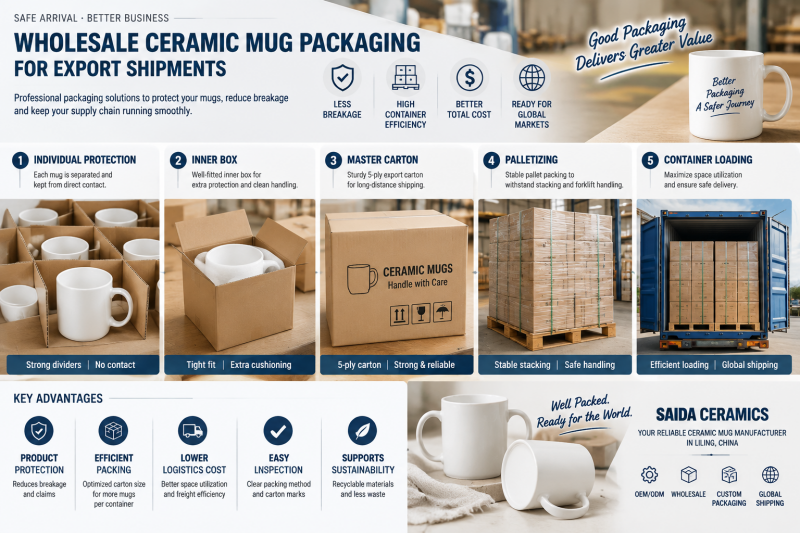
Wholesalers should choose wholesale ceramic mug packaging that balances stacking strength, carton efficiency, product separation, and easy warehouse handling. The best solution usually includes individual protection, strong master cartons, clear carton markings, and a packing layout that maximizes container loading without increasing damage risk.
Wholesale Buyers Need Container Efficiency
For wholesale ceramic mug packaging, the carton must do two jobs. It must protect the mugs, and it must use space efficiently. If the carton is too large, the buyer pays more freight per piece. If the carton is too weak, the buyer may face breakage during stacking.
When I design ceramic mug export packaging for wholesalers, I usually look at:
- Mug size and weight
- Number of pieces per inner box
- Number of pieces per master carton
- Carton stacking direction
- Pallet size, if required
- Container loading plan
- Destination warehouse handling methods
- Buyer’s retail or resale requirements
A wholesaler may not need a premium unboxing experience for every mug. However, the packaging still needs to be clean, consistent, and strong enough for the route. Many European and American buyers also ask for barcode labels, item codes, carton marks, and recyclable material options.
Common Wholesale Ceramic Mug Packaging Formats
Different wholesale buyers prefer different formats. The best choice depends on product value and distribution method.
| Packaging Format | Business Benefit | Possible Limitation | Suitable Buyer |
|---|---|---|---|
| Bulk pack with dividers | Efficient and lower cost | Less retail-ready | Importers and wholesalers |
| Individual white box + master carton | Better item protection and resale flexibility | Slightly higher cost | Distributors and retailers |
| Color gift box + master carton | Retail-ready and brand-friendly | Higher cost and volume | Gift shops and brand owners |
| Molded pulp tray + outer carton | Good separation and eco positioning | Tooling or setup may be needed | Premium or sustainable brands |
| Foam insert + carton | Strong cushioning | Sustainability concerns in some markets | High-risk fragile items |
For many ceramic mug supplier packaging projects, I recommend starting with a practical format: individual inner box plus export master carton. It gives reasonable protection, clear counting, easier warehouse distribution, and better claim control. If one inner box is damaged, the buyer can identify the affected unit more easily.
Translate Technical Specs Into Business Questions
Buyers often receive carton specifications such as flute type, paper weight, burst strength, or ECT rating. These specs are useful, but they can feel abstract. I prefer to translate them into business questions.
Ask your supplier:
- Can this carton be stacked safely in a container?
- How many cartons can be stacked during storage?
- Will the bottom cartons deform under normal loading?
- Can the mug handles avoid direct pressure?
- Does the inner structure prevent mug-to-mug impact?
- Does the carton size improve or waste container space?
- Can you provide photos or videos of packing and internal checks?
This approach helps buyers evaluate ceramic packaging solutions without becoming packaging engineers.
Documentation and Supplier Verification
Our factory has ISO9001 and BSCI certification, and many buyers ask for these documents during supplier evaluation. I always recommend that buyers verify any certification documents directly and confirm the scope, validity date, and issuing body. Certifications help buyers assess management systems, but they do not replace product-specific packaging evaluation.
For wholesale buyers, I also suggest requesting:
- Packing method photos
- Carton dimension sheet
- Gross weight and net weight
- Loading quantity estimate
- Drop handling record or internal test notes, if available
- Pre-shipment inspection photos
- Sample packaging before mass production
A reliable ceramic mug packaging supplier should be able to explain the packaging logic. The supplier should not only say, “This is strong.” The supplier should explain why the structure fits the mug, the order quantity, and the shipping route.
How Should E-Commerce Sellers Choose Packaging for Fragile Ceramic Products?
E-commerce sellers face the hardest delivery environment. Their products may pass through conveyors, sorting machines, courier vans, lockers, and doorsteps. A carton may be dropped from different angles. A single broken mug can also create a public review problem, not just a private claim.
E-commerce sellers should choose packaging for fragile ceramic products that survives last-mile parcel handling and supports a positive unboxing experience. The packaging should immobilize the mug, protect the handle and rim, fit courier dimensional rules, and present the product neatly when the customer opens the box.
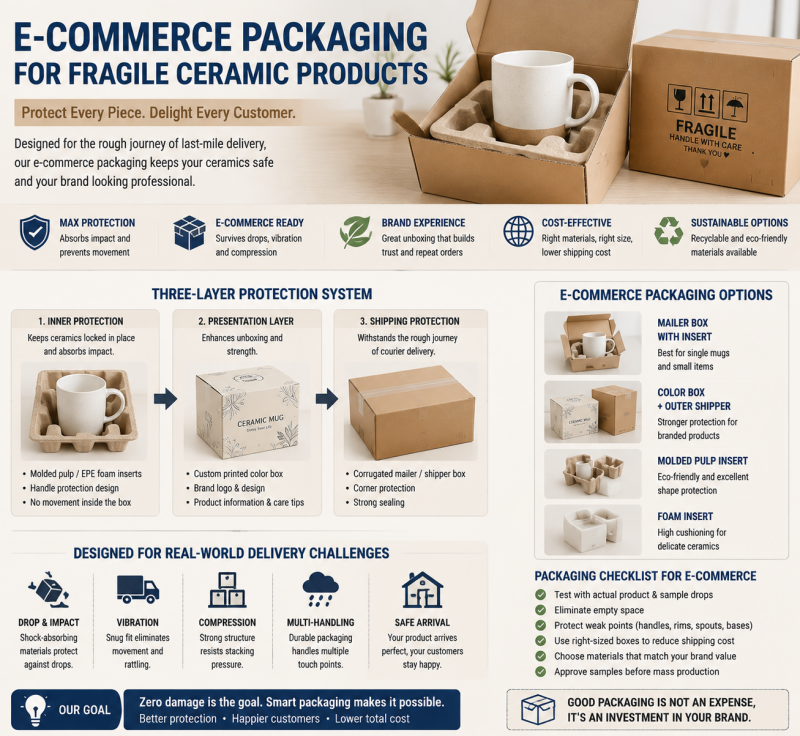
Last-Mile Delivery Is Not Gentle
When buyers ask me how to pack ceramic mugs for shipping, I first ask whether they mean bulk export shipping or direct-to-consumer parcel shipping. The two situations are different.
For e-commerce, the package may experience:
- Single-parcel drops
- Side impact
- Corner impact
- Conveyor vibration
- Mixed stacking with heavy parcels
- Delivery van compression
- Customer returns in poor repacking condition
A master carton in a container often moves as part of a stable load. A single parcel moves alone. That is why e-commerce ceramic shipping packaging usually needs stronger individual protection than wholesale packaging.
What Good E-Commerce Ceramic Mug Packaging Includes
A strong e-commerce packaging system usually has four layers of thinking.
-
Product surface protection
The mug should avoid scratches, especially if it has a decal, metallic print, reactive glaze, or matte surface. -
Internal cushioning
The mug should not touch the shipping box wall directly. The cushion should absorb shock. -
Handle and rim protection
The handle and rim need specific clearance because they are common breakage points. -
Outer shipping strength
The ceramic shipping box should resist crushing and corner impact during parcel handling.
A simple example for one mug may look like this:
| Layer | Function | Common Option |
|---|---|---|
| Surface wrap | Prevents scratches | Tissue paper, paper sleeve, thin wrap |
| Inner support | Holds mug in place | Molded pulp, corrugated insert, paper insert |
| Retail box | Improves presentation | Kraft box, white box, printed gift box |
| Shipping box | Handles courier impact | Corrugated mailer or outer carton |
The best structure depends on the mug. A small espresso cup has different needs from a 16 oz ceramic coffee mug with a large handle. A tall travel-style ceramic mug may need more vertical support. A sculpted mug may need custom inserts.
Unboxing Is Also Part of Brand Protection
E-commerce sellers should not treat packaging only as damage prevention. Customers judge the product from the moment they open the box. If the packaging looks careless, the product feels less valuable even when it is not broken.
Good ceramic mug packaging can support brand value through:
- Clean folding structure
- Neat paper-based inserts
- Clear logo placement
- Simple care card
- Gift-ready presentation
- Easy disposal or recycling
- Low dust and low mess materials
I do not recommend using expensive packaging just for appearance if the product margin cannot support it. However, I do recommend making the packaging feel intentional. A mug is often bought as a gift, souvenir, office item, or lifestyle product. The packaging should reflect that use.
Practical Advice on How to Pack Ceramic Mugs for Shipping
If you are shipping ceramic mugs one by one, I would use this basic checklist:
- Keep the mug from moving inside the inner package.
- Create space between the handle and the box wall.
- Protect the rim from direct pressure.
- Use a box size that avoids both tight stress and loose movement.
- Test the packed mug with realistic handling before scaling.
- Check courier dimensional weight before finalizing the box.
- Review customer return photos to improve future packaging.
This is important because packaging improvement is often a process. One seller may start with bubble wrap and a plain box. Later, the seller may move to a molded pulp insert or corrugated insert after reviewing damage data and return causes.
Sustainability Matters, But Protection Still Comes First
Many buyers in Europe and North America prefer paper-based ceramic packaging solutions. I understand this trend, and we often discuss kraft paper boxes, corrugated inserts, molded pulp, and reduced plastic packaging. However, the packaging must still protect the ceramic item.
A broken mug is also waste. It wastes the ceramic product, the packaging, the freight, and the replacement shipment. So the best sustainable packaging is not the thinnest option. It is the option that uses responsible materials while dramatically reducing shipping risk.
How Can Buyers Evaluate a Ceramic Mug Packaging Supplier?
Choosing the right supplier matters because packaging quality is not only about the printed carton. It is about whether the supplier understands ceramic products, export routes, claim patterns, carton loading, and buyer expectations. A weak supplier may copy a box style without understanding why it works.
Buyers should evaluate a ceramic mug packaging supplier by checking product-specific experience, packaging design logic, material consistency, internal testing practices, documentation, and claim resolution ability. The supplier should explain how the packaging protects the ceramic shape and how it supports the buyer’s wholesale or e-commerce business model.
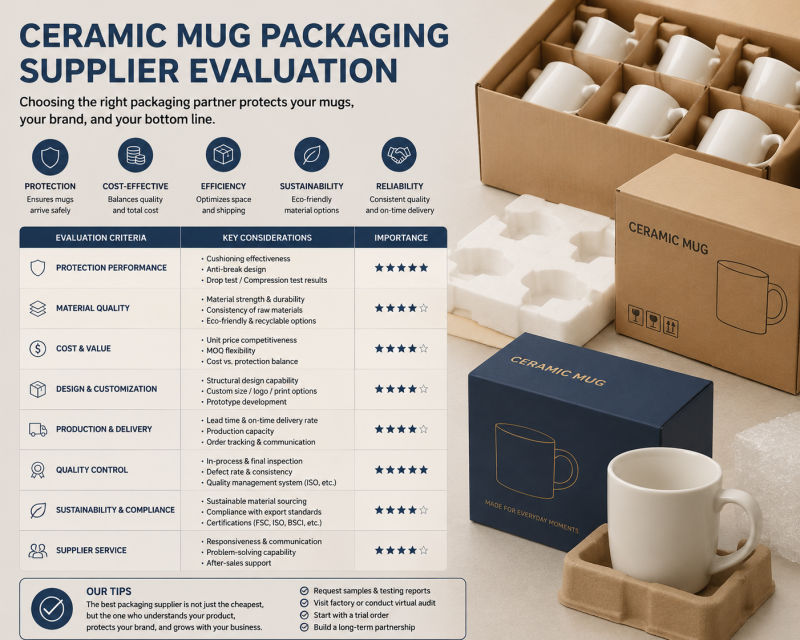
A Good Supplier Asks Questions Before Quoting
A common trap I see clients fall into is asking only, “What is your cheapest packaging?” That question may produce a low quote, but it does not produce a safe decision.
A good ceramic mug packaging supplier should ask questions such as:
- What is the mug size and weight?
- Does the mug have a thin or large handle?
- Is the surface glossy, matte, reactive, or decorated?
- Will the item sell wholesale or online?
- Will the mug ship by sea, air, truck, or parcel courier?
- Does the buyer need retail-ready packaging?
- What damage rate has the buyer experienced before?
- Does the destination market have packaging material preferences?
- What carton marks, labels, or barcodes are required?
These questions show that the supplier is thinking about risk, not just carton price.
Supplier Evaluation Checklist
Here is a practical checklist I would use if I were sourcing ceramic mug export packaging or selecting a ceramic mug supplier packaging plan.
| Evaluation Area | What to Check | Why It Matters |
|---|---|---|
| Ceramic experience | Similar mug, tableware, vase projects | Fragile shapes need product-specific knowledge |
| Export experience | Main markets and freight routes | Packaging must match handling conditions |
| Material consistency | Carton grade, insert quality, thickness control | Inconsistent materials create unpredictable risk |
| Packing method | Photos, samples, worker instructions | Good design fails if packing is not consistent |
| Internal tests | Drop handling, shake checks, stacking simulation | Practice-based checks reveal weak points |
| Documentation | Carton specs, packing list, certification copies | Buyers need traceability and verification |
| Claim response | Clear process for damage analysis | Problems should lead to improvement, not excuses |
In our own factory, I directly handle solution design, cost calculation, and claim resolution for many international buyers. That experience has taught me that packaging decisions should be reviewed before mass production, not after the buyer receives damaged goods.
Ask for Samples Before Mass Production
A packaging sample is not a formality. It is a risk control tool. Before confirming mass production, buyers should review:
- Inner box fit
- Insert strength
- Mug movement inside the box
- Handle clearance
- Outer carton strength
- Carton marks and labels
- Gross weight
- Carton dimensions
- Packing appearance
- Retail presentation, if needed
If possible, buyers should also ship a few samples through the expected delivery route. For e-commerce sellers, this can reveal last-mile problems that warehouse inspection may not show.
Do Not Accept Vague Promises
No responsible supplier should promise zero breakage. Ceramic is fragile, and logistics handling varies. A trustworthy supplier should speak in terms such as:
- “Minimize shipping risks”
- “Reduce expected damage rate”
- “Improve handle protection”
- “Control carton movement”
- “Match the packaging to the route”
- “Review claims and adjust design”
That language is more credible than unrealistic guarantees.
Packaging Must Match the Ceramic Product
Packaging for fragile ceramic products should always connect back to the item itself. A basic cylindrical mug is easier to protect than a hand-painted mug with an irregular handle. A ceramic vase may need different vertical support from a ceramic bowl. A dinnerware set needs separation between plates, bowls, and mugs.
This is where supplier experience matters. A general packaging supplier may understand cartons. A ceramic factory understands where ceramics break. The best result often comes when the product team and packaging team work together.
Frequently Asked Questions
What is the safest ceramic mug packaging for export?
The safest ceramic mug export packaging usually combines individual protection, internal dividers or inserts, and a strong master carton. The exact structure depends on the mug shape, handle strength, surface finish, order quantity, and shipping route. Buyers should test samples before confirming mass production.
How do I reduce breakage when shipping ceramic mugs?
You can reduce breakage by stopping movement inside the box, protecting the handle and rim, using the right ceramic shipping box, and matching the packaging to the shipping method. For parcel delivery, use stronger individual cushioning than you would use for bulk container shipping.
Is bubble wrap enough for ceramic mug packaging?
Bubble wrap can help with cushioning, but it is not always enough. If the mug moves inside the box or the handle touches the carton wall, breakage can still happen. Inserts, dividers, molded pulp, or structured corrugated supports often provide more reliable fragile product packaging.
Should wholesalers and e-commerce sellers use the same packaging?
Wholesalers and e-commerce sellers usually should not use the same packaging. Wholesale ceramic mug packaging focuses on container efficiency, stacking strength, and bulk handling. E-commerce packaging focuses on last-mile impact, individual parcel protection, and customer unboxing experience.
How should I choose a ceramic mug packaging supplier?
Choose a ceramic mug packaging supplier with real ceramic export experience, clear packaging logic, consistent materials, internal handling tests, and responsive claim support. Ask for samples, carton dimensions, packing photos, and documentation. You should also verify any certifications and request professional testing when needed.
Conclusion
The best packaging for fragile ceramic products is not the thickest box or the most expensive insert. It is the packaging system that protects the product, controls freight cost, reduces claims, and supports your sales channel. In my 15 years exporting ceramic mugs and tableware, I have seen smart packaging protect both inventory and brand reputation. If you need ceramic mug packaging for wholesale or e-commerce, I can help you review the product, route, and cost structure before production.