You’re sourcing wholesale ceramic mugs and a potential supplier sends you a document labeled "SGS Report." A wave of relief washes over you—they've passed. But this feeling of security can be dangerously misleading. Relying on a generic report could lead to your entire shipment being rejected at customs, leaving you with costly delays and unsellable inventory. Understanding what SGS testing for ceramic mugs truly means is the key to protecting your business and ensuring your products are compliant.
SGS testing for ceramic mugs is a third-party verification service that tests a specific, pre-production batch of mugs against market-driven safety standards, such as FDA or EU regulations. It primarily checks for leachable heavy metals like lead and cadmium to confirm the product is food-safe for a particular region. Crucially, it is not a one-time, permanent certification for a product line; it is a snapshot of a single batch's compliance.
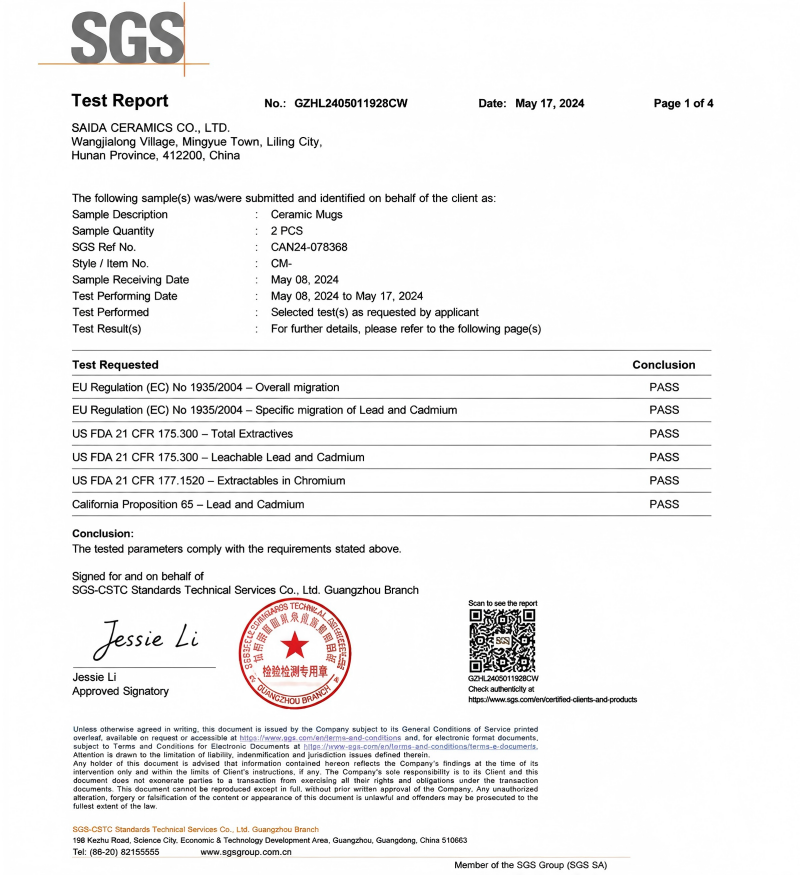
Now that you have the core definition, let's explore the critical details that separate savvy importers from those who take unnecessary risks. The difference lies in understanding what that test report actually represents for your specific order, your target market, and your business's reputation.
Is One SGS Report Valid Forever?
You're evaluating a new supplier, and they proudly email you a PDF of an SGS report. It has the official logo and a big "Pass" result. The problem? The report is dated 18 months ago. Relying on this document is a gamble that could put your entire investment at risk. Let's look at why a test report's date is one of the most important details to check.
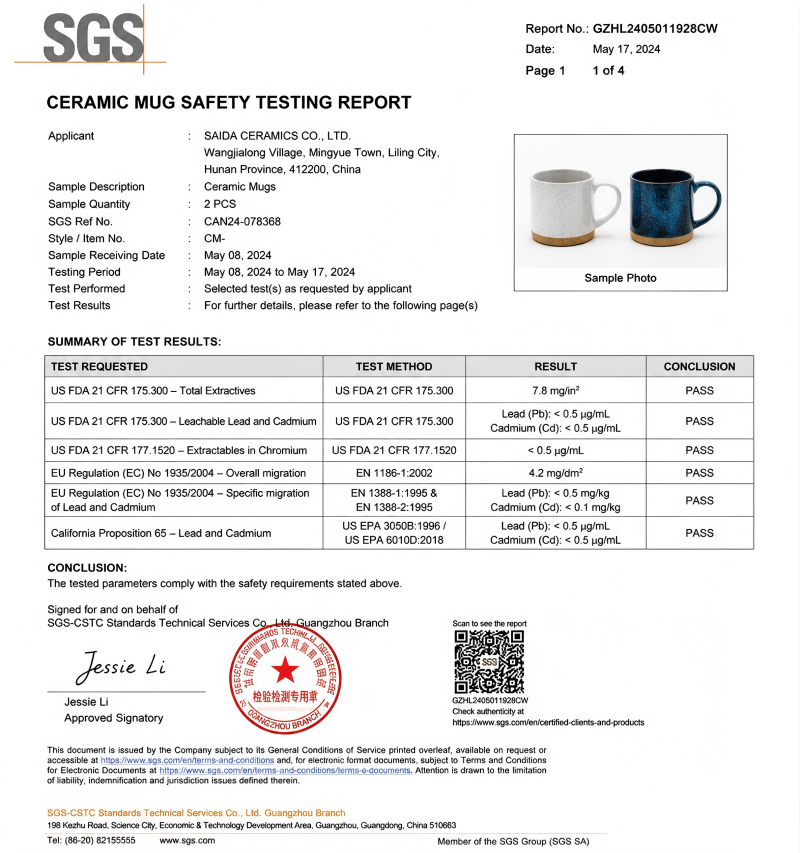
No, a single SGS report is not valid forever. An SGS report, sometimes called an SGS certificate for ceramic mugs, is only valid for the specific batch of samples submitted for testing on a particular date. Any subsequent changes in raw materials, glaze formulas, or production processes would require a new round of testing to ensure compliance.
Dive Deeper: The Report is a Snapshot, Not a Permanent Passport
When I review a test report with a client, the first thing I point them to is the "Sample Received Date" or "Test Period" section. This is non-negotiable proof that the report is a snapshot in time, not a lifetime pass for a product design.
Think of it this way: a factory producing thousands of mugs uses raw materials like clay, pigments, and glazes that are sourced in batches. While a responsible ceramic mug factory in China will have strong quality control to maintain consistency, minor variations can occur between these material batches. A glaze purchased in May might have a slightly different composition from one purchased in December. These subtle differences could potentially affect the final product's compliance.
This is why batch-specific testing is so important. A report from 2022 only proves that the samples tested in 2022 met the standard. It says nothing definitive about the mugs being produced for your order today. Customs officials and regulatory bodies are well aware of this. If your shipment is inspected, they will look for documentation relevant to the current production run, not an archived report.
Here’s what this means for your business:
- Risk Mitigation: Tying testing to your specific purchase order ensures the mugs in your container have been verified.
- Supplier Accountability: It requires your supplier to demonstrate ongoing quality control, not just a one-time success.
- Due Diligence: It provides you with the correct documentation to present if your shipment is ever questioned, proving you've done your due diligence on ceramic mug safety testing.
Relying on an old report is like accepting a weather forecast from last year. The conditions have changed, and you need current data to make a safe decision.
Does a 'Pass' for the US Market Work for the EU?
Your supplier provides an FDA-compliant report for your new mug design. It clearly passes the ceramic mug lead and cadmium testing, so you assume you're cleared for global sales. But when your first shipment lands in Hamburg, it's flagged by German customs for non-compliance. Suddenly, your "pass" certificate is worthless. This costly scenario happens because safety standards are not universal.
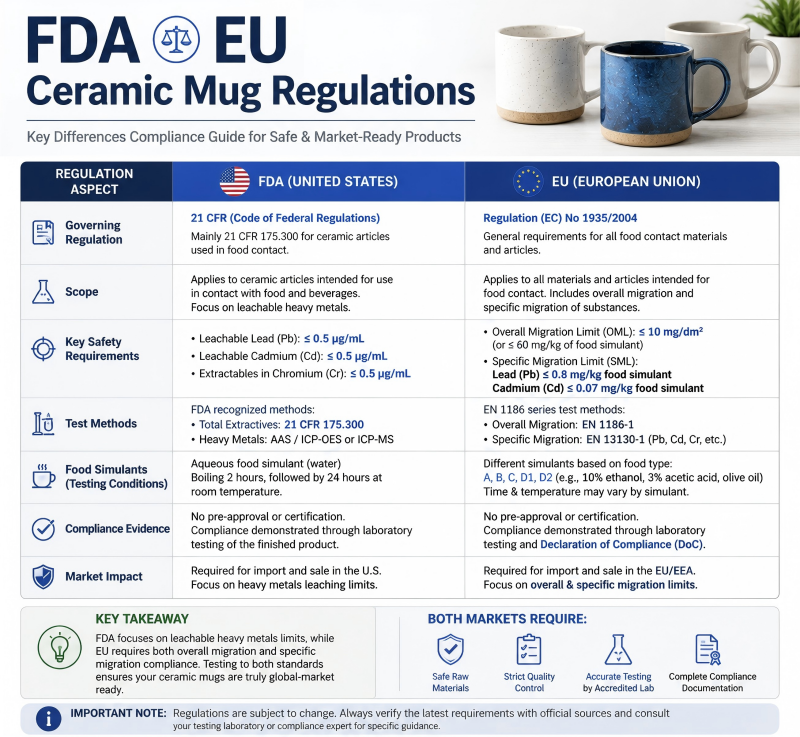
No, a report confirming compliance with US FDA standards is generally not sufficient for the European Union market. The EU has its own specific regulations for food-contact materials, primarily Regulation (EC) No 1935/2004, which may have different testing protocols and permissible migration limits for heavy metals compared to the US FDA.
Dive Deeper: Navigating the Maze of Global Regulations
A common question I get from new importers is, "Is it safe?" The better question is, "Is it compliant for my specific sales market?" Most food safe ceramic mugs are tested for lead and cadmium, but how they are tested and the limits they must meet vary significantly.
H3: A World of Standards Beyond the Basics
As an importer, you don't need to be a chemist, but you do need to know which rules apply to you. Here's a simplified breakdown:
-
The US Market: The primary concern here is making sure you have FDA compliant ceramic mugs. This is a baseline requirement. However, the complexity doesn't stop there. If you sell in California or on a platform like Amazon that ships there, you must also consider California Proposition 65. Prop 65 regulates over 900 chemicals and has much stricter limits than the FDA for many substances. A product can be FDA compliant but still require a Prop 65 warning label to be sold legally in California. You can learn more by reading about the FDA requirements for ceramic drinkware.
-
The EU Market: The framework here is governed by EU ceramic mug regulations, specifically (EC) No 1935/2004 and directive 84/500/EEC. While they also focus on lead and cadmium, the testing methodology and acceptable migration levels can differ from FDA standards. You cannot assume an FDA pass will translate to an EU pass. Your report must explicitly state that it was tested according to the relevant EU standards.
-
Other Markets: Countries in South America (like Brazil under ANVISA), Canada, Australia, and others have their own ceramic drinkware testing requirements. They often align with either US or EU standards, but this must be verified. Never assume.
To make this clearer, consider this table:
| Market | Key Regulation(s) | Main Focus | Why a "Pass" Isn't Universal |
|---|---|---|---|
| USA | FDA CPG Sec. 545.400 / CA Prop 65 | Leachable Lead and Cadmium / +900 other chemicals | Prop 65 has unique warning requirements not covered by basic FDA tests. |
| EU | (EC) No 1935/2004 / 84/500/EEC | Leachable Lead and Cadmium | Migration limits and testing conditions can differ from the FDA's. |
| South America | Varies (e.g., Mercosur, ANVISA) | Often aligns with US/EU but requires verification | Local authorities require reports specific to their country's laws. |
I once worked with an e-commerce seller who had a valid FDA report for their mugs. A competitor reported their Amazon listing for not having a Prop 65 warning, leading to a temporary suspension and a frantic scramble for re-testing. This is why we, as your OEM ceramic mug supplier, always start a project by asking, "Where are you selling?"
How Can You Ensure Effective SGS Testing for Ceramic Mugs?
You now know that old reports and mismatched standards are major pitfalls. So how do you take control of the process? You might feel asking for a new test is an extra burden, but it's the only way to operate safely. Asking a vague question like, "Do you have a test report?" leaves you vulnerable to receiving a document that is technically a "report" but practically useless for your order.
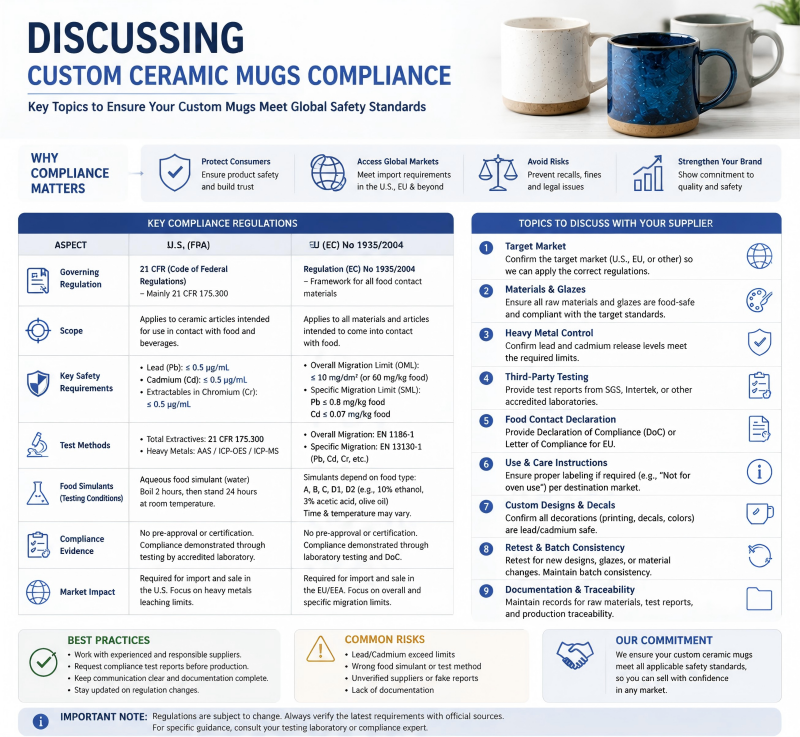
To ensure effective testing, ask your supplier a precise and action-oriented question: "For our upcoming order, can you arrange for batch-specific SGS testing for our ceramic mugs to comply with [Your Target Market]'s specific regulations, such as both FDA and Prop 65 for the US, or EC 1935/2004 for the EU?"
Dive Deeper: Shifting from a Question to a Requirement
The single most powerful change you can make in your procurement process is to reframe your request.
H3: From "Do You Have?" to "Can You Provide?"
- "Do you have an SGS report?" This is a simple yes/no question. It allows a supplier to check a box by sending you any report they have on file, regardless of its age or relevance to your market.
- "Can you provide a new SGS report for my order, compliant with [standard]?" This is a request for action. It makes custom ceramic mugs compliance a condition of the order. It signals to your supplier that you are an informed buyer who understands the risks and expects a professional process. As a ceramic mug manufacturer with SGS testing experience, we welcome this question. It shows that our client is serious about quality and safety, which aligns with our own values.
H3: The Cost-Benefit of Batch-Specific Testing
Yes, arranging a new test for your batch has a cost, typically a few hundred dollars depending on the complexity of the standards. Some importers hesitate at this extra expense. I always frame it as the cheapest insurance policy you can buy.
Consider the alternative costs:
- Your shipment is held at customs. You're now paying daily storage fees.
- The shipment is rejected. You now have to pay for return shipping or have the goods destroyed.
- A customer files a complaint or a lawsuit for non-compliance. The legal fees and brand damage can be catastrophic.
I remember a client who, against our advice, decided to save $400 by not ordering a new EU-specific test. Their shipment was flagged at customs in France. The subsequent delays, storage fees, and rush re-testing costs ended up exceeding $5,000, completely wiping out the profit on that order. Since then, batch-specific ceramic mug testing requirements have become a non-negotiable part of their buying process.
An experienced factory will have this process streamlined. At our facility, we integrate testing into our production timeline. Before mass production, we use a detailed ceramic mug inspection checklist to confirm material consistency, which minimizes the risk of a test failure and ensures the final SGS testing for ceramic mugs goes smoothly.
Frequently Asked Questions
How much does SGS testing for ceramic mugs typically cost?
The cost can vary depending on the target market and the number of specific tests required. For basic lead and cadmium testing for FDA or EU compliance, you can expect to pay a few hundred US dollars per sample set (e.g., per color). It's a small but critical investment for significant risk protection.
Can I use one mug from my shipment and send it for testing myself?
While you can do this, it is far more efficient and safer to have the factory coordinate testing with samples taken directly from the production line before the shipment leaves China. This ensures the test represents the entire batch and allows any issues to be fixed before you've paid for shipping.
What's the difference between SGS, Intertek, and TUV?
SGS, Intertek, and TUV are all highly respected, globally recognized third-party testing, inspection, and certification companies. They perform similar ceramic mug safety testing, and their reports are accepted by virtually all international authorities. The choice often comes down to the factory's existing relationship, location, and logistical convenience.
Are all lead-safe ceramic mugs automatically compliant everywhere?
No. The term "lead-safe ceramic mugs" typically means a product has passed the specific leachable lead standards for one market, usually the FDA in the US. However, as we've discussed, EU regulations have different limits, and California's Proposition 65 regulates hundreds of other chemicals besides lead. Compliance is market-specific.
Conclusion
The key takeaway is that a test report is not just a piece of paper; it's a critical risk management tool. True compliance goes far beyond simply having a document with a "Pass" on it. Effective SGS testing for ceramic mugs must be batch-specific, market-relevant, and current. By shifting your mindset from asking "Do you have a report?" to requiring "Can you provide a compliant report for my order?", you take control of the process. This proactive approach protects your capital, prevents customs nightmares, builds a trustworthy brand, and establishes you as a serious, professional importer.
As a wholesale ceramic mugs supplier with 15 years of experience exporting to the US, EU, and South America, we guide our clients through these compliance challenges every day. If you're looking for an experienced partner who understands the nuances of custom ceramic mugs compliance, contact us to discuss your next project.