Anxious about your first major order of ceramic mugs? A detailed ceramic mug inspection checklist is crucial, but many new importers make a costly mistake. They obsess over tiny cosmetic flaws, creating friction with suppliers while overlooking the real risks that can sink their investment and damage their brand's reputation. The secret isn't finding perfection; it's using the checklist as a powerful business risk management tool.
A smart ceramic mug inspection checklist prioritizes business-critical risks over minor cosmetic variations. It should classify defects into functional/safety hazards (e.g., chips, instability, lead/cadmium compliance) and cosmetic issues (e.g., small pinholes, color variations). Critically, it must also include rigorous checks for packaging integrity to prevent catastrophic shipping damage.
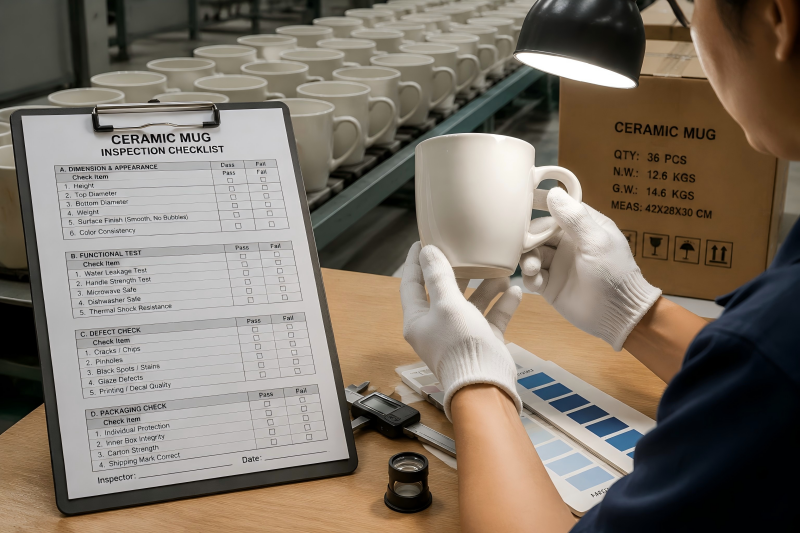
That answer might seem counterintuitive. Aren't you supposed to demand flawless products? In my 15 years of exporting ceramic mugs, I've seen that the most successful importers learn to shift their focus from an impossible ideal of "perfection" to a practical strategy for protecting their profitability.
Why Does Your Perspective on Quality Need to Change?
Worried that every tiny speck on a mug is a sign of a bad supplier? It’s a common fear for new buyers. You've invested a lot of capital and want to ensure your customers receive a product that reflects well on your brand.
This is a conversation I have almost weekly. A new client, anxious about their first container, sends me a list of tiny imperfections they found on a pre-production sample. My job is to help them understand the difference between a natural characteristic and a genuine defect.
The Myth of the "Perfect" Ceramic Mug
The single biggest misconception in our industry is that "Grade-A" means flawless. It doesn't. In the world of ceramics, "Grade-A" means the product meets a high standard of functional and aesthetic quality, but it acknowledges the nature of the material itself.
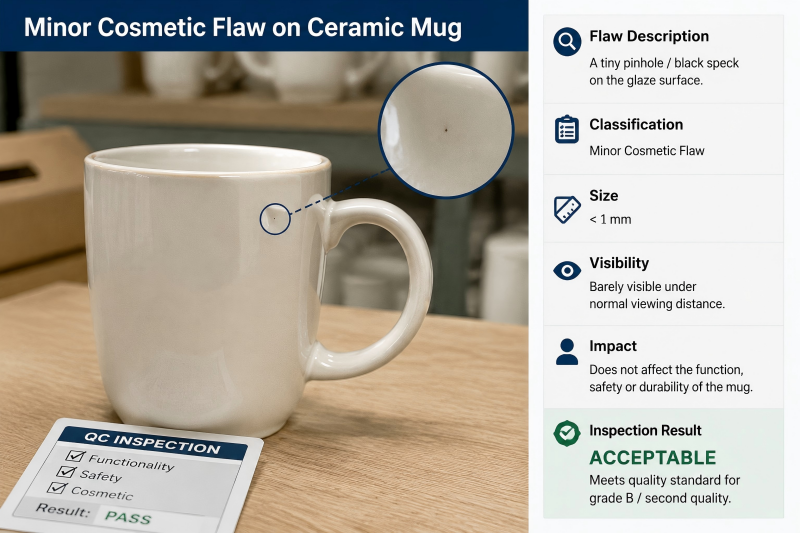
The Ceramic Mug Manufacturing Process is a beautiful but temperamental art, involving natural clays, liquid glazes, and firing temperatures exceeding 1200°C (2200°F). Small variations are not just possible; they are inherent. A tiny pinhole, a minute color variation, or a small dark spot from iron particles in the clay are often unavoidable byproducts.
Chasing a "perfect," machine-made ideal in a semi-artisanal process leads to frustration and conflict. A few years ago, I was working with a new e-commerce seller from Germany. He was incredibly detail-oriented and flagged nearly a dozen tiny cosmetic spots on his first sample. He was convinced we were trying to pass off low-quality goods.
I walked him through the firing process, explaining how these tiny marks occur. I showed him examples of mugs from major international brands that had similar characteristics. The goal isn't to create a sterile, plastic-like object. The goal is to create a durable, safe, and beautiful ceramic piece that is free from any issues that impact its use, safety, or overall commercial appeal. This shift in perspective is the first step in effective ceramic mug quality control.
How Do You Prioritize on a Ceramic Mug Inspection Checklist?
Once you accept that minor variations are normal, how do you decide what's acceptable? You're worried that if you accept small flaws, you might open the door to bigger problems. This is where a risk-based framework becomes your most valuable tool.
The solution is to stop thinking in subjective terms like "good" or "bad" and start categorizing every potential issue based on its business impact. On your ceramic mug inspection checklist, every point should fall into one of two simple categories: Functional/Safety Hazards or Cosmetic Flaws.
Functional/Safety Hazards vs. Cosmetic Flaws
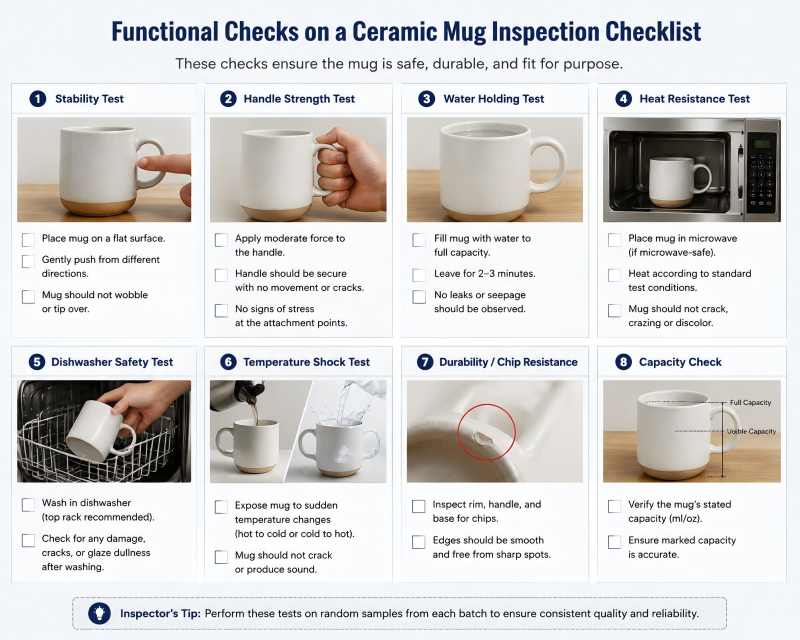
A Functional/Safety Hazard is any issue that prevents the mug from working as intended, poses a safety risk to the end-user, or violates regulations in your target market. These are non-negotiable and are grounds for rejection.
A Cosmetic Flaw is a surface-level imperfection that does not affect the mug's use, safety, or durability. These are typically managed with an AQL (Acceptable Quality Limit) standard, which we'll discuss later.
Here's how I break it down for my clients. This simple table can transform your ceramic mug factory inspection.
| Defect Category | Examples | Business Impact | Your Action |
|---|---|---|---|
| Functional/Safety Hazards | <ul><li>Cracks, chips (especially on the rim)</li><li>Wobbly or unstable base</li><li>Handle not securely attached</li><li>Leaks</li><li>Sharp edges from glaze drips</li><li>Failure of lead & cadmium tests</li></ul> | High risk of customer injury, returns, negative reviews, brand damage, legal liability. | Zero Tolerance. Reject. |
| Cosmetic Flaws | <ul><li>Pinholes (<0.5mm)</li><li>Small black spots</li><li>Slight color/decal misalignment</li><li>Minor glaze unevenness</li><li>Small scratches not through the glaze</li></ul> | Low impact. Unlikely to be noticed or cause a return by the average customer. | Manage with AQL. Accept within agreed limits. |
For that German client, this framework was a breakthrough. We agreed on a "zero tolerance" policy for any functional hazards. For cosmetics, we defined clear limits: no more than two pinholes smaller than a pencil tip per mug, and no black spots larger than 1mm.
This turned an emotional debate about "quality" into a logical business discussion. He felt in control, and we had clear, objective standards to work towards. This is the essence of a professional ceramic mug defect checklist. For a more detailed breakdown of specific issues, you can review our [Ceramic Mug Defects Guide].
What's the Biggest Risk Your Ceramic Mug Inspection Checklist Is Missing?
So, you've separated major hazards from minor flaws. You feel confident. But what if I told you the single greatest cause of financial loss for new importers is something they barely even glance at during inspection?
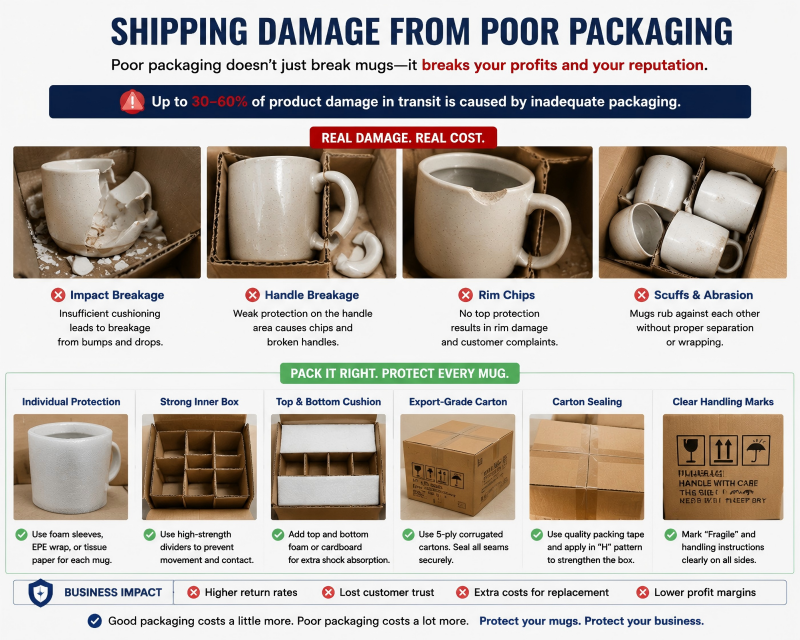
New buyers obsess over pinholes. They spend hours measuring decal placement. But they often miss the ticking time bomb: the packaging. A 20% breakage rate on arrival is infinitely more damaging to your bottom line than a few cosmetic specks on the surviving 80%.
This is the hidden catastrophe. You can have the most beautiful, functionally perfect mugs leave the factory, but if they arrive in a thousand pieces, your investment is gone. Your pre-shipment inspection for ceramic mugs must treat packaging with the same seriousness as the product itself.
From Product Inspection to Transit Simulation
During my initial calls with that German client, all his questions were about the mugs. Not once did he ask about the master carton specs or the drop test protocol. This is incredibly common.
I told him, "Your biggest risk isn't a tiny black spot. It's a forklift operator in Hamburg dropping your pallet." That got his attention.
We immediately shifted a core part of his ceramic mug inspection checklist to focus on packaging integrity. Here's what we added, which should be on every importer's list:
-
Carton Specifications:
- Material: Is it a 5-ply corrugated master carton as specified? Is the inner box strong enough?
- Weight & Dimensions: Does the packed carton meet the specs? An overweight carton is more likely to be dropped or crushed.
- Markings: Are the shipping marks, "Fragile" labels, and handling instructions clear and correct? Wrong markings can lead to lost or mishandled cargo.
-
Internal Packing:
- Dividers: Are there sturdy cardboard dividers between each mug?
- Cushioning: Is there bubble wrap or other material protecting the mugs? Is there empty space inside the box where items can shift?
-
The Carton Drop Test: This is the most critical test. The inspector should perform a standardized drop test (based on ISTA standards) on a percentage of the master cartons. This simulates the rough handling of real-world logistics. The box is dropped on its corners, edges, and flat sides from a specific height. After the test, the inspector opens the carton and checks for any damage to the mugs inside.
For my client, the first drop test failed. An inner mug was chipped. We worked with our packaging engineer to reinforce the inner box design. The second test passed perfectly. That simple test probably saved him thousands of Euros in damages and lost sales.
How Can Your Checklist Build a Strong Supplier Partnership?
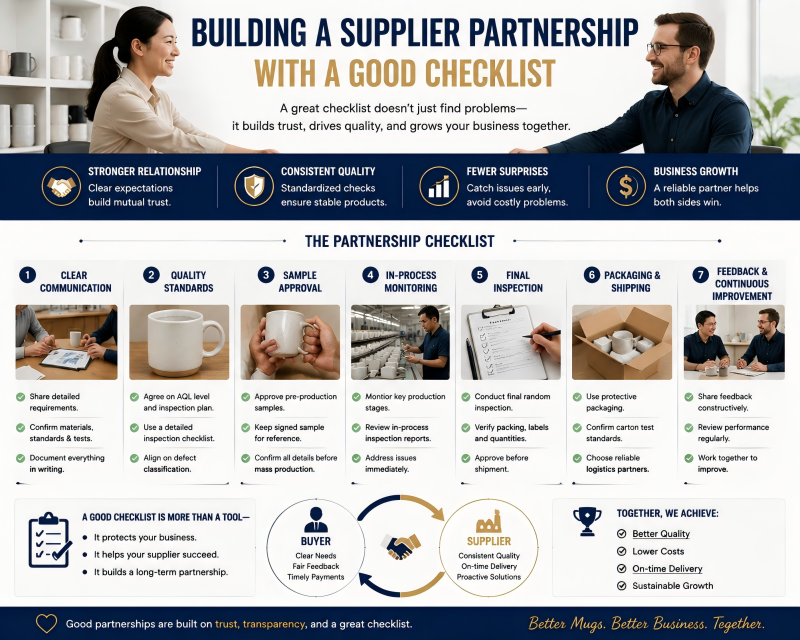
By now, you might see the checklist not as a weapon, but as a communication tool. The goal of a ceramic mug inspection process isn't to "catch" the factory; it's to create a shared, objective understanding of quality.
When you present a well-structured, risk-based checklist, you signal that you are a professional buyer. This allows a good supplier to work with you, not against you. You stop being an adversary and become a partner in managing quality.
A key part of this partnership is agreeing on an Acceptable Quality Limit, or AQL. This is a statistical tool used in inspections to determine how many defective items are acceptable in a batch.
AQL Inspection for Ceramic Mugs Explained
Instead of inspecting 100% of your 10,000 mugs (which is expensive and impractical), an inspector uses an AQL chart to determine a random sample size to check. For example, for 10,000 mugs, they might inspect 315.
You then set limits for different defect types. Using the framework from before:
- Critical Defects (Functional/Safety): 0 Allowed. If the inspector finds even one, the entire batch fails inspection.
- Major Defects (Significant Cosmetic/Functional): AQL 2.5. In a sample of 315, you might allow up to 14 major defects.
- Minor Defects (Small Cosmetic): AQL 4.0. In a sample of 315, you might allow up to 21 minor defects.
These numbers aren't random; they are industry standards that balance quality with commercial reality. The goal of an AQL inspection for ceramic mugs is to give you a statistically significant snapshot of the entire order's quality.
When you discuss AQL with your supplier before production starts, you align expectations. A reliable factory will welcome this clarity. They know exactly what target they need to hit. This is especially vital for custom orders, where a clear OEM ceramic mug inspection plan prevents misunderstandings about your unique specifications.
This collaborative approach is the difference between a one-time transaction and a long-term partnership. A supplier who understands your standards and works with you to meet them is the foundation of a successful import business. If you're just starting out, learning How to Choose a Reliable Ceramic Mug Supplier is just as important as writing your checklist. For custom designs, understanding the OEM Ceramic Mug Production Process will help you set realistic checkpoints.
Frequently Asked Questions
What is a standard AQL for ceramic mugs?
For ceramic mugs, a common standard is AQL 2.5 for major defects and AQL 4.0 for minor defects, with 0 for critical defects. Major defects might include noticeable cosmetic issues that affect saleability, while minor defects are small flaws an end customer likely wouldn't notice.
Are small black spots on ceramic mugs considered defects?
It depends on their size and quantity. Tiny black spots (under 1mm) are often inherent to the clay and firing process and are typically classified as minor cosmetic flaws. A good checklist will define an acceptable limit (e.g., "no more than 2 spots per mug") to maintain consistency.
How much does a third-party ceramic mug factory inspection cost?
The cost for a pre-shipment inspection by a third-party company in China typically ranges from $250 to $350 per "man-day." One man-day is usually enough to inspect a standard order size. The price includes travel, inspection time, and a detailed report with photos.
What are the most critical functional tests for a ceramic mug?
The most critical tests are: a stability test (it shouldn't wobble on a flat surface), a leak test (fill with water for a set time), a handle strength test (pulling on the handle with a specified force), and microwave/dishwasher safety tests if claimed.
Can I reject an entire order for only cosmetic flaws?
You can, but it's generally not a good business practice if the flaws fall within the pre-agreed AQL limits. Rejecting an order based on minor cosmetic issues can damage your relationship with the supplier and may not be contractually justifiable if you've agreed to an AQL standard.
Conclusion
Building a robust ceramic mug inspection checklist is less about chasing an unattainable ideal of perfection and more about smart risk management. By shifting your focus from subjective beauty to objective business impact, you can protect your investment and build a stronger brand. Prioritize functional and safety hazards, treat packaging as seriously as the product itself, and use your checklist as a tool for clear communication with your supplier. This approach transforms the inspection from a point of conflict into the foundation of a profitable, long-term partnership.
As a factory with over 15 years of experience exporting to discerning clients, we understand these challenges intimately. If you're looking for a partner who can help you navigate the complexities of ceramic mug quality control, please reach out. We would be happy to discuss your project and provide a quote.