Sourcing ceramic mugs can feel like navigating a minefield of potential quality issues. You worry about unboxing a shipment filled with flaws, leading to angry customer reviews, costly returns, and inventory you can't sell. Every tiny imperfection seems like a major problem, forcing you into technical debates with suppliers when you're not a ceramics expert. The solution isn't to become a ceramics engineer, but to reframe your perspective. This guide will walk you through the most common defects in ceramic mugs and teach you how to evaluate them based on business impact, not an impossible standard of perfection.
The most common defects in ceramic mugs include cracks, chips, and leaks (Critical Defects); glaze inconsistencies like drips, bubbles, and significant color variation (Minor Defects); and inherent manufacturing traits like tiny pinholes, small black dots, and slight warping (often Acceptable Craft Marks). These are typically classified based on their impact on the mug's safety, function, and commercial appeal.
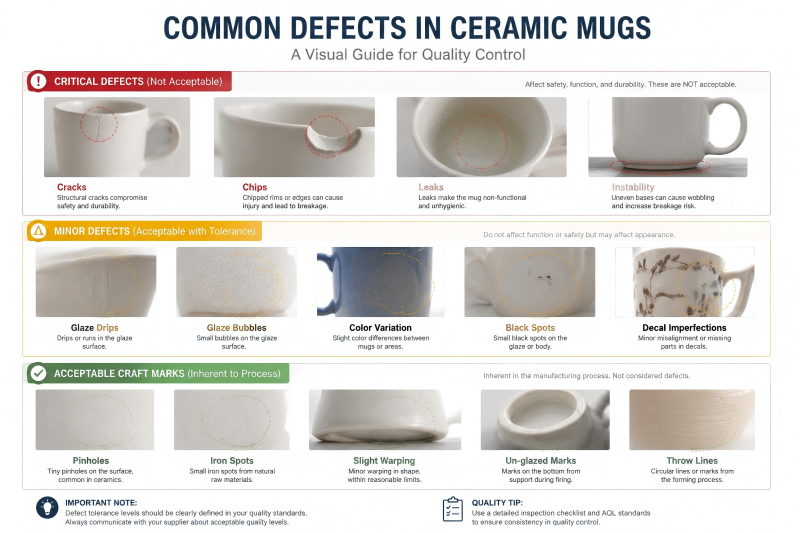
Understanding this list is just the first step. The real key to successful sourcing is learning to distinguish a business-critical flaw from an acceptable cosmetic imperfection. Let's explore a framework that my most successful clients use to make profitable, low-risk procurement decisions.
How Should You Classify Common Defects in Ceramic Mugs?
You've received a sample and spotted an imperfection. Is it a reason to reject the supplier, or is it a minor issue that won't affect sales? This uncertainty is stressful and can lead to costly delays or, worse, accepting a batch that will hurt your brand.
A structured approach is essential. For effective Ceramic Mug Quality Control, you should classify defects into three tiers: Critical, Minor, and Acceptable. This framework, a cornerstone of professional AQL inspection ceramic mugs, transforms a subjective debate into a clear, actionable process for you and your supplier.
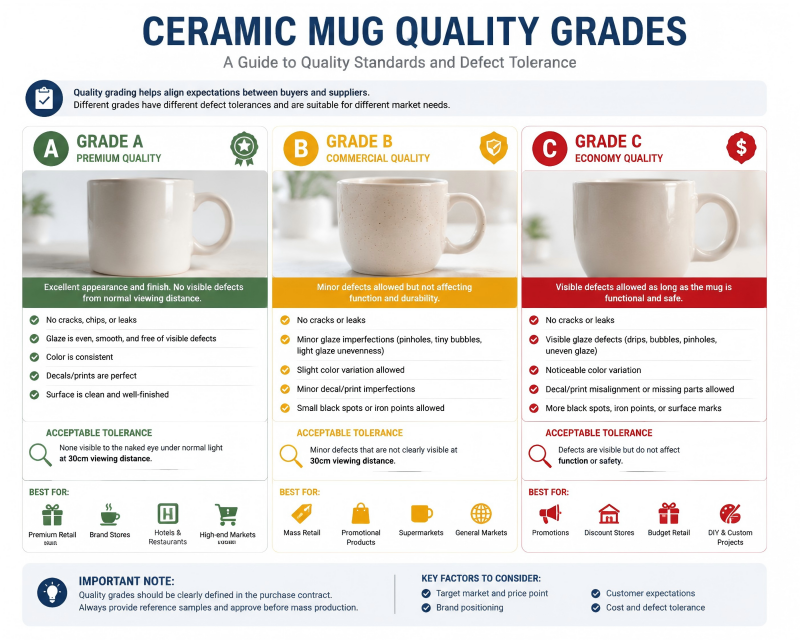
Dive Deeper: The 3-Tier Quality Framework
For over 15 years, I've helped international wholesalers and e-commerce sellers navigate the nuances of ceramic mug manufacturing defects. The most productive conversations always begin by establishing a shared understanding of quality. This 3-tier framework is the language we use to achieve that alignment.
H3: Tier 1: Critical Defects
These are non-negotiable deal-breakers. A single critical defect found during a pre-shipment inspection can, and often should, result in the rejection of the entire production lot. They render the product unsafe, unusable, or legally non-compliant.
Examples of Critical Defects:
- Cracks or Leaks: Any fracture that compromises the mug's structure, causing it to leak. This includes hairline cracks that may worsen with use.
- Chips: Especially on the rim or inner surface, as they pose a safety hazard and can harbor bacteria.
- Sharp Edges: On the handle, base, or rim that could cut the user.
- Contamination: Any foreign material fused into the glaze that could indicate a failure in food-safety protocols (e.g., potential for heavy metal leaching). A supplier must be able to provide valid FDA or Prop 65 compliance certification.
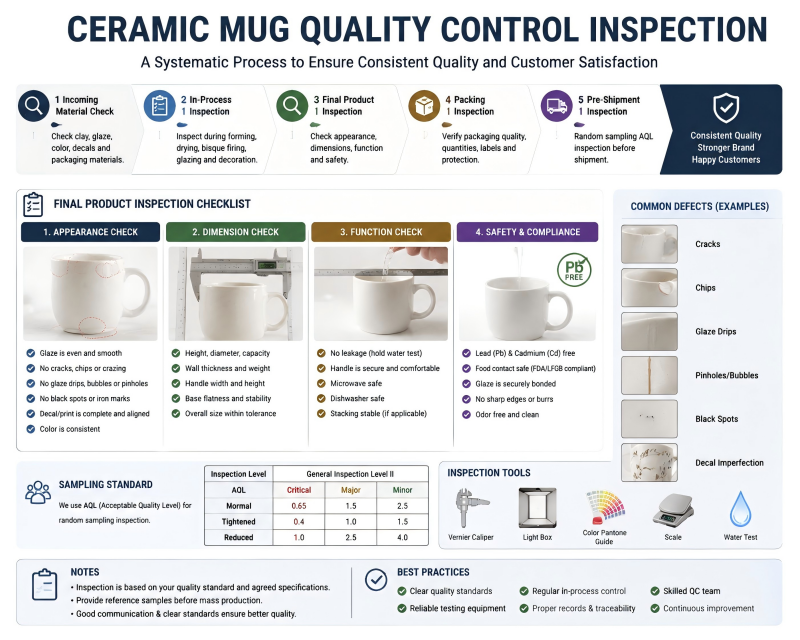
When we prepare a ceramic mug inspection checklist with a client, the tolerance for critical defects is always zero. There is no acceptable limit.
H3: Tier 2: Minor Defects
These are cosmetic flaws that do not affect the safety or function of the mug but may be noticeable to the end customer. They are the most common source of debate between buyers and suppliers. Minor defects are typically managed using an Acceptable Quality Limit (AQL), a statistical tool that defines how many defective units are permissible in a batch.
Examples of Minor Defects:
- Noticeable Glaze Drips: A visible run or thick drip of glaze, usually on the side of the mug.
- Large Pinholes or Blisters: A single pinhole over 1mm in diameter or a dense cluster of smaller ones in a prominent area.
- Significant Color Mismatch: A noticeable difference in color from the approved sample or between units in the same batch.
- Scratches or Scuffs: A mark on the surface that penetrates the glaze and is easily visible.
- Distorted Artwork: For printed mugs, if the logo or design is visibly skewed, blurred, or off-center.
During negotiations, we work with clients to set AQL levels (e.g., AQL 2.5/4.0) that match their market's expectations. An Amazon seller focused on volume may accept a higher limit than a premium corporate gift supplier.
H3: Tier 3: Acceptable Craft Marks
These are slight imperfections inherent to the mass production process of ceramics. As I explain in our guide on How Ceramic Mugs Are Made, firing clay at over 1200°C is not a perfectly predictable science. Demanding zero craft marks is like asking for a handcrafted art piece at a mass-market price—it's commercially unviable.
Examples of Acceptable Craft Marks:
- Tiny Pinholes: Isolated pinholes under 0.5mm in diameter, not clustered in a highly visible area.
- Small Black Dots: Tiny specks (often iron particles from the clay) that are not large or numerous enough to be distracting.
- Slight Handle Misalignment: Minor variations in handle angle that don't affect ergonomics.
- Subtle Glaze Unevenness: Very slight variations in glaze thickness, especially near the base or handle joints.
A key part of my job is helping clients understand that these marks are not typically noticed by the end-user and do not increase the risk of negative reviews for most sales channels.
| Defect Tier | Definition | Examples | Business Impact |
|---|---|---|---|
| Critical | Unsafe or unusable product. | Cracks, leaks, chips on the rim. | Must reject. Leads to 100% loss. |
| Minor | Cosmetic flaw, affects appearance. | Noticeable glaze drips, large pinholes. | Managed by AQL; may require sorting or discount. |
| Acceptable | Inherent manufacturing variation. | Tiny isolated dots, slight base unevenness. | No impact on sales for most markets. |
Is a "Perfect" Ceramic Mug a Realistic Goal?
Every buyer understandably starts with the desire for a flawless product. But when sourcing mass-produced goods, chasing 100% cosmetic perfection often leads to inflated quotes, production delays, and a product that's too expensive for your market.
No, a "perfect," flawless ceramic mug is not a realistic or profitable goal for mass production. The attempt to eliminate all minor cosmetic marks dramatically lowers the factory's "yield rate," which in turn significantly increases the unit cost. The proper goal is achieving a consistent, commercially viable quality standard that meets your customers' expectations.
Dive Deeper: The Commercial Trap of Perfection
When a new client insists on a "zero defect" standard for cosmetic issues like tiny pinholes, I don't just give them a higher price. I walk them through the "why." It's a conversation about yield rates.
The yield rate is the percentage of products from a production run that meet the agreed-upon quality standard.
Let's imagine we're producing 1,000 mugs.
-
Scenario A: Standard Quality (AQL 2.5)
- We inspect the mugs based on the 3-tier framework. We expect about 5% of mugs to have minor defects beyond the acceptable limit.
- Yield Rate: 95% (950 A-grade mugs).
- The production cost is spread across 950 units. Let's say the unit cost is $2.00.
-
Scenario B: "Perfection" Standard (Zero Minor Defects)
- We now have to discard any mug with even a tiny, barely visible glaze imperfection or a single small black dot. Due to the nature of high-temperature firing, this could mean rejecting an additional 30% of the production run.
- Yield Rate: 65% (650 A-grade mugs).
- The same total production cost must now be absorbed by only 650 units.
- The approximate new unit cost would be ($2.00 * 950) / 650 = $2.92.
That's a 46% price increase to chase a level of perfection your end customer likely won't notice or value. For an Amazon seller, that price difference is the entire profit margin.
This is why the core question is always "fitness for purpose."
- Are you selling to a discount store? Standard quality is appropriate.
- Are you supplying a luxury hotel chain? A higher grade (and higher cost) is necessary.
- Are you an e-commerce brand balancing reviews and cost? You need a partner who can help you find the sweet spot.
A good ceramic mug supplier quality control program isn't about achieving perfection; it's about achieving consistency at a quality level that makes commercial sense for your business.
How Can a Good Supplier Help Manage Common Defects in Ceramic Mugs?
You've sent your tech pack and approved a sample, but the first production photos show minor flaws you didn't expect. You feel like the supplier isn't listening, leading to frustrating back-and-forth emails and a feeling of losing control over your investment.
A good supplier acts as a consultant, not an order-taker. They proactively manage expectations around common defects in ceramic mugs by asking strategic questions before production starts. They help you define realistic ceramic mug quality standards that balance cost, quality, and your specific market needs, preventing problems instead of just reacting to them.

Dive Deeper: The Power of Counter-Questions
In my 15 years as an exporter, I've learned that the most valuable service I can provide is not just making mugs, but helping clients make smart business decisions. A factory that promises perfection without discussion is waving a red flag. A true partner engages you with questions.
Here are a few common scenarios:
Scenario 1: The client is concerned about small black dots.
- Typical Response: "Don't worry, we will control it." (This is vague and unhelpful).
- My Consultative Response: "I understand completely. To help me control this effectively, can you tell me more about your primary sales channel? Are your customers buying this as a budget-friendly item, or is it for a premium gift box where aesthetics are paramount?"
This counter-question immediately shifts the focus from a technical flaw to a business outcome. The answer helps us recommend the right grade of clay and the right level of inspection, aligning the final product with their commercial risk.
Scenario 2: The client's spec sheet says "no pinholes."
- Typical Response: "Okay, noted." (Followed by a much higher quote or, worse, a failed inspection later).
- My Consultative Response: "Thank you for the clear specification. Eliminating all pinholes is technically possible through multiple glazing and firing cycles, but it can increase the unit cost by 30-40%. For your target customer, have you found that minor, isolated pinholes lead to returns or negative reviews? We can aim for an 'A-grade' standard that allows for zero pinholes on the interior and rim, and only a few tiny ones on the lower body. Would that work for your brand?"
This approach demonstrates expertise, manages expectations on cost, and offers a practical, tiered solution. It shows we're thinking about their profit margins and brand reputation. This is the level of partnership we strive to provide as a dedicated Custom Ceramic Mug Manufacturer and specialist in OEM Ceramic Mug Production. It's about building a robust process for ceramic mug inspection before shipment from day one.
Frequently Asked Questions
What is an AQL inspection for ceramic mugs?
AQL, or Acceptable Quality Limit, is a statistical sampling method used during inspections. Instead of checking 100% of the mugs, an inspector checks a predetermined number of units from the batch. The AQL defines the maximum number of minor defects allowed in that sample. If the sample passes, the entire lot is accepted.
Are small black dots on ceramic mugs a defect?
It depends on their size, quantity, and location. A few tiny, isolated black dots (often from iron particles in the clay) are typically considered acceptable craft marks in mass-produced ceramics. However, large, numerous, or clustered dots in a prominent area like the inside of the mug would be classified as a minor defect.
How do I create a ceramic mug inspection checklist?
Start by listing all potential defects using the 3-tier framework (Critical, Minor, Acceptable). For each defect, specify the tools for inspection (e.g., visual, water test for leaks) and your tolerance level. Be specific about locations (rim, handle, interior, base, printed area). Share this checklist with your Wholesale Ceramic Mugs Supplier before confirming your order to ensure you're both aligned.
Can a mug with a defect still be food-safe?
A mug with a critical defect like a crack or a chip on the rim is not food-safe, as it can harbor bacteria. However, most minor cosmetic defects (e.g., a small glaze drip, a tiny pinhole) do not impact food safety. Always ensure your supplier can provide valid, up-to-date compliance certificates for your target market, such as FDA, California Prop 65, or LFGB.
Conclusion
Successfully sourcing ceramics is not about finding a factory that promises perfection. It's about finding a partner who helps you define what "good enough" means for your specific business. By shifting your focus from debating every tiny flaw to assessing its real-world impact, you can make smarter, more profitable decisions. Using a 3-tier framework (Critical, Minor, Acceptable) provides a clear language for discussing and agreeing upon quality standards. Ultimately, understanding the most common defects in ceramic mugs is less about the defects themselves and more about how you manage them commercially.
As a 15-year veteran in the industry, my team and I specialize in this consultative approach to Ceramic Mug Quality Control. If you're looking for a manufacturing partner who will help you balance quality, cost, and market expectations, contact us to discuss your next project.