Sourcing products for your e-commerce store or wholesale business can feel like walking a tightrope. You're trying to find the best price, but you're haunted by the risk of a bad batch wiping out your profit margins and your brand's reputation. This is especially true when it comes to a detailed process like quality control during mug production, where a small oversight can lead to a mountain of customer complaints.
Effective quality control during mug production is a multi-stage inspection process that begins with raw materials and continues through every step of manufacturing, including bisque firing, glazing, and final decoration. It is not a single check at the end but a system designed to catch and correct defects early, ensuring the final product meets commercial and safety standards.
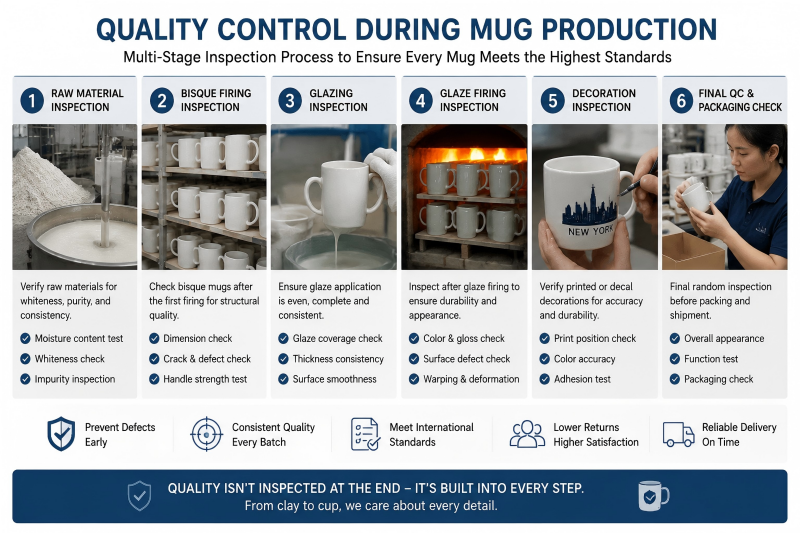
Simply relying on a final inspection is a gamble. The real secret to sourcing mugs that delight customers instead of disappointing them lies in understanding what happens before they are packed into the carton. Let's explore the critical checkpoints and why a supplier's approach to them is the best predictor of your success.
How Can Seemingly Minor Ceramic Mug Defects Ruin Your Business?
You've found a supplier with a price that seems too good to be true. It probably is. You might think you can live with a few "minor" flaws to save 30 cents per unit, but your customers won't be so forgiving. The disconnect between a manufacturer's technical jargon and a customer's real-world perception is where brands get destroyed.
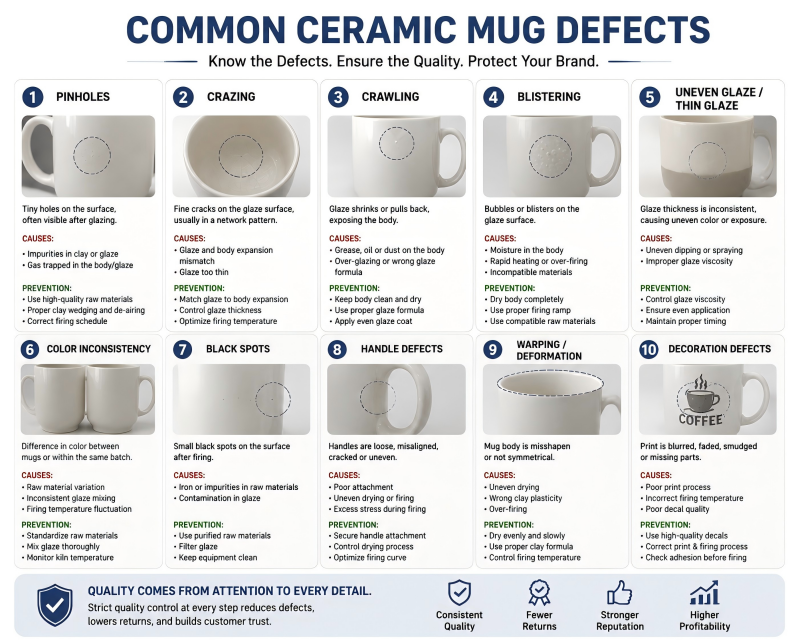
The reality is that ceramic mug defects that seem small in the factory become massive problems when they land in a customer's hands. What a factory might call a "small pinhole" is what a customer calls "unhygienic and gross," sparking a 1-star review that warns other buyers away.
Over my 15 years in this business, I've seen this story play out time and again. I recently onboarded a new client, an Amazon seller in Germany, who was recovering from a disastrous shipment from a previous supplier. They were lured in by a low price but ended up with an inventory of mugs riddled with what the supplier called "acceptable variations." Their customers, however, called them "defective."
The True Cost of a "Minor" Flaw
The financial damage went far beyond the cost of the mugs. They had to deal with a spike in returns, refund processing fees, and the cost of shipping replacements. Even worse, their product listing was flooded with negative reviews, causing their sales rank to plummet. The "savings" they made on the initial order were erased tenfold by the commercial fallout.
To help you avoid this fate, it's crucial to translate technical defects into tangible business risks. Here’s a breakdown of the most common issues I see and how they directly impact your bottom line.
| Technical Defect | A Customer's Interpretation | The Business Impact for You |
|---|---|---|
| Pinholes | "This mug feels dirty and unhygienic. It looks like it could trap bacteria." | Returns, negative reviews about safety/cleanliness, potential delisting from marketplaces for health concerns. |
| Black Spots / Impurities | "It arrived with dirt baked into the ceramic. It looks cheap and used." | "Item not as described" complaints, damage to brand perception, increased return rate. |
| Uneven Glaze / Color | "The color is blotchy and doesn't match the product photos. Disappointing quality." | High return rates, negative feedback on product accuracy, loss of customer trust. |
| Deformed Shape / Wobble | "The mug isn't stable and wobbles on the table. It feels flimsy and poorly made." | Functionality complaints, safety concerns (spilling hot liquid), immediate grounds for a refund. |
| Chipped Rim or Handle | "Arrived broken/chipped. Poor packaging or just a fragile product." | Product is unusable. Guaranteed return, refund, and a scathing review about your quality control. |
When you start asking potential suppliers What defects should I check when importing ceramic mugs?, don't just ask for a list. Ask them what their specific tolerance is for each of these business-killing flaws. Their answer will tell you everything you need to know about their commitment to your success.
What Are You Really Paying For with Quality Control During Mug Production?
When you compare quotes from two different factories, and one is 15-20% higher, it's easy to assume that the difference is just profit margin. You might be tempted to negotiate them down or simply go with the cheaper option. But this is one of the most dangerous assumptions a buyer can make.
That price difference isn't just margin; it's the budget for processes the cheaper supplier skips. Proper quality control during mug production is a series of deliberate, labor-intensive checkpoints. A lower price is often a direct indicator that some, or all, of these vital checks are missing from the workflow.
The price of robust quality control during mug production funds crucial in-process inspections at multiple stages, from raw material to pre-glazing checks. Cheaper suppliers often skip these steps, essentially gambling that final defects will go unnoticed, which puts all the risk on you, the buyer.
Think of it this way: a factory that skips in-process inspections is playing a game of chance with your money. They are betting that enough mugs will come out "good enough" in the final batch. The problem is, you are the one who pays the price for the ones that don't. A good ceramic mug manufacturer quality control system isn't a cost; it's insurance.
Key Inspection Stages That Protect Your Investment
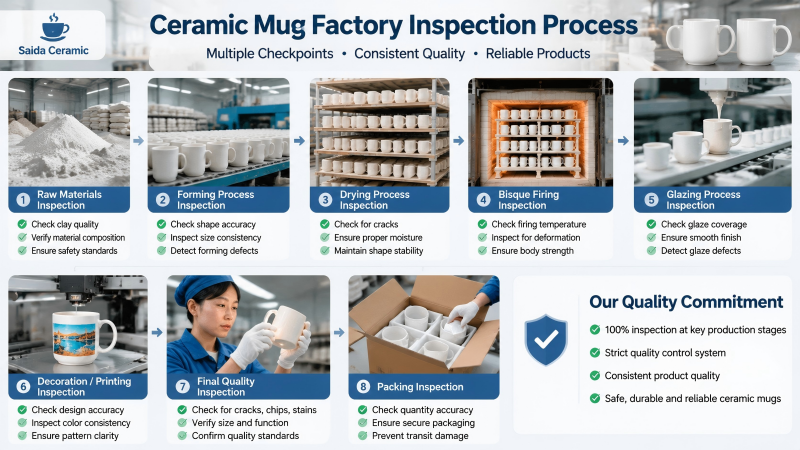
The ceramic mug manufacturing process is complex, with many opportunities for defects to arise. A reliable factory builds in checkpoints to catch these issues at the least expensive stage. Here are the non-negotiable inspection points that should be part of any reputable manufacturing line.
H3: 1. Raw Material and Forming Inspection
It all starts here. The clay's moisture content, purity, and consistency are checked. The molds used for forming are inspected for wear and tear.
- Why it matters: Inconsistent clay can lead to cracking during firing. Worn molds can create deformed or misshapen mugs. Catching this here prevents wasting energy firing a product that is doomed from the start.
H3: 2. White Body (Bisque) Inspection
After the mug has been formed and gone through its first, low-temperature firing, it's called a "white body" or "bisque." At this stage, it is porous and unglazed. This is arguably the most critical inspection point.
- Why it matters: Inspectors check for cracks, chips, and deformities. A hairline crack that is nearly invisible now will become a major fracture after the high-temperature glaze firing. A flawed piece can be discarded here with minimal loss. Once glaze and decoration are applied, the value (and cost of failure) increases dramatically.
H3: 3. Post-Glazing and Pre-Decoration Inspection
Workers check for even glaze application. They look for drips, bare spots, or areas where the glaze is too thin or too thick.
- Why it matters: Uneven glaze leads to the blotchy colors and rough textures that customers complain about. If a decal is going to be applied, the surface must be perfect.
H3: 4. Final Inspection (Post-Firing)
This is the quality inspection for ceramic mugs that every factory does. The fully fired and decorated mugs are checked for all the defects listed earlier: pinholes, black spots, color consistency, decal alignment, chips, and cracks.
- Why it matters: This is the last chance to protect your customer from a bad product. However, if this is the only major inspection point, it means the factory's strategy is to "inspect quality in" at the end, rather than "build quality in" from the beginning. This is inefficient and leads to either higher prices (to cover the high defect rate) or a supplier trying to pass off borderline products to you.
A factory that can proudly walk you through all these steps is one that respects your business.
How Do You Choose a Reliable Ceramic Mug Supplier?
You now understand that price is a poor indicator of value. So, how do you sift through the endless options to find a partner who will protect your brand? Shifting your focus from price to process is the key.
Asking the right questions transforms you from a simple buyer into a savvy sourcing partner. It signals to the factory that you understand quality and won't be fooled by a low price tag that hides significant risk. This is fundamental to how to choose a reliable ceramic mug supplier.
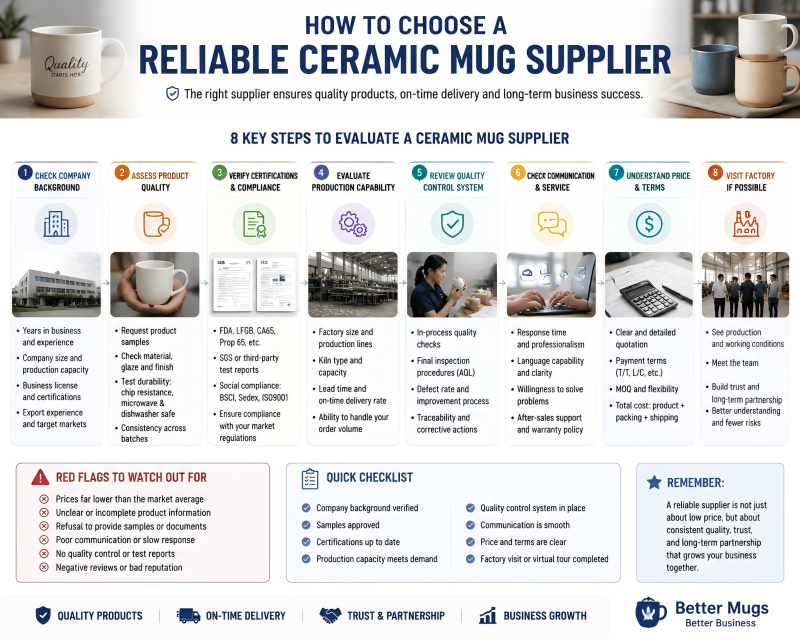
To choose a reliable ceramic mug supplier, shift your questioning from "How much per unit?" to "Can you describe your quality control process?" Ask for specifics on their inspection checkpoints, their standards for common defects, and how they handle failed items. Their ability to answer clearly and confidently is a strong indicator of their reliability.
When I speak with potential new clients, the ones who impress me most are those who come prepared with process-oriented questions. It shows they're serious about building a long-term, stable business. You can do the same.
The Smart Buyer's QC Checklist
Instead of starting with price, start your next supplier conversation with these questions. Their answers will reveal far more than a price list ever could. This is your guide on how to inspect ceramic mugs from China before you even place an order.
-
"Can you walk me through your
ceramic mug factory inspection processfrom raw materials to final packaging?"- What to listen for: You want to hear them mention multiple checkpoints, especially the white body (bisque) inspection. If they only talk about the final inspection, that's a major red flag. They should be able to explain why each stage is important.
-
"What are your specific standards for common
ceramic mug defectslike pinholes and black spots? Do you use an AQL standard?"- What to listen for: Avoid vague answers like "we have high standards" or "we check for those." A professional factory will have clear, often quantifiable, internal standards. They might say, "We allow no more than 2 pinholes under 0.5mm on the body, and zero on the lip or interior." This shows they have a defined system.
-
"How do you handle mugs that fail an inspection? What happens to the rejects?"
- What to listen for: The right answer is, "They are separated and scrapped." A concerning answer is, "We try to fix them" or vagueness. Some unscrupulous factories might try to repair defects (e.g., grinding down a bump and re-glazing) or even slip them into shipments for less discerning clients.
-
"Can you provide copies of your factory audit reports, such as BSCI or ISO 9001?"
- What to listen for: While you should always verify documents, a willingness to share them is a sign of transparency. An ISO 9001 certification specifically relates to a documented quality management system, which is a very positive sign.
-
"What is your process for ensuring materials are food-safe and comply with standards like California Prop 65 or the
FDA requirements for ceramic drinkware?"- What to listen for: They should talk about testing raw materials (clay and glazes) for lead and cadmium and being able to provide test reports from a reputable third-party lab for their materials or similar products. This is non-negotiable for exporting to the US and Europe.
By asking these questions, you take control of the conversation. You position yourself as a knowledgeable partner and make it clear that quality is your priority. For more tips on this, you can read our guide on how to find reliable ceramic mug manufacturers.
Frequently Asked Questions
How do I check ceramic mugs before shipment?
The best practice is a final random inspection (FRI) based on AQL standards once the order is 100% packed. You or a third-party inspector should check for cosmetic defects, dimensions, function (e.g., capacity, stability), and packaging quality. This is your last chance to catch issues before they ship.
What is an acceptable defect rate for ceramic mugs?
This is defined by the Acceptable Quality Limit (AQL) you negotiate with your supplier. A common standard for consumer goods is an AQL of 2.5 for major defects (unusable product) and 4.0 for minor defects (cosmetic flaws). The right level depends on your brand's quality positioning and customer expectations.
Are small black spots or pinholes normal in ceramics?
The ceramic firing process is part science, part art, so minor imperfections can occur. However, a manufacturer with strong quality control during mug production has processes to minimize these flaws to a level that is commercially acceptable and virtually invisible to the end-user. An excess of these is a sign of poor process control.
Why is a white body inspection so important?
The white body (or bisque) inspection occurs after the first firing but before the expensive glaze and decals are applied. It is the most cost-effective moment to find and discard items with critical flaws like cracks or chips. Skipping this step is a huge gamble that leads to higher defect rates in the final product.
Conclusion
Chasing the lowest price on ceramic mugs is a trap that has cost countless importers their profits and reputation. True value is not found in the unit price but in a supplier's unwavering commitment to robust quality control during mug production. Every skipped inspection and every ignored flaw in the factory becomes a direct and expensive problem for your business, manifesting as bad reviews, costly returns, and lasting brand damage. By shifting your focus from price to process and asking the tough, specific questions about how a manufacturer ensures quality, you transform yourself from a price-taker into a smart, protected sourcing partner.
As a factory with 15 years of experience exporting to demanding markets in Europe and South America, we have built our entire reputation on this principle of process-driven quality. If you're ready to partner with a manufacturer who understands that our quality control is your brand's first line of defense, contact us to discuss your next project.