Struggling with inconsistent orders after approving a perfect sample? You're not alone. Many importers face high defect rates and brand-damaging flaws in their bulk shipments, turning a promising product into a costly liability. To truly ensure ceramic mug quality, you must look beyond the sample and vet the manufacturer's entire production system.
To ensure ceramic mug quality, you must shift your focus from inspecting the final product to auditing the manufacturer's process. This means verifying their quality management systems (like ISO 9001), reviewing their in-process quality control records, and confirming their methods for controlling raw material consistency. A perfect sample proves they can make one good mug; a proven process proves they can make 10,000.
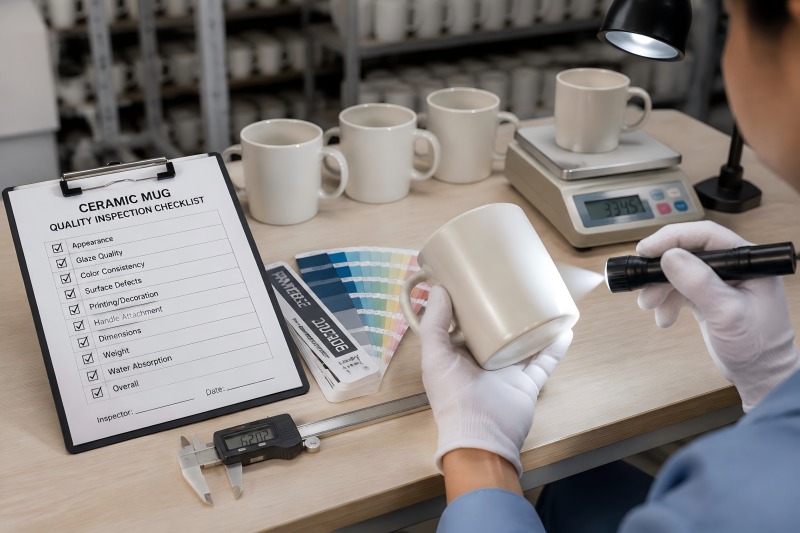
This shift in perspective is the single most important change you can make to de-risk your supply chain. Instead of hoping for the best, you can start making decisions based on data and systems. Let's explore why this approach works and how you can implement it.
Why Is the Perfect Sample a Seductive Trap?
You receive a sample from a potential new supplier, and it's flawless. The color is perfect, the glaze is smooth, and it feels sturdy. The price is right, so you place a large order, feeling confident. But when the container arrives, it’s a different story. Does this sound familiar?
The perfect sample is a trap because it proves a factory can make one good mug, not that they have the systems to consistently make thousands. It’s an idealized product, often made by a separate, highly-skilled sample team, not the actual mass-production line.

Dive Deeper: The Difference Between Capability and Consistency
In my 15 years running a ceramic factory in Liling, I've seen countless buyers fall for this. The core issue is confusing a factory's capability with its process consistency.
-
Capability (The Sample): A skilled technician, given unlimited time and the best materials, can create a masterpiece. This is your sample. It's made to win the order. They might cherry-pick the best clay, apply the glaze with extra care, and fire it in a small, perfectly calibrated test kiln. This proves they have the technical skill.
-
Consistency (Mass Production): Manufacturing 10,000 or 100,000 mugs is a different challenge. It relies on a stable, repeatable system that can handle variations in raw materials, environment, and human factors. This is where most factories fail if they don't have robust ceramic mug manufacturer quality control.
Here’s a breakdown of where things go wrong between sample and bulk order:
| Factor | Sample Production | Mass Production | The Risk to Your Order |
|---|---|---|---|
| Material Source | Small, hand-picked batch of clay and glaze. | Large batches from different mining lots or suppliers. | Inconsistent color, durability, and safety (e.g., lead/cadmium levels). |
| Labor | Top technician or dedicated sample department. | Regular production line workers with varying skill levels. | Higher rates of forming defects, glaze imperfections, and handling damage. |
| Firing Process | Small, controlled test kiln. | Large industrial tunnel kiln with potential temperature zones. | Warping, cracking, pinholes, and color shifts due to firing variations. |
| Inspection | 100% inspection by a senior manager. | AQL-based spot checks by line inspectors. | More ceramic mug defects can slip through into the final packaging. |
Approving an order based solely on a sample is like hiring a chef based on one perfect dish they made for you. It tells you nothing about their ability to run a busy restaurant kitchen during a Saturday night rush. You aren't just buying a product; you are buying a factory's capacity for consistent output.
Where Are the Real Risks in the Ceramic Mug Production Process?
You’re worried about receiving mugs with cracks, pinholes, or colors that don't match your brand guidelines. These visible defects are frustrating, but they are symptoms of a deeper problem. The true risks to ceramic mug quality are hidden in the earliest stages of the complete ceramic mug production process, long before a mug ever takes shape.
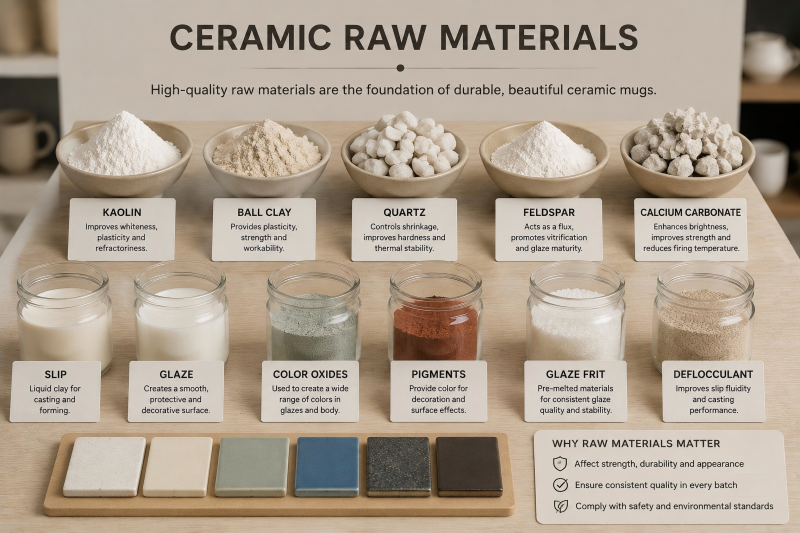
The most significant risks are found in two areas most buyers never see: raw material formulation and the firing process. Weaknesses here are where unreliable suppliers often cut corners, creating problems that only surface weeks later in your warehouse or, worse, in your customer’s hands.
Dive Deeper: Uncovering the Hidden Factory Floor
As a manufacturer, we live and die by our process control. A beautiful design is worthless if the mug cracks in the dishwasher. Let's pull back the curtain on the two most critical, yet opaque, stages.
H3: The Raw Material "Black Box"
A ceramic body isn't just "clay." It's a precise recipe of different materials, typically including kaolin, feldspar, quartz, and ball clay. The exact ratio determines the mug's final properties:
- Durability: The right formulation prevents chipping and ensures it can withstand thermal shock (e.g., from microwave to countertop).
- Porosity: Incorrect composition can lead to a porous body that absorbs water, harbors bacteria, and is prone to "crazing" (fine cracks in the glaze).
- Safety: Most importantly, the purity of these raw materials and the glaze composition determines compliance with standards like FDA and California Prop 65 for lead and cadmium.
An unreliable factory might switch to a cheaper, lower-grade clay supplier mid-production to save a few cents per unit. You won't see this change on an inspection report. You'll see it six months later when you get a wave of customer complaints about chipping or staining. A reliable ceramic mug supplier will have strict batch control for their raw materials, testing each new shipment to ensure it meets their formulation standards.
H3: Firing: The Moment of Truth
The kiln is where a fragile piece of shaped clay becomes a durable ceramic product. This transformation depends on the "firing curve"—a precise graph of temperature over time. A typical curve involves slowly heating, holding at a peak temperature (often over 1200°C / 2200°F), and then slowly cooling.
Any deviation can be catastrophic:
- Heating too fast: Trapped moisture turns to steam, causing pieces to explode.
- Peak temperature too low/high: The body may not vitrify properly (making it weak), or the glaze may not mature correctly (causing pinholes or a dull finish).
- Cooling too fast: This creates internal stresses, leading to cracks and crazing that may only appear days or weeks after firing.
We use digitally controlled tunnel kilns with multiple sensors to ensure every mug experiences the exact same firing curve. This is a core part of our OEM ceramic mug quality control. When you evaluate a factory, ask to see their kiln logs. A factory that can't provide this data is a factory that is guessing, and you will pay the price for their guesswork.
How Do You Shift from Product Inspector to System Auditor?
Feeling like you need a degree in ceramic engineering just to source mugs safely? The good news is, you don't. Your real job isn't to become a ceramics expert; it's to become a good auditor of your supplier's systems. This simple shift in focus is less overwhelming and far more effective.
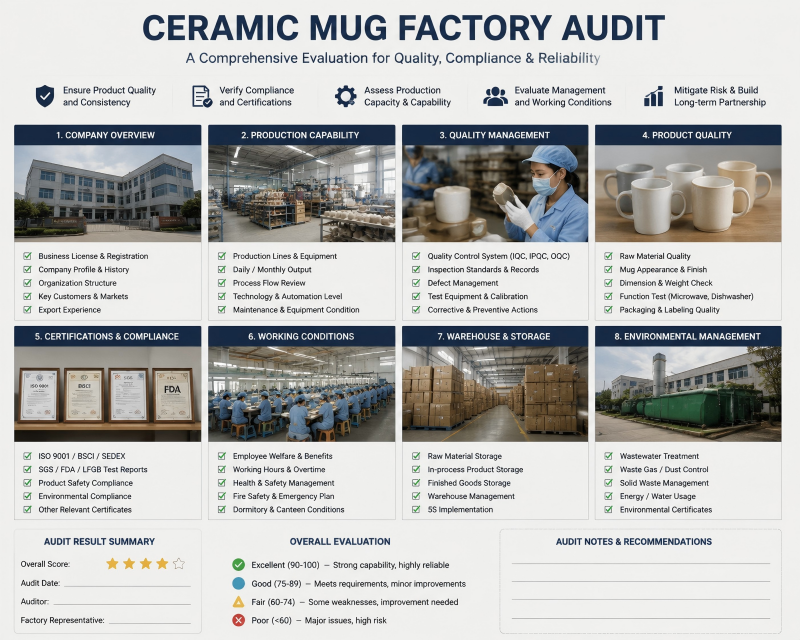
Instead of focusing only on the final product, a system audit means you're looking for evidence of control, consistency, and documentation. A proper ceramic mug factory audit verifies that the factory has a robust process designed to prevent defects from happening in the first place.
Dive Deeper: Your System-Level Inspection Checklist
When we onboard a new major client, they rarely start by scrutinizing a single mug. Instead, their procurement teams come prepared with a system-level checklist. They are auditing our factory, not just our products. You can do the same.
Here is a ceramic mug inspection checklist that focuses on the system, not just the sample:
-
Verify Management System Certifications:
- What to ask for: "Can you provide a copy of your current ISO 9001 and BSCI certificates?"
- Why it matters:
- ISO 9001 (Quality Management): This isn't just a piece of paper. It certifies that the factory has a documented system for things like controlling production processes, managing non-conforming products, tracking raw materials, and continuous improvement. It's the blueprint for consistency.
- BSCI (Social Compliance): While focused on ethics and labor, a BSCI-compliant factory is generally better managed and more organized. Chaos in labor management often correlates with chaos in quality management.
- Pro Tip: Don't just accept the PDF. Use the certificate number to verify its authenticity on the website of the issuing body (e.g., SGS, Intertek, TÜV).
-
Request In-Process Quality Control (IPQC) Records:
- What to ask for: "Can you show me your IPQC reports for a recent, similar production run? I'd like to see your inspection data from the greenware, bisque, and final decoration stages."
- Why it matters: This is your proof of life. It shows they are actively looking for defects throughout the ceramic mug production process, not just at the end. A good factory measures things like forming dimensions, moisture content, and glaze thickness at multiple checkpoints. A blank stare is a major red flag.
-
Inquire About Raw Material Batch Control:
- What to ask for: "How do you ensure consistency between different batches of clay and glaze? Do you have incoming material inspection procedures?"
- Why it matters: This question cuts right to the heart of long-term consistency. The best suppliers will explain their process for testing new material batches for color, shrinkage, and chemical composition before they are introduced to the main production line. This prevents entire orders from shifting in color or durability.
-
Review Defect Analysis and Corrective Action Reports:
- What to ask for: "When you find a high rate of a specific defect, what is your process for investigating the root cause and preventing it from happening again?"
- Why it matters: Every factory has defects. Great factories study them. Their answer reveals their maturity. A good answer involves a formal process, like a Corrective Action Report (CAR), that documents the problem, the root cause analysis, the solution, and verification. A bad answer is, "Our workers just try to be more careful."
By asking these questions, you change the dynamic. You are no longer a passive buyer hoping for good luck; you are an active partner holding the factory accountable to a system that produces predictable wholesale ceramic mug quality standards.
What Does Reliable Ceramic Mug Quality Control Look Like in Practice?
All this talk about systems and audits can feel abstract. You might be wondering what this looks like for a real business and how it solves real problems. The difference between a product-focused supplier and a process-focused one is the difference between constant firefighting and predictable growth.
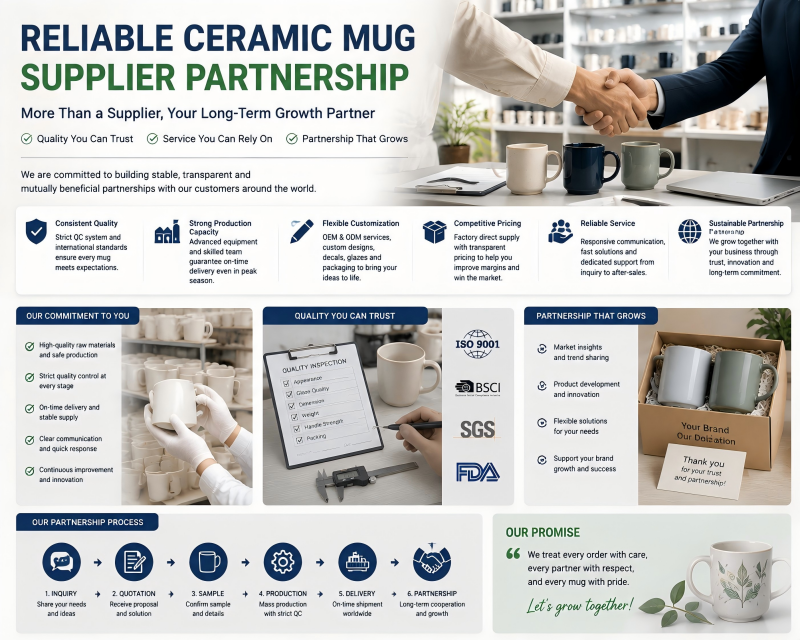
In essence, reliable OEM ceramic mug quality control manifests as a transparent partnership. It’s a supplier who proactively shows you their data, involves you in key decisions, and has systems in place to prevent problems before they start, ensuring your ceramic mug quality meets expectations every time.
Dive Deeper: A Case Study in Reducing Supply Chain Headaches
A few years ago, we began working with a fast-growing e-commerce seller from the US. They came to us with a serious business problem, not just a product problem.
The Client's Pain Points: Their previous supplier was causing constant headaches that were crippling their growth:
- Inconsistent Colors: Their signature brand color varied by up to 15% from shipment to shipment. This led to customer complaints and damaged their brand identity.
- High Defect Rate: They were experiencing an 8-10% rate of chipped rims and handles found during their 3PL's inbound receiving process. These costs were eating directly into their margins.
- Zero Transparency: When they complained about the issues, they were simply told "we will do better next time" with no explanation or plan. They were flying blind, and every new purchase order felt like a gamble.
Our Solution: A System-Based Approach When they approached us, we didn't just send them a beautiful sample. We knew their trust had been broken. Instead, we spent our first several meetings walking them through our systems.
- Solving the Color Problem: We showed them our computerized glaze formulation and mixing records. We explained our use of a spectrophotometer to digitally measure color (using CIE Lab* values) on every batch, ensuring it stayed within a tiny, pre-agreed tolerance. They weren't just getting a promise; they were getting a data-backed guarantee.
- Solving the Chipping Problem: We walked them through our multi-stage inspection process. We showed them our IPQC reports where we check for micro-cracks after the bisque firing stage—long before the expensive glaze and decoration are applied. We also demonstrated our reinforced packaging design, which was tested using industry-standard drop tests.
- Building Transparency: For their first order, we shared weekly progress reports, including photos from the production line and copies of the actual IPQC checklists being filled out. They could see their ceramic mug quality being built and verified in near real-time.
The Result: Within two orders, their problems vanished. Their defect rate on arrival dropped to below 1.5%. Their brand color was stable across every mug. Most importantly, their team could stop spending hours dealing with quality claims and focus on marketing and growing their business. They found a partner, not just a supplier. This is the tangible business outcome of choosing a factory based on its process, and it's how you find truly reliable ceramic mug manufacturers.
Frequently Asked Questions
What is an acceptable defect rate for wholesale ceramic mugs?
For A-grade quality, most importers work with an AQL (Acceptable Quality Limit) of 2.5 for major defects (like cracks or severe color mismatch) and 4.0 for minor defects (like small pinholes). However, a reliable supplier with strong process control should consistently achieve an actual defect rate of 2% or less.
How can I verify a factory's ISO 9001 certificate?
First, request a clear copy of the certificate. Then, locate the name of the issuing certification body (e.g., SGS, TUV, Intertek) and the certificate number. Go to the certifier's website, where they usually have an online directory to validate the certificate's authenticity and status.
What are the most common ceramic mug defects I should look for?
Common visual defects include pinholes (tiny holes in the glaze), crazing (a fine web of cracks in the glaze), color variations, chips, cracks, warped bodies (not sitting flat), and decal or printing misalignments. These are often symptoms of poor process control in firing or raw materials.
Does BSCI certification relate to ceramic mug quality?
Not directly. BSCI (Business Social Compliance Initiative) audits a factory's adherence to social and ethical standards, like working hours and safety. However, a factory that invests in passing a BSCI audit is typically more organized, professional, and well-managed, which often correlates with better quality control systems.
Conclusion
The secret to sourcing high-quality ceramic mugs consistently isn't about finding a factory that can make one perfect sample. It’s about finding a partner with a transparent, data-driven, and robust manufacturing system. By shifting your mindset from a product inspector to a system auditor, you can move beyond hope and start making decisions based on evidence. Focus on verifying certifications, demanding process data, and understanding how a factory controls its raw materials. This is how you truly ensure long-term ceramic mug quality. It protects your investment, your brand, and your peace of mind.
If you are tired of inconsistent quality and want to partner with a manufacturer that values process and transparency, we invite you to reach out. Let's discuss how our proven systems can help you de-risk your supply chain and build a more predictable, profitable business.