Sourcing inventory for your business can feel like walking a tightrope. You need a quality product at a competitive price, but one bad batch of non-compliant goods can lead to catastrophic losses. When it comes to a food-safe ceramic mug, a single failed inspection could mean customs rejection, a costly recall, or irreparable damage to your brand. So how can you be sure every mug in your order is genuinely safe?
A truly food-safe ceramic mug is one produced through a consistently controlled manufacturing process that minimizes the risk of heavy metal leaching, particularly lead and cadmium. While a single test report confirms compliance for a sample, true safety assurance comes from a supplier's documented quality management system, raw material control, and precise firing techniques.
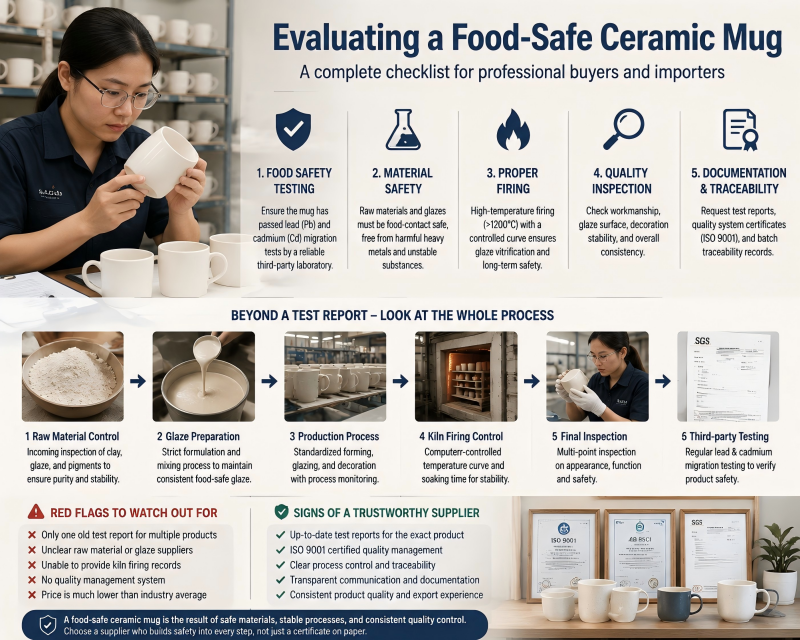
Understanding this distinction is the key to protecting your investment. It shifts your procurement strategy from a simple certificate check to a more robust evaluation of a supplier's entire operation. Let's explore what this means for your business and how to spot the critical red flags.
Why Is a Test Report Not a Complete Guarantee of Safety?
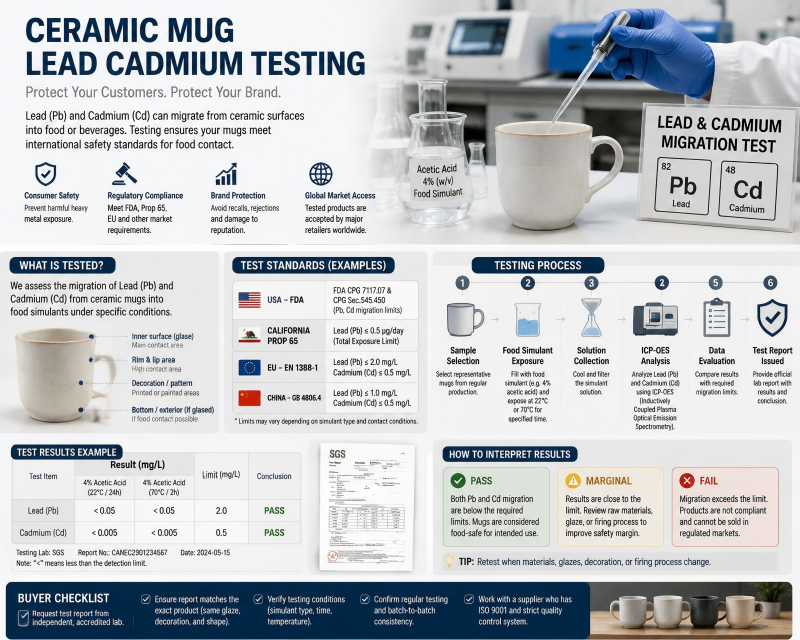
You've received a test report from a potential supplier showing their mug passes FDA or Prop 65 standards. It feels like a safe bet, the green light you were waiting for. But what if that report only represents one "golden sample," while thousands of others in your order were made with less care? This gap between sample and bulk production is a major blind spot for importers. To truly mitigate risk, you must learn to see a test report for what it is: a snapshot in time, not a guarantee of ongoing ceramic mug quality control.
A test report is not a complete guarantee because it validates only the specific sample submitted for testing. It doesn't prove that every mug in a 10,000-unit production run consistently meets the same ceramic mug safety standards, as variations in materials or firing can occur across the batch.
Dive Deeper: The Snapshot vs. The Feature Film
Think of a food safety test report as a single, perfectly staged photograph. It looks great, but it doesn't tell you the whole story. The supplier may have carefully selected a "golden sample"—a mug produced under ideal conditions—specifically for testing purposes. This proves they can make a safe product, but it doesn't prove they always do.
Your business, however, relies on the full story—the "feature film" of the entire production run. True safety assurance comes from the consistency of the manufacturing process, which ensures that the 10,000th mug is just as safe as the first. This is where many importers get into trouble; they approve a supplier based on the snapshot, only to receive a shipment where quality varies dramatically.
The Impact of Production Variables
In my 15 years of manufacturing ceramic mugs, I've seen how tiny deviations can have major consequences. Several key variables can alter the safety profile of a mug from one batch to the next:
- Raw Material Consistency: The composition of clay and feldspar can vary. Without pre-production testing of raw materials, impurities can unknowingly enter the production line.
- Glaze Formulation: The glaze is the primary barrier that prevents leaching. An incorrectly mixed batch—even a small error in the ratio of components—can create an unstable surface.
- Firing Temperature and Duration: This is arguably the most critical step. If a kiln is under-fired (even by a few degrees to save on energy costs), the glaze won't fully vitrify. An unvitrified glaze is porous and significantly more likely to leach lead and cadmium into beverages.
These are not hypothetical risks. They are daily variables that a professional factory must rigorously control.
The Business Risk of Inconsistency
This is where the risk translates directly into dollars and cents. The ceramic mug import requirements for markets like the United States (FDA) and Europe (EC 1935/2004) are strict. Customs agents can and do perform random spot tests on incoming shipments. If they pull a single mug from your container and it fails a leach test, the consequences can be severe:
- Shipment Detention: Your entire container can be held at the port, incurring demurrage fees that pile up daily.
- Forced Re-Export or Destruction: You may be ordered to ship the entire container back to the origin country or have it destroyed—both at your own expense.
- Product Recalls: If the product has already reached the market, you could face a mandatory recall, which involves logistical nightmares, financial losses, and significant damage to your brand's reputation.
I’ve personally spoken with importers who were blindsided by this. They had a valid test report in hand but lost their entire investment because a random sample from their bulk order failed at the port. The certificate didn't matter; the inconsistency in production did.
How Does a Low Price Indicate a Higher Safety Risk for a Food-Safe Ceramic Mug?
You're comparing quotes from several factories, and one supplier's price is significantly lower than the rest. It's incredibly tempting to choose that option and boost your profit margin. But as a business advisor in this industry, I must caution you: where are those savings really coming from? In ceramics manufacturing, the deepest cost-cutting measures are often invisible, hidden in the raw materials and process shortcuts that directly impact safety. Recognizing that an unsustainably low price is a major red flag is the first step toward protecting your business.
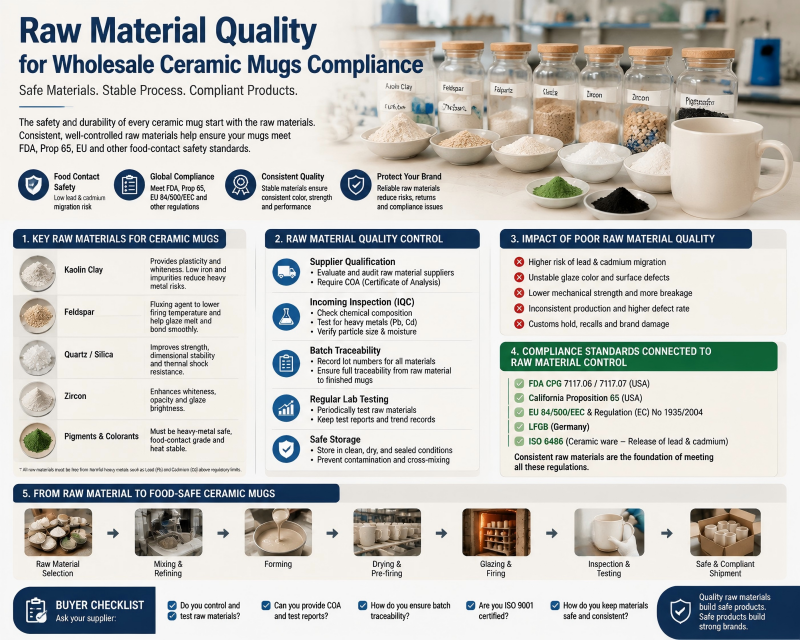
A low price often indicates a higher safety risk for a food-safe ceramic mug because it suggests the manufacturer is cutting corners on critical, "invisible" inputs. This can include using lower-grade clay with impurities or cheaper glazes with unstable compositions, increasing the likelihood of heavy metal leaching.
Dive Deeper: The Anatomy of Mug Production Costs
To understand the risk, you need to understand the cost structure. When a factory offers a price that seems too good to be true, the cuts are rarely made in their own profit margin. They are made in the quality of the product itself. Here’s a breakdown of where a low-price supplier might cut corners compared to a quality-focused one:
| Cost Component | High-Quality Supplier Practice | Low-Price Supplier Shortcut | Inherent Safety Risk |
|---|---|---|---|
| Clay/Kaolin | Uses purified, screened clay with consistent mineralogy. | Buys cheaper, less-refined clay that may contain heavy metal impurities from the source. | Higher baseline levels of lead or cadmium in the mug body itself. |
| Glaze | Employs stable, well-tested, and often more expensive glaze formulas and pigments. | Uses cheaper pigments (e.g., certain bright reds/oranges are known risks) or unstable binders. | The primary source of leachable lead and cadmium if the formula is compromised. |
| Kiln Firing | Fires at the precise, high temperature for the required duration to ensure full vitrification. | Lowers the peak temperature or shortens the firing cycle to save significant energy costs. | Incomplete vitrification; the glaze remains porous and is much more likely to leach chemicals. |
| Quality Control | Has a dedicated QA team that performs checks at multiple stages (material, forming, post-firing). | Relies on workers for self-inspection or has one final, cursory check, if any. | Safety and quality defects are not caught before the product is packed and shipped. |
Real-World Example: The Firing Cycle "Savings"
Energy is one of the largest operational costs in a ceramic factory. A kiln firing cycle can last 8-12 hours, reaching temperatures over 1200°C (2200°F). A factory can save a substantial amount of money on its electricity or gas bill by cutting that cycle short or lowering the peak temperature by just 20-30 degrees.
You, the buyer, will never see this "saving." The mug might look identical. However, this shortcut is one of the most dangerous. It directly undermines the integrity of the glaze, turning a potentially safe product into an unsafe one. This is a crucial detail to grasp when evaluating lead safe ceramic drinkware. The safety is fired into the mug, and cutting corners here is non-negotiable for a responsible manufacturer.
The Long-Term Cost of a "Bargain"
The initial savings from a low-cost supplier can be quickly erased by a single safety failure. Consider the true business impact:
- Legal Liability: Selling non-compliant products opens you up to lawsuits, particularly in litigious markets. A violation of California's Proposition 65, for example, can result in hefty fines.
- Unsellable Inventory: A rejected shipment or a recalled product line is dead capital. The money you invested is gone, with additional costs for storage or disposal.
- Reputational Damage: Today's consumers are highly conscious of product safety. A public recall or negative press can erode customer trust that takes years to rebuild.
A few years ago, I consulted with a new e-commerce seller who was thrilled to have sourced mugs at a 15% lower cost than other quotes. The shipment arrived, and the mugs looked great. But they had to recall the entire batch after their own due diligence testing revealed inconsistent and sometimes high lead levels. Their "bargain" cost them their entire initial investment and delayed their store launch by six months.
What Makes Process Control the True Mark of a Food-Safe Ceramic Mugs Supplier?
If certificates are not a complete guarantee and low prices are a major risk, how do you confidently select a supplier for your business? Relying on a smooth sales pitch or gut feeling is a recipe for disaster. You need a concrete framework for assessing a factory's true capabilities. The key is to shift your focus from final-product promises to the production process itself. A supplier who can articulate, document, and prove their process control is a partner genuinely invested in your success and safety.
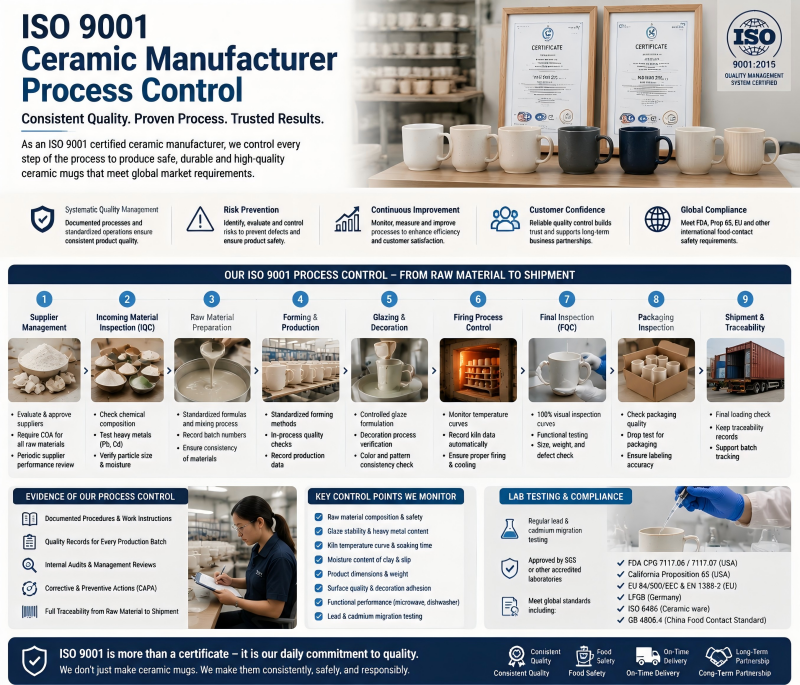
Process control is the true mark of a food-safe ceramic mugs supplier because it demonstrates a proactive, systematic approach to safety. It proves the factory has documented procedures for raw material screening, glaze consistency, and precise firing to ensure every single mug meets safety standards, not just a hand-picked sample.
Dive Deeper: From Reactive to Proactive Safety
Many factories operate on a reactive safety model: they produce a large batch of mugs and then send one to a lab, hoping it passes the test. This is a gamble—a gamble they are taking with your investment.
A truly professional manufacturer operates on a proactive safety model. This philosophy is embedded in quality management systems like ISO 9001. Instead of hoping for a good result at the end, we control every input and every step of the process to ensure a safe result.
As an ISO 9001 ceramic manufacturer, our certification isn't just a plaque on the wall. It's a blueprint that dictates our daily operations. It means we have documented, repeatable, and audited procedures for everything:
- How we qualify and test incoming raw materials.
- How we mix glazes to exact specifications.
- How we calibrate and monitor our kilns.
- How we trace a finished product back to its original material batch.
This system is designed to create consistency and minimize deviation, which is the very foundation of product safety.
Key Areas of Process Control to Ask About
When you evaluate a potential supplier, go beyond "Do you have a food-safe certificate?" Ask probing questions about their process. A good supplier will welcome these questions; a risky one will be evasive.
-
Raw Material Control:
- "How do you vet your clay and glaze component suppliers?"
- "Do you perform any testing on raw materials before they are used in production?"
- A strong answer will involve supplier audits and batch testing for heavy metals.
-
Glaze Formulation and Management:
- "Is your glaze mixed in-house or purchased pre-mixed?"
- "How do you ensure consistency from one batch of glaze to the next?"
- Look for answers mentioning documented formulas, digital scales for precision, and batch numbering. This is essential for producing FDA compliant ceramic mugs.
-
Kiln Temperature Monitoring:
- "What technology do you use to control your kiln temperature?"
- "Can you show me firing curve records for a recent production run?"
- Modern factories use computer-controlled kilns with multiple thermocouples to ensure even and accurate heating. A supplier should be able to provide this data.
-
In-Process & Finished Goods Testing:
- "What internal ceramic mug quality control checks do you perform during and after production?"
- "Do you perform your own in-house leach testing on random samples from production runs?"
- While not a substitute for third-party labs, regular in-house checks demonstrate a commitment to ongoing wholesale ceramic mugs compliance.
The Role of Certifications like ISO 9001 and BSCI
While a product test report is a snapshot, a process certification like ISO 9001 is a validation of the entire system.
- ISO 9001 (Quality Management): This is the single most important certification for assessing consistency. It confirms that a third-party auditor has verified the factory has a robust, documented process for producing its goods and managing quality. It’s your best assurance that the 10,000th mug will be made to the same standard as the first.
- BSCI (Business Social Compliance Initiative): This audit focuses on social and ethical standards. While not directly a product safety certification, it’s an excellent indicator of a well-managed, professional organization. Factories that invest in ethical practices and their workers' well-being are far more likely to invest in robust quality and safety systems as well. Our factory holds both certifications, which we see as fundamental to building long-term trust with our clients.
Frequently Asked Questions
What is the difference between FDA and Prop 65 compliance for ceramic mugs?
The FDA sets federal limits on lead and cadmium leaching for all food-contact items sold across the U.S. California's Proposition 65 is a state-specific law that is much stricter; it requires businesses to provide warnings about exposure to a long list of chemicals, often at much lower levels than federal limits. Non-compliance with Prop 65 can lead to significant legal action, so it's a critical standard for anyone selling into the California market.
How often should a supplier perform ceramic mug lead cadmium testing?
A reliable supplier should have a third-party test report that is updated at least annually or whenever there is a major change in raw materials or glaze formulation. More importantly, they should have an internal protocol for conducting spot checks on a batch-by-batch basis. This continuous verification is more telling than a single, year-old certificate.
Can I tell if a ceramic mug is food-safe just by looking at it?
No. There is no visual cue that can reliably indicate whether a mug will leach heavy metals. While physical defects like cracks or crazing (fine lines in the glaze) can pose a bacterial risk and indicate poor quality, chemical safety can only be determined through laboratory testing and confidence in the manufacturer's certified production process.
Why is an ISO 9001 ceramic manufacturer a safer choice?
Choosing an ISO 9001 certified manufacturer is a safer bet because the certification validates their entire Quality Management System. It's third-party proof that they have documented, repeatable, and audited processes for everything from raw material sourcing to final inspection. This systematic approach drastically reduces the risk of inconsistency and safety failures across large production runs, making them a more reliable long-term partner.
Conclusion
Navigating the world of international sourcing requires moving beyond surface-level checks. For wholesalers and e-commerce sellers, ensuring the safety of your products is paramount to protecting your brand and your bottom line. The key takeaway is this: a single test report is merely a starting point, a low price is often a sign of hidden risks, and true confidence comes from a supplier's robust and transparent process control. Choosing the right partner for your food-safe ceramic mug supply is a critical risk management decision that defines the long-term health of your business.
At our factory in Liling, we have built our reputation over 15 years on this principle of process-driven quality. Our ISO 9001 and BSCI certified operations are designed to provide our partners in Europe and the Americas with the consistency and peace of mind they deserve. If you're looking for a supplier who treats your business's safety as their own, please contact us to discuss how we can build a reliable supply chain for your next project.