Struggling with customer complaints about mugs that chip, crack, or fade after just a few uses? Many importers believe a thicker, heavier mug is a stronger one, only to face costly returns and negative reviews when that assumption proves false. The real secret to sourcing a reliably strong product lies in understanding how manufacturers test for genuine mug durability.
Manufacturers test mug durability by simulating real-world stresses through a series of controlled laboratory procedures. These include thermal shock tests (rapid heating and cooling), dishwasher resistance tests (hundreds of cycles with harsh detergents), microwave safety tests, and impact tests (measuring resistance to chipping and breakage) to ensure the mug withstands daily use.
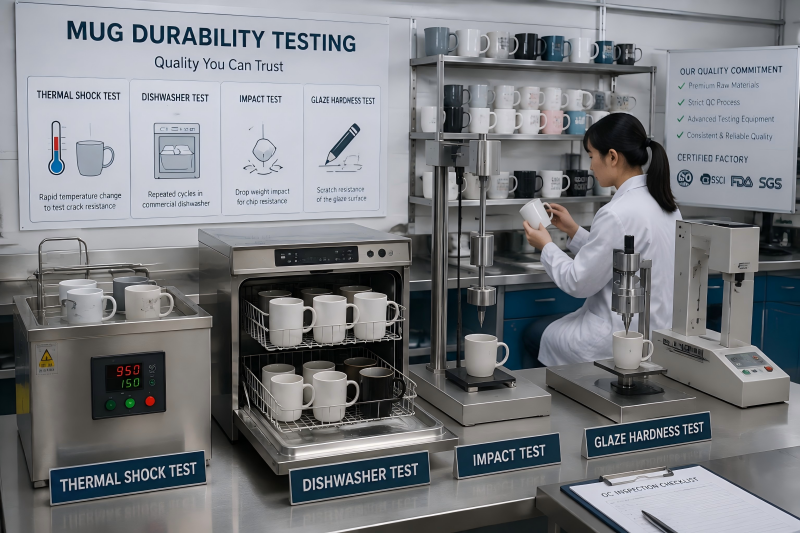
These tests go far beyond a simple visual inspection. They provide objective data on how a mug will perform in your customer's hands. Now, let’s dive into what these specific tests are and, more importantly, why they are essential for protecting your business's reputation and bottom line.
Why Is Thermal Shock Testing Crucial for Mug Durability?
Have you ever had a customer claim their new mug cracked the second they poured hot coffee into it? This frustrating and costly problem is caused by thermal shock. It's a silent profit-killer for importers, but it's entirely preventable with the right quality control.
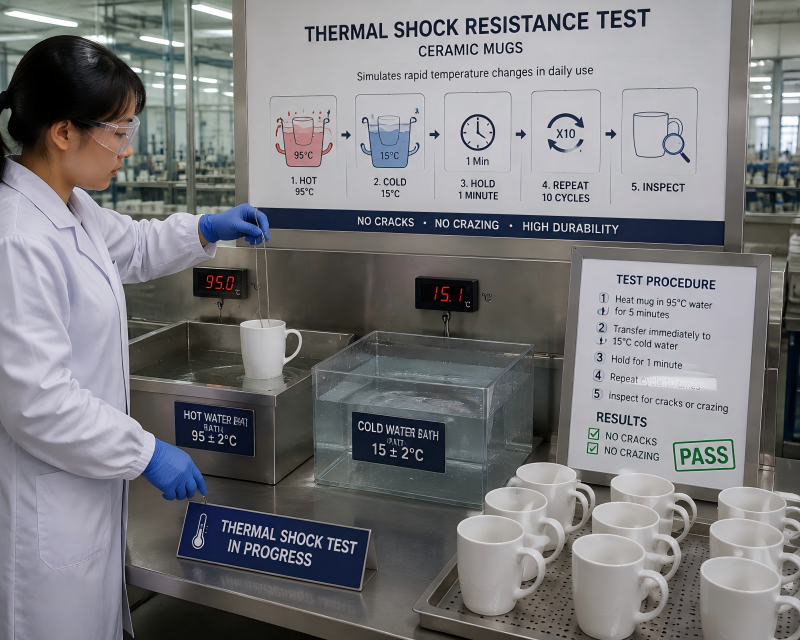
Thermal shock testing is vital for mug durability because it directly simulates the single most common reason for sudden failure: a rapid change in temperature. This test verifies that the ceramic body is properly vitrified and can expand and contract without developing structural flaws.
Dive Deeper: The Science and Business of Thermal Shock
As a sales manager, one of the most painful issues I hear about from new clients is unexpected cracking. They invested in a container of mugs that looked great, only to have a portion of their inventory fail in the most dramatic way possible. This is almost always a thermal shock issue.
What Causes Thermal Shock Failure?
At its core, thermal shock failure happens when one part of a mug expands or contracts much faster than another, creating immense internal stress. The classic example is pouring boiling water into a mug that was sitting in a cold room. The inner surface expands rapidly while the outer surface stays cool. If the ceramic material can't handle that stress, it will crack.
I once discussed this with our production manager, and he explained that the root cause isn't thickness, but a flawed firing process. "If the kiln temperature curve isn't precise," he said, "the clay and glaze don't fully fuse, or 'vitrify.' This creates microscopic weaknesses. The mug looks perfect, but it's a ticking time bomb." This is a critical aspect of how to ensure ceramic mug quality from the very beginning.
How We Conduct Thermal Shock Resistance Tests
Our ceramic mug testing for thermal shock is rigorous and designed to replicate worst-case scenarios. The process, often guided by standards like ASTM C554, involves:
- Heating: A batch of sample mugs is placed in a laboratory oven and heated to a specific, high temperature, for example, 180°C (356°F).
- Quenching: The hot mugs are then immediately plunged into a cold water bath, typically around 20°C (68°F).
- Inspection: After this sudden shock, each mug is carefully removed and inspected for any signs of failure. This includes:
- Cracks: Visible fractures in the ceramic body.
- Crazing: A network of fine cracks in the glaze surface, which is a common early indicator of stress. You can learn more about this in our guide to common ceramic mug defects.
- "Dunting": A type of crack that occurs during cooling.
A mug that passes this test demonstrates that its material and manufacturing process are robust. This is a key feature to look for when sourcing thermal shock resistance ceramic mugs.
The Business Impact of Strong Thermal Shock Resistance
Passing this test isn't about an academic grade; it's about risk management. For an e-commerce seller or wholesaler, a mug with proven thermal shock resistance translates directly to:
- Fewer Customer Returns: Significantly reduces the number of "cracked on first use" complaints.
- Better Product Reviews: Happy customers who trust your product's quality are more likely to leave positive reviews.
- Brand Protection: Prevents the brand damage that comes from viral posts about exploding or cracking products.
How Do You Verify Mug Durability for Dishwashers and Microwaves?
You've confidently marketed your mugs as "dishwasher and microwave safe," but are you certain they are? A single customer experience with a faded decal, a cracked handle, or a dangerously hot mug from the microwave can trigger a wave of bad reviews and refund requests.
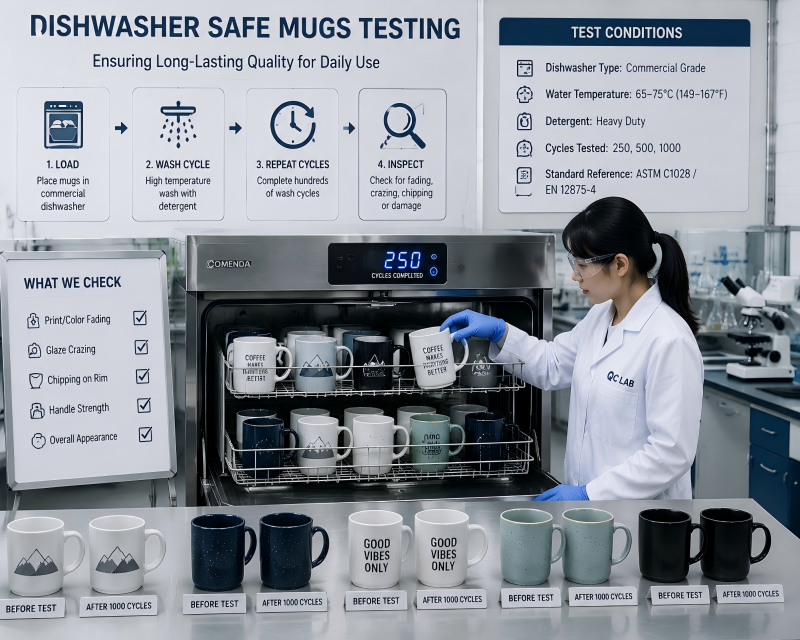
To truly stand behind these claims, we verify mug durability through accelerated use testing. This involves subjecting mugs to hundreds of residential dishwasher cycles and repeated microwave heating sessions to proactively check for glaze damage, decal fading, and any loss of structural integrity.
Dive Deeper: Validating Everyday Use Claims
When a client wants to develop OEM ceramic mugs, one of their first requirements is almost always "dishwasher safe." It's a non-negotiable feature for the European and American markets. However, not all "dishwasher safe" claims are equal. Here’s how a professional manufacturer substantiates them.
The Science Behind Dishwasher Testing
A home dishwasher is a surprisingly aggressive environment for ceramics. The durability challenge comes from a combination of three factors:
- High Heat: Prolonged exposure to hot water (60-75°C / 140-167°F) can stress the glaze.
- Harsh Detergents: The chemical agents in dishwasher pods and powders are designed to be abrasive, which can attack both the glaze and any applied decorations over time.
- Water Jets: The physical force of high-pressure water jets can contribute to wear.
Our ceramic mug quality control process for this involves using commercial-grade dishwashers that run on standardized cycles.
| Test Parameter | Specification | Purpose |
|---|---|---|
| Number of Cycles | 250-500 cycles | Simulates years of regular home use. |
| Water Temperature | 60-75°C (140-167°F) | Matches the upper range of typical home dishwashers. |
| Detergent Type | Standard commercial grade | Ensures resistance to common, aggressive chemical agents. |
| Inspection Frequency | Every 50 cycles | Allows us to monitor for progressive degradation like fading, gloss loss, or crazing. |
A mug that emerges from 500 cycles looking virtually identical to a new one is what we consider truly one of the dishwasher safe mugs.
Microwave Safety: It's More Than Just 'Not Breaking'
Microwave safety testing addresses two primary concerns:
- Handle Temperature: The handle should not absorb significant microwave energy and become dangerously hot to the touch. This is a common failure in mugs made with clays that have high iron or water content.
- Arcing: If the mug has any metallic components in its glaze or decal, it can create dangerous electrical arcs in the microwave.
Our test is straightforward: we fill the mug with a set amount of water, microwave it on high for two minutes, and then use an infrared thermometer to measure the temperature of both the water and the handle. The handle must remain at a safe, touchable temperature.
What's the Best Way to Test a Mug's Durability Against Chipping?
A chipped rim is often the first sign of poor quality, a defect that can occur during shipping, in a retail store, or within the first few weeks of a customer's use. It makes the product look cheap and can even be a safety hazard. So, is there a reliable way to predict and prevent chipping?
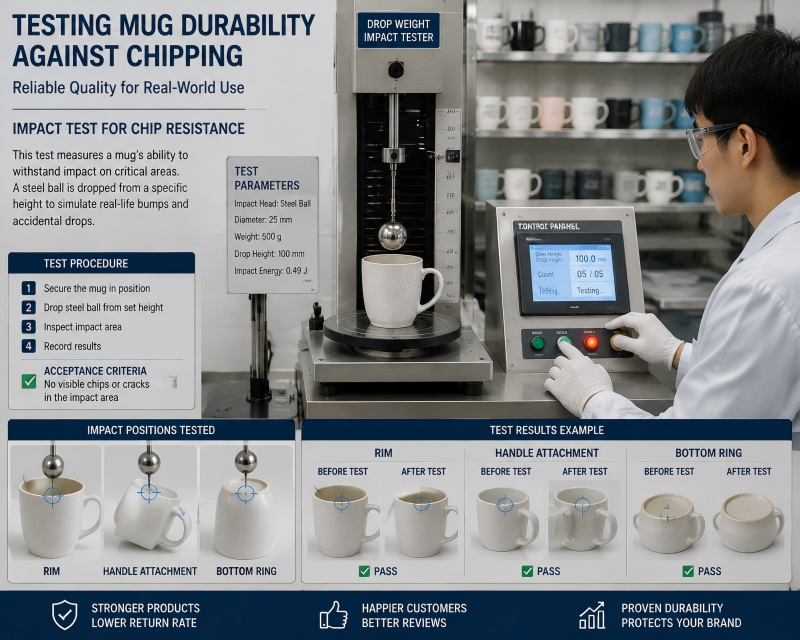
The most effective method for testing a mug's resistance to chipping involves controlled impact tests. At our factory, we use specialized equipment, like a pendulum impact tester, to deliver a precise, repeatable force to the most vulnerable areas of the mug—typically the rim and the handle—to measure its structural mug durability.
Dive Deeper: The Truth About Strength and Impact
A common question I get from clients, especially those new to sourcing ceramics, is, "How thick is the mug wall?" It’s an understandable question, as we intuitively associate thickness with strength. However, in ceramics, this is a dangerous oversimplification.
Why Thickness Isn't the Whole Story
I've seen thick, heavy mugs that chip if you just look at them the wrong way, and I've seen elegantly thin mugs that are surprisingly robust. The true measure of strength and chip resistance comes from two invisible factors:
- Body Composition: The precise ratio of clay, feldspar, and quartz in the ceramic formula. A well-engineered formula creates a dense, strong internal structure.
- Vitrification: As mentioned earlier, the firing process is paramount. A fully vitrified mug has its microscopic particles fused into a glass-like, non-porous state, which gives it immense strength. A thick but poorly fired, porous mug is brittle and weak.
This is why a robust ceramic mug manufacturer quality control program focuses on process consistency rather than just simple final dimensions.
Simulating Real-World Impacts
To get objective data, we don't just randomly knock mugs together. We use standardized tests. The pendulum impact test is a great example.
- How it works: A pendulum of a specific weight is raised to a set height and released, striking the mug's rim at a precise point.
- What it measures: We record the energy (measured in joules) required to cause the first chip.
- Why it matters: This gives us a number, not an opinion. We can state that our mugs can withstand a specific impact force, which provides a consistent quality benchmark for every production run.
This kind of ceramic mug testing is essential when sourcing durable ceramic mugs wholesale. It ensures that the mugs you receive in your warehouse have a lower risk of being damaged during transit and handling, saving you money on unsellable inventory.
The Handle: A Critical Point of Failure
The handle is another high-risk area. We test handle strength by clamping the mug and applying a steady, increasing force or hanging a specific weight (e.g., 25 lbs / 11 kg) from the handle for a set period. The handle attachment must not show any signs of cracking or separation. This is particularly important for OEM ceramic mugs durability, as a new, unique handle design must be validated to ensure it's not just stylish, but also safe and strong. Using a detailed Ceramic Mug Inspection Checklist helps ensure points like this are never missed.
Frequently Asked Questions
What's the difference between crazing and cracking?
Crazing is a network of very fine, hairline fractures that only appear in the surface glaze of the mug. It's often a sign of stress but doesn't mean the mug will leak. A crack is a fracture that goes through the ceramic body itself, compromising the mug's structure and integrity.
Can a "Grade A" ceramic mug still fail these durability tests?
Yes, absolutely. "Grade A" typically refers to the surface appearance of a mug—the absence of pinholes, black spots, or glaze imperfections. It says nothing about the underlying structural integrity. A visually perfect mug can still be brittle if it was fired improperly and will fail a thermal shock test.
How many dishwasher cycles are considered "good" for mug durability?
For a high-quality decorated mug, passing 250-500 dishwasher cycles without significant fading or glaze damage is a strong benchmark. This simulates several years of typical household use and demonstrates excellent durability of both the decal and the ceramic itself.
Does the shape of a mug affect its durability?
Yes, shape plays a role. Mugs with sharp angles or very thin, delicate handles are inherently more susceptible to chipping and stress fractures than mugs with smooth, rounded contours and thick, well-attached handles. Good design engineering works to minimize these stress concentration points.
Conclusion
Ultimately, ensuring true mug durability goes far beyond judging a product by its weight or thickness. It is the direct result of a meticulous manufacturing process validated by a series of rigorous, data-driven tests. From surviving extreme temperature changes in thermal shock tests to enduring hundreds of washes and resisting everyday impacts, this comprehensive ceramic mug testing is what separates a reliable, high-quality product from a liability. This focus on quality control protects your investment, reduces customer returns, and helps build lasting trust in your brand.
When evaluating a new supplier, don't just ask about price. Ask to see their durability test reports. If you're looking for a manufacturing partner who prioritizes this level of quality and transparency, our team is here to help. Contact us today to discuss your project and learn how our processes can secure your supply chain.