Sourcing ceramic mugs seems simple, but are you evaluating them correctly? Choosing a supplier based on looks or heft alone can lead to a flood of customer complaints, costly returns, and lasting brand damage. Understanding how professional manufacturers test for mug durability is the key to protecting your business and building a reputation for quality.
A mug’s true durability is not determined by its thickness or weight, but by the quality of its raw materials and its ability to pass specific performance evaluations like the Thermal Shock Test. This critical test simulates the stress of a dishwasher cycle, ensuring the mug won’t crack or craze from rapid temperature changes, which is the real measure of "dishwasher-safe" performance.
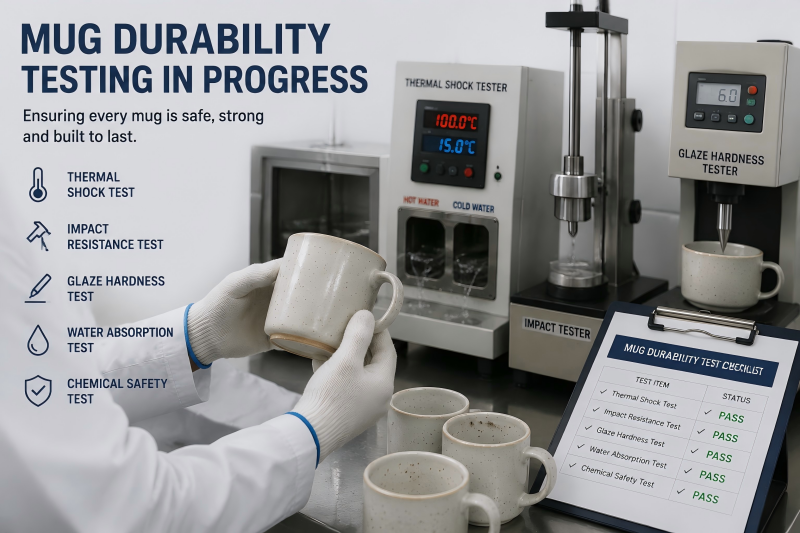
This distinction between perceived strength and proven resilience is what separates a reliable product from a business liability. Let's explore the specific tests that matter and why the most common purchasing mistake could be costing you dearly.
Why Isn't Thickness a Good Indicator of Mug Durability?
Many buyers I speak with instinctively believe that a thicker, heavier mug must be a stronger one. This assumption seems logical, but it often leads them to procure cheap, bulky products that fail under the most common household stress: the dishwasher. The truth about mug durability is hidden at a microscopic level.
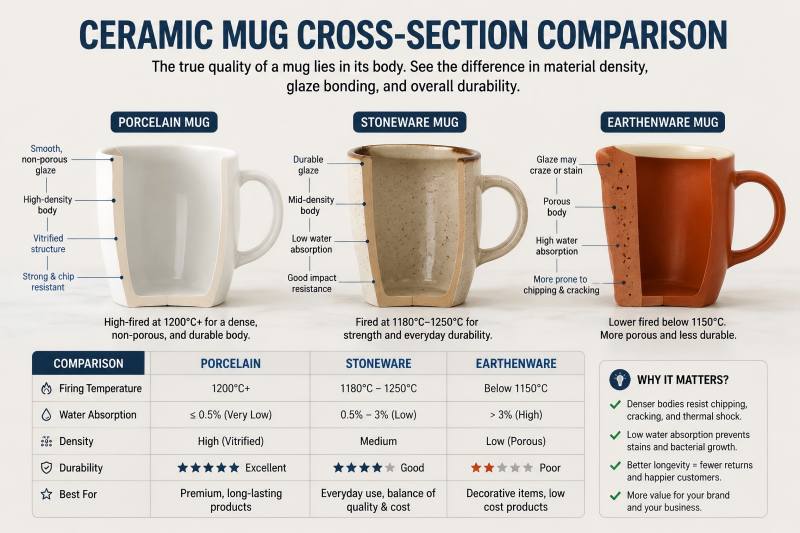
The true resilience of a ceramic mug is dictated by its material composition and the vitrification achieved during the firing process, not its physical bulk. A well-made, properly fired mug can be lightweight yet incredibly strong, while a thick, poorly made mug can be brittle and prone to cracking.
Dive Deeper: The Microscopic Battle of Vitrification vs. Porosity
To understand why thickness is a misleading metric, we need to look at what happens to clay inside the kiln. The goal of firing is to achieve vitrification—the process where clay particles melt and fuse, forming a dense, glass-like, non-porous structure.
- High-Quality Materials and Process: When a manufacturer uses high-quality kaolin, feldspar, and quartz and fires the mug at the correct temperature (often above 1200°C or 2200°F), the ceramic body becomes fully vitrified. It’s like turning a pile of sand into a solid sheet of glass. This dense structure has extremely low porosity, meaning it absorbs virtually no water. This is the foundation of true mug durability.
- Low-Quality Materials and Process: Conversely, using inferior raw materials or firing at lower temperatures to save costs results in an under-fired, porous body. Think of it more like a brick than glass. It contains microscopic pores that act like tiny sponges.
This difference becomes critical when the mug is used. When a porous mug is washed, water seeps into these tiny cavities. If it's then put in a microwave or exposed to the heat of a dishwasher, that trapped water turns to steam and expands. This internal pressure creates stress fractures from within, leading to cracking or crazing (the fine web of cracks in the glaze). A thick wall doesn't help; it just means there's more porous material to absorb water and fail. I've seen countless examples of heavy, "sturdy-feeling" mugs that couldn't survive a month of regular use for this very reason.
For a more detailed look at this stage, you might find our guide on How Ceramic Mugs Are Made: Complete Manufacturing Process helpful. It breaks down how proper firing is essential for creating a durable final product.
What Is the Most Critical Test for Mug Durability?
You need to confidently market your mugs as "dishwasher safe" to your customers. But how can you be sure a supplier's claim is valid and not just an empty promise? The answer isn't in their marketing material; it's in their quality control reports, specifically one that confirms they perform the Thermal Shock Test.
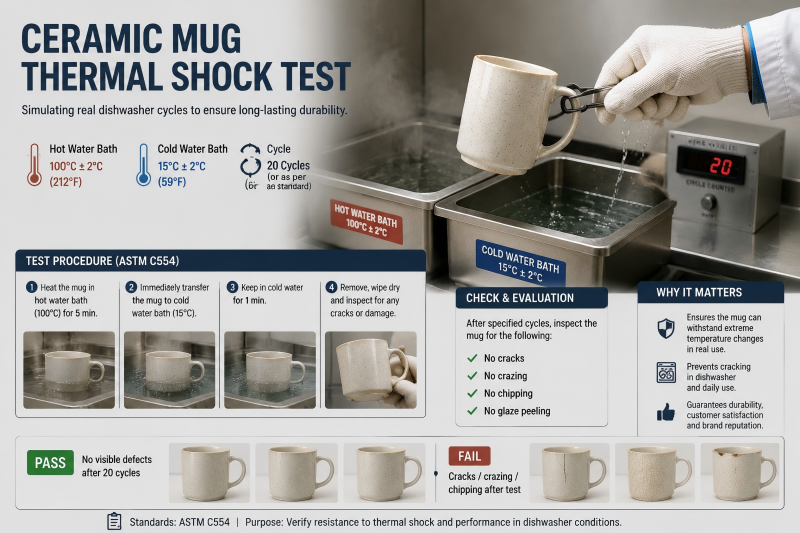
The Thermal Shock Test is the single most important procedure in ceramic mug durability testing. It directly simulates the intense and rapid temperature changes a mug experiences inside a dishwasher, making it the ultimate proof of its ability to withstand daily use without cracking.
Dive Deeper: How This Test Prevents a Business Nightmare
The Thermal Shock Test is brutally simple but incredibly effective. Here's how a professional manufacturer tests their products:
- Heating: The mug is placed in a laboratory oven and heated to a specified high temperature, typically between 160°C and 180°C (320°F to 356°F). It's held at this temperature for a set period to ensure the entire body is heated through.
- Quenching: The heated mug is then immediately removed and plunged into a bath of room-temperature water, usually around 20°C (68°F).
- Inspection: After this sudden, violent temperature drop, the mug is carefully inspected for any signs of failure—cracks, fractures, or crazing in the glaze.
A mug must survive this cycle without any damage to be considered truly resistant to thermal shock. This process mimics the punishing environment of a modern dishwasher, where an item is blasted with hot water and then hit with a cooler rinse.
A few years ago, a new client came to us after a disastrous experience with another supplier. They were an e-commerce seller who had sourced a large batch of thick, heavy mugs that "felt" durable. Within two months of launching the product, they were inundated with one-star reviews and return requests. The reason? The mugs were cracking in customers' dishwashers.
Their previous supplier had skipped thermal shock testing to offer a lower price. That small cost-cutting measure led to thousands of dollars in refunds, return shipping fees, and, worst of all, a damaged brand reputation that took over a year to repair. This is the direct business risk that proper mug durability testing mitigates. It's not just a technical check; it's a critical part of your business's risk management strategy. A complete Ceramic Mug Quality Control: From Raw Materials to Final Inspection process must include this step. Understanding potential flaws, such as those detailed in our article on Common Defects in Ceramic Mugs and How Manufacturers Prevent Them, further highlights the importance of these tests.
What Other Quality Tests Ensure Overall Mug Durability?
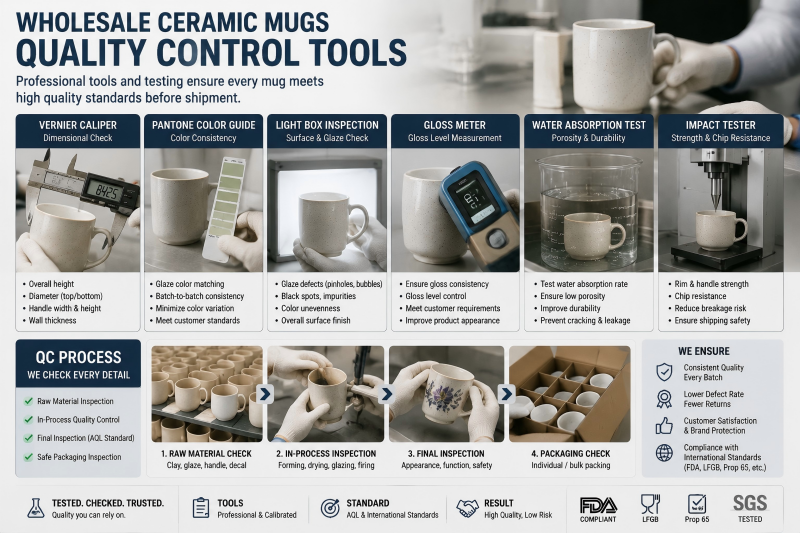
While thermal shock resistance is paramount for dishwasher safety, it isn't the only factor in overall mug durability. A mug can survive extreme temperatures but still disappoint customers if its handle snaps off or its surface scratches easily. A comprehensive ceramic mug quality inspection therefore includes a battery of other mechanical and safety tests.
Beyond thermal shock, key mug quality tests include adhesion tests for handles and printed decorations, chip resistance tests for the rim, and glaze hardness checks. Together, these evaluations ensure you're sourcing a product that is not only dishwasher safe but also robust enough for everyday handling and use.
Dive Deeper: A Multi-Point Inspection for a Reliable Product
A supplier committed to quality will have a robust testing protocol that covers the entire user experience. When evaluating a potential durable ceramic mugs supplier, you should ask about their procedures for the following tests. These are non-negotiable for any serious manufacturer.
| Test Name | What It Checks | Why It Matters for Your Business |
|---|---|---|
| Handle Pull/Torque Test | The strength of the joint where the handle is attached to the mug body. A machine applies a specific force (e.g., 25-30 lbs) to pull and twist the handle. | Prevents a major safety hazard. A handle that breaks off while filled with a hot beverage can cause serious injury and lead to liability issues, not to mention severe brand damage. |
| Chipping Resistance Test | The durability of the mug's rim and base against impact. This is often done by dropping a small steel ball from a set height onto the rim. | Reduces returns from shipping damage and everyday use. Customers expect mugs to withstand minor bumps from stacking in a cupboard or clinking against other dishes in the sink. |
| Glaze Hardness / Abrasion Test | The glaze's resistance to scratching from cutlery and abrasive cleaning. This can be measured on the Mohs scale of hardness or through abrasion testing. | Ensures long-lasting appearance. A soft glaze will quickly become covered in ugly grey marks from spoons and look "dirty" or worn, leading to customer dissatisfaction with the product's aesthetic lifespan. |
| Decoration Adhesion Test | The durability of any printed logos, decals, or precious metal accents. This often involves applying strong adhesive tape and pulling it off to see if the decoration lifts. | Protects your branding and the mug's value. If your logo or design peels off after a few washes, the product looks cheap and fails to serve its branding purpose. This is a crucial test for promotional mugs. |
| Lead & Cadmium Leach Test | The safety of the glaze and any decorations, ensuring they do not leach harmful chemicals into beverages. | Ensures legal compliance and consumer safety. This is not optional. Passing tests for standards like the FDA and California Proposition 65 is legally required to sell in the US and other markets. See our overview of FDA Requirements for Ceramic Drinkware for more on this critical topic. |
Asking a potential supplier for their testing documentation for these checks is a perfectly reasonable part of your due diligence. A transparent and reliable partner will have this information ready to share.
Frequently Asked Questions
How do you test if a ceramic mug is dishwasher safe?
The most reliable method is the Thermal Shock Test. Manufacturers heat the mug to a high temperature (around 160-180°C) and then immediately plunge it into cold water. If the mug shows no cracks or damage, it has passed the test and can be considered truly dishwasher safe.
What makes one ceramic mug more durable than another?
True durability comes from high-quality raw materials and a proper, high-temperature firing process that achieves full vitrification. This creates a dense, non-porous body that resists water absorption and thermal shock. It's about the material science, not how thick or heavy the mug feels.
How can I verify a supplier's claims about mug durability?
Ask for their internal Quality Control (QC) documentation and third-party test reports. A reputable manufacturer will be able to provide reports for Thermal Shock Tests, Handle Pull Tests, and lead/cadmium safety compliance. Don't just take their word for it; ask to see the proof.
Does a BSCI or ISO9001 certification guarantee mug durability?
No. Certifications like ISO9001 and BSCI are important as they audit a factory's management systems and ethical standards, respectively. However, they do not certify the specific performance of a product. You still need to perform due diligence on their product-specific mug quality tests and protocols.
Conclusion
Ultimately, securing your supply chain comes down to understanding what truly defines quality. For ceramic mugs, true mug durability is not a matter of weight or thickness but a demonstrable result of rigorous manufacturing processes and testing. The Thermal Shock Test, in particular, is the single most important guarantor of "dishwasher-safe" performance and the key to preventing the costly returns and negative reviews that can cripple an e-commerce brand. By focusing on a supplier's testing protocols instead of surface-level attributes, you shift from guessing about quality to verifying it.
Before you place your next wholesale order, I encourage you to ask potential partners pointed questions about their ceramic mug durability testing. This simple step is one of the most effective forms of risk management you can practice. If you're looking for guidance on what to ask, our guide on How to Choose a Reliable Ceramic Mug Supplier in China is a great place to start. As a durable ceramic mugs supplier with 15 years of experience, we believe transparency in our testing is fundamental to building lasting partnerships. Contact us today to learn how our quality control processes can help you build a more reliable and profitable product line.