Are you an e-commerce seller worried that your next shipment of mugs could be a business-ending disaster? The fear is real: receiving a container filled with cracked, poorly printed, or flawed products. This leads to a wave of negative reviews, soaring return rates, and a damaged brand reputation you’ve worked so hard to build. The solution isn't just hoping for the best; it's understanding the quality assurance process in mug factories before you even place an order.
A quality assurance (QA) process in a mug factory is a comprehensive, multi-stage system designed to prevent defects and ensure consistency from raw material procurement to final packaging. It is not just a final inspection but a proactive risk management strategy that includes raw material testing, in-process checks at every manufacturing stage, and final product evaluation against agreed-upon standards. This process directly protects a buyer's investment and brand reputation.
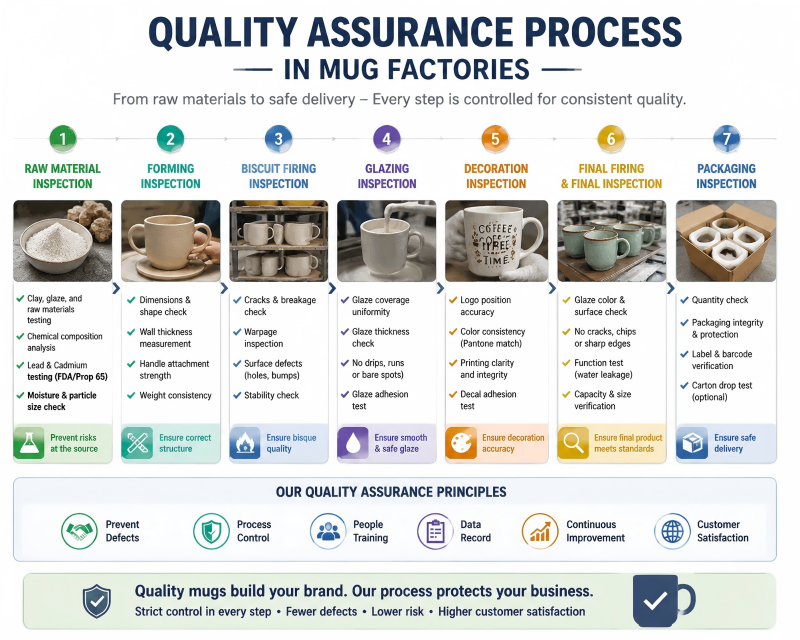
Now that you have the basic definition, you might be wondering what these stages actually involve. Let's peel back the layers of this critical process. We'll explore how each step on the factory floor translates directly into security for your e-commerce business, helping you distinguish a truly reliable supplier from the rest.
Why Do Certifications Like ISO9001 Matter in a Factory's Quality Assurance Process?
You're sourcing suppliers and see "ISO9001 Certified" on a factory's website. It feels like a stamp of approval, a sign of quality. But then doubt creeps in. Does a piece of paper truly guarantee that every single mug in your 10,000-unit order will be perfect? You need more than just a certificate to feel secure.
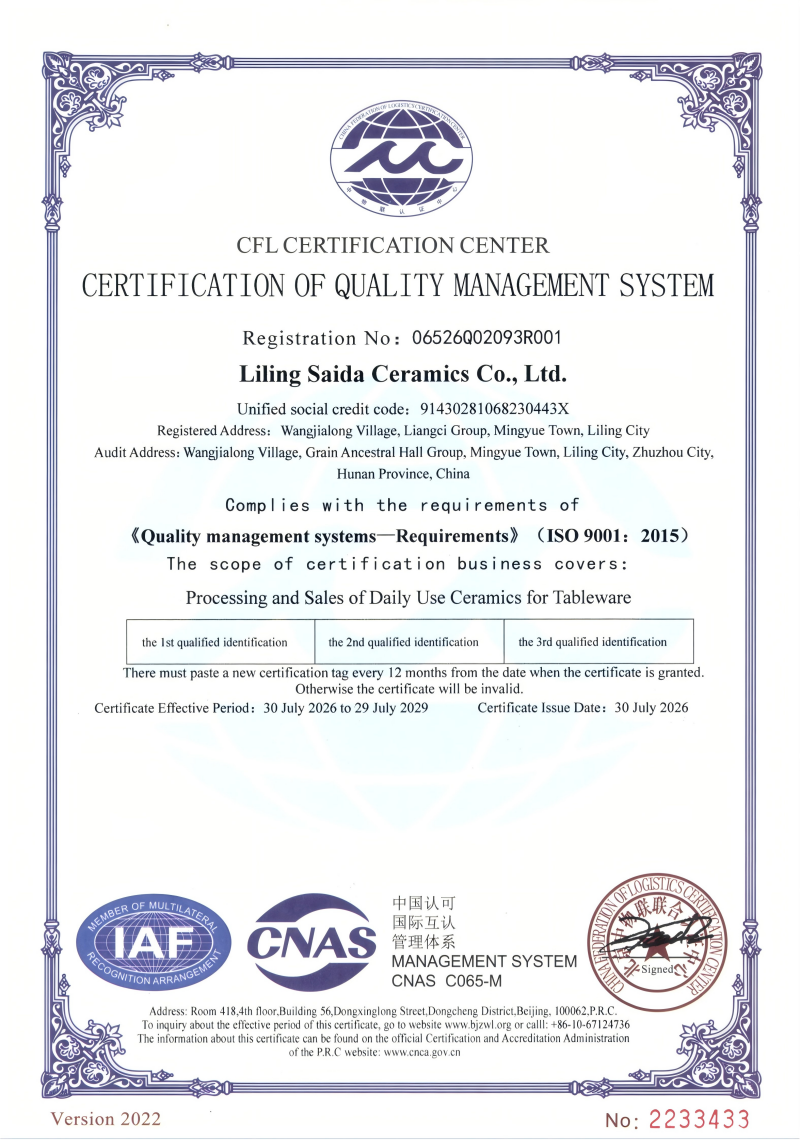
Certifications like ISO9001 are a crucial baseline in your ceramic mug supplier evaluation. They confirm that a factory has a documented, standardized quality management system. However, the true value lies not in the certificate on the wall, but in how rigorously that system is executed on the production line every single day.
Dive Deeper: Beyond the Certificate—A Conversation I Often Have
As a sales representative for our factory for over 15 years, I often get asked by new clients, particularly Amazon sellers, for our certifications. I remember one client from Germany who was very direct. His first email asked for only two things: our ISO9001 and BSCI certificates.
I promptly sent them over, but I also added a note. "I'm glad to share these," I wrote, "and as a proud ISO9001 ceramic manufacturer, we stand by these systems. But to give you real peace of mind, let me explain what this means for your mugs."
I explained that a certificate is like a driver's license. It proves you passed the test and know the rules of the road, but it doesn't guarantee you're a safe driver every minute of every day. The real proof is in the daily driving habits.
For us, the ISO9001 framework isn't just for an annual audit. It dictates our daily operations. Here’s how it translates into tangible actions that form the backbone of our quality assurance process in mug factories:
- Documented Procedures: Every step, from mixing the clay to applying the glaze, follows a written Standard Operating Procedure (SOP). This isn't left to an individual worker's memory or preference.
- Traceability: If a problem is found in a batch of finished mugs, our system allows us to trace it back. We can identify the specific batch of raw materials used, the kiln it was fired in, and even the team that handled the glazing. This is essential for root cause analysis and preventing a recurrence.
- Continuous Improvement: The system requires us to log non-conformities (i.e., defects). We hold regular meetings to review this data and ask, "Why did this happen? How can we adjust our process to stop it from happening again?"
This documented, repeatable system is the core of effective mug supplier quality control. A certificate proves the system exists; a transparent conversation with your supplier about how they use that system proves their commitment to quality. This is what protects your business from the costly inconsistencies that can arise from a factory that only looks good on paper.
How Does Raw Material Inspection Protect Your E-commerce Business?
You've probably seen news headlines about product recalls due to harmful materials like lead or cadmium. The thought of your brand being at the center of such a story is a business owner's worst nightmare. It can lead to inventory seizure, legal action, and a complete loss of customer trust.
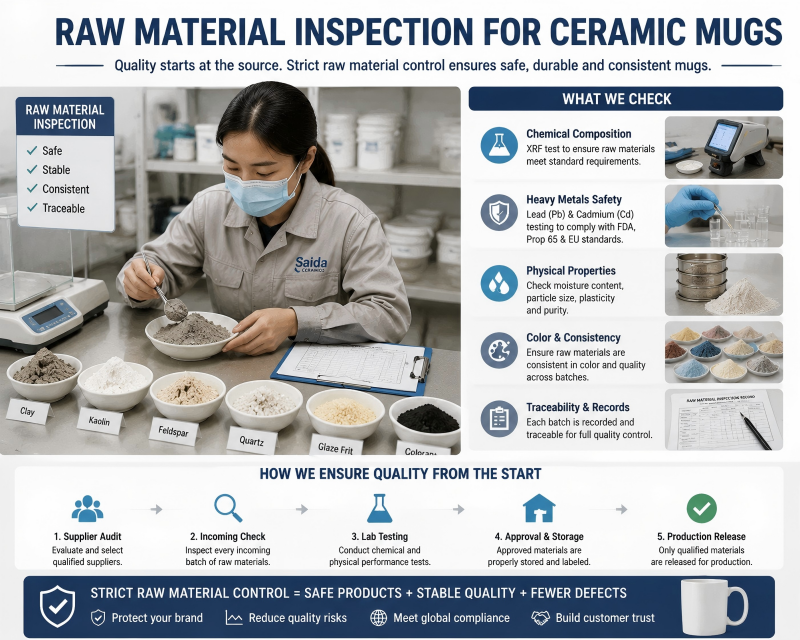
A rigorous raw material inspection is the first and most critical line of defense in the entire quality assurance process in mug factories. This step ensures the clay, glazes, and pigments are stable, consistent, and—most importantly—free from hazardous contaminants. It's not just about passing a test; it's about preventing a business-ending catastrophe.
Dive Deeper: More Than Just a Lab Report
This part of the ceramic mug manufacturing process is foundational. When I discuss this with clients, especially those selling in the US and Europe, I frame it in terms of business survival.
I often say, "Our strict check for lead and cadmium in the glaze isn't just about getting a report to satisfy FDA Requirements for Ceramic Drinkware. It's about preventing a scenario where your Amazon listing gets suspended overnight and your brand is publicly associated with a health scare."
A proper raw material inspection goes far beyond a single lab test on a finished product. It’s a proactive system.
- Supplier Qualification: We don't source our materials from the open market based on price. We have long-term, vetted relationships with a handful of trusted suppliers who provide their own material analysis reports for every batch. This is a key part of our
ceramic mug factory inspectionprotocol before a single mug is ever made. - Incoming Material Verification: Even with trusted suppliers, we don't take chances. Samples from every new shipment of clay and glaze chemicals are tested to ensure they match the approved specifications. We check for consistency in composition, moisture content, and particle size. An inconsistent clay body can lead to cracking during firing, a disaster for production efficiency and order fulfillment times.
- Glaze Formula Control: This is the most critical area for safety. Our glaze formulas are locked. We use stable, lead-free and cadmium-free compositions that we have used for millions of mugs exported globally. Any change, no matter how small, would require extensive re-testing before being used in mass production.
Ultimately, this first step in the quality assurance process in mug factories is what allows you to confidently tell your customers that your products are safe. It shifts the burden of safety from a reactive "test and hope" model to a proactive "verify and produce" model, safeguarding your investment, your customers' health, and your brand's future.
Can You Expect a "Perfect" Ceramic Mug?
As a brand owner, you want to deliver a flawless product to your customers. So when a potential supplier starts talking about "acceptable imperfections," it can be unsettling. How do you draw the line between a charming, minor quirk of a handmade-style product and a genuine, return-worthy defect?
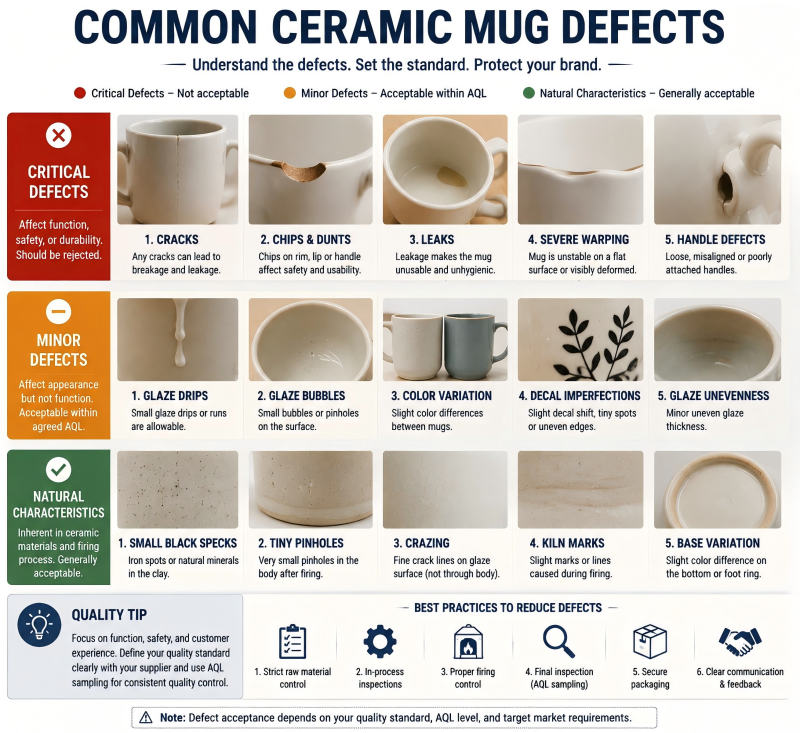
The honest answer is that no mass-produced ceramic mug is 100% "perfect" in the way a plastic part from a mold is. Ceramics are a natural material transformed by intense heat. Because of this, industry-standard wholesale ceramic mug quality standards allow for minor, almost unnoticeable variations. The key to a successful partnership is a factory that transparently defines, manages, and sorts products based on these standards.
Dive Deeper: The Honest Conversation About Ceramic Mug Defects
One of the most important conversations I have with new clients is about managing expectations. This honesty builds trust. I remember explaining to a new Amazon seller why a single 0.5mm pinhole on the side of a mug is acceptable under Grade-A standards, but a 2mm pinhole on the lip is a clear defect that must be rejected.
This isn't about making excuses for poor quality. It's about educating our partners on the nature of the material so they can make informed decisions. A crucial part of our quality assurance process in mug factories is using a detailed Ceramic Mug Inspection Checklist to sort every mug. This ensures consistency.
To make it clear, here is a simplified table showing how we classify common issues. This is the kind of detail you should discuss with any potential supplier.
| Feature | Acceptable (Grade A) | Unacceptable Defect | Business Impact of the Defect |
|---|---|---|---|
| Pinholes | A single, tiny dot (<0.5mm), not on the drinking lip or inside. | Multiple pinholes, any size on the lip, or >1mm elsewhere. | Looks dirty, raises hygiene concerns, triggers "poor quality" reviews. |
| Glaze Variation | Minor, even shade difference between production batches. | Obvious color spots, streaks, or unglazed areas. | Product doesn't match listing photo, looks cheap, increases returns. |
| Black Spots | A tiny speck (<0.5mm) from iron in the clay, fired into the glaze. | Multiple spots or any spot larger than 1mm. | Looks like a stain or dirt that can't be washed off. |
| Shape/Symmetry | Minor deviation (<1mm) in height or diameter across a batch. | Mug wobbles on a flat surface; handle is visibly crooked. | Feels unstable and cheap, frustrating for the end-user. |
Our job isn't to produce "perfect" mugs—it's to produce mugs that consistently meet the Grade-A standard you're paying for. This is where statistical tools like AQL inspection for ceramic mugs come into play. Put simply, AQL (Acceptable Quality Limit) is an agreement on how many minor imperfections are acceptable in a random sample of the batch. It’s a statistical way to ensure the overall quality of the entire order is high, protecting you from receiving a batch with widespread issues.
By discussing and agreeing on these standards upfront, we avoid future disputes. It turns the subjective idea of "quality" into a set of objective, measurable rules. This transparent approach to Common Ceramic Mug Defects is a hallmark of a reliable manufacturing partner.
What's the Best Way to Judge a Supplier's Real Quality Process?
You've reviewed the certificates, seen the product photos, and read the website claims. Everything looks good. But a lingering question remains: how will this supplier really act when something goes wrong? How can you be sure they will stand with you if a problem arises after you've already paid?
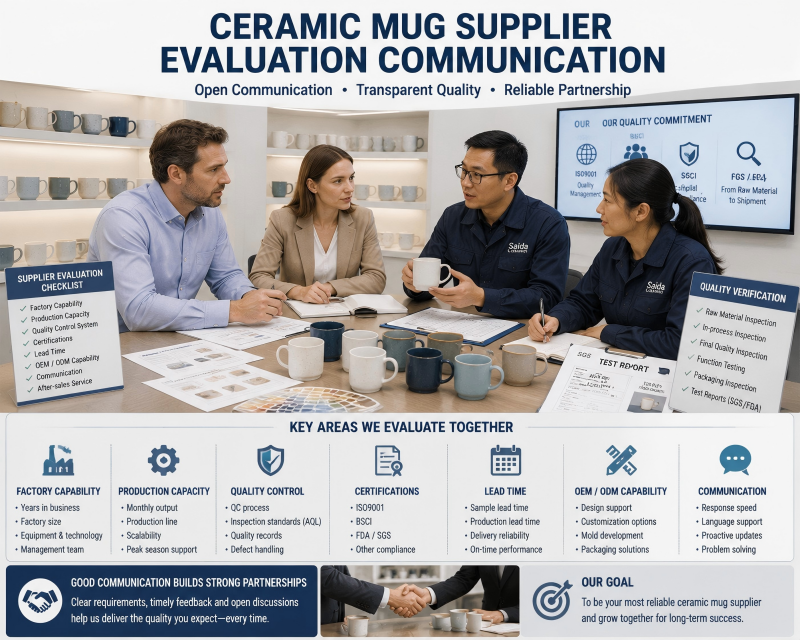
The single best way to audit a supplier's true commitment to quality is through conversation. Forget the standard questions for a moment and ask them this: "What is your process if your internal inspection finds a 10% critical defect rate in my order after it's been produced but before it ships?" Their answer will tell you everything you need to know about their mug factory inspection process and their character as a partner.
Dive Deeper: The Hypothetical Crisis—A Test of Transparency
A bad supplier might give a vague answer like, "Don't worry, that won't happen," or "We'll fix it." A true partner will welcome the question and walk you through their specific, pre-planned crisis protocol.
Just last month, a prospective wholesale client from the USA asked me this exact question during a video call. They had been burned before and were understandably cautious.
My response was not a simple promise. Instead, I detailed the exact steps our quality assurance process in mug factories would trigger:
- Immediate Quarantine and Hold: The first action is to immediately isolate the entire production lot. A "Hold" tag is placed, and the batch is moved to a designated quarantine area. Absolutely nothing from that lot will be packed or shipped. This prevents any accidental contamination of good stock.
- Alert and Assemble QA Team: The production manager and I are immediately notified. A root cause analysis team is assembled, including the head of the specific production stage where the defect likely originated (e.g., glazing, firing).
- Root Cause Analysis: The team's job is to find out why. Was it a bad batch of glaze? Did a kiln temperature sensor fail? Was a new employee not following the SOP? We need to understand the source to prevent it from happening to the replacement batch.
- 100% Re-Inspection and Sorting: We would then deploy a team to manually inspect every single mug from the affected lot—not just a sample. Each mug is sorted into three categories: Grade A (meets standards), Grade B (minor flaw, sellable at discount if client agrees), and Reject (to be destroyed).
- Transparent Client Communication: Once this is complete, I would contact the client with a full, honest report. I would say, "Here is what happened, here is the root cause we identified, and here is the result of the 100% re-inspection. We have 6,500 mugs that meet Grade A standards from your 10,000-unit order. The other 3,500 have been rejected. We have already scheduled production to remake those 3,500 units, which will be ready in X days. We apologize for this delay."
This detailed, process-driven answer showed the client that we have a plan for failure. It demonstrated that our quality assurance process is not just about success; it's a robust system for managing failure transparently. It's this level of planning and communication that truly defines superior mug supplier quality control and protects your business from risk.
Frequently Asked Questions
What is AQL in ceramic mug inspection?
AQL stands for Acceptable Quality Limit. It's a statistical method used in inspections to determine the quality of an entire order by checking a random sample. For example, an AQL of 2.5 means you're willing to accept a batch if a sample has no more than 2.5% defective items. It's a key part of AQL inspection for ceramic mugs.
What are the most common quality issues with wholesale ceramic mugs?
The most common issues we manage are minor pinholes, small black spots from iron particles in the clay, slight color or glaze variations, and minor scratches from handling. A robust QA process is designed to catch and sort these, ensuring only mugs that meet the agreed-upon wholesale mug quality standards are shipped.
How does a BSCI audit differ from an ISO9001 audit?
They audit different aspects of a factory. ISO9001 focuses on the quality management system—the processes a factory uses to ensure product quality and consistency. BSCI (Business Social Compliance Initiative) focuses on social compliance—auditing labor rights, working hours, workplace safety, and ethical business practices. Both are important indicators of a responsible supplier.
Can I provide my own inspection checklist to a mug factory?
Absolutely. In fact, we encourage it. A collaborative approach is best. A good factory will welcome your clear standards and will often use your checklist to refine their own internal QA documents for your order. This alignment is crucial for a successful ceramic mug supplier evaluation and partnership.
Conclusion
Choosing a manufacturing partner is one of the most significant decisions you'll make for your brand. As we've seen, a supplier's quality assurance process in mug factories is far more than a certificate on a wall or a final check at the end of the line. It is a comprehensive, living system designed to manage risk at every step—from vetting raw materials to handling unforeseen production issues with transparency. Understanding this process empowers you to ask the right questions, evaluate suppliers beyond their marketing claims, and protect your business from the financial and reputational damage of poor quality.
Investing in a partner with a robust and transparent quality assurance process is a direct investment in your own profitability and brand longevity. It's the foundation upon which you can confidently build and scale your business, one perfectly-made mug at a time.
If you are looking for a reliable ceramic mug supplier who understands what’s at stake for your business and prioritizes transparent quality control, let’s have a conversation. Contact us today to discuss how our process can safeguard your brand and help you grow.