Sourcing custom mugs can feel like navigating a minefield. You're worried about getting a good price, but you're even more worried about quality issues, communication breakdowns, and shipping delays that could sink your project. Finding the right OEM mug factory isn't just about the unit cost; it's about finding a reliable partner who protects your investment and helps you bring a profitable product to market.
The best way to choose the right OEM mug factory is to shift your focus from securing the lowest price to finding a consultative partner. A great factory acts as an advisor, asking about your business goals, target market, and brand positioning to help you engineer a commercially successful product, not just quote a price on a technical spec sheet.
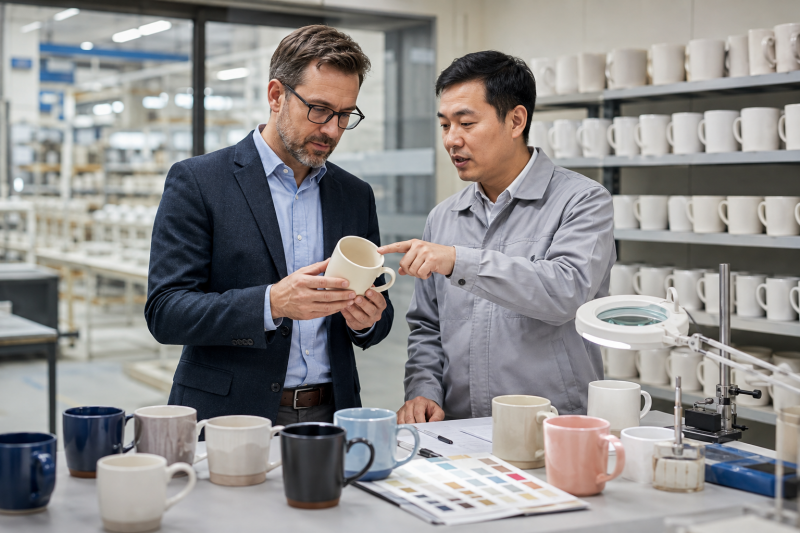
Now that you know the secret, let's explore what this looks like in practice. We'll break down the common traps to avoid and the key questions you should be asking to identify a factory that will truly have your back, based on my 15 years of experience exporting ceramic mugs to wholesalers and e-commerce sellers worldwide.
Is the Cheapest Quote Really the Best Deal?
It’s always tempting to go with the lowest price. A quote that comes in 15% below the competition feels like a huge win, especially when you're managing tight margins. But what happens when those "savings" evaporate due to hidden problems? A truly cheap price often becomes the most expensive mistake you can make.
The cheapest quote is almost never the best deal because it only reflects the unit price, not the total cost of ownership. Low-ball offers often come from factories that cut corners on materials, quality control, and packaging, leading to expensive defect rates, shipping damage, and delays that destroy your profit margins and brand reputation.
Dive Deeper: The True Cost of a "Bargain"
Over my career, I've seen many first-time importers fall into the low-price trap. They focus entirely on the Free on Board (FOB) price and forget to calculate the real-world costs that follow. A wholesale mug factory that competes only on price has to cut costs somewhere, and it's usually in areas that directly impact your bottom line.
Here are the hidden costs I see most often:
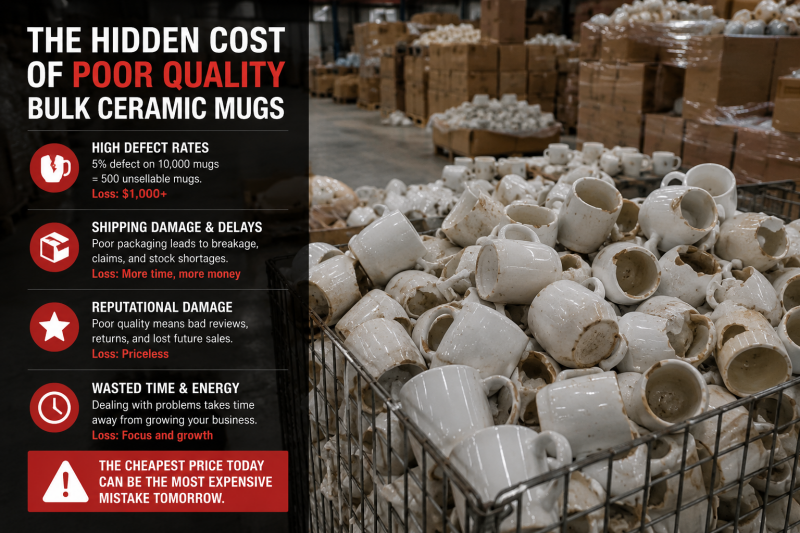
- High Defect Rates: Let's put this in real numbers. A 5% defect rate on a 10,000-unit order of bulk ceramic mugs means you have 500 units you can't sell. If you paid $2 per mug, that's $1,000 in dead stock. If the defect rate is 10% or 20%—which is not uncommon with low-cost suppliers—the financial damage can be devastating. A good partner invests in a robust ceramic mug quality control process to keep defect rates below 1-2%.
- Shipping Delays and Damage: To save money, a cheap factory might use flimsy inner boxes or master cartons. The result? A higher rate of breakage during transit. Now you're dealing with insurance claims and stock shortages. Similarly, if they mismanage the production schedule, you could miss your container cutoff, leading to weeks of delays and potentially lost seasonal sales. We always advise clients to consider our ceramic mug packaging standards as a crucial part of the product itself.
- Reputational Damage: What's the cost of a one-star review? A customer receiving a mug with a crooked handle, a chipped rim, or a faded decal isn't just a lost sale; it's a negative review that can deter hundreds of future buyers. Your brand's reputation is your most valuable asset, and poor quality erodes it instantly.
- Wasted Time and Energy: The time you spend emailing back and forth about defects, negotiating rework, and managing unhappy customers is time you're not spending on marketing and growing your business. The stress and frustration are a significant, unquantifiable cost.
When you're sourcing, always think in terms of Total Cost of Ownership. You can learn more about how to calculate landed cost for mug imports to get a fuller picture. A slightly higher unit price from a reliable OEM mug factory is an investment in predictability, quality, and peace of mind.
What Questions Should a Good OEM Mug Factory Ask You?
You’ve prepared a detailed spec sheet with your design, dimensions, and desired color. You send it to a few factories. One factory replies in an hour with a price and a lead time. Another replies a day later with a price... and a list of questions. Which one is the better partner?
A great custom mug manufacturer will almost always be the one that asks questions. A simple order-taker sees a transaction; a consultative partner sees a collaboration. Their questions show they are thinking about your success, not just their production line.
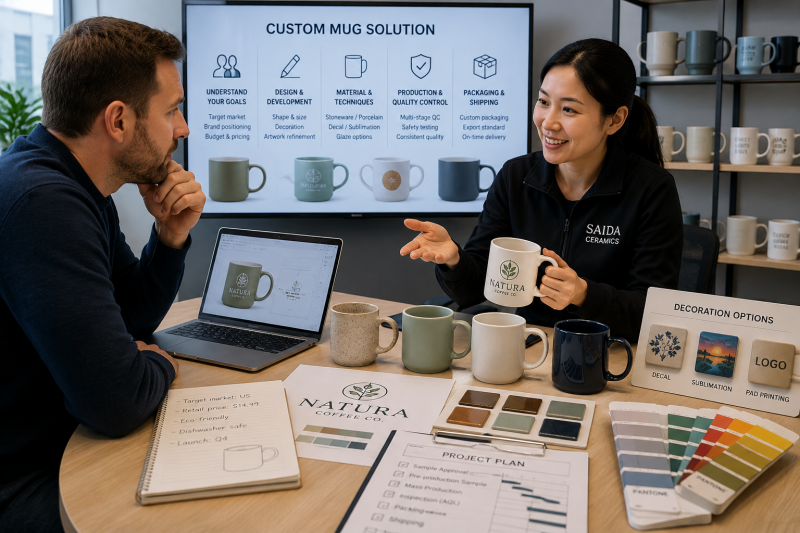
A top-tier OEM mug factory should ask about your target market, brand positioning, and desired retail price before they finalize a quote. They use this business context to recommend the best materials, decoration methods, and quality standards to create a product that is not only well-made but also commercially viable.
Dive Deeper: From Order-Taker to Strategic Partner
The difference between an order-taker and a consultative ceramic mug OEM supplier is night and day. An order-taker says "yes" to everything, which can be dangerous. They'll produce exactly what you ask for, even if they know the material is wrong for your use case or the design is prone to fading. A consultant, on the other hand, uses their expertise to guide you.
Here’s a comparison of the questions you might get:
| Order-Taker Questions | Consultant Questions |
|---|---|
| "What is your quantity?" | "Who is your end customer? Are these for a coffee shop, a corporate gift, or online retail?" |
| "Can you send the Pantone code?" | "What is your brand's positioning? Are you aiming for a premium, eco-friendly, or budget-friendly feel?" |
| "Do you accept our standard packaging?" | "What is your target retail price? This will help us suggest materials and processes that protect your margin." |
| "What is your target price?" | "Will these mugs need to be dishwasher and microwave safe? This affects the type of glaze and decal we use." |
Why do the consultant's questions matter so much?
- Target Market: Knowing the end customer helps the factory recommend the right product. For a high-traffic coffee shop, durability is key, so they might suggest a thick-walled stoneware mug. For an e-commerce brand targeting millennials, the aesthetic and unboxing experience might be more important, pointing toward a porcelain mug with a high-end gift box.
- Brand Positioning: A luxury brand needs a flawless finish, a weighty feel, and perhaps a subtle embossed logo. A
private label mug supplierworking with you should understand this and guide you toward materials like New Bone China and premium glazes. A brand focused on playful, colorful designs might be better served by different printing techniques that allow for vibrancy. - Commercial Viability: By asking about your target retail price, the factory can work backward with you. They can say, "To hit your desired margin at a $15 retail price, we should use Material A with Decoration B. If we use Material C, your landed cost will be too high." This is a partnership. They are helping you build a profitable business.
A factory that asks these questions is demonstrating its experience. They've seen what works and what doesn't in the market. They are leveraging their custom mug manufacturing capabilities to serve as an extension of your product development team.
How Does a Top OEM Mug Factory Handle Problems?
No manufacturing process is perfect. Raw materials can have slight variations. A machine can fall out of calibration. The true measure of a factory isn't whether problems happen, but how they respond when they do. A bad partner goes silent, makes excuses, or tries to ship the defective goods anyway.
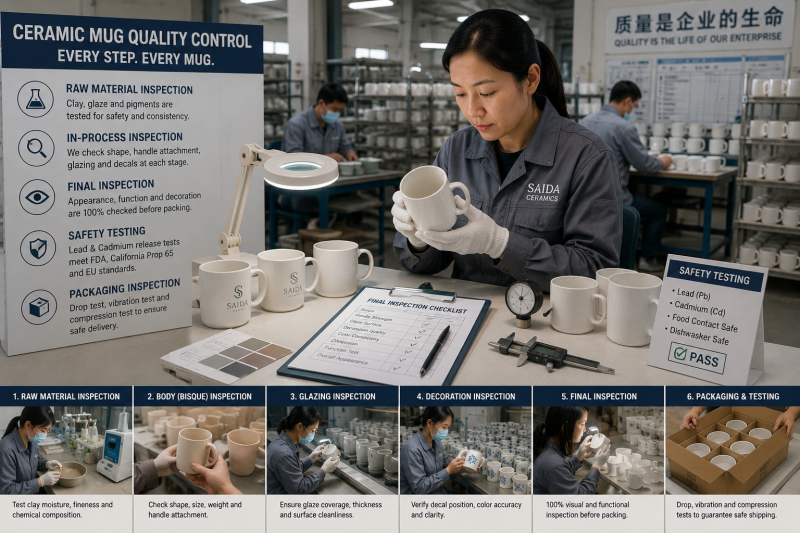
A top OEM mug factory addresses problems proactively and transparently. They have robust internal systems for ceramic mug quality control to catch issues early. When a problem does arise, they immediately communicate it to you, explain the root cause, and present a clear solution to fix it while minimizing impact on your timeline and budget.
Dive Deeper: A Real-World Rescue Mission
Let me share a story from a few months ago. A new client, an e-commerce seller in the US, came to us in a panic. They had placed an order for 5,000 custom-printed mugs with another mug factory in China based on an incredibly low price. With their launch date just six weeks away, they received pre-production samples, and it was a disaster.
The Problem: The client reported that nearly 20% of the sample mugs had issues. Handles were slightly crooked, the printed colors were inconsistent and didn't match their brand's Pantone shade, and the glaze had tiny pinholes. Communication with the factory was slow and difficult. They were told these issues were "within normal tolerance." The client knew that selling these mugs would damage their new brand before it even got off the ground.
Our Solution: When they contacted us, the first thing we did was ask for samples of the defective products. Our engineering team analyzed them and immediately diagnosed the issues:
- Crooked Handles: This was a worker training and jig alignment issue, a sign of poor process control during the
custom mug productionphase. - Inconsistent Color: The other factory was likely using a low-quality decal and inconsistent firing temperatures, causing the colors to burn out or shift.
- Pinholes: This pointed to impurities in the clay or a poorly applied glaze.
Instead of just giving them a new quote, we laid out a rescue plan. We explained that our standard ceramic mug quality control process involves multiple inspection points to prevent these very issues.
- Step 1: Consultation. We held a video call to explain the technical failures in clear business terms—why these defects would lead to customer returns and bad reviews. We reviewed their design and confirmed that with the right materials and processes, a near-perfect result was achievable.
- Step 2: Expedited Production. We knew their launch date was critical. As an experienced
OEM ceramic mug manufacturer, we re-engineered the production flow. We rushed a new set of high-quality samples within a week. - Step 3: Transparent Execution. Once they approved the perfect samples, we dedicated a production line to their order. We provided them with weekly photo updates from the factory floor, showing the mugs at each stage. This transparency rebuilt the trust they had lost.
We delivered the full order of 5,000 high-quality mugs on time, enabling them to hit their launch date successfully. Yes, our unit price was slightly higher than their original quote, but we saved their investment and their brand reputation. This is the difference a true partner makes.
What Do Technical Mug Specs Mean for Your Business?
When you receive a spec sheet, you'll see terms like "stoneware," "porcelain," "decal application," or "vitrification." It’s easy for your eyes to glaze over. You might think these are just technical details for the factory to worry about. But these choices are business decisions in disguise.
The technical specifications of a mug directly impact its durability, perceived value, safety, and final cost. A good custom ceramic mug factory won't just ask you to choose from a list; they will explain the business trade-offs of each option so you can make an informed decision that aligns with your brand and budget.
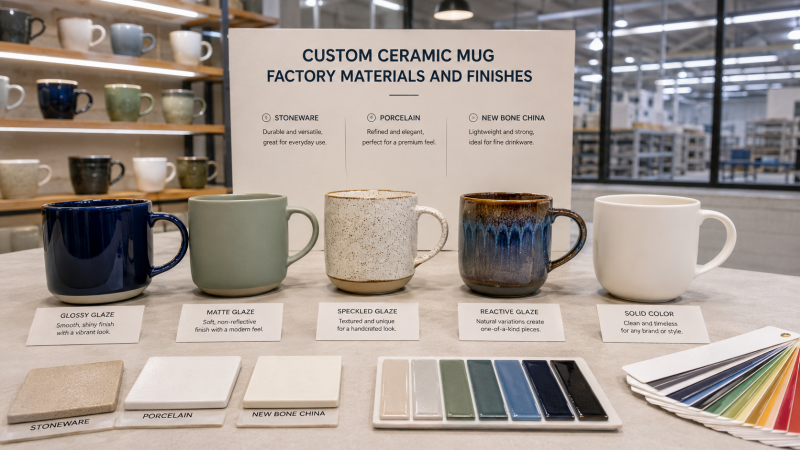
Dive Deeper: Translating Jargon into Profit
Let's demystify some of the most common technical choices and translate them into what they mean for you, the business owner.
Material Choices: More Than Just Clay
The type of ceramic used is the foundation of your product. Each has a different feel, durability, and cost.
| Material | Look & Feel | Durability | Cost | Best For... |
|---|---|---|---|---|
| Stoneware | Opaque, earthy, rustic, heavy feel. | Good; typically dishwasher & microwave safe. | $$ | Coffee shops, rustic brands, everyday use. |
| Porcelain | Bright white, translucent, elegant, lighter feel. | Excellent; non-porous and very durable. | $$$ | Premium brands, corporate gifts, high-end retail. |
| New Bone China | A type of porcelain; warm white, delicate, high-end. | Very good, but can be less chip-resistant. | $$$$ | Luxury giftware, fine dining, designer brands. |
Your factory should help you match the material to your target audience's expectations.
Decoration Methods: Bringing Your Design to Life
How your logo or design is applied affects its longevity and visual appeal.
- Decal Application: This is the most common method for complex, multi-color designs. A special decal is printed, applied to the mug by hand, and then fired in a kiln. When done correctly, it is highly durable and dishwasher safe. A low-quality decal or incorrect firing can lead to peeling or fading. This is a key area where we check for adherence to food-safe ceramic mug standards.
- Sublimation Printing: This method is great for full-color photographic images. The ink turns into a gas and infuses the mug's coating. It's fast and cost-effective for smaller runs but can fade over time with heavy UV exposure or many dishwasher cycles.
- Pad Printing: Excellent for simple, one or two-color logos. It's very fast and cost-effective for large volumes, but less suitable for intricate designs.
A consultative OEM mug factory will ask about your design's complexity and your durability requirements to recommend the best method, balancing quality with cost. They won't just default to the cheapest option.
Frequently Asked Questions
What is the typical Minimum Order Quantity (MOQ) for custom mugs?
For most established factories, the MOQ for a fully custom design is typically between 1,000 and 3,000 pieces per design/color. This is because setting up the molds, color-matching the glazes, and configuring the production line has significant fixed costs. A lower MOQ often means a much higher unit price.
How do I verify a factory's certifications like ISO9001 or BSCI?
Don't just take their word for it. Ask for a copy of the certificate. Pay attention to the expiration date. For certifications like BSCI (Business Social Compliance Initiative), you can often verify the factory's status in the official database. These documents demonstrate a factory's commitment to quality management and ethical labor practices.
What is the difference between an OEM and ODM mug supplier?
OEM stands for Original Equipment Manufacturer. This is where you provide your own unique design, and the factory manufactures it for you. ODM stands for Original Design Manufacturer. This is where the factory offers a portfolio of their own pre-designed mugs, which you can then private label with your logo. Many factories, including ours, offer both services.
How important is the factory's location, like Liling, China?
Location can be very important. Liling, where our factory is based, is known as one of China's "Porcelain Capitals." A factory in a major industry cluster like this benefits from a highly skilled labor force, a robust local supply chain for raw materials and equipment, and generations of accumulated expertise in ceramics. This ecosystem helps ensure quality and efficiency.
Conclusion
Choosing the right OEM mug factory is one of the most critical decisions you'll make for your business. The temptation to chase the lowest price is strong, but as we've seen, that path is often filled with hidden costs that damage your profits and brand. The smarter approach is to find a true partner—a consultant who understands your business goals, translates technical specs into commercial value, and uses their expertise to de-risk your supply chain. By asking the right questions and evaluating a factory on its problem-solving abilities and transparency, you can build a lasting partnership that fuels your growth for years to come.
If you're looking for a consultative partner for your next ceramic mug project, I invite you to reach out to our team. We're here to help you build a successful product, not just take an order.