Finding a reliable supplier can feel like navigating a minefield, especially when your brand's reputation is on the line. You need a consistent product, but every online listing promises "good quality," leaving you to wonder who you can trust. The fear of a bad batch, a delayed shipment, or a complete communication breakdown is real, and it’s what keeps smart buyers up at night. The solution lies in shifting your focus from finding a supplier to identifying the right ceramic mug manufacturer with a proven system for risk reduction.
The best ceramic mug manufacturer for a wholesale buyer is not the one with the lowest unit price, but the one that offers the lowest total business risk. This partner provides transparent and predictable landed costs, demonstrates quality through verifiable systems like ISO9001 certification and a multi-stage QC process, and acts as a strategic partner who understands your market's needs for compliance, durability, and design.
Finding this kind of partner requires a different evaluation process. It's less about haggling over pennies on a sample and more about interrogating their processes, certifications, and track record. In my 15 years running a ceramic export factory, I've seen firsthand what separates a simple order-taker from a true manufacturing partner. Let's dive into the key questions you should be asking.
Why is the Lowest Price Often the Most Expensive Choice?
You've just received five quotes for your latest custom mug design, and one is 15% cheaper than the others. It's tempting to jump on it, isn't it? But experienced buyers know that this initial excitement can quickly turn into a costly headache. What looks like a great deal on paper can hide expenses that will demolish your profit margin.
The cheapest quote is often the most expensive because professional buyers calculate the "total landed cost," not just the unit price. A low price from an unvetted ceramic mug manufacturer frequently leads to higher defect rates, unexpected shipping delays, communication friction, and rework costs that far exceed the initial savings.
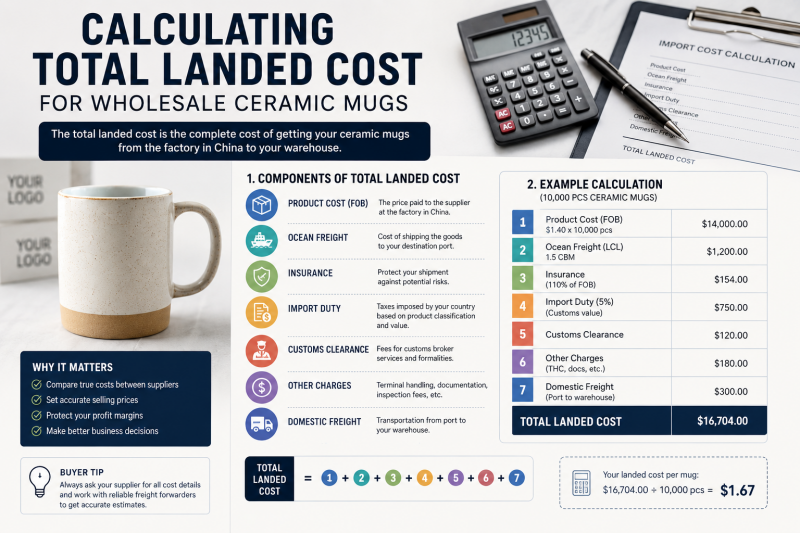
Over my career, I've seen many buyers make the same mistake: they focus solely on the Free on Board (FOB) price. This is the price of the product at the factory gate, but it's a tiny piece of the puzzle. A true business operator understands that the real metric is the Total Landed Cost. This is the sum of all costs to get the product from the factory floor to your warehouse shelf, ready for sale.
H3: The Hidden Costs of a "Cheap" Supplier
A common story we see is a new client approaching us after a nightmare experience elsewhere. One client, a promising e-commerce seller in Germany, decided to go with a factory that quoted them $0.20 less per mug. It saved them $2,000 on a 10,000-unit order—a significant saving, or so they thought.
The problems started immediately.
- Communication Lag: Simple questions took 48 hours to answer.
- Production Delays: The promised 30-day lead time stretched to 60 days, causing them to miss a key holiday sales window.
- Quality Issues: When the mugs finally arrived, nearly 20% had defects—uneven glazing, color inconsistencies, and small cracks. The "cheap" supplier refused to take responsibility.
Their "savings" were wiped out instantly. They had to pay for a full container shipment of mostly unsellable goods, suffered brand damage from the few bad mugs that did ship to customers, and lost thousands in sales from the missed season. They eventually came to us, not for a low price, but for predictability.
H3: Stable Quote vs. Low Quote: A Comparison
The difference between a professional ceramic mug factory China and a low-cost operator becomes clear when you map out the total costs.
| Cost Factor | The "Cheap" Supplier Quote | The Stable Partner Quote |
|---|---|---|
| Unit Price (FOB) | $1.20 | $1.40 |
| Order Quantity | 10,000 units | 10,000 units |
| Initial Cost | $12,000 | $14,000 |
| Defect Rate (hidden) | 15% (1,500 units lost) | <2% (200 units lost) |
| Cost of Defects | $1,800 | $280 |
| Expedited Freight (due to delays) | $1,000 (airfreight part of order) | $0 |
| Communication/Mgmt. Time | 20 hours of extra work | 5 hours of standard follow-up |
| Total Landed Cost (Approx.) | $14,800 + Opportunity Cost | $14,280 |
As you can see, the stable partner wasn't just cheaper in the end; they provided peace of mind. Choosing a ceramic mug wholesale supplier is a risk management decision. The right partner protects your investment and ensures your landed cost is predictable.
How Can You Verify a Chinese ceramic mug factory’s Quality Claims?
Every supplier's website says they have "great quality" and "excellent service." These are empty promises without proof. You’re running a business, not a lottery. You need concrete evidence that the 50,000th mug will be identical to the approved sample.
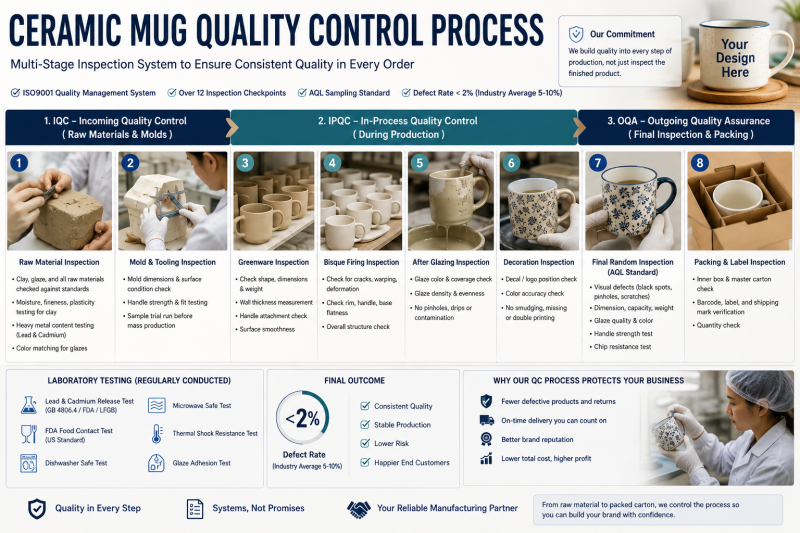
You verify a manufacturer's claims by inspecting their systems, not their promises. Ask for and verify quality management certifications like ISO9001, request social compliance audits like BSCI, and demand a detailed explanation of their multi-stage ceramic mug quality control process, from raw material inspection to final outbound testing.
For over a decade, we've built our reputation not on claims, but on a transparent, systematic approach to quality. This is what separates a professional ceramic mug manufacturer from a simple workshop.
H3: Look Beyond "Made in China"
First, understand that "Made in China" is a category, not a quality standard. The capabilities of factories vary enormously by region. Our factory is located in Liling, Hunan, which is known as one of China's "Porcelain Capitals." This isn't just a title; it means we are part of a deep industrial ecosystem. We have access to:
- Specialized raw material suppliers who provide consistent, high-quality clay and glazes.
- A deep pool of skilled labor, with artisans and technicians who have been working with ceramics their entire lives.
- A network of supporting industries, from decal printers to packaging experts, all located within a few kilometers.
A factory in a less-developed region may not have access to this ecosystem, forcing them to use inconsistent materials or less-skilled labor, which directly impacts your product's final quality.
H3: Demand Verifiable Certifications
Certifications are your first line of defense. They are third-party proof that a factory has its processes in order. The two most important for a wholesale buyer are:
- ISO9001 (Quality Management System): This is the global standard for quality management. An ISO9001-certified factory has documented processes for everything from handling your initial inquiry to final inspection and shipping. It means they have a system for delivering consistency and are committed to continuous improvement. For you, this translates to predictable lead times and lower defect rates.
- BSCI (Business Social Compliance Initiative): This is especially critical for buyers selling in Europe and North America. A BSCI audit verifies that a factory adheres to ethical labor practices. This isn't just about "doing good"; it's about protecting your brand. Having a BSCI report on file proves you've done your due diligence on ethical sourcing, mitigating the risk of your brand being associated with a labor scandal.
Always ask for the certificate or audit report and verify its validity. A reliable partner will provide this without hesitation.
H3: The Anatomy of a Robust QC System
Finally, ask a potential ceramic mug factory to walk you through their QC process. If they can't explain it in detail, they don't have one. A robust system always includes at least three critical checkpoints:
- Incoming Quality Control (IQC): Before a single mug is made, we inspect all raw materials. Is the clay free of impurities? Is the glaze color matched precisely to the Pantone standard? Catching a problem here prevents thousands of bad units from ever being produced.
- In-Process Quality Control (IPQC): Inspectors monitor the production line at key stages. This includes checking semi-finished "bisque" ware after the first firing for cracks or warping, and inspecting mugs after decal application but before the final firing. This allows us to correct issues in real-time.
- Outgoing Quality Assurance (OQA): This is the final, most rigorous check. A random sample from the finished, packed batch is pulled and inspected based on AQL (Accepted Quality Limit) standards. We check for everything: dimensions, color, glaze imperfections, handle strength, and packaging integrity. Only after a batch passes OQA is it cleared for shipment.
This systematic approach is how we ensure consistency and what any serious custom ceramic mug manufacturer should be able to demonstrate.
Does Your Ceramic Mug Supplier Understand Your Market?
You've found a factory with good systems and a fair price. But there's one more layer: do they just take orders, or do they think like a partner? A supplier who just manufactures a product is a commodity. A partner who understands your end-customer and market challenges is a competitive advantage.
A true manufacturing partner leverages their experience to provide insights that help you sell more effectively. With 15 years of exporting to Europe and the Americas, a mug production factory should be able to advise on popular shapes, compliant materials for your region, and packaging strategies that reduce costs and breakage.
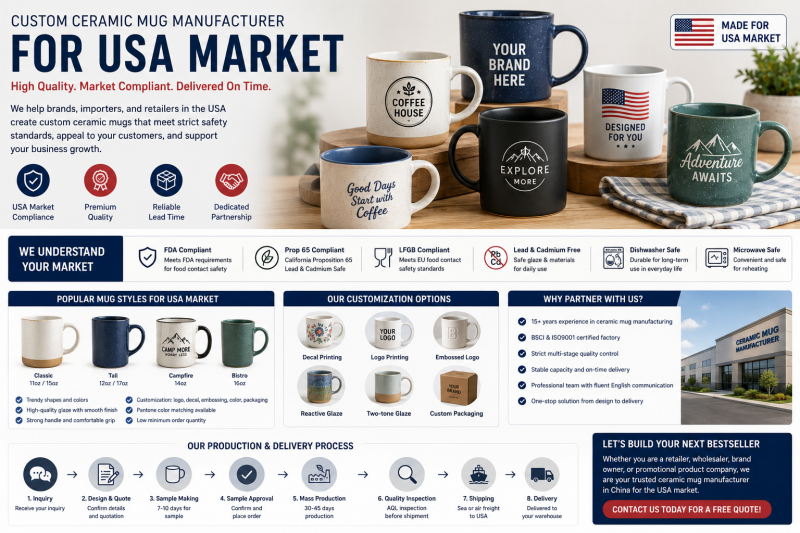
I can't count the number of times a small suggestion has saved a client thousands of dollars or prevented a product launch failure. This is where experience transforms from a resume line item into tangible value for your business. A transactional supplier builds your product; a strategic partner helps build your business.
H3: Proactive Advice, Not Reactive Manufacturing
A good partner doesn't just say "yes" to everything. They ask "why."
- For an EU Client: A new client wanted a specific matte glaze. Knowing the EU's strict regulations on heavy metal release (especially cadmium and lead), we proposed a slightly different, fully certified lead-free glaze that had the same aesthetic but guaranteed compliance. This prevented a potential import rejection and protected their brand.
- For a US E-commerce Seller: A client was launching a high-end gift set. Their initial packaging idea was beautiful but flimsy. Drawing on our experience, we explained how rough handling during last-mile delivery could lead to high breakage rates. We worked with them to redesign the inner packaging, creating a more robust solution. We have extensive knowledge of Packaging for Fragile Ceramic Products and shared best practices on How to Reduce Breakage During Shipping, ultimately lowering their customer complaint rate by over 10%.
- For a South American Wholesaler: A buyer was debating between two mug shapes for a promotional campaign. We were able to share sales data showing that one shape consistently sold better in their target demographic. They switched their order, and the campaign was a huge success.
H3: Navigating Logistics and Compliance
Understanding a market also means understanding its logistics. A partner with 15 years of export experience has navigated the complexities of global shipping thousands of times. We can provide clear guidance on the trade-offs between Sea Freight vs Air Freight for Ceramic Mugs based on your timeline and budget. For our many clients in the United States, we have a streamlined process for handling the specific documentation and customs requirements involved in Shipping Ceramic Mugs from China to USA.
This expertise isn't an "add-on"; it's a core part of the service. It reduces your administrative burden and helps you avoid costly logistical mistakes.
Frequently Asked Questions
What's the difference between a ceramic mug factory and a trading company?
A ceramic mug factory (like us) owns the production facilities, employs the workers, and directly controls the entire manufacturing process and quality. A trading company is a middleman; they source from various factories. Working directly with a factory often provides better pricing, more control over customization, and clearer communication.
What is BSCI and why does it matter for my brand?
BSCI (Business Social Compliance Initiative) is an audit that verifies a factory's adherence to ethical labor standards, including fair wages, safe working conditions, and no child labor. For brands selling in Western markets, BSCI compliance is crucial for risk management. It protects your brand's reputation and ensures your supply chain is ethically sound.
What are typical MOQs for custom ceramic mugs?
Minimum Order Quantities (MOQs) for a custom ceramic mug manufacturer typically range from 1,000 to 3,000 pieces per design or color. This is because setting up the production line—molds, color mixing, decal printing—has significant fixed costs. The MOQ ensures that production is efficient and cost-effective for both the factory and the buyer.
How long does production and shipping take from China?
As a general guideline, production for a custom order takes about 30–45 days after the sample is confirmed. Sea freight to Europe or the Americas can take an additional 30–40 days. In total, you should plan for a 70–90 day lead time from placing the order to receiving the goods in your warehouse.
Conclusion
Choosing the right partner is the single most important decision you will make for your ceramic mug business. The search for the "best" supplier shouldn't end at the lowest price tag. Instead, it should be a thorough evaluation of a manufacturer's ability to manage your risk and protect your profitability. Look for a partner who offers a predictable total landed cost, not just a low unit price. Verify their quality claims through certifications like ISO9001 and by interrogating their QC systems. Finally, choose a partner whose experience in your market becomes your competitive advantage. Finding the right OEM ceramic manufacturer is about securing a stable, reliable, and strategic link in your supply chain that will support your growth for years to come.
If you are a wholesale buyer or e-commerce seller looking for a partner who prioritizes predictable quality and clear communication, I invite you to reach out. Let's discuss your next project and how our 15 years of experience can help you succeed.