Sourcing at a global scale introduces immense risk to your brand's consistency. You've spent years building a reputation, but one poor batch of products can undermine that trust. When it comes to something as personal as a coffee mug, choosing the right Chinese mug manufacturers is less about cost and more about finding a partner who can translate your brand's intangible value into millions of identical, high-quality units.
Global brands choose leading Chinese mug manufacturers not for lower prices, but for their strategic ability to de-risk mass production. These specialized factories act as partners, translating abstract brand values like "premium feel" into concrete manufacturing specifications, thereby ensuring unwavering product consistency and protecting the brand's reputation across millions of units.
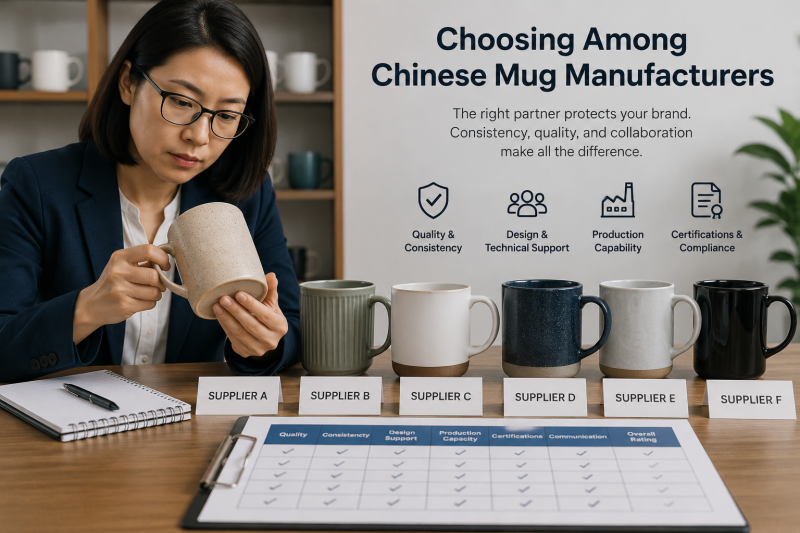
This strategic partnership goes far beyond a simple purchase order. It's about a collaborative process that starts long before the production line ever runs. Let's explore how this relationship transforms a simple sourcing decision into a powerful brand protection strategy.
What Role Do Top Chinese Mug Manufacturers Play Beyond Production?
You have a marketing brief that calls for a mug with an "artisanal feel" or a "reassuring heft." How do you put that on a technical spec sheet? This is where many procurement processes fail. A top-tier manufacturer's most important role is to bridge this gap between brand identity and factory floor reality.
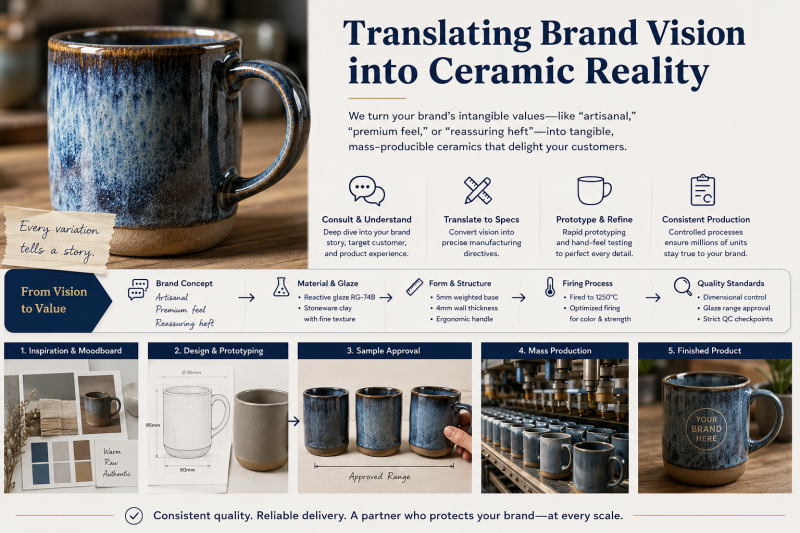
The best suppliers act as brand-to-factory translators. Their job is to convert subjective marketing language into a precise set of manufacturing directives that can be replicated perfectly, whether you're ordering ten thousand units or ten million.
Dive Deeper: The Art of Translating Brand Vision
Over my 15 years in this industry, I've seen countless technical packs that are perfect on paper but fail to capture the client's true intent. A global coffee brand I worked with wanted to launch a new line of private label ceramic mugs that felt "more authentic and handcrafted" than their standard glossy white mugs. Their design agency sent over a PDF with a target Pantone color and a 3D model.
A passive supplier would simply quote that. My first question, however, was, "What does 'authentic' mean to your customer?"
This question opened up a crucial dialogue. We discussed what creates that feeling: subtle variations in color, a surface that isn't perfectly uniform, and a weight that feels substantial. The agency's single Pantone color would have produced a flat, lifeless mug. Instead, I proposed using a specific type of reactive glaze ceramic mugs.
Translating "Authentic Feel" into Manufacturing Specs:
- From "Authentic Color" to "Reactive Glaze": A reactive glaze contains crystals and other chemicals that react uniquely in the kiln's heat. This means no two mugs are exactly identical, but they all share a consistent "family" look. This delivers the "handcrafted" feel without sacrificing overall brand consistency.
- From "Reassuring Heft" to "Wall Thickness & Clay Density": We increased the specified wall thickness by 0.5mm and used a slightly denser clay composition. This minor adjustment, imperceptible to the eye, completely changed the "hand-feel" of the mug from generic to premium.
- From "Comfortable Handle" to "Ergonomic Prototyping": The 3D model had a handle that looked stylish but was angular and uncomfortable. We produced three rapid prototypes with slight variations in the handle's curve and finger clearance. The client could then hold them and choose the one that felt right, a decision impossible to make from a screen.
This consultative process is the core value a strategic ceramic mug supplier China provides. We aren't just order-takers; we are the technical consultants who ensure the final product fulfills the brand promise, not just the spec sheet.
How Do Experienced Chinese Mug Manufacturers Mitigate Mass Production Risks?
Your brand's reputation is your most valuable asset. Inconsistent quality in a mass-produced item is a direct threat to that asset. What happens when a handle shape is prone to breaking during shipping, or a specific color can't be reproduced consistently across batches? An experienced partner identifies these risks before they become a million-unit problem.
A true ceramic mug factory for global brands acts as a proactive risk manager. They critically evaluate a design not just for its aesthetics, but for its stability in mass production, its durability in the supply chain, and its safety in the end-user's hands.
Dive Deeper: Challenging the Design to Protect the Brand
The most common mistake I see is when a procurement team falls in love with a design and seeks only a supplier who can execute it cheaply. A true partner will be the one brave enough to say, "This is a beautiful design, but it presents three major production risks."
I had a client, a major European retailer, who brought us a design for a mug with a very thin, elegant, rectangular handle. It looked fantastic in the renders. My team and I immediately flagged it as a high-risk feature.
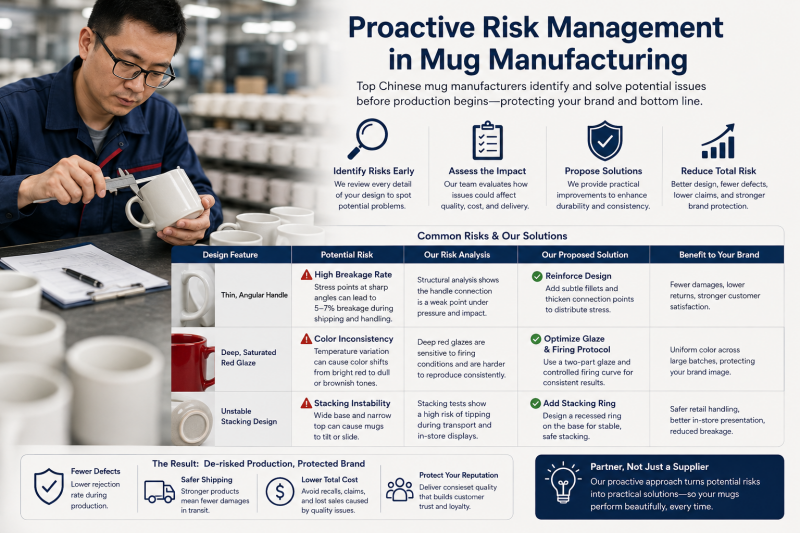
Our Risk Assessment Breakdown:
| Design Feature | Potential Risk | Our Proposed Solution |
|---|---|---|
| Thin, Angular Handle | High Breakage Rate: The sharp angles create stress points. We projected a potential 5-7% breakage rate during shipping and in-store handling. | Modified Handle Design: We proposed adding a slight, almost imperceptible fillet to the inside corners to distribute stress, and slightly increasing the connection point to the mug body. |
| Deep, Saturated Red Glaze | Color Inconsistency: Deep reds are notoriously difficult to fire consistently. Temperature variations of just 5°C in the kiln can lead to visible shifts from bright red to a duller, brownish hue. | Glaze & Firing Protocol: We recommended a two-part glaze application and a stricter firing curve, holding the peak temperature for a longer duration. This adds a marginal cost but guarantees color uniformity. |
| Unusually Wide Base | Stacking Instability: The design was intended to be stacked for in-store displays, but the wide base and narrow top made the stacks unstable and a safety hazard. | Base & Stacking Ring: We suggested adding a subtle, recessed "stacking ring" on the base of the mug, allowing them to nest securely. |
This process of critical feedback is not about being difficult; it's the ultimate form of risk management. By challenging the design, we helped the client avoid the catastrophic cost of product recalls, customer complaints, and the long-term damage to their brand's perception of quality. A robust ceramic mug quality control process isn't just about inspecting finished goods; it starts with de-risking the design itself. This is a hallmark of the best Chinese mug manufacturers. We know how to reduce breakage during shipping because we engineer durability into the product from the start.
What's the Right Way to Evaluate a Chinese Mug Manufacturer?
Your procurement process dictates the quality of your partnership. If your process is built solely around RFQs and price comparisons, you'll attract transactional suppliers. To find a strategic partner, you need a process that evaluates their ability to think, consult, and solve problems.
Instead of asking "Can you make this?", you should be asking "How would you improve this?". A proactive partner will welcome this question and provide insightful feedback, demonstrating their expertise and commitment to a successful outcome beyond just fulfilling an order.
Dive Deeper: Moving from RFQ to Collaborative Evaluation
The traditional procurement model often looks like this:
- Finalize a design internally.
- Send a technical pack to ten suppliers.
- Award the contract to the one with the best price and lead time.
This approach is fundamentally flawed because it treats the supplier as a commodity. It completely misses the opportunity to leverage their manufacturing expertise. As a wholesale ceramic mug manufacturer, I can tell you that the clients who get the best results use a different approach.
When a new potential client from a global brand approaches me, my first question is never "What's your quantity and target price?". It's "What experience are you trying to create for your customer with this mug?".
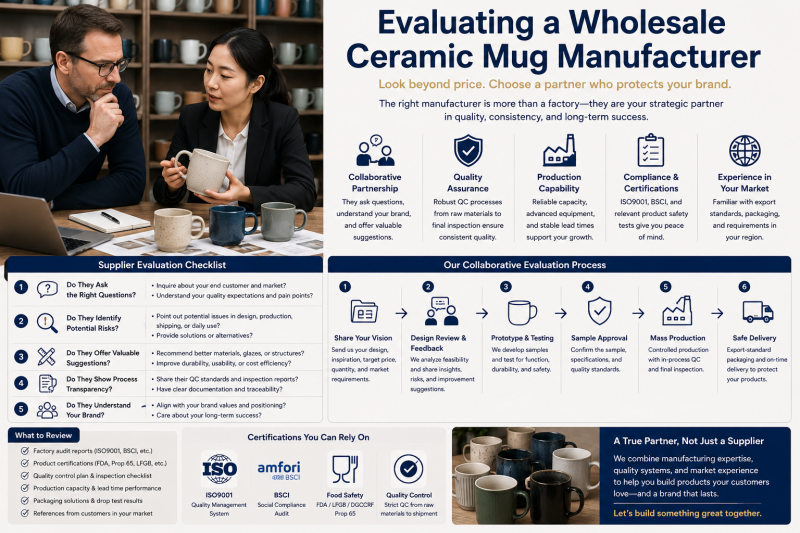
A better evaluation process focuses on dialogue and problem-solving:
- Initial Design Review: Share your draft design and marketing goals with a shortlist of 2-3 potential partners. Ask for their feedback. Do they spot potential issues? Do they suggest improvements? Their response is the first and most important test.
- Assess Communication: Is the account manager just a salesperson, or are they a technical consultant? Can they clearly explain why a certain glaze is risky or how a different handle shape would improve user experience? Look for a custom ceramic mug manufacturer in China whose team can speak both the language of brand and the language of production.
- Request a "Problem" Sample: Instead of just a sample of their best work, give them a challenge. For example, "We need to match this specific fabric swatch, which is notoriously hard to replicate in a glaze. Can you produce three sample variations for us?" This tests their technical capability in a real-world scenario.
- Review Their Process Documentation: Don't just ask for certifications like ISO9001 or BSCI—ask to see their internal process documents. For example, what does their ceramic mug inspection checklist look like? How detailed is it? This reveals how deeply they think about quality at every step.
By shifting your evaluation from price to process, you change the nature of the relationship. You are no longer just buying mugs; you are securing a partner who will actively work to protect and enhance your brand's reputation in the marketplace.
Frequently Asked Questions
What's the difference between a Chinese mug trading company and a factory?
A factory, like us, directly manufactures the products. We have full control over the production line, quality control, and materials. A trading company is a middleman; they source from various factories. For large brands requiring consistency and risk management, working directly with a factory provides greater transparency and control.
How important are certifications like BSCI and ISO9001 for Chinese mug manufacturers?
These certifications are crucial baseline indicators. ISO9001 demonstrates a commitment to documented quality management systems, while BSCI shows adherence to social compliance and ethical labor practices. For any global brand, these are non-negotiable, but they are the start—not the end—of your due diligence. Always ask to see the actual certification documents.
What is a common mistake when ordering private label ceramic mugs?
The most common mistake is focusing entirely on the visual design while ignoring the tactile experience and manufacturing feasibility. A mug that looks good on screen might feel cheap, be uncomfortable to hold, or have design elements that cause high defect rates in production. Always engage your supplier in a dialogue about the design before finalizing it.
How much does design complexity affect the final unit cost?
Complexity is a major cost driver. Elements like multi-color logos, intricate handle shapes, non-standard capacities, or specialty glazes (like reactive or metallic glazes) all increase costs. They may require more materials, slower production speeds, additional firing cycles, or higher rejection rates, all of which impact the final unit price.
Conclusion
Ultimately, the reason top global brands partner with strategic Chinese mug manufacturers is for brand protection. In a world of mass production, consistency is the ultimate measure of quality, and it can only be achieved through a deep, collaborative partnership. Moving the conversation from unit price to total value—including risk mitigation, design consultation, and process transparency—is the key. The right partner isn't the one who passively accepts your design, but the one who actively works with you to perfect it, ensuring that every single mug that reaches your customer is a perfect ambassador for your brand.
If you are a procurement manager looking for a manufacturing partner who can help de-risk your supply chain and translate your brand's vision into a high-quality ceramic product, we should talk. Let's discuss how we can protect your brand together.