Are you a B2B buyer constantly told that sustainability is crucial, yet you struggle to see a clear return on that investment? You spend valuable time verifying supplier certificates, but this compliance doesn't seem to move the needle on your sales or profits. The solution lies in shifting your perspective: true value from sustainability in ceramic mug manufacturing isn't found in a piece of paper, but in the authentic, verifiable stories from the factory floor that allow you to command a higher price.
Sustainability in manufacturing boosts profits by providing unique, authentic marketing stories derived from tangible factory-floor practices like energy efficiency, water recycling, and waste material reuse. These specific, defensible narratives differentiate your brand, build consumer trust, and justify a premium price point, moving you beyond simple certificate compliance and into a more profitable market position.

This approach transforms sustainability from a cost center into a powerful profit driver. But how do you uncover these stories and translate them into something your customers will pay more for? Let's go beyond the certificates and take a look at the real-world practices that can build your brand and your bottom line.
Why Do Certifications Alone Fall Short in Driving Profit?
You've done your due diligence. After weeks of vetting, you’ve found a supplier with the right credentials—perhaps ISO9001 for quality management and BSCI for social compliance. But when you launch your product, you realize your competitors are waving the same flags. The certification that felt like a win is really just the ticket to the game.
Certifications are essential for market access, risk management, and ensuring baseline ethical standards. However, they offer little competitive marketing advantage because they are standardized and widely held by serious international suppliers. True profit drivers are the unique, non-standardized stories behind the compliance.

H3: Certificates as Table Stakes, Not a Trump Card
From my conversations with dozens of US and European buyers over the past 15 years, I've seen a recurring pattern. Many fixate on certifications as the end goal, believing that a BSCI logo is a powerful marketing tool. In reality, for major Western markets, these credentials are now table stakes—the minimum requirement to be considered a credible partner. They prove you're a professional operation, but they don't make your product special in the eyes of the end consumer.
Think of it this way: when a customer is browsing online, they don't see a BSCI audit report. They see a mug. Your marketing must connect with them on an emotional and value-based level, and a compliance acronym rarely achieves that. This is especially true when it comes to meeting fundamental requirements like food-safe ceramic mug standards, which are an absolute must but not a point of differentiation.
H3: The "So What?" Test for Consumers
The biggest weakness of a certificate-led marketing strategy is that it fails the "so what?" test.
- Your Marketing: "Our mugs come from a BSCI-audited factory!"
- The Customer: "So what? What does that mean for me?"
Translating "BSCI-compliant" into a compelling consumer benefit is incredibly difficult. It speaks to supply chain ethics, which is important, but it's an abstract concept. In contrast, a story about how the mug was made using 80% recycled water is tangible, easy to understand, and emotionally resonant.
I once worked with a German wholesale client who was adamant about sourcing from a factory with top-tier certifications. They found one and placed a large order. Six months later, their sales were flat. Meanwhile, a competitor—who also had the same certifications—was actively marketing their mugs with a story about the factory's new, energy-efficient kilns. That competitor was able to command a 15% retail premium and was gaining market share. The lesson was clear: compliance gets you in the door, but a unique story lets you own the room.
How Can You Find Profitable Stories on the Factory Floor?
So, you know you need a unique story. But as a buyer, you're not a factory engineer. Where do you even begin to look for these narratives of ceramic mug factory sustainability? Asking a supplier a vague question like "Are you sustainable?" will likely get you a generic "yes" and a list of their certificates. It's an unproductive loop.
The secret is to ask specific, operational questions about the ceramic mug production process itself. Profitable stories are found by investigating tangible details of resource management. Focus your questions on energy consumption, water systems, waste material handling, and the sourcing of raw materials. These specifics are the building blocks of an authentic and compelling narrative.
H3: The Kiln: The Heart of Energy Efficiency
The kiln is the most energy-intensive component in ceramic manufacturing. It's a massive oven that fires mugs at over 1200°C (2200°F). This stage consumes a tremendous amount of natural gas or electricity. Here lies a huge opportunity for a sustainability story. A modern, well-insulated kiln can be up to 30% more energy-efficient than a model from 15 years ago.
Ask your supplier about their kilns. Have they been upgraded recently? Do they use heat recovery systems? A reduction in energy use per firing cycle directly translates to a lower carbon footprint for each mug produced. That's a powerful and quantifiable claim.
H3: Water: The Unsung Hero of Sustainability
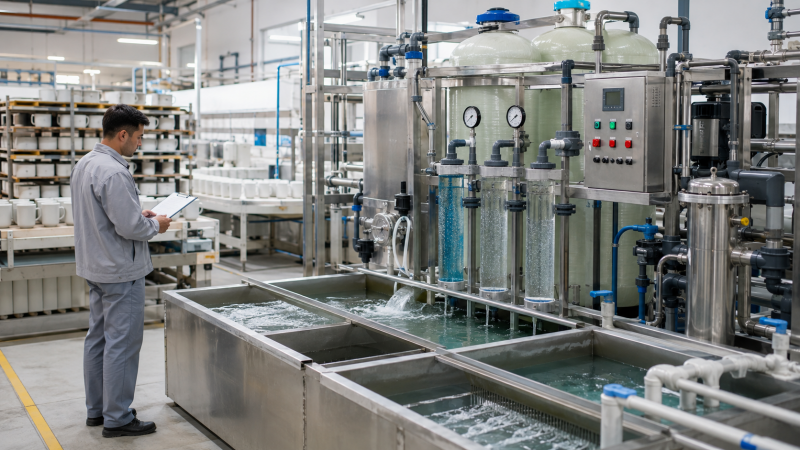
Water plays a critical role in making ceramics, from mixing the clay body to rinsing pieces before glazing. In a traditional factory, this can generate significant wastewater. However, a forward-thinking factory invests in systems to manage this resource. For instance, at our own factory in Liling, we installed a closed-loop water recycling system. This allows us to treat and reuse approximately 80% of our process water. This isn't greenwashing; it's a verifiable engineering fact that forms the basis of a powerful conservation story.
H3: Waste Not, Want Not: Reusing Ceramic Waste
Not every mug that enters the kiln comes out perfect. Inevitably, some pieces will have minor defects and fail our rigorous ceramic mug inspection checklist. Before glazing, these rejected pieces are known as "biscuit." Instead of sending this material to a landfill, it can be crushed into a powder and reintroduced into new batches of clay. This is a perfect example of a circular economy in action. It reduces landfill waste and decreases the demand for virgin raw materials. This is a core part of our ceramic mug factory sustainability program and a story that resonates deeply with conscious consumers.
To help you start these conversations, here are the questions you should be asking your potential suppliers:
| Area to Investigate | Question to Ask Your Supplier | Potential Marketing Angle |
|---|---|---|
| Energy (Kilns) | "What is the energy source for your kiln, and have you made recent efficiency upgrades?" | "Fired with greater efficiency to reduce its carbon footprint." |
| Water Usage | "Do you have a system for recycling process water from glazing and cleaning?" | "Crafted with a commitment to water conservation." |
| Material Waste | "What happens to ceramic pieces that fail quality inspection before glazing?" | "Made with recycled porcelain content, reducing landfill waste." |
| Raw Materials | "Where do you source your clay and glazes? Are they local and confirmed non-toxic?" | "Crafted from locally sourced, non-toxic, earth-friendly minerals." |
How Do You Translate Production Facts into Consumer Benefits?
You've done the work and gathered some great data from your supplier: "Our new kiln uses 15% less natural gas per firing cycle." This is a fantastic, quantifiable fact. But if you put "Made with 15% less gas!" on your website or packaging, it sounds technical, cold, and unappealing. It doesn't create an emotional connection with the person buying the mug.
The real art, and where my expertise comes in, is translating that technical fact into a relatable, value-driven story. You do this by shifting the focus from the factory's action (e.g., recycling water) to a shared human value (e.g., preserving nature) and the positive feeling a customer gets from making a thoughtful choice.

H3: From Feature to Feeling
This is the cornerstone of great marketing. The "feature" is what a product is or has. The "benefit" is what it does for the customer. In our case, the benefit is often an emotional one.
Example 1: The Water Recycling Story
- Factory Fact: "Our facility recycles 80% of its process water."
- Consumer Story: "Every sip from this mug is a toast to water conservation. It's crafted in a facility that recycles and reuses 80% of its process water, ensuring that the beauty of your morning ritual doesn't come at the expense of our planet's most precious resource. It’s a better mug for a better morning."
Example 2: The Energy Efficiency Story
- Factory Fact: "Our new kiln reduces energy consumption by 20% compared to older models."
- Consumer Story: "Fired with intention. This mug was created in a state-of-the-art kiln, using 20% less energy than conventional methods. It’s a small change in our process that makes a big difference for our shared environment. Feel good about the mug you use every day."
H3: Authenticity Is Your Shield Against Greenwashing
The beauty of this approach is that because your stories are rooted in specific, verifiable factory operations, they are highly defensible against accusations of "greenwashing." You are not using vague, unprovable buzzwords like "eco-friendly." Instead, you are transparently explaining how your product is more considerate of the environment.
This is where a deep partnership with a transparent sustainable ceramic mug manufacturer becomes your greatest competitive asset. They provide the facts, you build the story. This collaboration turns a simple sourcing relationship into a strategic partnership. It allows you to build a brand that is both profitable and proud of its production origins. When you combine these stories with proof of safety, like results from SGS testing for ceramic mugs, you create an unbeatable combination of trust and appeal for your eco-friendly ceramic mugs wholesale business.
How Does Sustainability in Ceramic Mug Manufacturing Actually Increase Your Margin?
You're intrigued by the power of storytelling, but you're a business person. The bottom line is always the bottom line. You might worry that investing in a product from a factory with better sustainable practices—which may have a slightly higher cost—won't pay off in a crowded and competitive market.
The proof is in the profits. A strong, authentic sustainability narrative is one of the few remaining ways to justify a premium price and build a protective moat around your brand. Ultimately, sustainability in ceramic mug manufacturing increases your margin by creating powerful brand differentiation, allowing you to escape price wars and build a loyal customer base.

H3: Escaping the Race to the Bottom
The market for generic, undecorated ceramic mugs is completely saturated. If your only selling point is price, you are in a race to the bottom that you can't win. Someone will always be willing to make less margin than you. A unique story about how your product is made is your escape hatch. It elevates the conversation from "How cheap is it?" to "What does this brand stand for?"
I recently worked with an e-commerce seller in the United States who was struggling. They were selling plain white mugs and competing with dozens of other sellers on price alone, with margins shrinking every quarter. We worked together to build a new narrative for their brand focused on our factory's water recycling system and our use of local, non-toxic glazes. They redesigned their packaging, updated their product pages with the new story, and increased their retail price by $3 per mug. Their sales volume dipped slightly in the first month, as expected, but their overall profit margin jumped by a staggering 25% within six months. They were selling a story, not just a mug.
H3: Building a Brand, Not Just Selling a Product
Sustainability stories attract a specific type of customer: one who is often less price-sensitive and more values-driven. When a customer buys from you because they believe in your brand's ethos, they become more than a one-time purchaser; they become a loyal advocate. This long-term loyalty reduces your customer acquisition costs and builds a stable, profitable business. You stop being a commodity seller and start becoming a brand builder.
This entire strategy hinges on the idea that sustainability in ceramic mug manufacturing isn't just an ethical choice; it's a powerful commercial strategy. It’s about creating a product that people can feel good about buying, and that you can feel good about selling—all while strengthening your financial performance.
Frequently Asked Questions
Is a sustainable ceramic mug more expensive to source?
Sometimes there is a small initial cost premium, as investments in efficient technology or water systems need to be amortized. However, the focus should be on the return on investment. A 5% higher sourcing cost that enables a 20% higher retail price and a 25% increase in profit margin is a strategically sound business decision.
How can I verify a factory's sustainability claims?
Ask for specifics and evidence. A transparent partner will be happy to share details. Request photos or even a virtual tour of their water recycling systems, kiln upgrades, or waste management areas. A truly sustainable ceramic mug manufacturer sees these features as assets and will be proud to show them to you.
What's more important: a BSCI certificate or a good sustainability story?
They are both critical, but for different functions. A BSCI certificate is your foundation—it ensures ethical compliance and is a non-negotiable baseline for market access. The sustainability story is your marketing engine—it's what drives differentiation, customer loyalty, and ultimately, profit. You need the certificate for compliance and the story for commercial success.
Can I use these stories if I'm just a wholesaler and don't own the brand?
Absolutely. This is a massive value-add for your retail clients. By partnering with a factory that provides these authentic stories, you gain a unique asset. You can package this information and pass it along to the e-commerce sellers and retailers you supply, empowering them to build stronger brands and achieve higher margins. Their success becomes your success.
Conclusion
The path to higher profits in the ceramic mug market is no longer paved with price cuts. It's built on a foundation of authenticity and a compelling brand story. The key is to look past certifications as the final goal and see them as the starting point. By partnering with a transparent manufacturer, you can uncover powerful, verifiable stories from the factory floor—stories about energy efficiency, water conservation, and circular economy practices. Translating these facts into emotional consumer benefits is what allows you to differentiate your brand and justify a premium price.
Ultimately, effective sustainability in ceramic mug manufacturing is a commercial strategy that transforms an operational detail into a marketing triumph. It's about creating value that customers can see, feel, and are willing to pay for, securing your brand's profitability for the long term.
If you're a wholesale or e-commerce buyer looking to turn authentic ceramic mug factory sustainability practices into a profitable brand story, let's talk. We have 15 years of experience helping clients do just that. Contact us today to learn how our production process can become your most powerful marketing advantage.