Struggling with sourcing partners who don't seem to understand your vision for a new product line? It’s a common frustration when your detailed feedback gets lost in a chain of emails, leading to costly sample revisions and delays. The real problem isn't just the middleman; it's the communication gap they create. The solution is to buy ceramic mugs directly from a factory and build a relationship that turns your ideas into tangible products, without the friction.
Buying ceramic mugs directly from a factory is about gaining control, clarity, and a collaborative partner. Instead of relying on a middleman, you communicate your exact design, quality, and business needs to the people actually making your product. This eliminates information distortion, reduces delays, and lowers your risk of costly errors.
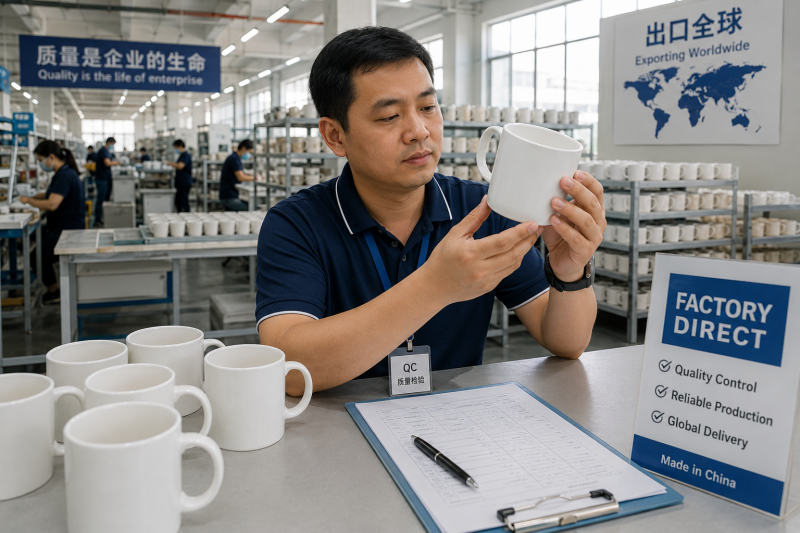
This direct connection is about much more than just a potential price advantage. It’s about transforming your supply chain from a simple transaction into a strategic partnership. Let’s explore what that partnership really looks like and how it can directly benefit your business as a wholesaler or e-commerce seller.
How Does Direct Factory Sourcing Reduce Communication Errors?
Are you tired of playing the "game of telephone" with your product specifications? You send a detailed brief to your sourcing agent, who then translates it for the factory, and with each step, a little bit of your original vision is lost.
The most significant benefit of working directly with a factory is the elimination of communication layers. Your feedback, questions, and design specifications go straight to the team responsible for production, ensuring nothing is lost in translation. This is the essence of effective ceramic mug factory direct sourcing.
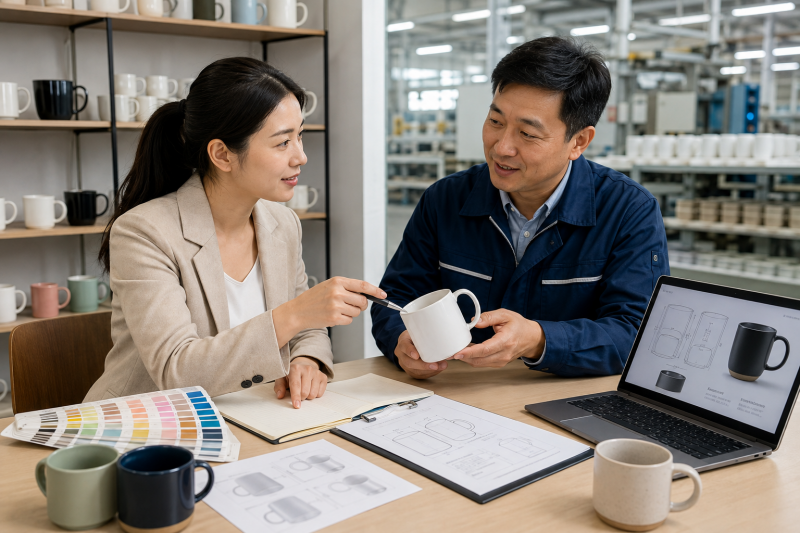
Dive Deeper: The True Cost of "Lost in Translation"
In my 15 years of helping importers bring their products to life, the most expensive problems almost always start with a small miscommunication. A client might tell their trader they want a mug with a "rustic, handmade feel." The trader, who may not have deep ceramics knowledge, might just relay "make it look rustic." The factory then makes its best guess.
When you work directly with an experienced custom ceramic mug manufacturer, that conversation is completely different. When a buyer asks me for a "rustic feel," my first questions are:
- Glaze: Are we talking about a reactive glaze that creates unique patterns on each piece, or a matte glaze with a speckled finish?
- Shape: Should the form be slightly irregular to mimic hand-thrown pottery, or are you looking for a standard shape with a textured surface?
- Clay Body: Do you want to see the raw, exposed clay at the base of the mug? This can create a beautiful contrast.
This is a consultative dialogue, not a one-way order. We translate your market-facing language ("rustic feel") into precise technical specifications. This ensures the first sample is much closer to your vision, saving weeks of time and hundreds of dollars in shipping fees for revised samples.
Here’s how we formalize this to prevent errors:
| Communication Stage | Trader-Based Model | Direct Factory Partner Model |
|---|---|---|
| Initial Brief | Client -> Trader -> Factory (potential for distortion) | Client -> Factory (direct and clear) |
| Sample Feedback | "The color is wrong." -> Trader tries to explain -> Factory guesses again. | "The blue is too saturated. Let's try Pantone 294 C with a semi-matte finish." -> Factory adjusts to exact spec. |
| Quality Control | Trader may use a generic checklist. | We build a custom checklist based on your specific requirements. You can review our detailed ceramic mug quality control process to see how. |
By closing the communication loop, you move from hoping for the best to actively guiding the production of your assets.
What Does a Proactive Factory Partnership Actually Look Like?
Does the thought of managing production yourself bring up fears of unexpected problems and quality issues? Many importers worry that without an agent, they will be left to handle crises alone. This is where the value of a true partner, not just a supplier, becomes clear.
A proactive factory partner anticipates problems before they happen. They leverage their manufacturing experience to identify potential risks in your design and offer solutions upfront, turning a simple transaction into a collaborative effort to build a successful product.

Dive Deeper: From Order-Taker to Problem-Solver
A factory that simply takes your order and sends an invoice is just a supplier. A partner invests in your success. Professionalism is shown, not told, through proactive communication.
Let me give you a real-world example. A few months ago, a European e-commerce client sent us a beautiful new design for a 16 oz mug. It was sleek, with a very thin, elegant handle. My production manager and I immediately saw a potential issue. While the design looked great on paper, our experience told us that a handle that thin on a mug that large could be a weak point, especially during shipping or with daily use.
Instead of just proceeding with the mold, we did the following:
- Immediate Flag: I emailed the client with a photo of their design, annotating the specific area of concern.
- Clear Explanation: I explained, "Based on our drop tests for similar designs, a handle with this cross-section on a 16 oz body has a higher-than-average risk of fracture. This could lead to negative customer reviews and returns."
- Proposed Solutions: We didn't just present a problem; we offered solutions. "We can slightly increase the handle's thickness at the joint by 2mm, which won't noticeably alter the aesthetic but will increase its durability by over 50%. Alternatively, we can use a fortified porcelain body, but this will increase the unit cost by $0.12. We've attached a revised render showing the thicker handle."
The client was thrilled. We hadn't just prevented a potential quality disaster; we had demonstrated that we were looking out for their business. This is the core difference. A middleman would likely not have the technical expertise to even spot this issue, and the problem would only be discovered after the first production run was complete—or worse, by their end customers.
A good partner de-risks the process for you. We use tools like a comprehensive ceramic mug inspection checklist and pre-production meetings to ensure every detail is confirmed before mass production begins. That's the value you get when you buy ceramic mugs directly from a factory that acts as your manufacturing consultant.
Can You Get Better Customization When You Buy Ceramic Mugs Directly From a Factory?
Have you ever had a unique product idea but felt it was too complex to explain to a supplier? Maybe you even have a napkin sketch that you believe could be a bestseller, but you don't know how to turn it into a technical specification.
Absolutely. When you buy ceramic mugs directly from a factory, especially an experienced OEM ceramic mug factory, you gain direct access to the engineers and technicians who can turn your concept into a production-ready design. This is where true innovation happens.
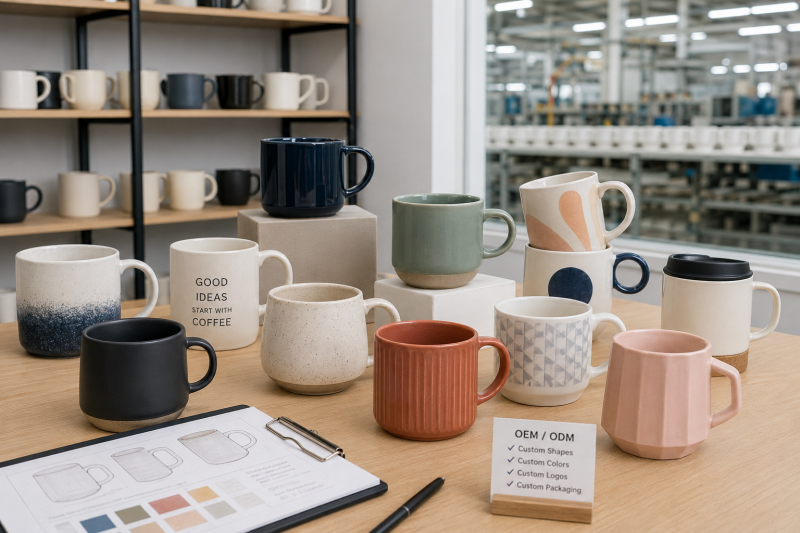
Dive Deeper: From Napkin Sketch to Bestseller
Working directly with the source empowers you to create truly unique factory direct ceramic mugs. The journey from an idea to a finished product involves several critical steps where direct communication is invaluable.
1. Translating Concept to CAD:
I once had a client from the US who wanted to create a mug shaped like a vintage camping lantern. They sent me a simple hand-drawn sketch. A trading company might have struggled to proceed, but our process was different. I sat down with our mold engineer, and together we translated the sketch into a 3D CAD model. We sent it back to the client for approval within 48 hours. After a few minor tweaks to the handle for better ergonomics, we were ready to create the master mold. This is the power of getting custom mugs directly from manufacturer.
2. Precision in Color and Finish: Achieving the perfect color is an art and a science. When you work through layers of communication, specifying a "light blue" can result in anything from sky blue to baby blue. In a direct partnership, the process is precise:
- You provide a Pantone code (e.g., Pantone 292 C).
- We create a physical glaze sample on a ceramic chip and fire it.
- We mail you this physical sample for approval. This guarantees the color you see is the color you get. There is no ambiguity.
3. Ensuring Safety and Compliance: For any product that comes into contact with food, safety is non-negotiable. As a direct partner, we guide you through the requirements. We understand the nuances of regulations like California Prop 65 and the FDA requirements for ceramic drinkware. We can arrange for third-party lab tests with agencies like SGS to provide you with the documentation you need to sell your products with confidence. This is a critical step that requires direct, knowledgeable collaboration, which you can learn more about by reading about SGS testing for ceramic mugs.
By controlling these key stages of customization, you aren't just buying a product; you are creating an asset that is unique to your brand.
Frequently Asked Questions
What's the typical Minimum Order Quantity (MOQ) when I buy ceramic mugs wholesale from a factory?
MOQs vary by design complexity and factory scale, but for a standard 11 oz ceramic mug with a simple logo, you can often expect an MOQ between 1,000 and 3,000 pieces. More complex shapes or glazes may require a higher commitment because of the dedicated tooling and setup time involved.
How do I verify a factory's certifications like BSCI or ISO9001?
You should always ask for a copy of the certificate and check the validity date. You can then verify the certificate number on the issuing body's website (e.g., Amfori for BSCI). A transparent ceramic mug supplier from China will provide this documentation without hesitation as proof of their commitment to quality and ethical standards.
Is the price always lower when buying directly from a factory?
While you eliminate the trader's margin, the final price isn't always lower. A reputable factory invests heavily in quality control, experienced staff, and compliance, which has a cost. The primary benefit is not just a lower price, but a much higher value in terms of risk reduction, control, and partnership.
What's the difference between an OEM and an ODM factory?
An OEM (Original Equipment Manufacturer) factory, like us, builds products based on your design specifications. An ODM (Original Design Manufacturer) offers pre-designed products that you can brand with your logo. Many factories offer both services, allowing you to create a fully custom product or quickly launch a line with existing designs.
Conclusion
Ultimately, the decision to buy ceramic mugs directly from a factory is a move toward building a more resilient and transparent supply chain. It's about shifting your mindset from finding the cheapest supplier to building a partnership with a manufacturing expert. By closing the communication gap, you gain unprecedented control over your product's quality, design, and timeline. This direct collaboration reduces the risk of costly errors, ensures your vision is executed precisely, and empowers you to create truly unique products for your market.
If you are a wholesaler or e-commerce seller ready to explore a more direct, transparent, and collaborative sourcing model, I invite you to reach out. Let's discuss your next project and how we, as your custom ceramic mug manufacturer, can help you build it together, directly and efficiently.