Finding genuinely American-made products can feel like a maze, and this is especially true when sourcing ceramic mugs. You're trying to meet a specific requirement, but you're met with confusing labels and brand claims that seem to blur the lines of origin. If you make the wrong call, you risk misleading your customers and damaging your reputation. The key isn't a simple list of brands, but a clear process to verify exactly where and how your mugs are produced.
When sourcing, you must verify the country of origin at the individual product (SKU) level, not the brand level. Many American brands sell mugs produced in various countries, so "Made in the USA" must be confirmed with documentation for the specific mug you intend to purchase, distinguishing it from claims like "Decorated in the USA" or "Designed in the USA."
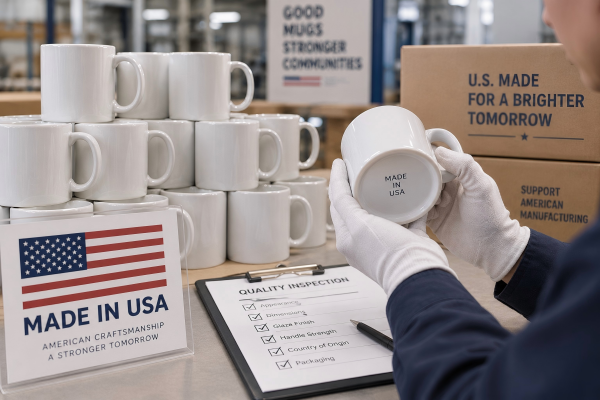
A simple brand list won't cut it because a company's sourcing strategy can change over time or vary across its product lines. To truly answer the question, we need to move beyond brand names and into the specifics of supply chain verification. Let’s explore the practical steps you can take to confirm a mug's origin and reduce your sourcing risk.
How Do You Verify "Made in USA" Claims for Mugs?
You’ve found a potential supplier, and their website proudly displays an American flag. But how can you be sure the mug itself is a product of domestic mug production? Accepting a claim at face value is a huge risk, potentially leading to compliance issues or accusations of false advertising. The solution is to adopt a systematic verification process that leaves no room for doubt.
To verify a U.S. origin claim, you must request a written declaration from the supplier, cross-reference it with supporting documents like factory certifications, and ensure the claim is consistent across all packaging, invoicing, and marketing materials for that specific SKU.
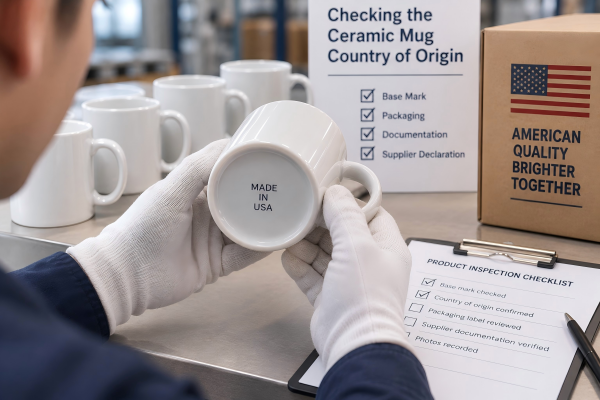
Dive Deeper: A Buyer's Verification Checklist
In my 15 years of manufacturing ceramic dinnerware for U.S. and European buyers, I've seen firsthand how confusion over origin can create major problems. A buyer might assume a mug from an "American brand" is made here, only to find out later it was imported and decorated domestically. This distinction is critical.
H3: Distinguishing Manufacturing from Decoration
The most common point of confusion is the difference between where a mug is made and where it is decorated. These are two separate manufacturing stages.
- Manufacturing: This involves forming the mug body from raw materials (like clay, feldspar, and silica), firing it in a kiln (a bisque fire), applying the glaze, and firing it again at a high temperature. The entity that performs these steps is the manufacturer. This determines the ceramic mug country of origin.
- Decoration: This involves applying a logo, image, or design to an already-manufactured mug. This can be done through screen printing, sublimation, or applying decals. A company can import blank mugs from China or elsewhere and decorate them in the USA.
The U.S. Federal Trade Commission (FTC) has strict guidelines. For a product to be labeled "Made in USA," "all or virtually all" of the product must be made in the United States. A mug manufactured abroad but printed in the U.S. would not meet this standard. It would need a more qualified claim, like "Decorated in USA on an imported mug."
| Activity | Description | Meets "Made in USA" Standard? |
|---|---|---|
| Manufacturing | Forming the clay body, glazing, and firing. | Yes, if done in the USA. |
| Designing | Creating the mug shape and artwork in the USA. | No, design location doesn't determine origin. |
| Decorating | Printing a logo on an imported blank mug. | No, this is a finishing step. |
| Packaging | Boxing a finished mug in the USA. | No, packaging is not part of the product itself. |
H3: The Importance of SKU-Level Verification
Never assume all products from a single brand share the same origin. It's common for companies, especially large retailers or promotional product suppliers, to source different products from different factories around the world to achieve specific price points, features, or capacities.
For example, a brand might source a standard 11 oz. ceramic mug from a factory in Ohio but source a complex, custom-shaped travel mug from an overseas partner like us who specializes in that form. That’s why you must ask: "For this specific SKU, what is the country of origin?"
H3: Requesting Documentation
Don't just take a salesperson's word for it. As part of your ceramic mug supplier evaluation, ask for proof. Legitimate manufacturers of U.S.-made ceramic mugs should be able to provide:
- A formal Certificate of Origin for the product.
- Traceability documents showing where the raw materials were processed and the mug was fired.
- An up-to-date factory address and operational certifications, which you can independently verify.
I’ve always advised my clients to get everything in writing. A clear paper trail is your best defense against sourcing errors.
Are American-Made Mugs Better Quality?
There's a common assumption that a "Made in USA" label is a shortcut to superior quality. Buyers often believe that sourcing American-made mugs automatically protects them from defects like chipping, crazing, or faulty handles. While domestic producers can make outstanding products, origin alone is not a guarantee of quality. You could pay a premium for a U.S. product that still fails to meet your standards.
A mug’s quality is determined by the grade of its raw materials, the precision of the manufacturing process, and the rigor of the quality control inspections—not solely by its country of origin. A well-managed overseas factory can produce higher-quality mugs than a poorly managed domestic one.
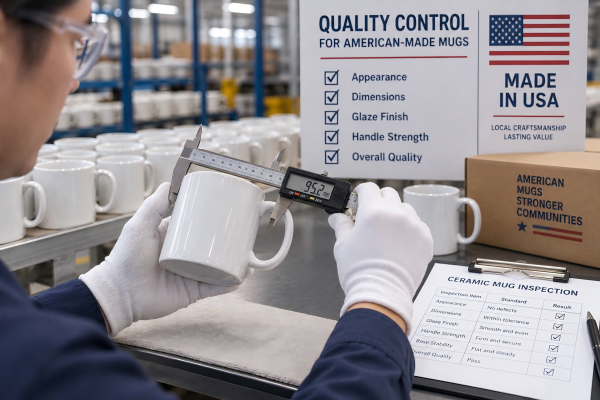
Dive Deeper: What Truly Defines Mug Quality
As a manufacturer, I live and breathe quality control. It's a universal language spoken through specifications, testing, and process management. Whether a factory is in Ohio or Liling, these are the factors that separate a great mug from a mediocre one.
H3: The Pillars of Mug Quality
Let's break down what you should actually be looking at when assessing quality, which is a core part of any good ceramic mug quality control program:
- Material Grade: Is the mug made from high-grade stoneware, porcelain, or bone china? Lower-grade earthenware is more porous and prone to chipping. The quality of the clay body and glaze composition directly impacts durability and longevity.
- Firing Process: Were the mugs fired at the correct temperature for the correct amount of time? Inconsistent firing can lead to a weak body or a "crazed" glaze (a network of fine cracks). We use computer-controlled kilns to ensure every batch is consistent.
- Physical Properties: A quality mug should have a uniform wall thickness, a flat, stable base, and a handle that is securely attached and ergonomically sound. We inspect for things like pinholes in the glaze, black spots from iron contamination, and color consistency against a master sample.
- Glaze Durability: The glaze should be hard, smooth, and resistant to scratches from utensils. It also needs to be dishwasher and microwave safe if advertised as such.
A commitment to American ceramic manufacturing is admirable, but it doesn't replace the need to ask hard questions about these quality pillars.
H3: The Role of a Supplier's Quality System
A supplier's commitment to quality is best demonstrated by its management systems. For example, our company is ISO 9001 certified. This means we have a documented, audited system for managing quality at every step—from raw material intake to final packing.
When evaluating any potential supplier, domestic or international, ask:
- Do you have a quality management system like ISO 9001?
- Can you provide reports from third-party quality inspections?
- What is your standard AQL (Acceptable Quality Limit) for inspections?
- How do you handle products that fail inspection?
These questions give you a much clearer picture of a supplier's capabilities than a simple country-of-origin label.
H3: A Balanced Sourcing Approach
The smartest buyers I work with use a balanced scorecard. They treat origin as one important variable among many. They weigh the benefits of sourcing domestically manufactured mugs—such as potentially shorter lead times and marketing appeal—against other factors like cost, customization capabilities, and proven quality. They don't let a "Made in USA" tag prevent them from performing full due diligence.
What Should Buyers Consider Besides Where Mugs Are Made in the USA?
Focusing exclusively on finding mugs made in the USA can create tunnel vision. You might find a domestic supplier but overlook other critical business factors. This narrow focus can lead to stockouts if the supplier can't handle your volume, or you might miss out on unique customization options available elsewhere.
Beyond origin, buyers must evaluate a supplier's production capacity, lead times, customization technology, safety compliance, and overall reliability. These factors are often more critical to a successful partnership and a healthy bottom line than the country listed on the box.
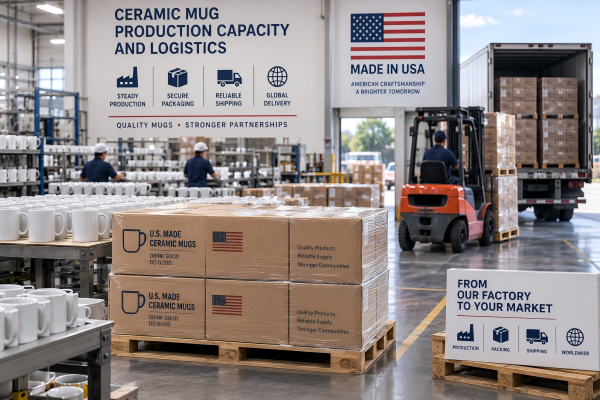
Dive Deeper: Building a Robust Supplier Profile
When a large retail chain or promotional company approaches us, their questions go far beyond origin. They are building a complete picture of our ability to be a reliable partner. This is a great model for any buyer to follow. Here's what you should be evaluating.
H3: Production Capacity and Lead Times
This is a simple but crucial question: Can the supplier produce the volume you need within your required timeframe?
- Capacity: Ask for their daily or monthly output for the type of mug you need. A small artisanal pottery might make beautiful U.S.-made ceramic mugs, but they can't supply a 50,000-piece order for a national promotion. Our factory, for instance, is built for high-volume, consistent output.
- Lead Time: This is the time from placing an order to receiving the goods. It includes production, decoration, quality control, and shipping. While domestic shipping is faster, a U.S. supplier might have a longer production queue. You need to get a clear, committed lead time for your specific order.
H3: Customization and Decoration Capabilities
Your mug is a canvas for your brand. Can the supplier bring your vision to life?
- Decoration Methods: Do they offer basic screen printing, or can they handle more complex techniques like full-wrap sublimation, reactive glazing, or interior printing?
- Custom Shapes: Can they create a new mold for a unique mug shape? This is a specialized capability. As a custom ceramic mugs manufacturer, developing custom molds is one of our core services.
- Packaging: Can they provide custom-printed gift boxes, retail-ready packaging, or bulk packing solutions?
Don't assume every manufacturer offers the same level of customization. Ask to see examples of their work that are similar to what you need.
H3: Safety and Compliance
This is non-negotiable. All food-contact items, including ceramic mugs, must be safe and meet regulatory standards for things like lead and cadmium content.
Ask for recent ceramic mug safety testing reports, such as those for FDA or California Proposition 65 compliance. Reputable suppliers, regardless of location, will have these readily available. Our products are regularly tested, and we hold a BSCI (Business Social Compliance Initiative) audit certification, which speaks to our ethical operations.
H3: Choosing the Right Partner
Ultimately, your goal is to find a reliable partner, not just a product. The process of how to choose a ceramic mug manufacturer should be thorough. Consider their communication, transparency, and problem-solving skills. After 15 years, I can tell you that the best client relationships are built on trust and a clear understanding of capabilities.
Frequently Asked Questions
What's the difference between "Made in USA" and "Assembled in USA"?
"Made in USA" means all or virtually all parts and labor are of U.S. origin. "Assembled in USA" means the product was put together in the U.S., but its components are substantially sourced from other countries. For a mug, this claim is less common, as it's a single-piece item.
Can a mug be "Designed in the USA" but made elsewhere?
Yes, this is very common. "Designed in California" or "An American Brand" are marketing statements about where the creative or corporate work happens. The physical manufacturing of the ceramic mug itself often occurs in another country, like China, Thailand, or Mexico. Always check the manufacturing origin.
Why do some American brands sell mugs made in other countries?
Companies source globally for many reasons, including access to specialized manufacturing capabilities, higher production volumes, and competitive pricing. A factory in China might have advanced molding technology or the capacity to produce millions of units, which may not be available or cost-effective domestically.
How can I find reliable U.S. mug manufacturers?
Start with industry directories, trade shows, and B2B platforms that allow you to filter by country of origin. However, always follow up with the verification steps outlined in this article. Request documentation, ask about their quality systems, and treat any claim with professional skepticism until proven.
Conclusion
Determining what mugs are made in the USA is less about finding a definitive list and more about mastering a process of verification. The most critical takeaway is to investigate origin at the SKU level, demanding clear documentation that separates true American ceramic manufacturing from simple decoration or design. Remember that quality is not guaranteed by a country's flag; it is built through superior materials, controlled processes, and rigorous inspection. A balanced approach that weighs origin alongside capacity, quality systems, and customization will always lead to the best sourcing decision.
If your project requires high-volume, consistent quality, and deep customization options, a proven global partner may be the right fit. With 15 years of experience supplying major retailers and importers, we understand the standards you demand. Contact our team to discuss your next ceramic mug or dinnerware project.