Lead in ceramic mugs cannot be identified reliably by color, gloss, age, cracks, or country of origin. That uncertainty can expose importers to compliance failures, recalls, and damaged customer trust. I recommend using visual review only to identify warning signs, then checking product-specific documents and arranging appropriate laboratory testing when confirmation is needed.
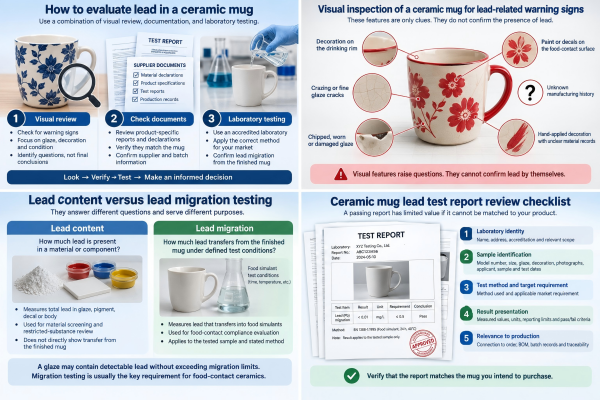
You cannot tell whether a ceramic mug has lead by appearance alone. I treat visual features as clues, supplier documents as preliminary evidence, and product-specific laboratory testing as confirmation. For food-contact purchasing, the key issue is usually lead migration from the finished mug under test conditions applicable to the destination market.

In my experience helping European and American buyers review ceramic compliance documents, the hardest part is not spotting a suspicious mug. The real challenge is connecting the proposed product, its glaze and decoration, the laboratory report, and the production batch into one credible evidence chain.
Can You Identify Lead in a Ceramic Mug by Appearance?
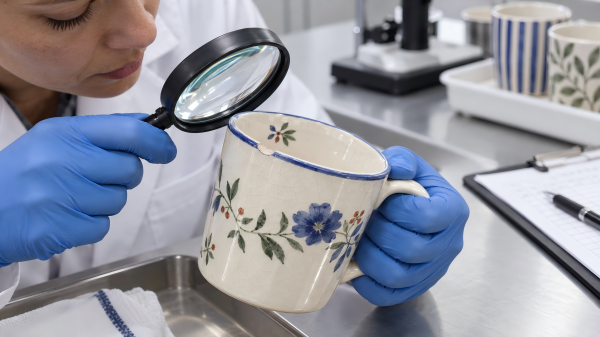
A bright color, glossy glaze, worn surface, or decorative pattern may raise questions about lead in ceramic mugs. However, these visual details can also create false confidence or unnecessary alarm. I use appearance to decide what questions to ask, but I never use it to make a final compliance conclusion.
A visual inspection cannot confirm whether a mug contains lead or releases excessive lead. I recommend checking the food-contact surface, rim decoration, glaze condition, and product history for warning signs. I then verify those observations through relevant documentation and, when needed, an appropriate accredited laboratory test for the intended market.
What Visual Features Deserve More Attention?
I pay closer attention when a ceramic mug has:
- Decoration on the drinking rim
- Paint or decals on the food-contact surface
- Visible crazing or fine glaze cracks
- Chipped, worn, or damaged glaze
- Unknown manufacturing history
- No item-specific food-contact documentation
- Hand-applied decoration with unclear material records
- A sample that differs from the supplier’s test report
These features do not prove that a ceramic mug has lead. They only show that I should investigate further.
For example, a glossy red mug is not automatically a lead risk. Modern ceramic colors can be formulated and fired in many different ways. Likewise, a plain white mug is not automatically compliant. The finished product, material formulation, firing process, and production controls all affect the final result.
Why Are Cracks and Age Only Clues?
Buyers sometimes assume that an old or cracked mug must release lead. I avoid that conclusion because age and surface condition do not establish the glaze composition or migration performance. Crazing can justify additional evaluation, especially when the mug will receive repeated food contact, but it does not confirm lead by itself.
The opposite assumption also causes problems. A new mug with a smooth glaze may still require testing. A visually perfect surface does not prove that the product meets the applicable requirements.
Country of origin also provides no reliable answer. Ceramic production exists across many countries, and manufacturing quality varies by factory, material system, decoration process, and quality controls. I evaluate the specific supplier, item, and batch instead of relying on a country-level assumption.
I treat appearance as a prompt for due diligence, not as proof of compliance or non-compliance.
Can Home Lead Test Kits Provide a Final Answer?
I do not rely on consumer lead swabs as final evidence for ceramic food-contact products. Some swabs are designed primarily for accessible lead on painted surfaces. Their performance can vary with the glaze, surface chemistry, lead form, and testing procedure.
A negative swab result may not show what happens when food simulants contact the mug under a standardized laboratory method. A positive screening result may also require confirmation and interpretation.
Portable X-ray fluorescence, or XRF, can identify elemental composition in some screening situations. However, XRF screening does not establish how much lead will migrate from the finished mug under specified food-contact conditions. I keep screening and migration testing separate because they answer different questions.
What Is the Difference Between Lead Content and Lead Migration in Ceramic Mugs?
Buyers can receive a material declaration showing lead content and assume that it answers the food-contact question. That assumption creates a documentation gap. I separate the amount of lead present in a material from the amount that may transfer out of the finished mug during a specified migration test.
Lead content describes how much lead is present in a material or component. Lead migration measures how much lead transfers from the finished ceramic article under defined test conditions. For food-contact procurement, I usually focus on migration because it more directly reflects potential transfer from the mug during the applicable laboratory procedure.

Content and Migration Answer Different Questions
I use the following comparison when explaining ceramic mug lead testing to buyers:
| Evaluation | Main question | Typical use | Important limitation |
|---|---|---|---|
| Material content review | Is lead present in a glaze, pigment, decal, or body? | Material screening and restricted-substance review | It does not directly show transfer from the finished mug |
| XRF screening | Which elements may be detected in the tested area? | Rapid screening and investigation | It does not confirm migration performance |
| Laboratory migration test | How much lead transfers under defined conditions? | Food-contact compliance evaluation | The result applies to the tested sample and stated method |
| Supplier declaration | What does the supplier claim about materials or compliance? | Preliminary document review | It requires supporting, product-relevant evidence |
| Production control record | Was the approved process followed? | Batch consistency and quality assurance | It does not replace testing when testing is required |
A glaze or decoration may contain detectable lead without necessarily exceeding an applicable migration limit. Conversely, I would not infer compliant migration only because a supplier describes its materials as “lead-free.” The term may be undefined, based on a detection threshold, or unsupported by a product-specific test.
I therefore avoid absolute statements such as “completely safe,” “permanently compliant,” or “lead-free” unless the wording has a clear technical and legal basis. Even then, I prefer precise language that identifies:
- The tested product
- The tested components
- The test method
- The measured result
- The applicable requirement
- The report date and sample reference
Why Do Test Conditions Matter?
Migration testing uses defined preparation, contact, extraction, time, and temperature conditions. The laboratory also considers the type and shape of the ceramic article. A mug, plate, bowl, and storage vessel may not be assessed in exactly the same way.
Different destination markets can apply different legal frameworks, methods, categories, or limits. For this reason, I do not publish one universal lead limit for every ceramic mug. I ask the importer to confirm the current requirements for the country where the product will be sold.
Depending on the market and purchasing program, a qualified laboratory may reference recognized methods or regulatory procedures associated with authorities and standards bodies. The laboratory should select and explain the appropriate method. I do not substitute my manufacturing experience for regulatory, laboratory, or legal judgment.
Why Does the Finished Mug Matter?
A raw-material test does not always represent the finished article. Firing temperature, firing time, glaze fit, decoration position, and secondary firing can influence the final surface. Even when materials are controlled, the buyer still needs evidence that connects those materials to the actual mug.
I have seen buyers receive a glaze certificate when they actually needed evidence for a decorated finished mug. I have also seen one report used for a family of products without a clear explanation of whether the products shared the same glaze, color, decal, firing process, and shape category. I ask for that connection before accepting the report as relevant.
How Should Buyers Review a Ceramic Mug Lead Test Report?
A professional-looking report can still be irrelevant to the proposed order. A report may cover another mug, another glaze color, or an old sample from a different production process. I review both the technical result and the evidence linking the tested sample to the item that the buyer intends to purchase.
I verify the report’s laboratory, sample description, photographs, model number, glaze, decoration, test method, destination market, dates, and results. I also check whether the supplier can connect the sample to the proposed production order. A passing report has limited value when the tested mug cannot be matched to the purchased mug.
My Report Review Checklist
I use a structured checklist because it reduces the chance of accepting unrelated paperwork.
1. Laboratory identity
I check the laboratory’s full name, address, and accreditation information. I then review whether the stated accreditation scope is relevant to the test method. A laboratory logo alone does not establish that every reported method falls within its accredited scope.
Buyers can ask the laboratory or accreditation body to confirm the report when authenticity is uncertain.
2. Sample identification
I compare the report with the purchasing specification. I look for:
- Product name and model number
- Mug dimensions and capacity
- Body material
- Glaze color and finish
- Decal or printing design
- Decoration location
- Product photographs
- Supplier or applicant name
- Sample receipt and test dates
A white mug report should not automatically support a dark glazed mug. A report for an undecorated sample may not cover a decorated version. A report for one decal design may also be insufficient when another design uses different pigments or application coverage.
3. Test method and target requirement
I check whether the report names the method and the specification or requirement used to judge the result. I also confirm that the evaluation fits the destination market.
European and American buyers may face different regulatory frameworks, retailer protocols, and customer specifications. A large retail chain can also impose requirements beyond the basic legal minimum. I recommend that importers verify current obligations with an appropriate accredited laboratory or qualified compliance professional.
4. Result presentation
I look for measured values, reporting limits, units, pass/fail criteria, and laboratory comments. A simple statement saying “passed” provides less information than a table that identifies the analyte, result, method, and requirement.
I also check whether the result is below the laboratory’s reporting limit or merely below a stated acceptance limit. Those statements do not mean the same thing.
5. Relevance to production
I ask how the tested sample relates to the order. Useful evidence can include:
- A sealed and identified approval sample
- Internal item codes
- Bill of materials references
- Glaze and decal batch records
- Production dates
- Kiln firing records
- Inspection records
- Batch traceability documents
- Purchase order references
A report can provide strong evidence for the sample that was tested. It does not automatically guarantee every future production batch, especially after changes in materials, decoration, equipment, or process settings.
What Do Factory Certifications Prove?
I treat certifications according to their actual scope. Our company has completed amfori BSCI audit or monitoring activities and maintains an ISO 9001 quality management system certification. These documents can support supplier evaluation, but they do not replace product-specific ceramic migration testing.
An amfori BSCI document relates primarily to social performance monitoring rather than food-contact chemistry. ISO 9001 addresses the quality management system rather than proving that a particular mug complies with a specific lead migration requirement.
I recommend that buyers verify current certificate validity, issuing bodies, covered sites, and scope. I then combine those documents with product test reports, process controls, and order-level inspections.
When Should Buyers Arrange Ceramic Mug Lead Testing?
Importers often need to balance testing cost, order value, product risk, and customer requirements. Too little testing leaves an evidence gap, while unfocused testing wastes time and money. I use a tiered approach that increases verification when the product, supplier, decoration, or market creates greater uncertainty.
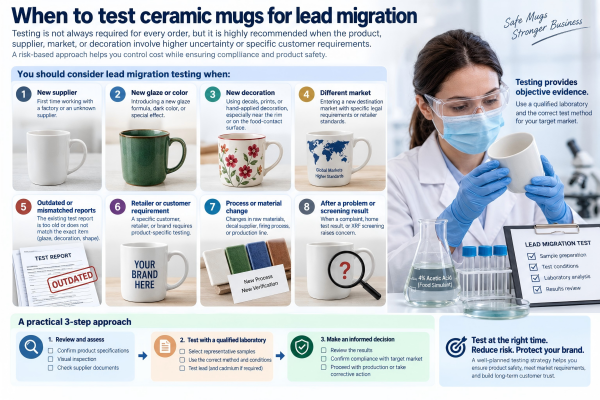
Buyers should consider ceramic mug lead testing when they introduce a new supplier, glaze, color, decal, or manufacturing process; enter a different market; receive outdated or mismatched reports; or face a retailer-specific requirement. I recommend that a qualified laboratory determine the correct method, sampling plan, and acceptance criteria.
A Three-Level Procurement Process
I organize lead risk evaluation into three practical levels.
Level 1: Visual and specification review
I begin by defining the product clearly. The specification should identify the body, glaze, color, decoration, rim treatment, capacity, and intended use.
I also inspect pre-production samples for obvious defects. This step can reveal differences between the buyer’s request and the supplier’s actual product. However, it cannot confirm lead migration.
Level 2: Supplier and document screening
I request relevant evidence before mass production. The document package may include:
- Product-specific laboratory reports
- Material or glaze declarations
- Decal and pigment records
- Quality management certificates
- Social audit documents
- Traceability procedures
- Change-control procedures
- Previous inspection records
I check whether the supplier understands the destination market. I also ask who controls subcontracted decoration, because an external decal or hand-painting process can create an additional point of variation.
Level 3: Independent laboratory confirmation
I recommend laboratory testing when the buyer needs stronger confirmation. The buyer, supplier, or an independent inspection company should select samples under a documented sampling plan.
Testing deserves particular consideration when:
- The buyer starts with a new factory
- The supplier changes the glaze or decal
- The mug uses decoration near the rim
- The report does not match the item
- The report is too old for the buyer’s policy
- The retailer requests batch-specific testing
- Production differs from the approved sample
- The product enters a new destination market
- A complaint or screening result raises concern
How Should Buyers Select Samples?
I prefer sampling that reduces supplier selection bias. When feasible, an independent party can draw samples from finished production rather than allowing an unverified sample to be prepared separately.
The sampling record should identify the purchase order, item number, production quantity, carton numbers, sample quantity, and seal numbers. Photographs can strengthen traceability. The laboratory report should then use the same identifiers.
No single sample can describe every unit with absolute certainty. A sampling plan manages risk rather than eliminating it. Buyers should base the plan on order size, product variation, supplier history, customer protocol, and regulatory advice.
What Happens After a Failed or Questionable Result?
I do not recommend shipping first and investigating later. If a result exceeds an applicable criterion or conflicts with other evidence, I place the affected order on hold while qualified parties review the issue.
The review may include:
- Confirming the sample identity
- Checking the method and calculation
- Reviewing glaze and decal batches
- Examining firing records
- Testing retained or independently selected samples
- Identifying affected production lots
- Implementing corrective action
- Revalidating the revised product
A retest should not become a way to shop for a passing result. I want the supplier to identify the root cause and demonstrate process control. The importer should make the final disposition decision with advice from the laboratory and relevant compliance professionals.
Frequently Asked Questions
Does a brightly colored ceramic mug contain more lead?
Color alone cannot confirm lead in ceramic mugs. Some pigments and decorations deserve closer review, but modern formulations vary widely. I check the exact glaze or decal, its location, the firing process, and product-specific migration evidence rather than judging a mug from its color.
Can a smooth, glossy ceramic mug still require lead testing?
Yes. A smooth and glossy surface can look well made, but appearance does not prove migration compliance. I still review the product specification, laboratory report, destination-market requirement, and production controls. New products, changed materials, and mismatched reports can justify additional testing.
Is an FDA, EU, or “food-safe” logo on packaging enough?
No. I treat an unsupported logo or statement as a supplier claim, not conclusive evidence. I ask for the underlying report, method, tested sample, dates, and applicable criteria. I also verify whether the mug sold is the same as the mug described in the supporting documents.
How often should importers retest ceramic mugs?
No single frequency fits every buyer or market. I consider supplier performance, order volume, product changes, retailer protocols, report age, and destination-market rules. A new glaze, decal, factory, process, or compliance requirement can trigger retesting even when a previous report was satisfactory.
Do ISO 9001 and amfori BSCI prove that a mug passes lead migration requirements?
No. ISO 9001 supports evaluation of a quality management system, while amfori BSCI monitoring addresses social performance topics. I view both as useful supplier documents, but neither proves that a specific ceramic mug meets an applicable lead migration requirement.
Conclusion
Lead in ceramic mugs cannot be confirmed or ruled out by sight. I use visual clues to guide questions, documents to screen the supplier, and product-specific laboratory testing to obtain stronger evidence for the intended market and order. Buyers should distinguish lead content from lead migration and verify that every report matches the mug’s glaze, decoration, method, and production reference.
As a ceramic manufacturer with 15 years of custom production experience, we can help importers review mug specifications, traceability records, and available compliance documents. Contact us to discuss your ceramic mug project and prepare an appropriate supplier and testing plan with a qualified laboratory.