Choosing a ceramic production city sounds simple until importers compare history, product specialization, export capacity, and factory performance. A famous location can create confidence, but it can also hide a poor supplier fit. I recommend using city reputation as an initial sourcing clue, then evaluating the manufacturer behind each quotation.
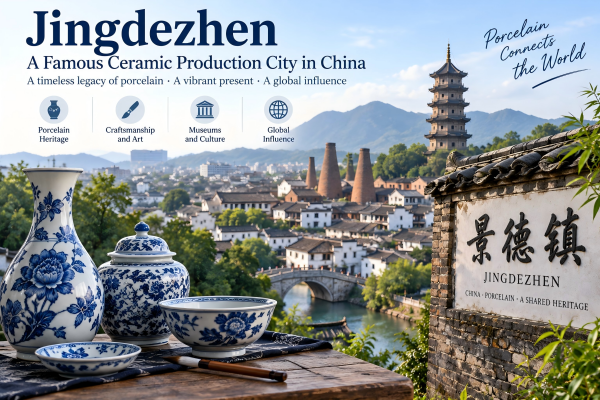
Jingdezhen is probably the best-known general answer and one of the most internationally recognized ceramic cities, especially for Chinese porcelain history, craftsmanship, and cultural influence. However, no ceramic production city is universally best. Importers should also consider Liling, Chaozhou, and Dehua according to product type, customization, order volume, quality control, and delivery requirements.
The useful question is therefore not only, “Which city is famous?” It is also, “Which production cluster fits my order?” Based on my 15 years in custom ceramic production in Liling, I see the second question as the one that usually determines sourcing results.
What Makes a Ceramic Production City Famous?
Ceramic-city comparisons become confusing when buyers use “famous” to mean several different things. Historical recognition, artistic influence, output, export activity, and commercial specialization are not the same measure. If buyers mix them together, they can reach an attractive but impractical sourcing conclusion.
A ceramic production city can be famous for its heritage, manufacturing scale, skilled workforce, distinctive techniques, export network, or product specialization. Jingdezhen stands out for international cultural recognition, while Liling, Chaozhou, and Dehua have their own manufacturing strengths. Buyers should define the relevant measure before comparing locations.
Fame has several meanings
I divide ceramic-city recognition into four practical categories:
- Historical and cultural recognition
- Industrial scale and supply-chain depth
- Export strength and commercial experience
- Specialization in particular ceramic products or techniques
A city can lead in one category without leading in the others. For example, a place that attracts museum visitors and collectors may not be the most efficient location for a high-volume supermarket tableware program. In the same way, a large manufacturing cluster may be commercially capable without having the same international cultural profile.
| Measure of fame | What it tells a buyer | What it does not prove |
|---|---|---|
| Historical importance | The city has a meaningful ceramic tradition | A factory can meet modern retail requirements |
| Artistic recognition | The region has skilled craftspeople or distinctive styles | Designs can be reproduced consistently at scale |
| Industrial concentration | Suppliers, decorators, kiln operators, and packaging providers are nearby | Every local supplier is reliable |
| Export activity | Some manufacturers understand overseas trade requirements | A specific supplier meets the buyer’s market rules |
| Product specialization | The cluster may have suitable equipment and expertise | The quoted factory is strong in every ceramic category |
| UNESCO recognition | The heritage has documented international significance | Commercial production quality is automatically higher |
Buyers should separate heritage from production suitability
I respect ceramic history because it explains how skills and regional techniques developed. However, procurement teams usually need answers to different questions:
- Can the supplier make the required ceramic body and shape?
- Can it reproduce the approved color and decoration?
- Can it control glaze defects and dimensional variation?
- Can it meet the required order quantity?
- Can it pack products for international transportation?
- Can it provide relevant test reports and factory documents?
- Can it communicate changes before they affect delivery?
These questions cannot be answered by a city name.
City reputation is evidence of an industrial environment, not evidence that an individual supplier can execute a particular order.
I have seen buyers begin with a location because they heard that it was famous. That approach can create a useful supplier list. However, I always suggest narrowing that list by product capability rather than allowing geographic reputation to make the final decision.
Comparative rankings also require caution. Statements about output, export value, or the number of enterprises can change by year and may use different statistical boundaries. Buyers should verify such claims through current government, industry-association, customs, and UNESCO records.
Why Is Jingdezhen Probably the Best-Known Ceramic Production City?
Buyers who want one short answer usually expect to hear Jingdezhen. That answer is reasonable, but it needs a clear boundary. If importers interpret historical fame as proof of universal manufacturing superiority, they may overlook regions that are better matched to daily-use ceramics or specific commercial programs.
Jingdezhen is probably the best-known general answer because of its long association with Chinese porcelain, imperial production, craftsmanship, and global cultural influence. The 2026 UNESCO recognition of the city’s porcelain-industry heritage provides particularly strong international evidence of its significance. This recognition supports its heritage status, not the quality of every local factory.
Why does Jingdezhen have such strong recognition?
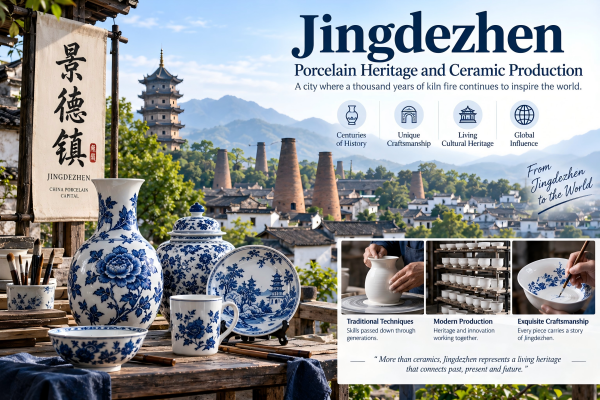
Jingdezhen’s name has been connected with porcelain for centuries. Its historical role, surviving production heritage, museums, workshops, artists, and educational institutions all contribute to its international profile.
The strongest recent evidence is UNESCO’s 2026 World Heritage recognition of Jingdezhen’s porcelain-industry heritage sites. Buyers and researchers should consult the official UNESCO World Heritage record for the exact property name, boundaries, criteria, and inscription documentation. That primary record is more reliable than promotional claims or unsourced city rankings.
This UNESCO development matters because it reflects documented cultural significance evaluated through an international heritage process. It gives the statement “Jingdezhen is internationally recognized” a stronger basis than personal opinion alone.
However, the recognition should not be misused. UNESCO status does not mean:
- Every manufacturer in Jingdezhen has passed a quality audit.
- Every workshop can produce large commercial orders.
- Every supplier is suitable for food-contact tableware.
- Every factory has strong export documentation.
- Every handmade design can be standardized for mass production.
- Every quotation reflects the same material, firing, and inspection standard.
When might Jingdezhen be a strong sourcing option?
Jingdezhen may deserve close attention when a project values:
- Strong cultural or artistic associations
- Hand-painted or craft-led products
- Decorative porcelain
- Collectible or premium concepts
- Complex artistic development
- Small-batch designs, subject to supplier capability
- Products whose marketing story benefits from recognized porcelain heritage
The city also has commercial manufacturers, so buyers should not reduce it to art ceramics alone. The important point is to investigate the actual producer rather than rely on a simplified regional label.
For a retailer seeking a highly standardized dinnerware range, I would compare a Jingdezhen quotation with suppliers in other clusters. I would review the ceramic body, mold development, decoration method, production capacity, acceptable quality limit, packing system, testing plan, and lead time.
In other words, Jingdezhen can be both culturally important and commercially relevant. Its fame makes it a logical starting point. It does not make it the automatic endpoint of supplier selection.
How Do China’s Major Ceramic Production Cities Compare?
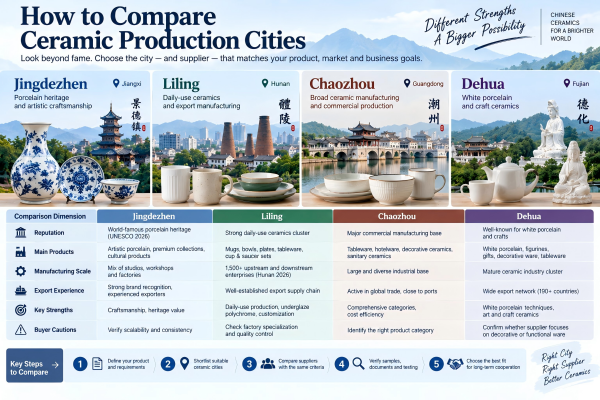
A two-city comparison can create a predetermined conclusion. China has several established ceramic clusters, and each one contains different factory types. I therefore recommend comparing at least Jingdezhen, Liling, Chaozhou, and Dehua before deciding which ceramic production city fits a project.
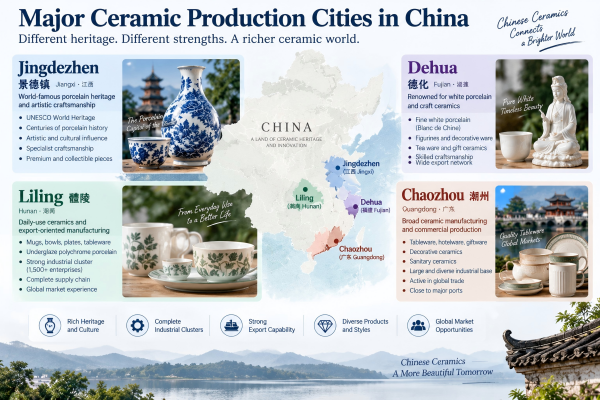
Jingdezhen is widely recognized for porcelain heritage and artistic production. Liling has a mature daily-use and export-oriented ceramic chain. Chaozhou has broad commercial ceramic manufacturing, including tableware and other categories. Dehua is especially associated with white porcelain, figures, decorative ware, and related tableware production.
A practical city-level comparison
The table below describes common market associations. It should guide investigation, not replace supplier verification.
| Ceramic city | Commonly associated strengths | Projects worth investigating | Buyer cautions |
|---|---|---|---|
| Jingdezhen, Jiangxi | Porcelain heritage, artistic work, craft skills, cultural recognition | Premium porcelain, decorative items, artist-led collections, custom concepts | Confirm scalability, consistency, testing, and export execution |
| Liling, Hunan | Daily-use ceramics, underglaze decoration, export production, established supply chain | Mugs, bowls, plates, cup-and-saucer sets, tableware, customized retail lines | Verify the exact factory’s equipment, capacity, QC system, and category experience |
| Chaozhou, Guangdong | Broad ceramic manufacturing base, commercial production, access to Guangdong trade infrastructure | Tableware, hotelware, giftware, sanitary or decorative categories depending on supplier | The local product range is broad, so buyers must identify the correct specialization |
| Dehua, Fujian | White porcelain tradition, figurines, decorative ceramics, tableware capabilities | White porcelain, sculptures, gifts, home décor, selected dining products | Confirm whether a supplier focuses on decorative work or repeatable functional ware |
Jingdezhen: heritage and creative depth
Jingdezhen often enters a buyer’s search because of its global name recognition. It may be especially relevant when the product needs a cultural narrative, artistic input, or specialized porcelain craftsmanship.
Yet buyers should still distinguish between an artist’s studio, a small workshop, a trading company, and a production factory. These organizations can all offer valuable services, but they solve different sourcing problems.
Liling: daily-use ceramics and export production
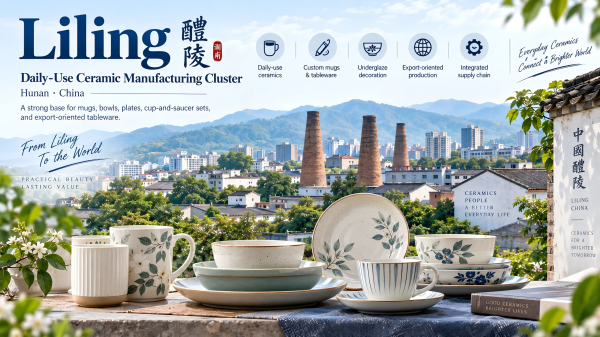
From my own work in Liling, I see a cluster that supports ceramic mugs, bowls, plates, cups and saucers, and coordinated tableware. The surrounding network includes body production, decal and decoration services, kiln operations, packaging, and other supporting activities.
Industry descriptions commonly report more than 1,500 upstream and downstream ceramic enterprises in the Liling cluster. Buyers should verify the current number and its statistical definition with up-to-date local government or industry sources. Still, the figure helps explain why Liling can support a mature daily-use and export-oriented supply chain.
Chaozhou: broad commercial manufacturing
Chaozhou deserves inclusion because it has a diverse ceramic industry. Depending on the supplier, buyers may find tableware, hotel-use ceramics, gift products, decorative items, or other ceramic categories.
That diversity creates opportunities, but it also makes supplier classification important. A factory that is experienced in one category may not have suitable molds, firing conditions, testing controls, or packaging systems for another.
Dehua: white porcelain and decorative expertise
Dehua has a strong association with white porcelain and sculptural ceramics. It can be highly relevant for figurines, religious or artistic pieces, white decorative ware, gifts, and some tableware programs.
Importers should ask whether the supplier’s main competence is decorative craftsmanship or repeatable functional production. A beautiful showroom sample does not always reveal the systems used for volume orders.
No city-level table can capture every factory. Each ceramic production city includes strong manufacturers, narrow specialists, workshops, traders, and suppliers with different levels of export experience.
When Is Liling the Right Ceramic Production City?
Liling should not be presented as a replacement for Jingdezhen, Chaozhou, or Dehua. That approach would ignore the strengths of other regions. Instead, buyers should consider Liling when its daily-use ceramic capabilities and supporting supply chain correspond to the actual product brief.
Liling may be a suitable ceramic production city for customized mugs, bowls, plates, cup-and-saucer sets, and tableware, especially when buyers need coordinated development and export production. Its industrial ecosystem is relevant, but buyers must still verify the individual supplier’s category experience, systems, capacity, and quality performance.
What I observe from working in Liling
I have worked in ceramic customization and production for 15 years. My experience mainly covers customer projects involving daily-use ceramics rather than every type of porcelain or every production region in China.
That experience has taught me that cluster depth matters most when a project moves beyond an attractive drawing. A custom product may require cooperation among several processes:
- Shape and mold development
- Clay-body selection
- Biscuit or glaze firing
- Glaze matching
- Decal or hand-applied decoration
- Logo positioning
- Color control
- Inspection and sorting
- Retail or transit packaging
When these services exist within an established cluster, suppliers may have more options for solving development problems. However, a dense supply chain can only help if the lead supplier manages it properly.
Product fit should drive the decision
Liling is worth evaluating for products such as:
- Ceramic coffee mugs
- Promotional mugs
- Bowls and plates
- Cup-and-saucer sets
- Coordinated dinnerware
- Decal-decorated ceramics
- Underglaze-decorated products
- Retail and gift tableware
A buyer should provide a detailed specification before asking whether Liling is suitable. I recommend including:
- Product dimensions and target weight
- Ceramic body and glaze requirements
- Decoration artwork and color references
- Food-contact market and testing requirements
- Order quantity by design
- Packing and drop-test expectations
- Target delivery date
- Inspection criteria and defect classifications
I also advise buyers to compare the approved sample with the planned mass-production method. A supplier may create a development sample through extra manual adjustment that is difficult to repeat on a production line. That risk exists in every ceramic production city, not only Liling.
Our company states that it has passed amfori BSCI audit or monitoring and holds ISO 9001 quality-management certification. I treat these as documents for buyers to review, not as automatic proof of product compliance. Buyers should check validity, scope, issuing body, audit dates, corrective actions where applicable, and whether the named legal entity matches the contracting factory.
How Should Importers Choose a Ceramic Production City?
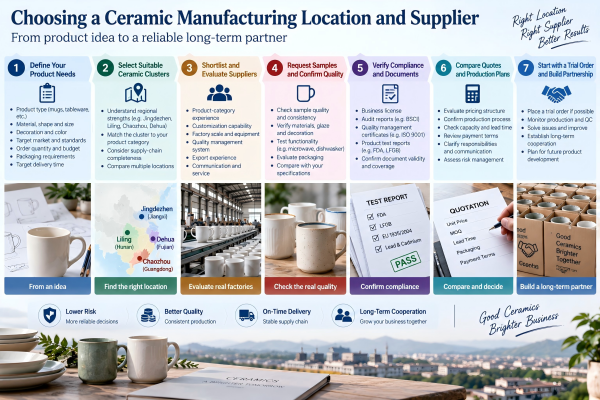
Focusing only on city fame can lengthen sourcing rather than simplify it. Buyers may collect impressive stories but still receive incomparable quotations. I prefer a short evaluation that begins with product-category fit and then checks whether the city’s supply chain supports the required manufacturing process.
Importers should select a ceramic production city by matching regional specialization with the product, customization level, quantity, lead time, and compliance needs. They should then qualify individual suppliers through samples, production records, quality procedures, capacity evidence, test documents, communication, and an appropriate independent or professional evaluation.
Start with the product, not the map
I suggest using this order of evaluation:
-
Define the product category.
Decide whether the project involves artistic porcelain, daily-use tableware, white figurines, hotelware, giftware, or another category. -
Define the manufacturing challenge.
Identify unusual shapes, tight tolerances, reactive glazes, hand decoration, decal registration, color matching, or packing requirements. -
Shortlist relevant cities.
Select clusters that commonly support the required product and process. -
Compare actual suppliers.
Request equivalent information and quotations from manufacturers in two or more locations. -
Verify before ordering.
Use samples, document checks, testing, and qualified inspection or audit professionals as appropriate.
Use a compact supplier-fit scorecard
The supplier review does not need to become a separate research project at the city-selection stage. A concise scorecard can keep the comparison commercial and objective.
| Evaluation area | Suggested weighting | Evidence to request |
|---|---|---|
| Product-category experience | 20% | Similar products, process explanation, production examples |
| Sample-to-production control | 20% | Sealed sample process, color limits, inspection plan |
| Quality-management capability | 15% | QC flow, defect standards, traceability records |
| Capacity and lead time | 15% | Production schedule, kiln access, realistic output plan |
| Customization capability | 10% | Mold, glaze, decal, artwork, and packaging process |
| Compliance documentation | 10% | Current certificates and relevant test reports |
| Communication and project control | 10% | Clear responsibilities, change records, response quality |
The weighting should change with the order. A hand-painted premium collection may place more weight on craftsmanship. A supermarket dinnerware program may prioritize repeatability, capacity, packing, and test compliance.
Verify application-specific requirements
Ceramic products can involve food-contact rules, thermal-use considerations, dishwasher or microwave claims, labeling obligations, and market-specific chemical limits. The applicable requirements depend on the product, glaze, decoration, intended use, and destination market.
I recommend using qualified laboratories, inspectors, compliance specialists, or other competent professionals for application-specific decisions. A city’s fame and a general factory certificate cannot replace product testing or legal review.
The final question should therefore be:
Which supplier, in which suitable ceramic cluster, can reproduce my approved product consistently and document the required controls?
That question keeps city reputation in its proper role. It helps buyers find capable regions without assuming that geography alone guarantees performance.
Frequently Asked Questions
Is Jingdezhen the most famous ceramic city in China?
Jingdezhen is probably the best-known general answer and one of the most internationally recognized Chinese porcelain cities. Its historical influence and 2026 UNESCO World Heritage recognition provide strong support for that description. However, “most famous” remains dependent on whether the measure is heritage, manufacturing scale, export activity, or specialization.
Which Chinese city is best for ceramic tableware?
No single city is best for every tableware order. Liling, Chaozhou, Jingdezhen, and Dehua can all have relevant suppliers. Buyers should compare ceramic body, shapes, decoration methods, order quantity, consistency controls, compliance documentation, capacity, packaging, and export experience before choosing a location or manufacturer.
What is Liling ceramics known for?
Liling is associated with daily-use ceramics, underglaze decoration, custom mugs, bowls, plates, cups and saucers, and tableware production. It also has an established network of upstream and downstream ceramic businesses. Buyers should verify current industry figures and assess each supplier independently.
Is a factory in a famous ceramic production city automatically reliable?
No. A famous ceramic production city can provide skilled labor, specialized services, and a deep supply chain, but it cannot guarantee an individual factory’s performance. Buyers should check samples, capacity, quality controls, test reports, certificates, legal identity, communication, and sample-to-production consistency.
Should buyers choose a ceramic factory based on certifications?
Certifications can support due diligence, but they should not be the only selection criterion. Buyers should confirm each document’s validity, scope, issuing organization, audit date, and factory name. They should also evaluate product-specific controls and arrange qualified testing or inspection when needed.
Conclusion: Which Ceramic Production City Should Buyers Choose?
Jingdezhen is probably the best-known general answer to “Which city is most famous for ceramic production?” Its porcelain heritage and 2026 UNESCO recognition give that answer a strong basis. However, the best ceramic production city for an importer may also be Liling, Chaozhou, or Dehua, depending on the product and order.
I recommend treating city reputation as a shortlist tool rather than a quality guarantee. If you are sourcing customized mugs, bowls, plates, cup-and-saucer sets, or ceramic tableware, contact us to discuss your specifications and evaluate whether our Liling production capabilities fit your project.