Getting a low quote from a ceramic mug factory can feel like a huge win, but are you sure it's not setting you up for a loss? In my 15 years in this business, I’ve seen countless importers get burned by a price that was too good to be true, only to face a container of broken products, customs delays, or a shipment that fails quality control. The initial excitement over a low price quickly turns into a very expensive problem. The solution isn't just finding a cheaper supplier; it's using a smarter ceramic mug supplier checklist that prioritizes reliability and total cost over a tempting unit price.
A comprehensive ceramic mug supplier checklist is not a price-shopping tool; it is a risk-mitigation framework. Its purpose is to help you evaluate a supplier's processes, transparency, and ability to solve problems before they impact your business. This moves the focus from the initial unit price to the total landed cost and the long-term reliability of your supply chain.
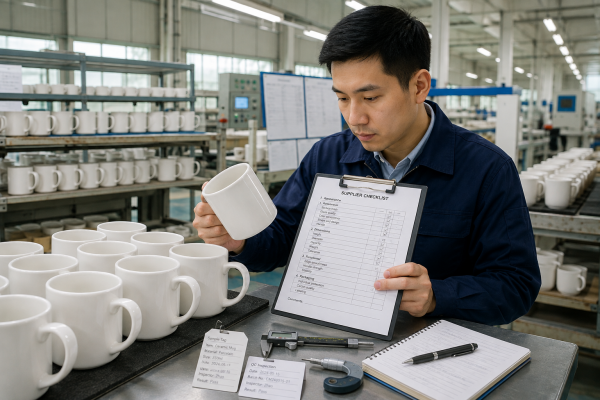
This shift in perspective is the single most important step you can take toward building a resilient import business. A good checklist forces a conversation about what really matters: quality systems, compliance, and communication. Let’s break down exactly what questions you should be asking.
Is the Quoted Price Really the Final Cost?
You've just received a quote that’s significantly lower than the competition. It's tempting to sign the PO immediately, right? But this is often where the most costly mistakes are made. An unusually low price is a red flag, not a green light.
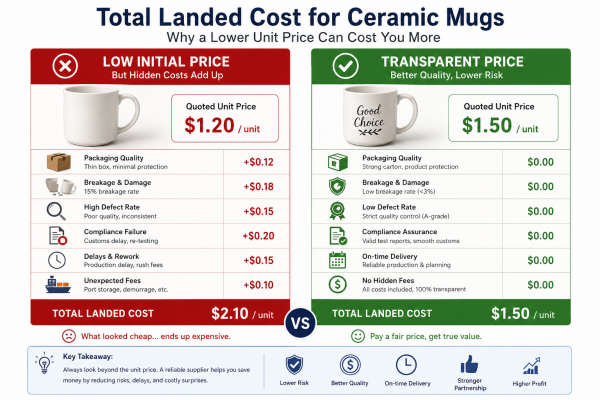
That low number rarely represents your final expense. The real cost—your total landed cost for ceramic mugs —includes the unit price plus the cost of every problem that arises from a supplier cutting corners.
Dive Deeper: The Hidden Costs of a "Cheap" Mug
Over the years, I've talked to dozens of importers who learned this lesson the hard way. They chose a supplier based on a $0.10 per-unit price difference, only to lose thousands of dollars down the line. A professional supplier builds costs for quality and compliance into their price. A supplier focused only on being the cheapest will cut them out, leaving you to pay for it later.
Here are the most common hidden costs I've seen pop up from a suspiciously low quote:
- Subpar Packaging: The factory uses thin cardboard and minimal dividers to save a few cents. The result? You open a container to find 15% of your mugs are chipped or shattered. You just lost a huge chunk of your profit margin. Good packaging is a cost, but it's also your insurance policy. You can learn more about protecting your investment in our guide to Packaging for Fragile Ceramic Products.
- High Defect Rates: A low price often means no rigorous quality control. The supplier ships both A-grade and B-grade products together, hoping you won't notice. Suddenly, you're dealing with customer complaints about wobbly bases, inconsistent colors, or sharp spots on handles.
- Failed Compliance Testing: Your shipment is held at customs because it doesn't meet safety standards. The supplier claims they make FDA compliant ceramic mugs, but they can't produce a valid, recent test report. Now you're on the hook for expensive third-party testing or, worse, the destruction of your entire order.
- Unexpected Mold or Setup Fees: The initial quote was for a standard mug. When you ask for a slight change to the handle or shape, you're hit with a massive, non-negotiable mold fee that wasn't mentioned upfront.
- Rework and Delays: An issue is found mid-production, and the factory's "solution" is to charge you for the rework or push your delivery date back by six weeks, wrecking your sales calendar.
The key takeaway is that a price is just a number. The cost is the total financial impact on your business. You can learn more about this in our full guide to calculating the Landed Cost for Mug Imports.
How Can Your Ceramic Mug Supplier Checklist Deconstruct a Quote?
You're trying to compare offers from three different factories, but one gives you a single line item, "Ceramic Mug: $1.50/unit," while another provides a detailed cost breakdown. How can you make a fair comparison? You can't, and that's the point.
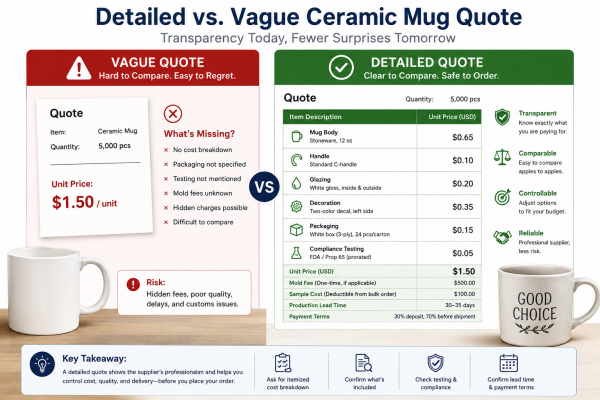
Your checklist should require a detailed, itemized quote. A transparent wholesale ceramic mug supplier will have no problem providing this. A supplier who sends a vague quote is often hiding something or lacks the professionalism to track their own costs accurately.
Dive Deeper: Demanding a Transparent Quote
A professional quote is an educational tool. It shows you where the costs are and gives you levers to pull if you need to adjust the price. I always advise new buyers to demand a quote that looks less like a restaurant bill and more like a bill of materials.
Here’s an example of what you should be asking for. This level of detail empowers you to make informed decisions and is a strong signal of a supplier's professionalism.
| Cost Component | Vague Quote | Professional Quote (What You Should Demand) |
|---|---|---|
| Mug Body | Included | $0.65 (Stoneware, 12 oz standard shape) |
| Handle | Included | $0.10 (Standard C-shape, hand-applied) |
| Glaze | Included | $0.20 (Standard white gloss, interior & exterior) |
| Decoration | Included | $0.35 (Two-color decal, left side application) |
| Packaging | Included | $0.15 (Individual 3-ply white box, 24 units/master carton) |
| Testing | Not Mentioned | $0.05 (Prorated cost for batch FDA/Prop 65 testing) |
| Total Price | $1.50 | $1.50 |
Look at the difference. With the professional quote, you can now ask intelligent questions:
- "What is the cost difference if we switch to a one-color decal?"
- "Can we reduce the cost by using bulk packaging instead of individual boxes?"
- "Is this stoneware body durable enough for restaurant use, or should we consider porcelain?"
When a custom ceramic mug manufacturer provides this level of detail, it shows they understand their own business and respect yours. It’s the first step in building a partnership, not just a transaction. If you want to know what else to include in your RFQ, check out our guide on How to Get an Accurate Mug Manufacturing Quote.
What Questions Should Your Ceramic Mug Supplier Checklist Include for Quality Control?
You've approved a beautiful pre-production sample. But your biggest fear is that the 5,000th mug in your bulk order won't look or feel anything like that perfect sample. How do you ensure consistency across an entire production run?
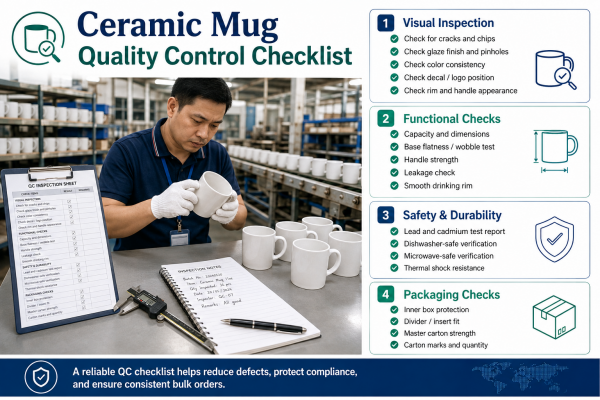
The answer is to use your checklist to investigate the supplier's Quality Management System (QMS). Don't just ask, "Do you have quality control?" Ask specific, operational questions that reveal how they actually prevent, find, and fix issues.
Dive Deeper: From "Do You?" to "How Do You?"
A good supplier welcomes questions about their process. It's a chance for them to demonstrate their expertise. In contrast, a factory that gives vague, one-word answers is a major red flag.
Your ceramic mug quality control checklist should be a list of diagnostic questions. Here are the ones I tell every serious importer to ask:
- "What is your standard for A-grade vs. B-grade products, and what is your typical defect rate for export orders?"
- Why it matters: This shows if they have clear, measurable standards. A professional factory will have documented tolerances for things like pinholes, glaze color variation, or small blemishes. A common A-grade standard is a defect rate under 3%.
- "Can you walk me through your quality inspection process, from raw materials to final packaging?"
- Why it matters: You're looking for multiple inspection points. Good factories inspect incoming clay and glazes, check semi-finished "bisque" ware, inspect again after glazing and firing, and perform a final check during packing. One single "final inspection" is not enough.
- "How do you handle a quality issue if it's discovered mid-production?"
- Why it matters: This question tests their problem-solving process. A great answer sounds like: "We immediately quarantine the affected batch, our production manager investigates the root cause, we inform you with photos and a proposed solution, and we don't proceed without your approval." A bad answer is: "Don't worry, it doesn't happen."
- "How do you ensure color and decal consistency on a
ceramic mug bulk order checklistfor 10,000+ units?"- Why it matters: This probes their technical capability. They should mention using master color panels for reference, controlling kiln temperatures precisely, and using the same batch of decal ink for the entire run.
These questions are directly tied to the systems a factory develops to achieve a certification like ISO 9001. That certificate isn't just a piece of paper; it’s your proof that the factory has a documented, repeatable system to answer these questions well. It's how we ensure consistency, and you can see more about How Do We Control Quality in Every Production Batch.
How Do You Verify a Supplier's Compliance Claims with Your Checklist?
A supplier's website says they are "BSCI Audited" and their products are "FDA and Prop 65 Compliant." This sounds great, but a claim is not proof. A shipment held by customs can cost you your entire investment.
Your checklist must include a section for verifying all ceramic mug compliance documents. Never take a supplier's word for it. Always ask to see the original, unedited reports and check the dates.
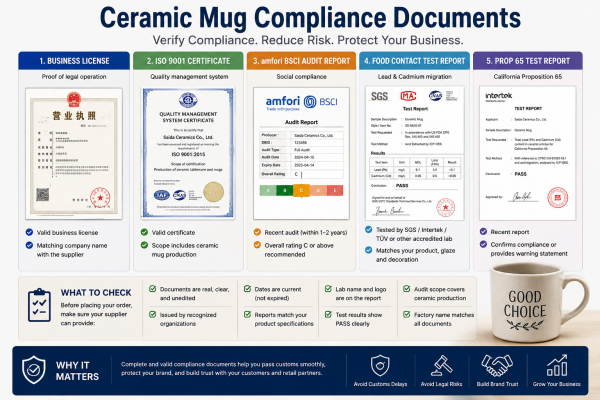
Dive Deeper: Reading Between the Lines of the Reports
Conducting a ceramic mug supplier audit, even a remote one, starts with documentation. When you get the reports, you need to know what you're looking for.
1. Social Compliance (BSCI)
- What it is: A BSCI (Business Social Compliance Initiative) audit checks for fair labor practices, workplace safety, and ethical business conduct. It’s crucial for protecting your brand's reputation, especially if you sell to major retailers in Europe or the US.
- What to check:
- The Date: Is the audit report current (ideally within the last 1-2 years)?
- The Overall Rating: The report will give a rating from A to F. A 'C' rating is often considered the acceptable minimum for many Western importers.
- The Corrective Action Plan (CAP): If there were issues found, is there a clear plan in place to fix them? A factory that is honest about its non-conformities and has a plan to improve is often more trustworthy than one that claims to be perfect.
2. Food-Contact Safety (FDA & EU)
- What it is: This ensures that no harmful levels of lead or cadmium will leach from the mug into the beverage. This is non-negotiable for any product intended for drinking.
- What to check:
- The Testing Lab: Was the test done by a recognized third-party lab like SGS, Intertek, or TUV?
- The Specific Product: Does the report apply to the same material (e.g., stoneware, porcelain) and glaze you are ordering? A report for a white mug doesn't automatically apply to a red one, as the color pigments can contain different metals.
- The Results: The report should explicitly state that the product "PASSES" the required standards. For more detail, read our guide on FDA Requirements for Ceramic Drinkware.
3. Chemical Safety (California Prop 65)
- What it is: For importers selling in California,
Prop 65 ceramic mugscompliance is a must. This regulation requires warnings for products containing any of a long list of chemicals known to cause cancer or reproductive toxicity. - What to check: Just like with the FDA, you need a specific, recent test report from a reputable lab that confirms the product is compliant. The consequences of non-compliance can be severe lawsuits.
A reliable ceramic mug supplier for importers will have these documents organized and ready to share. Hesitation or providing expired/irrelevant reports is a serious warning sign.
Frequently Asked Questions
What is a reasonable defect rate for bulk ceramic mugs?
For A-grade export quality, a defect rate of 2-3% is a widely accepted industry standard. B-grade products, which have minor cosmetic flaws, might have a higher rate. It's critical to define these standards with your supplier before production begins and include them in your purchase order.
How do I conduct a ceramic mug supplier audit remotely?
Start with a thorough documentation review: ask for their business license, ISO 9001 and BSCI certificates, and recent product test reports. Follow this with a detailed video call and a factory tour. For larger orders, hiring a local third-party inspection agent for an on-site audit is a wise investment.
What's the difference between FDA and Prop 65 compliance for mugs?
FDA compliance focuses specifically on whether harmful levels of lead and cadmium leach from the food-contact surface (the inside of the mug). California's Prop 65 is much broader, covering exposure to over 900 chemicals and can apply to exterior decorations or materials, often requiring a warning label if certain thresholds are exceeded.
Can I use a single ceramic mug bulk order checklist for all suppliers?
Yes, you should use a standardized checklist as your starting point for every potential supplier. This allows you to compare them on an apples-to-apples basis. However, you should also be prepared to add specific questions based on the unique requirements of your project, such as complex decorations or custom shapes.
Conclusion
Switching your mindset from finding the cheapest price to mitigating the most risk is the hallmark of a professional importer. A well-crafted ceramic mug supplier checklist is your most powerful tool in this process. It transforms your sourcing from a gamble into a strategic business function. By asking detailed questions about cost breakdowns, quality control systems, and compliance documentation, you move beyond the surface-level price and evaluate a supplier's true capability as a partner. This systematic approach is the surest way to protect your investment, build a reliable supply chain, and ensure the products you receive are the products you and your customers expect.
If you are looking for a wholesale ceramic mug supplier who welcomes these tough questions and believes in transparency, my team and I are here to help you build a more resilient and profitable business. Feel free to reach out.