Finding the right product to stock for your wholesale or e-commerce business feels like a high-stakes bet. The biggest challenge with corporate mug trends is that what looks good on a social media feed often fails in mass production. You risk investing in a "trendy" mug that's a nightmare to manufacture, has high defect rates, or worse, can't even take a client's logo cleanly.
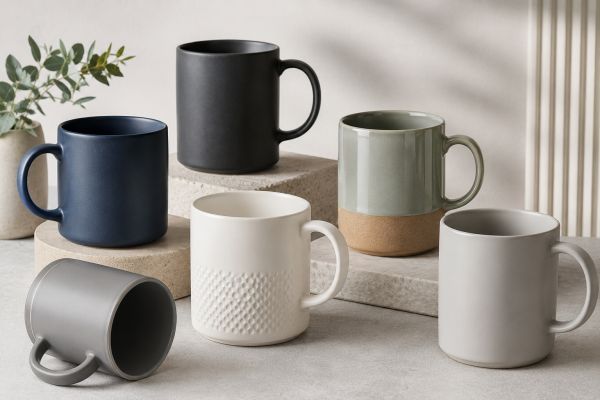
The most profitable corporate mug trends for 2026 are not about chasing fleeting visual fads. Instead, they focus on manufacturable innovations in glaze and texture that provide a premium, tactile experience while being fully compatible with corporate branding. The smartest investments will be in trends like matte finishes and subtle embossing, which enhance a logo rather than obstruct it.
This might sound less exciting than the wild, colorful designs you see online, but as someone who has managed production for 15 years, I can tell you this: profitability comes from reliability. Let's dive into which trends are safe bets and which are traps to avoid.
Is a Matte or Textured Finish the Safest Corporate Mug Trend?
You want to offer something more sophisticated than a standard glossy white mug. But you’re worried that adding texture will introduce production problems and increase costs. How do you find the right balance?
For large-scale orders of corporate mugs, a high-quality matte glaze is one of the most reliable and forward-looking trends you can invest in. It offers a premium feel without the production unpredictability of more complex finishes.
Dive Deeper: Why Tactile Finishes Work for B2B
For years, mug design was purely visual. Now, the experience is becoming tactile. End-users—the employees and clients receiving these mugs—associate a pleasant, interesting texture with higher quality. This is a huge win for companies wanting their branded mugs to feel premium.
However, not all textures are created equal. From a factory perspective, here’s how we see the options:
-
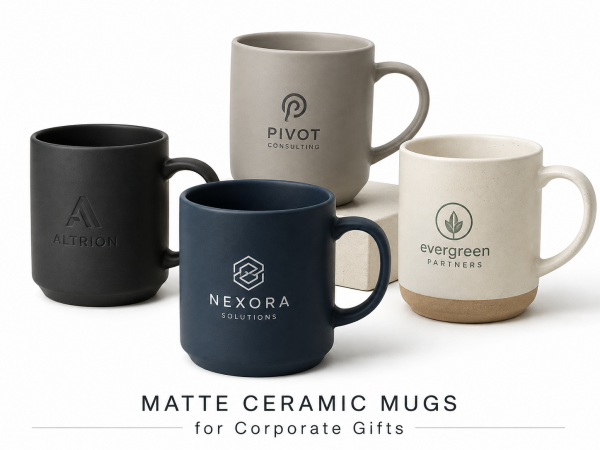
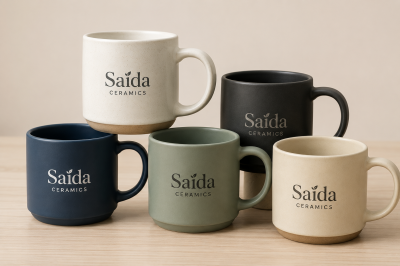
Matte Glazes: This is the superstar trend for 2026. A well-formulated matte glaze ceramic mugs finish feels modern, sophisticated, and photographs beautifully for e-commerce listings. More importantly, it's a stable, repeatable process. We can produce 10,000 matte black mugs that all have a consistent color and finish. This consistency is crucial for corporate clients who demand uniformity. The smooth surface is also excellent for most ceramic mug printing methods. I remember a client from Germany who switched their entire catalog from glossy to matte; they told me their customer complaints about minor scratches dropped to almost zero because the matte finish is more forgiving.
-
Embossing & Debossing: Creating a raised (embossed) or recessed (debossed) logo or pattern directly into the ceramic is a fantastic way to create a unique, high-end product. However, this is not a printing choice; it's a modification of the mug's mold itself. For wholesalers, this means you can't just decide to emboss a logo on a stock mug. It requires a dedicated production run with a custom mold. While the result is stunning, it involves higher setup costs and longer lead times. It’s a great option for large, bespoke orders but less flexible for smaller, varied batches of custom corporate mugs.
-
Partial Glazing: Another trend we're seeing is leaving a portion of the mug—usually the base—unglazed. This creates a beautiful contrast between the smooth, glazed upper and the slightly rough, earthy feel of the raw ceramic. It's a visually appealing and manufacturable trend. The key consideration here is ensuring the unglazed portion is properly vitrified so it doesn't absorb liquids or stains. A good factory will manage this perfectly.
The takeaway? Leaning into tactile finishes is a smart move. Focus on high-quality matte glazes as your core offering for matte ceramic mugs for corporate gifts, and consider embossed or partially glazed options for clients seeking a truly custom product.
Which Corporate Mug Trends Should You Absolutely Avoid?
You see a mug with a stunning, galaxy-like glaze online. It's unique, eye-catching, and you think, "This is the one my customers will love!" Before you place a 5,000-unit order, you need to ask if it can even be mass-produced consistently.
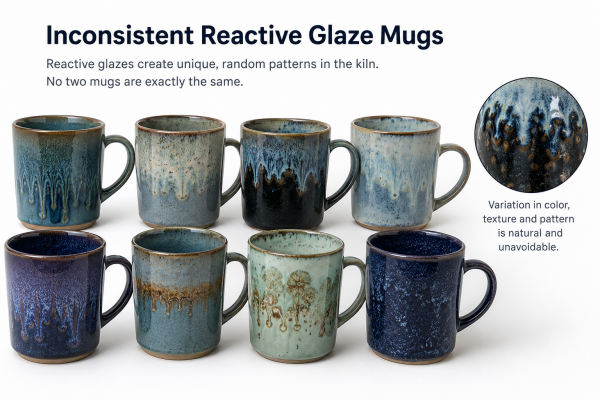
You should avoid any trend that relies on randomness for its beauty. The most common culprit is the "kiln-altered" or "reactive" glaze (窑变釉). While beautiful, its effect is chemically random, making it impossible to guarantee uniformity across a large batch of promotional mugs wholesale.
Dive Deeper: The Manufacturability Filter for Corporate Mugs
As a B2B buyer, your biggest risk is inconsistency. If a corporate client orders 1,000 mugs, they expect them to look identical to the sample you provided. Certain trends make this promise impossible to keep.
Here's my "factory-floor" perspective on what to filter out:
H3: The Problem with Reactive Glazes
Reactive glazes contain minerals and chemicals that "bloom" unpredictably in the heat of the kiln. The exact pattern depends on the glaze's thickness, its precise location in the kiln, and minute temperature fluctuations. The result is that no two mugs are ever exactly the same.
- For an artist or a small retail shop, this is a feature. They can sell each mug as a unique piece of art.
- For a corporate order, this is a fatal flaw. The client's brand identity is built on consistency. A batch of mugs where the colors and patterns vary wildly will look like a collection of factory seconds.
I've had to have difficult conversations with new buyers who fell in love with a reactive glaze sample. They show me a picture and say, "I want 3,000 of this." I have to explain that we can use the same glaze, but we cannot guarantee it will look like that specific photo. The risk of the final batch not meeting the client's expectations is simply too high. Effective ceramic mug quality control for a reactive glaze batch is about managing expectations, not enforcing uniformity.
H3: The Challenge of Unconventional Shapes
Another trap is overly complex or irregular mug shapes. While a unique silhouette can be a differentiator, it can introduce a host of production issues:
| Feature | Production Risk | Business Impact |
|---|---|---|
| Sharp, Unnatural Angles | Difficult to release from the mold cleanly. Prone to cracking during firing. | Higher defect rates, increased unit cost, potential delays. |
| Very Thin Handles | Weak structural point. High risk of breakage during shipping and daily use. | Increased customer complaints, returns, and damage to brand reputation. |
| Asymmetrical Bodies | Can warp or lean in the kiln. Difficult to stack for storage and shipping. | Higher defect rates, inefficient packing, increased shipping costs. |
The most successful corporate mug trends are built upon proven, classic shapes. Innovations in glaze and texture on a reliable form are a much safer and more profitable path.
How Can a Trendy Mug Design Ruin Your Branding Potential?
You've successfully avoided the manufacturing traps and found a beautifully textured, reliably produced mug. The job is done, right? Not yet. The final and most critical test is what I call the "Logo Trap."
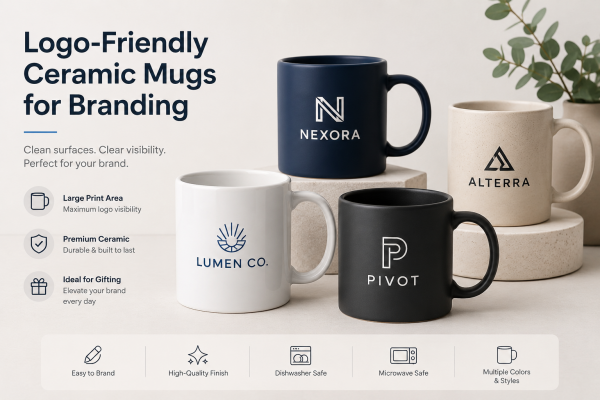
A trendy design with an uneven surface, deep texture, or dramatic curve can make it incredibly difficult, expensive, or impossible to apply a clean, crisp logo. The best corporate mugs are designed to be a canvas for a brand, not to compete with it.
Dive Deeper: Prioritizing Logo-Friendliness in Your Sourcing
In my 15 years of exporting, the number one point of failure for custom mug projects is a mismatch between the mug's surface and the branding requirements. A beautiful mug that can't take a logo is just a piece of ceramic. Here’s a breakdown of how different surfaces affect logo application, which is a key part of the custom mug manufacturing process.
H3: Matching the Surface to the Printing Method
Different printing methods have different needs. The most common method for multi-color logos is decal printing, where the logo is printed on special paper, applied to the mug by hand, and then fired in a kiln to fuse it permanently. This method requires a smooth surface.
Here's how different textures impact your branding options:
| Mug Surface | Suitability for Decal Printing | Best Use Case for Branding |
|---|---|---|
| Standard Glossy/Matte | Excellent. The smooth surface allows the decal to apply flat without bubbles or wrinkles. | Perfect for complex, multi-color logos. The ideal choice for most wholesale ceramic mugs with logo. |
| Subtly Textured (e.g., Sandstone Feel) | Good, with caution. If the texture is very fine, a decal can work. A test run is essential. | Best for simple, one-color logos. The texture can sometimes show through the decal slightly. |
| Ribbed or Heavily Grooved | Poor. The decal cannot conform to the deep grooves and will wrinkle, trap air, or tear. | Avoid decal printing. Consider a medallion or a printed area that is intentionally left smooth. |
| Embossed Surface | Not Applicable. The branding is the embossment itself. You can sometimes add color fill to the debossed area. | The logo is the texture. This creates a very premium, subtle branding effect. |
We once had a new e-commerce seller who sourced a batch of trendy, vertically ribbed mugs. They were beautiful. But when they tried to find a local printer to apply their clients' logos, no one could do it. The decals wouldn't stick properly. They were left with thousands of unbrandable mugs. This is a costly mistake that comes from not thinking about the final step first. Always source logo-friendly ceramic mugs.
Why Isn't the Cheapest Promotional Mug Wholesale Option Always the Most Profitable?
When you're sourcing inventory, it's natural to want the lowest unit price. The "sort by price: low to high" button is tempting. But focusing only on unit cost is a classic mistake that often leads to lower profits.
The cheapest promotional mugs wholesale option often comes with hidden costs like higher defect rates, branding limitations, and quality issues that ultimately erode your profit margin per batch. A slightly more expensive, reliable mug is almost always the more profitable investment.
Dive Deeper: Thinking in "Batch Profit" Instead of "Unit Cost"
Let's do some simple math. Imagine you're a wholesaler who needs to deliver 1,000 perfectly branded mugs to a corporate client.
Scenario A: The "Cheap" Mug
- Unit Cost: $1.00
- Initial Cost for 1,100 units (to cover defects): $1,100
- Defect Rate (from our ceramic mug inspection checklist): 10% on average. This includes chips, glaze flaws, and mugs that can't be printed on. You lose 110 mugs.
- Actual Good Units: 990. You are 10 mugs short of the client's order.
- Hidden Costs: Time spent sorting, cost of re-ordering, potential shipping delays, and damage to your reputation. Your true cost per good mug is much higher than $1.00.
Scenario B: The "Quality" Mug
- Unit Cost: $1.20
- Initial Cost for 1,020 units (a small buffer): $1,224
- Defect Rate: <1%. We pride ourselves on this. You might lose 5-10 mugs at most.
- Actual Good Units: 1,010+. You easily fulfill the order.
- Result: The process is smooth, predictable, and your client is happy. The slightly higher initial investment bought you peace of mind and protected your profit.
The cheapest factories often cut corners on material quality, firing processes, or quality control. This leads directly to the problems in Scenario A. As an experienced producer, my advice is to partner with a supplier who is transparent about their quality standards. A supplier who invests in quality is investing in your profitability. This is especially critical when dealing with international logistics and the high cost of ceramic mug packaging for international shipping. You don't want to pay to ship defective products across an ocean.
Frequently Asked Questions
What's the difference between embossing and debossing for custom corporate mugs?
Embossing creates a raised design on the mug's surface, while debossing creates a recessed or indented design. Both are done by creating a custom mold and offer a premium, tactile branding effect. Debossing is often easier to color-fill if you want to add a splash of color to the indented logo.
Are reactive glaze mugs good for corporate branding?
Generally, no. Reactive glazes create unique, random patterns, meaning no two mugs will be identical. This lack of uniformity is usually unacceptable for corporate branding, which relies on consistency. They are beautiful for retail or artistic purposes but very risky for large B2B orders of branded mugs.
How does packaging affect the cost of importing corporate mugs?
Packaging is a critical factor. Proper packaging—like individual boxes or molded pulp trays—protects against breakage during international shipping but adds to the volume and weight, increasing freight costs. Cheaper, bulk packaging saves on shipping but risks a higher damage rate. It's a trade-off that you should discuss with your supplier.
What is a realistic lead time for a large order of custom corporate mugs?
For an order of 5,000-10,000 custom corporate mugs involving a standard shape and decal printing, a realistic lead time from order confirmation to being ready for shipment is typically 45-60 days. This allows for raw material preparation, molding, firing, printing, and quality control. Custom shapes or glazes will extend this timeline.
Conclusion
To profit from corporate mug trends in 2026, you must look beyond surface-level aesthetics and adopt the mindset of a production partner. The winning strategy is not to chase every new, flashy design, but to identify trends that are both desirable and manufacturable at scale. Focus on tactile experiences like high-quality matte glazes, which offer a premium feel without compromising your ability to apply a perfect logo. Always filter your choices through the lens of manufacturability, logo-friendliness, and total batch profitability. By doing so, you de-risk your inventory and build a reputation for delivering quality.
If you are looking for a reliable factory partner to help you source profitable, high-quality corporate mugs for the European or American markets, our team is here to help. With 15 years of experience, we understand the balance between trend-forward design and production reality. Contact us to discuss your next project.