Finding a supplier for your ceramic mugs seems easy, but choosing the wrong one can lead to devastating quality issues, communication breakdowns, and shipping delays. This initial decision, often based on a simple price list, can threaten your profit margins and your brand's reputation. The solution is to look beyond the unit price and learn how to identify a true long-term mug manufacturing partner by reading the subtle clues in your very first interactions.
To select a long-term mug manufacturing partner, you must evaluate far more than just the unit price. A truly reliable partner is identified by their communication style, the professional detail in their quotation, and their willingness to ask clarifying questions about your market and quality requirements. These "micro-expressions" are powerful predictors of their professionalism, transparency, and future dependability.
It’s a common story I’ve seen play out over 15 years in this industry. But how do you actually learn to read these signals? Let's break down the process of interpreting these supplier "micro-expressions" so you can avoid costly mistakes and secure a stable, profitable supply chain.
Why Does Chasing the Lowest Price Often Backfire?
It’s incredibly tempting to look at a list of quotes and immediately gravitate toward the lowest number. After all, a lower unit cost should mean higher profit margins, right? But what if that low price leads to a container of unsellable goods, endless back-and-forth emails, and surprise fees that erase your profits? The cheapest option is rarely the best value in the long run.
Chasing the lowest price often backfires because that "saving" usually comes from hidden compromises in raw materials, quality control, or process management. These shortcuts inevitably lead to higher long-term costs stemming from product defects, rework, shipping delays, and significant damage to your business's reputation.

Dive Deeper: The True Cost of a "Bargain"
Over the years, I've seen many buyers make this exact mistake. The pattern is predictable, and it almost always ends in frustration.
A Real-World Cautionary Tale
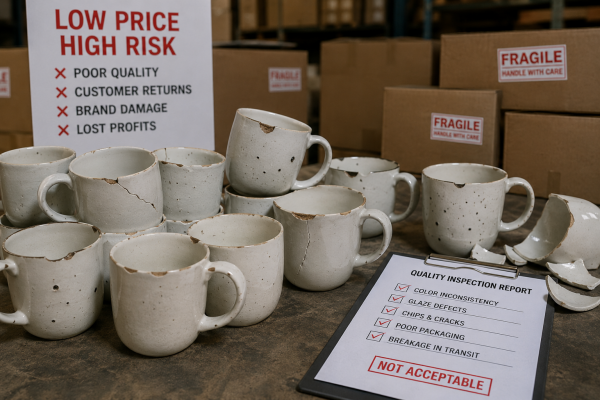
A few years ago, a promising e-commerce seller approached us. They were launching a new brand and had received quotes from several factories, including ours. They ultimately chose a different supplier whose price was about 15% lower. I understood their decision; as a new business, every cent counts. The pre-production samples they received looked perfect.
Six months later, they called us in a panic. Their first full container had arrived, and it was a disaster.
- Color Inconsistency: The mugs that were supposed to be a specific Pantone shade varied wildly from light to dark.
- Glaze Defects: A significant portion had pinholes and black spots in the glaze, making them look cheap.
- Breakage: Nearly 20% of the mugs were broken upon arrival due to flimsy, inadequate packaging.
They had to discard a large part of the shipment, issue refunds to angry customers, and absorb a total loss on their initial investment. They missed their peak holiday selling season, and their brand's reputation took a serious hit before it even got off the ground. Their 15% "savings" on the unit price cost them their entire business for that quarter. This is the tangible business risk hidden behind an unusually low quote.
Where Do "Savings" Actually Come From?
When a supplier's price is significantly lower than the market average, the discount has to come from somewhere. It's rarely from their profit margin. More often, it’s from cuts in crucial areas:
- Raw Materials: Using lower-grade clay (often called B-grade or C-grade) which is less durable, more porous, and prone to chipping or cracking after a few uses. They might also use cheaper glazes that could have an inconsistent finish or, in worst-case scenarios, fail to meet food-grade safety standards for heavy metals like lead and cadmium.
- Process Controls: A factory can cut costs by running kilns faster or at lower temperatures to save on energy, which results in weaker ceramic bodies. They might skip crucial inspection steps. For example, a reliable factory inspects incoming materials, inspects again after the initial "biscuit" firing, and performs a final check before packing. A low-cost factory might only do one quick final check, if that.
- Labor and Management: Underpaying labor or running a disorganized operation saves money upfront but creates massive downstream risks. An inexperienced team is more likely to make mistakes in production, packaging, and, critically, export documentation, leading to costly delays at customs.
Instead of unit price, experienced buyers focus on Total Cost of Ownership (TCO). TCO includes the product cost plus the costs of poor quality, communication friction, and potential rework. A good long-term mug manufacturing partner has a slightly higher unit price but a much lower TCO.
How Can a Supplier's First Reply Reveal Their Reliability as a Long-Term Mug Manufacturing Partner?
You've done your research and sent out inquiries to a half-dozen potential suppliers. Now, the replies are starting to arrive in your inbox. On the surface, they all look the same: a price, a minimum order quantity (MOQ), and a product photo. It can feel like you're just guessing which one is truly professional. The secret is to analyze their response as a diagnostic tool.
A reliable supplier's first reply goes beyond a simple price. They treat your inquiry as the start of a conversation, asking clarifying questions about your target market, intended use, and specific quality standards. This proactive engagement shows they are invested in providing a suitable solution for you, not just making a quick, transactional sale.
Dive Deeper: The Partner vs. The Transactional Supplier
From my position in sales, I can often tell how experienced a buyer is by the questions they ask—and I can tell how professional a factory is by the questions they ask in return. An inquiry response is a powerful "micro-expression" of a company's entire philosophy.
Let's compare two typical responses to an inquiry that just says, "Hello, please quote for 5,000 units of your model CM-101."
| Feature | Transactional Supplier's Reply | Potential Partner's Reply |
|---|---|---|
| Content | "Dear Sir, Price for CM-101 is $1.50/pc. MOQ is 3000 pcs. FOB Qingdao. Thank you." | "Hello [Buyer Name], Thank you for your interest in our model CM-101. To provide the most accurate quotation for your project, could you please clarify a few details?" |
| Focus | Price | Solution & Fit |
| Questions Asked | None. | - "What is your target market (e.g., USA, Germany)? This affects compliance requirements."<br>- "Is this for a promotional giveaway or for high-end retail?"<br>- "Do you have specific packaging needs, like an individual gift box or drop-test requirements for e-commerce?" |
| Implied Goal | Win the order on price alone. | Build a successful, long-term relationship. |
The transactional supplier is playing a numbers game. They send out hundreds of low-effort quotes hoping a certain percentage will convert based on price. They put the entire burden of due diligence on you.
The potential partner, on the other hand, is trying to prevent problems before they happen. Their questions are a form of risk management.
- "What is your target market?" They ask this because they know that regulations for food-contact materials in the EU are different from those in the US (like California Proposition 65). They want to ensure the product is compliant from the start.
- "Is this for promotion or retail?" This question helps them recommend the right quality grade. A mug for a one-time event doesn't need the same durability as one you intend to sell for $15 in a boutique. A good partner helps you avoid overpaying for quality you don't need, or under-specifying for a product that needs to last.
- "Do you have packaging needs?" An e-commerce seller needs robust packaging that can survive being shipped individually. A wholesaler shipping pallets to a distribution center has different needs. A proactive supplier understands this and quotes accordingly.
When a supplier asks these kinds of questions, it's not an inconvenience. It's a sign of expertise and a commitment to getting it right. They are demonstrating that they are thinking about your business success, not just their order book.
What Does a Professional Quotation from a Mug Manufacturer Look Like?
You've narrowed down your list to a few suppliers who communicate well. Now you're comparing their official quotations. One is a simple email with a price. Another is a multi-page PDF filled with tables and technical terms. It can be confusing to know which one holds more weight.
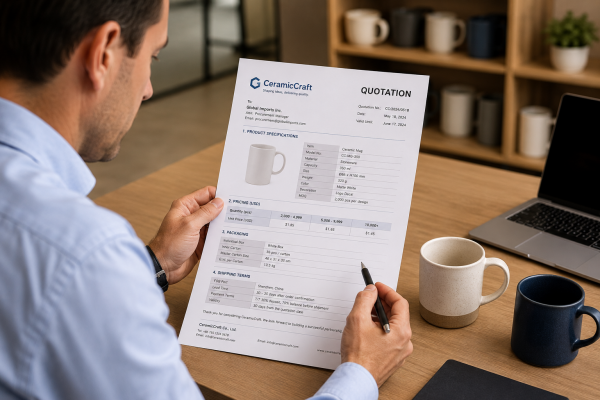
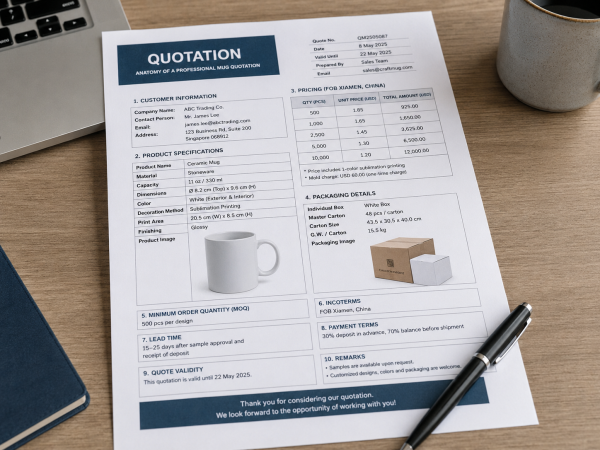
A professional quotation is a detailed document that specifies not just the price, but also the material grade (e.g., AB grade porcelain), decoration method, capacity, packaging details, Incoterms (like FOB or EXW), payment terms, and quote validity. This level of detail and transparency is a hallmark of a professional operation and serves to prevent future misunderstandings.
Dive Deeper: The Anatomy of a High-Quality Quotation
A quotation is more than just a price; it's a preliminary contract. A vague quote leaves room for ambiguity, which a less reputable supplier can exploit later. A detailed quote from a potential long-term mug manufacturing partner protects both you and them. Here’s what you should look for:
1. Detailed Product Specifications
A professional quote breaks down the product itself.
- Material: It won't just say "ceramic." It will specify Stoneware, Porcelain, or New Bone China and, crucially, the Quality Grade (e.g., A Grade, AB Grade). An A-Grade mug has a flawless finish, while an AB-Grade might have very minor, nearly imperceptible imperfections. Knowing the grade is essential for comparing apples to apples.
- Capacity & Dimensions: Exact capacity in milliliters (ml) or ounces (oz), plus height and diameter in millimeters (mm).
- Decoration Details: If it's a custom design, it should specify the method (decal printing, silk screening, etc.), the number of colors, and the logo size and position.
2. Clear Packaging Information
This is often overlooked but is a major source of hidden costs.
- Inner Packaging: Does the price include a bulk pack (e.g., cardboard dividers), an individual white box, or a custom-printed color gift box?
- Master Carton: Is it a standard 3-ply carton or a stronger, export-standard 5-ply carton? What are the carton dimensions and gross weight? This information is vital for calculating your shipping costs.
3. Unambiguous Commercial Terms
This section defines the financial and logistical framework of your agreement.
- Price Basis (Incoterms): This is critical. EXW (Ex Works) means the price is for the goods at the factory gate; you handle all shipping. FOB (Free On Board) means the supplier delivers the goods to the designated port and loads them onto the ship. An FOB price is higher than an EXW price, but includes more services.
- Payment Terms: The standard is often a 30% deposit to start production and 70% balance payment upon presentation of the bill of lading (B/L) copy.
- Quote Validity: A professional quote will state that the price is valid for a specific period, such as 30 or 60 days. This shows they are actively managing the risk of fluctuating raw material costs.
- Lead Time: This should clearly state the number of days required for mass production after you approve the final pre-production sample.
A quote that simply says "Mug: $1.50" is a red flag. Is that for an A-grade porcelain mug in a gift box, shipped FOB? Or a C-grade stoneware mug bulk-packed at the factory door? The difference in value is enormous. A detailed quotation is a sign of a transparent, organized, and reliable partner.
What Questions Should You Ask a Potential Long-Term Mug Manufacturing Partner?
You've found a supplier who communicates clearly and provides a detailed quotation. The price seems fair. But you still have a nagging feeling—what if you're missing something? How can you be absolutely sure their factory operations and quality control are as good as their sales team? Asking the right follow-up questions can uncover hidden risks and confirm you're dealing with a true professional.
To verify a supplier’s capabilities, ask specific, probing questions about their quality control systems, material sourcing, and third-party certifications. Request to see their QC checklists, ask how they handle production defects, and ask for copies of their ISO 9001 or BSCI audit reports. Their ability and willingness to provide clear, confident answers will reveal their genuine commitment to quality.
Dive Deeper: Probing for Hidden Risks
A good supplier expects and welcomes detailed questions. It shows them you are a serious and knowledgeable buyer. A supplier who becomes defensive or gives vague answers is a major red flag. Here are the questions I recommend my clients ask to peel back the curtain.
Questions About Quality Control (QC)
This is where you separate the workshops from the professional factories.
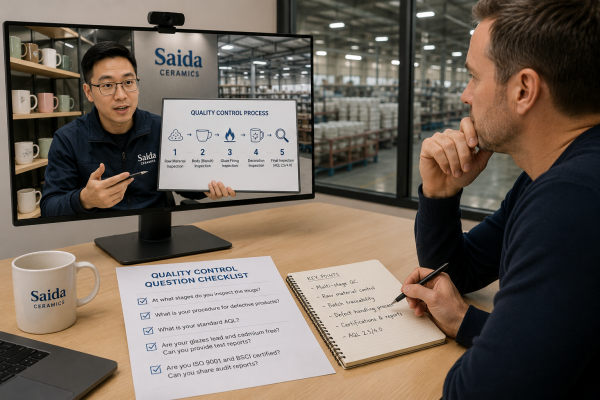
- "Can you walk me through your quality inspection process? At what specific stages of production do you check the products?"
- Look for a multi-stage process. A strong answer will mention checks at: Incoming Raw Materials (verifying clay and glaze quality), Post-Biscuit Firing (checking for cracks before glazing), Post-Glaze Firing (checking for glaze defects), and a Final Pre-Shipment Inspection.
- "What is your standard procedure if you find a batch of products with defects during production?"
- A bad answer: "We will fix them."
- A good answer: "We immediately isolate the defective batch to prevent it from mixing with good products. Our QC team then works with production to analyze the root cause. We document the issue and communicate with the client to decide on the next steps, whether it's rework or remanufacturing."
- "What is your standard AQL (Acceptable Quality Limit) for final inspections?"
- Even if you're not an expert on AQL, just asking the question signals that you understand international quality standards. A professional factory will know exactly what you mean and give you a clear answer (e.g., "We typically work to AQL 2.5/4.0").
Questions About Materials and Compliance
This verifies that they aren't cutting corners on safety and quality.
- "Are your glazes and decals certified lead and cadmium free? Can you provide recent test reports for standards like California Prop 65 or EU 84/500/EEC?"
- A reputable supplier who exports to Europe or the US will have these reports on hand from agencies like SGS, TUV, or Intertek. They should be willing to share them. Treat certifications as documents you need to see and verify.
- "I see you are ISO 9001 and BSCI certified. Could you please share the summary page of your most recent audit report?"
- Certificates on a website are nice, but they can be expired or forged. Asking for the actual audit report summary shows you are doing your due diligence. As a BSCI and ISO9001 certified factory, we expect this and have these documents ready. It builds trust.
These questions shift the conversation from price to process. A truly capable long-term mug manufacturing partner will be proud to show you how they operate. Their transparency is your best insurance policy against a future disaster.
Frequently Asked Questions
What is the difference between a trading company and a factory?
A factory, like us, is the direct manufacturer of the products. This offers you greater control over the production process, quality, customization, and lead times. A trading company is an intermediary that sources from various factories. While they can offer a wider variety of products, you have less direct control and transparency, which can introduce risks for a long-term mug manufacturing partner.
Why is a BSCI certification important when choosing a supplier?
A Business Social Compliance Initiative (BSCI) audit verifies a factory's adherence to ethical standards, including fair wages, workplace safety, and reasonable working hours. For brands selling in Western markets, partnering with a BSCI-compliant factory is crucial for maintaining corporate social responsibility, protecting your brand's image, and ensuring a humane supply chain.
What are Incoterms like FOB and EXW?
Incoterms are internationally recognized rules that define the responsibilities of buyers and sellers for the delivery of goods. EXW (Ex Works) means the buyer is responsible for all transportation costs and risks from the factory door. FOB (Free On Board) means the supplier is responsible for getting the goods to the designated port and loaded onto the vessel. Understanding the Incoterm is critical for accurately calculating your total landed cost.
How much does a custom mug mold cost?
The cost to create a mold for a new, unique mug shape typically ranges from $500 to $2,000 USD. The final price depends on the complexity of the design. While this is an upfront investment, it allows you to create a proprietary product that differentiates your brand in the marketplace. A transparent partner will be clear about these one-time costs from the beginning.
Conclusion
Selecting a supplier is one of the most consequential decisions you will make for your e-commerce or wholesale business. The goal shouldn't be to find the cheapest price, but to secure a true partner invested in your success. By learning to interpret the "micro-expressions" in a supplier's communication, carefully analyzing their quotation for professionalism, and asking targeted questions about their quality and compliance processes, you can look beyond the price tag and accurately gauge their reliability. Choosing a dependable long-term mug manufacturing partner is an investment that protects your capital, stabilizes your supply chain, and builds a solid foundation for future growth.
If you are looking for a transparent and experienced manufacturing partner for your next ceramic mug collection, our team is here to help. Contact us today to discuss your project and discover how a true partnership can make all the difference.