Starbucks ceramic mugs do not necessarily come from one permanent manufacturer. This uncertainty can frustrate buyers who are tracing a collectible or evaluating factories. A base stamp may look conclusive while proving very little. I recommend identifying the exact product first, then verifying its supplier through current, product-specific evidence.
Starbucks may source ceramic mugs from different manufacturing partners according to product line, market, order period, and commercial requirements. No single factory should be treated as the universal manufacturer without reliable evidence. Buyers should verify the mug’s item number, country of origin, packaging, importer information, production date, and documented supply chain.
The answer also depends on the buyer’s real goal. A collector may want to authenticate one mug, while an importer may need a factory with comparable production capabilities. In my experience, those two investigations require different documents, questions, and risk controls.
Who Actually Makes Starbucks Ceramic Mugs?
A search for the maker can produce factory names, marketplace claims, and photographs of base stamps. The problem is that these clues often lack a product number, manufacturing period, or primary source. If buyers accept them too quickly, they may rely on outdated or inaccurate supplier information.
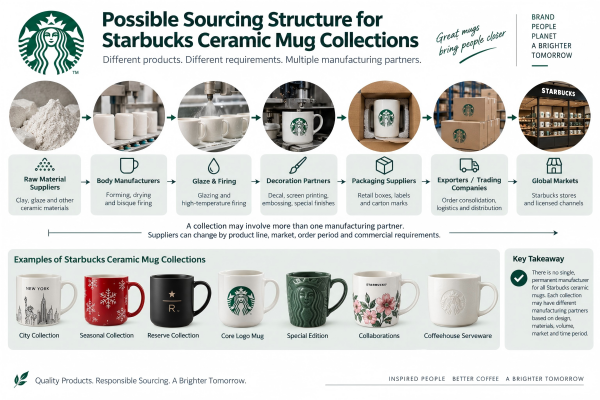
Starbucks ceramic mugs may be produced by multiple approved manufacturing partners rather than one fixed factory. The responsible manufacturer can change by collection, region, order volume, and year. I would only associate a factory with a specific mug when current documents or credible records connect the product, supplier, market, and production period.
Why a Single Factory Answer Is Usually Unreliable
Large retail brands commonly manage diverse product portfolios. Even within ceramics, different items can require different forming methods, decorations, packaging formats, capacities, and delivery schedules. One partner might specialize in decal-decorated souvenir mugs, while another might be better equipped for reactive glazes, embossed shapes, or high-volume promotional orders.
A manufacturing arrangement can also change over time. A supplier that was connected to a product several years ago may not produce the current version. Factory capacity, cost, delivery performance, quality results, compliance status, and sourcing strategy can all affect future orders.
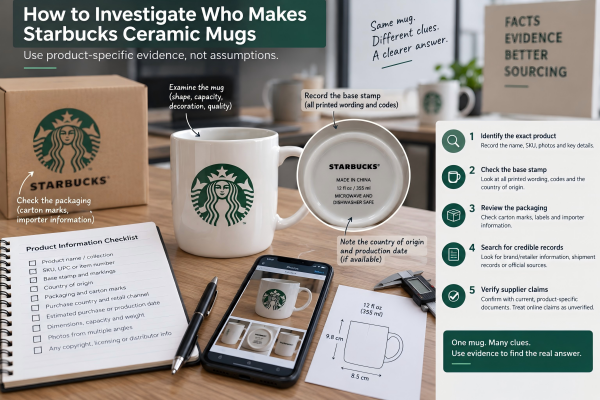
I have seen buyers make the mistake of asking, “Which factory makes this brand?” before identifying the product. I normally reverse the process and start with the physical mug.
Information Buyers Should Record
I suggest creating a product-identification file that includes:
- The full product name or collection name
- The SKU, UPC, EAN, or other item number
- The stated country of origin
- The base stamp and all printed wording
- The packaging, carton marks, and importer label
- The purchase country and retail channel
- The approximate purchase or production date
- The mug’s capacity, dimensions, weight, and decoration
- Any copyright, licensing, or distributor information
- Clear photographs from several angles
These details help separate similar-looking products. They also make supplier inquiries more precise.
Evidence Has Different Strengths
| Evidence source | What it may establish | Important limitation |
|---|---|---|
| Brand or retailer confirmation | A direct answer about a particular item | The company may keep supplier identities confidential |
| Product-specific commercial documents | A connection between an item and a supplier | Documents must be authentic, current, and legally obtained |
| Packaging and importer labels | Market, distributor, origin, or responsible party | The named company may not be the factory |
| Customs or shipment records | A possible commercial relationship during a period | Product descriptions may be broad or incomplete |
| Factory declaration | A supplier’s claimed manufacturing role | The claim requires independent verification |
| Marketplace listing | A lead for further research | Sellers can copy inaccurate information |
| Search snippet or forum post | A possible research direction | It does not prove a manufacturing relationship |
I would not publish or rely on a factory name based only on online repetition. A credible answer needs traceable evidence for the specific mug in question.
Can a Base Stamp Identify Who Makes Starbucks Ceramic Mugs?
A base stamp is often the first clue available, but it can create false confidence. Buyers may assume every printed company name identifies the manufacturer. That assumption can lead to incorrect factory attribution because marks often serve branding, legal, distribution, licensing, or origin-labeling purposes.
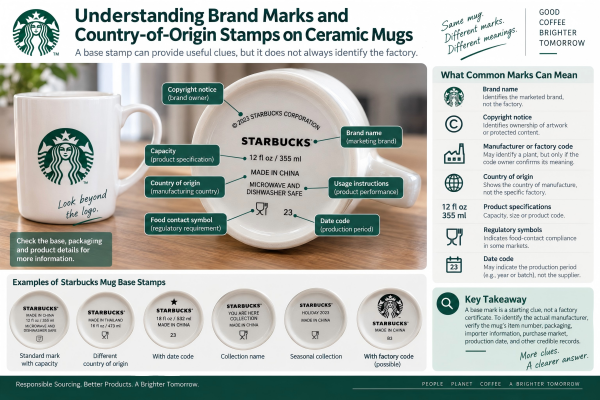
A base stamp can help identify Starbucks ceramic mugs, but it does not always disclose the actual factory. It may show the brand owner, copyright holder, distributor, collection, product code, or country of origin. Buyers should treat the stamp as one evidence point and verify it against packaging and commercial records.
What Common Marks Can Prove
The meaning of a mark depends on its wording and context.
- A brand name usually identifies the marketed brand, not the production facility.
- A copyright notice identifies ownership of artwork or protected content.
- A distributor name identifies a commercial party that handled the product.
- “Made in” wording usually identifies the country of manufacture.
- A product code can help the brand or retailer locate internal records.
- A factory code may identify a plant, but only if the code owner confirms its meaning.
- A licensing statement can identify authorized use of intellectual property.
- A date code may point to a production period rather than a supplier.
A country-of-origin statement narrows the search, but it normally does not reveal the specific factory. A country can contain hundreds or thousands of ceramic producers, decorators, packaging facilities, and trading companies.
Manufacturing and Decoration May Be Separated
Ceramic supply chains can include more than one production site. One factory may form and fire the body, while another applies decals or special decoration. A separate packaging company may prepare retail boxes. An exporter or trading company may then appear on shipping documents.
I have encountered sourcing cases where buyers called the exporter “the manufacturer.” After an on-site or documentary review, the buyer learned that the exporter had subcontracted production. That structure is not automatically unacceptable, but buyers need visibility because subcontracting affects quality control, delivery, and corrective-action responsibility.
I treat a base mark as a starting clue, not a factory certificate.
A Practical Verification Sequence
I recommend following this order:
- Photograph the base mark and retail packaging.
- Record every code exactly as printed.
- Contact the official retailer or brand support channel for product information.
- Ask whether the code identifies a collection, supplier, or production period.
- Check legally accessible shipment or corporate records.
- Compare information across at least two credible sources.
- Mark any unsupported supplier claim as unverified.
This method may not always reveal a confidential supplier. However, it reduces the risk of turning a weak clue into a public claim.
Why Can Starbucks Ceramic Mugs Have Different Suppliers?
Buyers sometimes expect visually similar mugs to come from the same production line. However, small design differences can require different manufacturing processes. If a buyer overlooks those differences, the buyer may draw the wrong conclusion about who produced a collection or what capabilities a comparable factory needs.
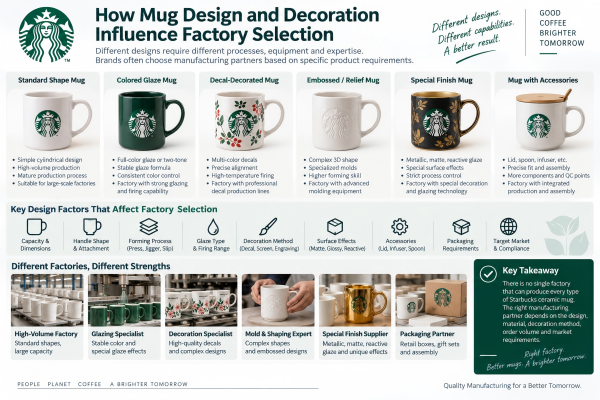
Starbucks ceramic mugs can have different suppliers because collections vary in shape, clay body, glaze, decoration, packaging, sales region, volume, and delivery schedule. A brand may allocate products among qualified partners or change sources over time. A supplier linked to one mug should not be assumed to make every other model.
Product Design Influences Factory Selection
A standard cylindrical mug and a complex embossed mug do not present the same manufacturing challenge. The following characteristics can affect supplier selection:
- Mug capacity and dimensional tolerances
- Handle size, shape, and attachment method
- Body-forming process
- Glaze type and firing range
- Underglaze or on-glaze decoration
- Full-wrap decal alignment
- Metallic or special-effect finishes
- Embossed or debossed surfaces
- Lid, infuser, or accessory fit
- Dishwasher and microwave expectations
- Gift-box and retail-packaging requirements
A factory with excellent results on plain glazed mugs may not perform equally well on detailed relief designs. Likewise, a decorative specialist may not have enough forming capacity for a large, time-sensitive program.
Market Requirements Can Differ
A product sold in the United States may have different labeling, testing, documentation, and packaging requirements from a product intended for the European Union. Buyers should define the destination market before requesting a quotation or approving a sample.
For food-contact ceramics, professional evaluation may involve migration testing for lead and cadmium. The applicable method and acceptance criteria depend on the market and product classification. Buyers may consider frameworks such as applicable U.S. FDA requirements or guidance, California Proposition 65 obligations, and European rules including Directive 84/500/EEC as amended. A qualified laboratory or compliance professional should confirm the current requirements for the intended market.
Production Period Matters
A supplier relationship is not permanent evidence. For example, the following events can cause a sourcing change:
- A collection reaches the end of its sales cycle.
- A factory cannot meet a new delivery window.
- A design requires equipment that another plant has.
- Quality performance falls below the buyer’s standard.
- A buyer consolidates or diversifies its supplier base.
- Costs, tariffs, logistics, or capacity conditions change.
- Audit or compliance requirements change.
For that reason, I would describe a verified relationship narrowly: a named supplier manufactured a specified item for a stated market during a documented period. I would not expand that statement to the brand’s entire ceramic range.
Does Finding a Supplier Permit Reproduction of Starbucks Ceramic Mugs?
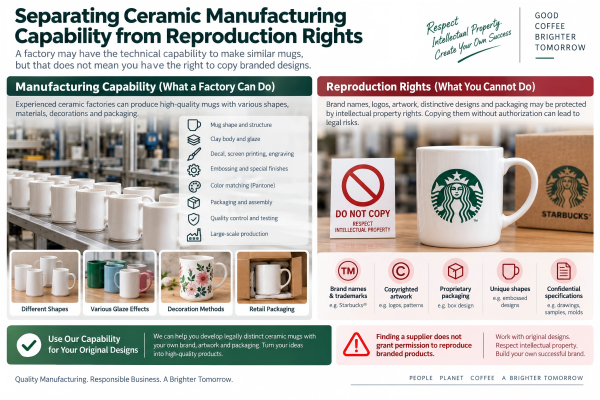
A supplier name can look like a shortcut to an existing product. However, manufacturing capability and reproduction authority are separate issues. If a buyer asks a factory to copy branded artwork, proprietary shapes, or protected packaging, both parties can face intellectual-property and commercial risks.
Finding a factory associated with Starbucks ceramic mugs does not grant permission to reproduce them. Brand names, logos, artwork, packaging, molds, technical specifications, and distinctive designs may be protected or contractually restricted. Buyers should develop legally distinct products and obtain qualified intellectual-property advice when design rights are uncertain.
Factory Access Does Not Equal Design Access
A manufacturer may be physically capable of making a similar mug while being legally prohibited from sharing or reusing:
- Customer artwork files
- Brand color standards
- Proprietary decals
- Custom molds and tooling
- Internal product specifications
- Packaging designs
- Testing reports owned by another customer
- Forecasts, prices, or purchase-order information
Professional factories should maintain customer confidentiality. In fact, a supplier that freely offers another brand’s artwork or molds creates a serious warning sign. I view poor intellectual-property controls as a supplier-selection risk, not as a purchasing advantage.
Buyers Should Use an Independent Development Process
A safer custom project starts with an original brief. I suggest that buyers define:
- An original shape or a demonstrably generic form
- Buyer-owned or properly licensed artwork
- Independent color references
- Target capacity and dimensional tolerances
- Destination-market compliance requirements
- Performance expectations
- Retail and transport packaging
- Tooling ownership and storage terms
- Confidentiality and non-use obligations
- Approval stages for samples and mass production
A ceramic manufacturer can then review manufacturability without copying a protected product.
Similar Quality Is Not the Same as Identical Design
Buyers can request a comparable performance level without asking for an identical branded item. They can specify attributes such as:
- Smooth rim finishing
- Consistent glaze coverage
- Stable placement on a flat surface
- Controlled decal alignment
- Defined color tolerances
- Handle-strength expectations
- Dishwasher or microwave performance, where applicable
- Food-contact testing for the destination market
- Packaging capable of passing an agreed transport test
I recommend that buyers ask legal professionals to assess trademarks, copyrights, design patents, registered designs, and trade dress when a new concept resembles a recognizable commercial product.
How Should Buyers Evaluate Manufacturers With Comparable Starbucks Ceramic Mug Capabilities?
Chasing an alleged brand supplier can distract buyers from the factors that actually determine project success. Even a genuine historical relationship would not prove that a factory suits a new design, order size, market, or delivery schedule. Buyers need to evaluate present capabilities directly.
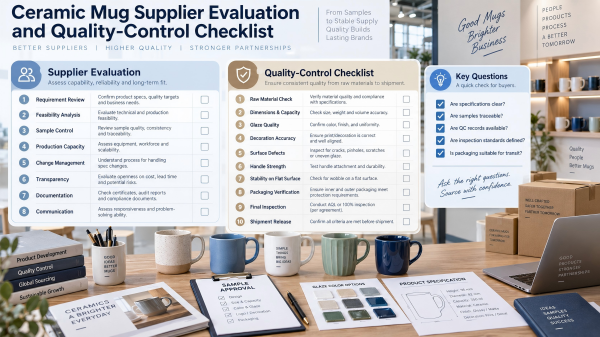
Buyers seeking capabilities comparable to those required for Starbucks ceramic mugs should assess design support, sampling, production capacity, quality consistency, compliance preparation, subcontracting control, and delivery performance. I recommend verifying these factors through documents, product-specific samples, audits, testing, and a controlled trial order rather than relying on a customer-name claim.
Evaluate the Development Process
A capable custom mug supplier should translate the buyer’s brief into controlled specifications. I normally expect the development file to cover:
- Shape drawings and capacity
- Critical dimensions and tolerances
- Clay body and glaze selection
- Pantone or approved color references
- Decal position and alignment limits
- Logo and artwork approval
- Sample revisions
- Packaging structure and carton marks
- Testing plan
- Approved pre-production sample
A beautiful sample alone does not prove scalable production. Buyers should ask how the factory transfers sample standards to the production line.
Review Quality Controls by Production Stage
| Production stage | Typical control point | Buyer verification |
|---|---|---|
| Raw materials | Clay and glaze consistency | Batch records and incoming checks |
| Forming | Shape, weight, and dimensions | Measurement records and samples |
| Drying | Cracking and deformation | Process controls and defect data |
| Bisque/glost firing | Temperature and kiln consistency | Firing records and visual inspection |
| Glazing | Coverage, pinholes, and color | Approved limits and inspection |
| Decoration | Position, adhesion, and color | Artwork standard and rub testing |
| Sorting | Functional and cosmetic defects | Inspection criteria and AQL plan |
| Packaging | Product protection and labeling | Drop or transport-test protocol |
| Final release | Quantity and conformity | Inspection report and retained sample |
I advise buyers to agree on defect definitions before production. Terms such as “minor pinhole” or “acceptable color variation” can produce disputes unless both parties approve measurable limits or representative samples.
Verify Management Documents Carefully
Our company has 15 years of ceramic customization experience and has completed amfori BSCI audit or monitoring and ISO 9001 quality-system certification processes. I present these as management and compliance credentials, not as evidence that we are approved by or supply Starbucks.
Buyers should independently verify:
- The legal company name on each document
- The manufacturing-site address
- The certificate or report number
- The issuing or audit body
- The covered scope
- The issue and expiry dates
- The exact standard or audit version
- Any corrective actions or unresolved findings
An audit report does not replace product testing. Likewise, a quality-management certificate does not guarantee that every shipment will meet the buyer’s specification.
Use a Controlled Trial Order
Before scaling, I recommend a trial order that tests the complete process. The buyer can review sample accuracy, communication, production records, inspection results, packaging, and delivery performance. A qualified third-party inspector can conduct pre-shipment inspection under an agreed sampling plan.
This approach gives buyers evidence from their own product instead of relying on an unverified claim about another customer.
Frequently Asked Questions
Are All Starbucks Ceramic Mugs Made in the Same Country?
I would not assume that all mugs are made in one country. The country of origin can vary by product, market, and production period. Buyers should check the individual mug, retail packaging, and current product records rather than applying one origin statement to the entire range.
Does “Made in China” Reveal the Factory?
No. “Made in China” identifies the country of manufacture, but it does not normally identify the factory. Buyers need additional evidence such as product-specific records, verified supplier declarations, shipment documentation, or confirmation from an authorized commercial party.
Can I Ask a Ceramic Factory to Copy a Starbucks Mug?
I do not recommend requesting copies of branded products, artwork, proprietary molds, or protected designs without authorization. Buyers should create a legally distinct product using original or licensed intellectual property. A qualified legal professional should review any concept that closely resembles an existing commercial design.
Do BSCI and ISO Certifications Prove Starbucks Approval?
No. An amfori BSCI audit addresses defined social-performance areas, while an ISO quality-system certificate addresses its stated management-system scope. Neither document, by itself, proves that a factory is an approved Starbucks supplier. Buyers should verify document validity and seek product-specific evidence for any customer claim.
What Is the Best Way to Find a Comparable Ceramic Mug Manufacturer?
I recommend evaluating original design support, sample quality, production capacity, quality-control systems, testing preparation, intellectual-property protection, subcontracting transparency, and delivery performance. Buyers should also complete document checks, factory evaluation, qualified laboratory testing, and a controlled trial order before committing to high-volume production.
Conclusion
The question “Who makes Starbucks ceramic mugs?” does not have one reliable, permanent answer without product-specific and current evidence. I recommend identifying the exact mug, interpreting base marks carefully, and verifying every supplier claim through credible records. Buyers seeking comparable quality should focus on development controls, scalable production, compliance preparation, and intellectual-property protection instead of chasing an unconfirmed factory name. If you need a legally distinct custom ceramic mug project, contact Saida Ceramic to discuss specifications, sampling, quality controls, and supplier-verification requirements.