Experienced manufacturers can reduce sourcing problems because they often recognize production conflicts before an order reaches the factory floor. A low quotation or attractive sample can hide risks that appear during volume production. I believe buyers get better results when they evaluate a manufacturer’s judgment, process controls, and communication—not its age alone.
Experienced manufacturers tend to deliver better results when they use their accumulated knowledge to identify feasibility problems, explain cost differences, and control the transition from an approved sample to mass production. However, years in business do not guarantee quality. Buyers should verify experience by examining the supplier’s questions, risk explanations, documentation, and production controls.

I have spent 15 years working with custom ceramic inquiries, order execution, and customer problem-solving. That background has taught me that useful experience shows up before production starts. It appears in the details a supplier notices, the questions it asks, and the impractical requests it is willing to challenge.
How Do Experienced Manufacturers Identify Problems Before Production?
Many custom ceramic problems begin with requirements that look reasonable on a drawing but conflict in practice. If nobody identifies the conflict early, the buyer may approve a design that becomes difficult to reproduce. I look for these hidden gaps before discussing final production commitments.
Experienced manufacturers identify problems by reviewing the relationship between shape, material, decoration, finish, packaging, order volume, and commercial tolerances. They do not evaluate each requirement separately. Instead, they consider how one decision affects the others and explain where a requested feature may create inconsistency, extra cost, or production difficulty.

I Treat Foresight as the Real Measure of Experience
I do not think a factory proves its competence simply by saying that it has operated for many years. A newer factory may have strong systems, while an older factory may rely on habits that are no longer effective. I therefore define ceramic manufacturing experience as the ability to anticipate what could go wrong and address it clearly.
When I review a custom inquiry, I usually consider questions such as:
- Does the requested shape support the intended decoration?
- Does the buyer expect a surface appearance that may vary naturally?
- Is the target price compatible with the design and inspection requirements?
- Can the approved sample method be repeated efficiently in volume?
- Does the packaging protect the product through the planned distribution channel?
- Does the order quantity justify the requested development work?
- Has the buyer defined acceptable variation rather than asking for undefined “perfection”?
These questions matter because ceramic production includes several connected stages. Forming, drying, firing, glazing, decoration, sorting, and packing can all influence the final result. I avoid treating a visual concept as if it were only a digital file.
I Pay Attention to Conflicting Requirements
A common warning sign appears when a buyer requests a highly customized product, a very low unit price, a short lead time, a small quantity, and strict cosmetic consistency at the same time. Each requirement may be possible on its own. The full combination may not be practical.
In that situation, an experienced mug manufacturer should not simply say yes. I would expect the supplier to explain which variables create the conflict and offer alternatives. Those alternatives might include:
- Simplifying the shape or decoration.
- Adjusting the order quantity.
- Allowing a more realistic development schedule.
- Defining appearance limits with reference samples.
- Changing the packaging configuration.
- Separating essential requirements from optional features.
I have handled buyer inquiries where the most useful part of the conversation was not a quotation. It was identifying that the requested visual effect, target cost, and consistency expectation did not align. I cannot say that every early warning prevents a problem, but I can say that silence before production usually gives the buyer less room to make an informed choice.
Why Can Experienced Manufacturers Reduce Total Delivered Cost?
A low unit price is easy to compare, but it is only one part of the buying decision. When an inexpensive order creates repeated sampling, missed delivery windows, extra inspection, claims, or unusable stock, the apparent saving can disappear. I encourage buyers to compare total exposure instead.
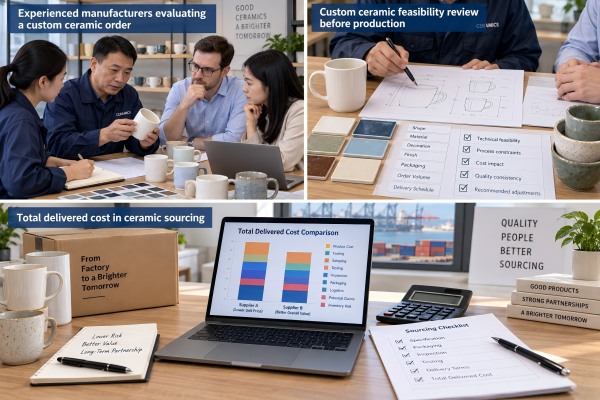
Experienced manufacturers can reduce total delivered cost by clarifying requirements early, selecting realistic processes, documenting approvals, and limiting preventable rework. A higher quotation may include stronger packaging, more inspection, better process control, or a more suitable decoration method. Buyers should compare what each quotation includes rather than evaluating unit price alone.
I Compare the Cost Behind the Price
When two suppliers quote different prices, I first ask whether they are quoting the same product and service level. A quotation can appear lower because the supplier made different assumptions about materials, decoration, sorting, packaging, inspection, or testing.
I use a comparison table like the one below to make the gaps visible:
| Cost area | Questions I recommend asking | Possible sourcing impact |
|---|---|---|
| Product specification | Are dimensions, capacity, weight, finish, and decoration defined? | Different assumptions can produce different products |
| Sampling | How many revisions are included, and what does approval cover? | Extra rounds can add time and development cost |
| Quality control | Which stages are checked, and what records are available? | Weak controls may allow variation to reach final inspection |
| Packaging | Is the quotation based on retail, bulk, gift, or transport packaging? | Inadequate protection can increase transit damage exposure |
| Inspection | Is pre-shipment inspection included or arranged separately? | Late findings can delay shipment or require sorting |
| Compliance documents | Which reports or declarations does the buyer require? | Missing documentation can interrupt approval or import processes |
| Claims process | How does the supplier investigate and respond to nonconformity? | Poor response can increase recovery time and administrative cost |
I never assume that the highest quotation is the best one. I also never assume that the lowest is the worst. I ask each ceramic supplier to explain the basis of its price.
I Include Indirect Costs in the Decision
Importers and wholesalers often carry costs that do not appear on the commercial invoice. I include these items when thinking about ceramic sourcing risk:
- Staff time spent correcting specifications.
- Repeated sample freight.
- Delays that affect promotions or seasonal programs.
- Third-party inspection or sorting.
- Replacement production.
- Customer claims.
- Inventory that cannot be sold through its intended channel.
- Damage to the buyer’s retail or distributor relationship.
I do not assign hypothetical savings or claim that experience eliminates these costs. Instead, I examine whether a supplier’s working method makes them more or less likely. In my experience, a careful explanation before ordering is often more valuable than an unexplained price reduction.
Why Does an Approved Sample Not Guarantee Ceramic Mass Production?
An approved sample gives buyers a physical reference, but it can create false confidence. A sample may receive close individual attention that is difficult to duplicate across a full order. I therefore view approval as the start of production control rather than the end of product development.
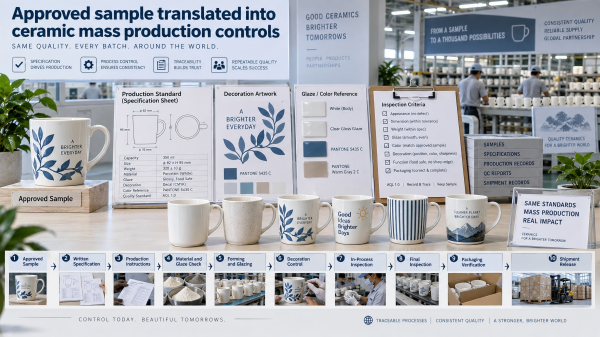
An approved sample does not guarantee consistent ceramic mass production because volume orders involve more materials, operators, equipment cycles, firing loads, and inspection decisions. The manufacturer must translate the sample into measurable specifications, approved reference standards, work instructions, checkpoints, and acceptance criteria that production and quality teams can repeat.
I Ask How the Sample Becomes a Production Standard
A buyer should not stop at “sample approved.” I recommend asking what information will be released to the production team. A reliable custom ceramic manufacturer should be able to connect the physical sample with written and visual controls.
Depending on the product, the control package may include:
- Approved dimensions and capacity requirements.
- Material and glaze references.
- Decoration artwork and placement instructions.
- Color references or approved boundary samples.
- Product weight expectations where relevant.
- Packaging specifications.
- Label and barcode files.
- Functional or regulatory requirements supplied by the buyer.
- Inspection criteria and sampling plan.
- Procedures for handling nonconforming pieces.
Not every characteristic can be judged with a single number. Ceramic products can show process-related variation, especially in glaze appearance, decoration placement, or handmade details. I want that variation discussed before production. Vague instructions such as “same as sample” may not be enough when different teams need to make consistent decisions.
I treat the approved sample as evidence of intent. I treat the production control documents as the method for repeating that intent.
I Examine Control at More Than One Stage
Final inspection remains important, but final inspection alone cannot rebuild a finished order. Effective ceramic quality control should begin earlier.
I ask how the factory checks:
- Incoming and prepared materials: The supplier should confirm that materials match the production requirement.
- Forming and drying: The team should monitor shape and visible process issues before firing.
- Glazing and firing: The factory should control the approved process and sort results against defined standards.
- Decoration: The team should verify artwork, position, appearance, and curing or firing requirements as applicable.
- Final sorting: Inspectors should apply agreed acceptance criteria.
- Packaging: The team should confirm pack configuration, labels, assortment, and protective materials.
- Pre-shipment release: The supplier and buyer should confirm that required checks and documents are complete.
Application-specific requirements can differ by market, product use, and customer program. I recommend qualified testing laboratories, inspection companies, or compliance professionals when specialized evaluation is needed. A factory’s internal checks should not replace independent expertise where laws, food-contact requirements, or retailer protocols apply.
How Can Buyers Verify Experienced Manufacturers?
Supplier presentations can make every factory look capable. Years-in-business claims, photographs, and sample-room displays provide context, but they do not prove execution. I prefer a structured evaluation that tests how the supplier thinks, documents decisions, and responds when a requirement is difficult.
Buyers can verify experienced manufacturers by giving them a detailed inquiry and evaluating the questions they ask. A capable supplier should identify missing specifications, explain process risks, distinguish fixed requirements from preferences, and describe how it will control mass production. Buyers should also verify facilities, records, references, certifications, and sample-to-production procedures.

I Use the Supplier’s Questions as Evidence
Good answers matter, but good questions often reveal more. When I receive an inquiry, I need to understand the buyer’s sales channel, product use, decoration expectations, packaging, target quantity, schedule, and quality priorities. Without that information, a quotation may rest on guesses.
During a ceramic supplier evaluation, I recommend noting whether the supplier asks about:
- Intended market and sales channel.
- Product dimensions, capacity, and shape.
- Material, glaze, and surface expectations.
- Artwork format and decoration coverage.
- Quantity by design or color.
- Retail and transport packaging.
- Testing, labeling, or documentation needs.
- Inspection requirements.
- Delivery window and approval schedule.
- Acceptable visual and dimensional variation.
A supplier that asks no questions may still send a fast quotation. However, the buyer should find out what assumptions sit behind it.
I Test Whether the Supplier Will Challenge Me
I consider polite disagreement a positive sign when the reasoning is clear. An experienced custom ceramic factory should be willing to say that a request needs adjustment, further testing, or professional review. The factory should also explain why.
I suggest giving shortlisted suppliers the same brief and comparing their responses. Buyers can score each one using practical criteria:
| Evaluation point | Strong evidence | Warning sign |
|---|---|---|
| Requirement review | The supplier identifies missing or conflicting details | The supplier quotes without clarification |
| Risk explanation | The supplier links the risk to a process or specification | The supplier gives vague warnings or absolute promises |
| Sample control | The supplier explains how approval is documented | The supplier relies only on one physical sample |
| Production control | The supplier describes stage checks and responsibilities | The supplier mentions only final inspection |
| Change management | The supplier records revisions and confirms approval | Instructions remain scattered across messages |
| Problem response | The supplier explains investigation and corrective action | The supplier focuses only on blame |
| Transparency | The supplier supports statements with records | The supplier relies mainly on marketing claims |
I also recommend video or in-person audits when commercially justified. Buyers can use independent auditors to verify facilities and systems. This approach does not remove all risk, but it produces better evidence than a supplier’s age alone.
What Systems Should Experienced Manufacturers Have?
Experience can remain trapped in one employee’s memory unless the factory turns it into a repeatable system. If that person leaves or misses a detail, production may drift. I therefore look for documents, review points, assigned responsibilities, and traceable approvals that make practical knowledge usable.
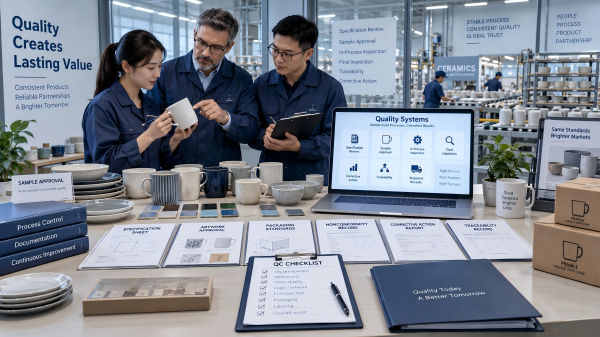
Experienced manufacturers should maintain specification reviews, sample approval records, controlled artwork, production instructions, in-process checks, final inspection criteria, packaging standards, and corrective-action procedures. Buyers should confirm that these systems are actually used. Certifications can support an evaluation, but they should be verified and should not replace product-specific due diligence.
I Look for Evidence of Daily Use
A certificate on a wall does not show how a specific mug, bowl, plate, or dinnerware order will be managed. I ask to see relevant examples of controlled documents, with confidential customer information removed where necessary.
Useful evidence may include:
- A completed order-review checklist.
- A signed or dated sample approval record.
- A revision history for artwork or packaging.
- In-process inspection forms.
- Final inspection reports.
- Nonconformity records.
- Corrective-action reports.
- Training or work-instruction records.
- Batch or order traceability records.
- Packing verification records.
My company has operated in custom ceramics for 15 years and reports BSCI and ISO 9001 certification. I present those facts as background, not as a guarantee of any order outcome. Buyers should verify certificate validity, scope, issuing body, audit status, and relevance to the products under consideration.
I Separate Factory Systems from Buyer Requirements
A ceramic mug manufacturer may have a general quality management system, but each buyer still needs to define its own product and market requirements. The supplier cannot infer every retail rule, test protocol, warning label, or packaging standard.
I prefer a responsibility matrix that states who will provide, review, approve, and verify each item:
| Requirement | Buyer responsibility | Manufacturer responsibility | Possible independent support |
|---|---|---|---|
| Product concept | Define intended use and commercial priorities | Review manufacturability | Product designer or engineer |
| Artwork | Provide approved files and legal rights | Check format and production suitability | Graphic or packaging specialist |
| Quality criteria | Approve expectations and tolerances | Create and follow control instructions | Inspection company |
| Compliance | Identify target-market requirements | Provide available production information | Accredited laboratory or compliance adviser |
| Packaging | Define retail and distribution needs | Develop and verify pack execution | Packaging specialist or transit-test provider |
| Shipment release | Review agreed evidence | Complete production and internal checks | Third-party inspector |
This division keeps the discussion practical. It also prevents either party from assuming that the other has handled an undefined requirement. In my view, experienced manufacturers add the most value when they make these responsibilities visible early.
Frequently Asked Questions
Does a manufacturer’s age prove that it is reliable?
No. I treat operating history as one data point. I also review the supplier’s questions, facilities, production controls, documentation, communication, and handling of difficult requirements. A long history cannot compensate for weak systems, while a newer manufacturer may perform well if it has capable people and disciplined processes.
What should I ask a custom ceramic manufacturer before requesting a sample?
I recommend providing the intended market, product dimensions, capacity, material, finish, artwork, quantity, packaging, schedule, testing needs, and quality expectations. I then evaluate which details the supplier challenges or clarifies. The response shows whether the factory is examining feasibility or simply trying to quote quickly.
How can I compare two ceramic supplier quotations fairly?
I compare the same specification, decoration method, quantity, packaging, inspection level, testing responsibility, delivery term, and included services. I also ask each supplier to list exclusions and assumptions. This process helps me distinguish a genuine efficiency from a price difference created by missing requirements.
Can ceramic mass production match an approved sample exactly?
I would not expect unrestricted exactness in every characteristic because ceramic production can involve process-related variation. I define measurable specifications and visual acceptance boundaries instead. Buyers should agree on reference samples, tolerances, inspection criteria, and testing requirements with the manufacturer and qualified specialists before production.
Should I verify ISO 9001 or BSCI documentation?
Yes. I recommend checking the certificate or audit document, validity period, named legal entity, site address, scope, and issuing organization. These documents can support supplier due diligence, but they do not certify that a specific product or shipment meets the buyer’s technical, legal, or quality requirements.
Conclusion
Experienced manufacturers deliver better results when they turn practical knowledge into early warnings, clear specifications, repeatable controls, and honest cost discussions. I do not believe that age alone guarantees quality or removes sourcing risk. I advise importers and wholesalers to test a supplier’s judgment through detailed questions, documented procedures, and verified evidence. If you are evaluating a custom ceramics project, contact our team to discuss feasibility, sampling, production controls, and the information needed for a responsible quotation.