What Is the Best Ceramic Mug?
The best ceramic mug can be difficult to define when buyers must balance appearance, unit cost, drinking comfort, and bulk-production reliability. A mug that looks excellent in a showroom may disappoint when it misses a target retail price or varies across production batches. I recommend starting with the market and intended use, then validating the supplier’s production capability.
The best ceramic mug is the mug that matches the target customer, intended beverage use, retail position, and purchasing conditions while remaining practical to produce consistently in bulk. For importers and wholesalers, the right choice is rarely one “best” material or shape. It is a well-specified product that meets commercial expectations for price, customization, quality, packaging, lead time, and repeatable mass production.

A coffee mug for a supermarket program has different requirements from a premium gift mug or a café merchandise item. In our experience as a custom ceramic mug supplier, the best decisions happen when buyers move from market positioning to product specifications, then from sample approval to controlled production.
Is the Best Ceramic Mug Defined by the Target Market?
The best ceramic mug can lose commercial value when the product does not fit its sales channel. A buyer may choose a premium-looking design, only to find that the retail price cannot support its production cost. This creates pressure on material, decoration, packaging, or delivery later in the project.
The best ceramic mug for a buyer is first defined by the target market, customer expectations, retail price, and sales channel. These factors determine an acceptable cost range, perceived quality level, capacity, decoration method, packaging standard, and order quantity. Buyers should set commercial boundaries before selecting a mug body or glaze.
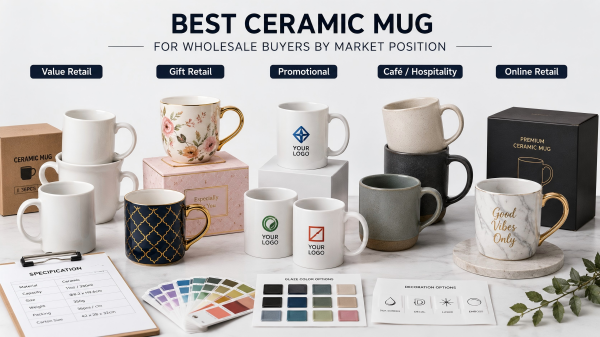
Start With the Shelf, Not the Factory Sample
I often see a common requirement conflict during early buyer discussions. A buyer wants a large-capacity mug, a complex full-wrap design, premium gift packaging, and a very competitive wholesale price. Each request is reasonable on its own. Together, they may not suit the intended retail position.
A useful ceramic mug buying guide begins with the product’s route to market:
| Sales Channel | Typical Buying Priorities | Common Mug Direction |
|---|---|---|
| Supermarkets and mass retail | Competitive cost, dependable supply, shelf-ready packaging | Standard shapes, practical capacities, controlled decoration |
| Department stores | Appearance, perceived value, consistent finish | Refined shapes, coordinated collections, stronger packaging |
| Gift and promotional markets | Brand visibility, customization, delivery timing | Printable surfaces, logo placement, practical MOQ planning |
| Homeware wholesalers | Range consistency, repeat orders, broad appeal | Timeless shapes, stackability, stable colors |
| Café and hospitality supply | Handling, repeated use, replacement availability | Functional handles, suitable capacities, consistent dimensions |
The target retail price should guide the acceptable landed cost. Buyers should include more than the ex-factory mug price. They should also consider decoration, inner packaging, export cartons, freight, duty, inspection, breakage allowance, and retailer margin.
Questions We Recommend Before Product Development
Before we develop a quotation or sample, I encourage buyers to clarify:
- Who will use the mug? Consider age group, lifestyle, drinking habits, and design preferences.
- Where will it be sold? A chain retailer, online store, gift shop, and importer warehouse may require different packaging and labeling.
- What retail price is realistic? This sets a commercial limit for the mug and pack.
- What product position is intended? Basic, mid-range, premium, seasonal, promotional, or licensed.
- Will the item need repeat orders? A one-time campaign can allow different choices than a core range.
- What quantity is planned? Order volume affects material options, customized molds, decoration efficiency, and carton planning.
A mug is not only a drinking vessel. It is also a retail product, a shipping unit, and a repeatable manufacturing specification. That is why we do not treat an attractive reference photo as a complete purchasing brief.
What Makes the Best Ceramic Mug for Actual Drinking Use?
The best ceramic mug should suit how customers will hold it, fill it, clean it, and use it each day. A visually impressive mug can still feel awkward if the handle is too small, the body is too heavy, or the capacity does not match the beverage occasion.
The best ceramic mug for drinking use matches the beverage, serving size, handling preference, and usage setting. Buyers should evaluate capacity, shape, handle comfort, rim design, weight, base stability, and suitability for the intended care instructions. A mug should work well in the user’s hand, not only in a product photograph.
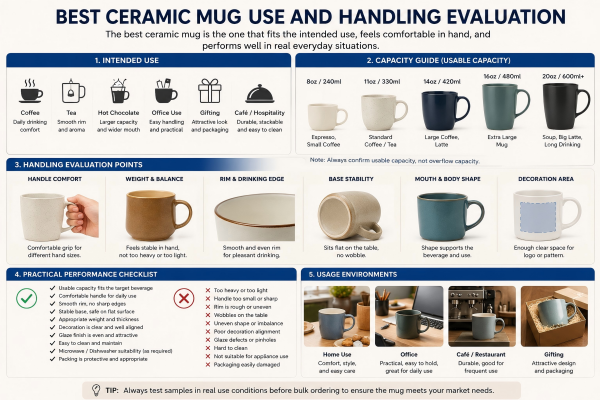
Define the Drinking Occasion First
The intended drink is a practical starting point. Espresso, tea, standard coffee, large lattes, soup, hot chocolate, and office beverages do not necessarily call for the same vessel.
For example, a broad mug may suit a relaxed tea or cocoa range, while a taller shape may better support a branded office-coffee concept. However, the “right” capacity also depends on the market. A size that feels generous in one region may be impractical in another.
We suggest buyers define the following before approving a body shape:
- Nominal capacity: The marketed volume, such as 300 ml or 12 oz.
- Usable fill capacity: The comfortable fill level below the rim.
- Overall dimensions: Diameter, height, and footprint.
- Handle opening: The space available for fingers.
- Mug weight: A factor in perceived quality, user comfort, and shipping cost.
- Rim profile: Important for drinking comfort and visual style.
- Base design: Important for stability and stacking considerations.
Material Is a Decision Variable, Not a Shortcut
Buyers often ask which material is automatically superior: stoneware, porcelain, new bone china, or another ceramic body. I believe this question is understandable, but it is incomplete.
Each ceramic material and firing approach can influence appearance, translucency, weight, durability expectations, glaze character, shape possibilities, production complexity, and cost. Yet material selection must still fit the project.
A technically appealing porcelain mug may not be the right commercial choice for a price-sensitive promotional order. A heavier stoneware look may support a rustic homeware collection, but it may not align with a lightweight premium gift concept. The best ceramic mug for wholesale buyers is therefore the one that supports both the user experience and the business model.
A material name does not replace a full specification. Buyers should ask how the finished mug will look, feel, pack, decorate, and perform within the intended product range.
Check Use Instructions and Market Requirements Early
If a buyer intends to market a mug as dishwasher-safe, microwave-safe, or suitable for other defined uses, the buyer should discuss these requirements before sampling. The applicable test methods, labeling expectations, and legal requirements can vary by destination market and product claim.
We recommend that buyers verify relevant food-contact, chemical, safety, and market-specific requirements with qualified testing providers, compliance specialists, and the applicable authorities. A supplier’s documents, test reports, and certifications should be reviewed for relevance, scope, date, and product applicability. They should not be assumed to cover every design, glaze, decoration, or destination market automatically.
How Should Buyers Compare the Best Ceramic Mug Options?
The best ceramic mug is rarely selected by material alone. Buyers can reduce risk by comparing complete product options against the same commercial and technical criteria. Without a decision sequence, it is easy to approve a mug based on appearance while overlooking packaging, decoration limits, or reorder consistency.
Buyers should compare ceramic mug options through a structured scorecard that covers market fit, drinking use, material appearance, decoration, cost, packaging, lead time, and production risk. This approach makes trade-offs visible before sample approval. It also prevents one attractive feature from outweighing more important purchasing requirements.
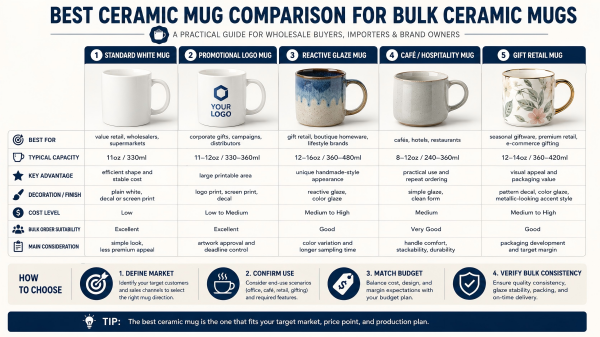
Use a Practical Evaluation Matrix
A simple evaluation matrix helps teams compare options fairly. The exact weighting depends on the buyer’s market position, but the categories should remain clear.
| Evaluation Area | Questions to Ask | Why It Matters |
|---|---|---|
| Market fit | Does the style match the target customer and price point? | Supports sell-through and margin planning |
| Capacity and use | Does the size fit the intended beverage occasion? | Affects customer satisfaction |
| Shape and handling | Is the mug stable, comfortable, and visually appropriate? | Influences daily usability |
| Material and finish | Does the body and glaze support the intended look? | Affects perceived value |
| Decoration | Can the artwork be applied clearly and consistently? | Protects branding |
| Cost | Does the full product cost fit the target? | Supports commercial viability |
| Packaging | Can the mug be protected and presented correctly? | Reduces transit and retail risk |
| Production repeatability | Can the approved result be reproduced at scale? | Reduces bulk-order variation |
| Lead time | Does development and production fit the launch schedule? | Prevents missed delivery windows |
I suggest buyers score each category from 1 to 5, then discuss low-scoring areas before progressing. This process is especially useful when multiple stakeholders are involved. A purchasing team may focus on price, while a brand team may focus on decoration and a logistics team may focus on carton efficiency.
Consider Customization as a Manufacturing Question
Custom work can include decals, screen printing, reactive glazes, embossing, debossing, colored glaze, custom handles, custom shapes, and packaging. However, each option has different implications for cost, development time, minimum order quantity, and visual variation.
For example:
- A standard body with custom decoration may offer a faster route for some programs.
- A new mold may create stronger differentiation but usually requires more development discussion and clearer volume planning.
- A complex decoration can add visual value, but artwork placement must account for curvature, handle position, print boundaries, and firing results.
- A handmade-looking glaze effect can create character, but buyers should define the acceptable range of variation.
As a ceramic mug manufacturer, we find that clear artwork files, approved color references, placement dimensions, and tolerance expectations help prevent repeated revisions. Buyers should avoid describing a finish only as “high-end,” “rustic,” or “exactly like the photo.” These descriptions can guide direction, but they are not production requirements.
Can the Best Ceramic Mug Be Reproduced in Bulk Production?
A perfect sample does not automatically guarantee consistent bulk ceramic mugs. Buyers can face delays and quality disputes when the approved sample lacks measurable specifications, approved limits, or a documented inspection process. This is one of the most important risks to address before mass production begins.
The best ceramic mug must be reproducible in bulk, not merely attractive as a single sample. Buyers should convert the approved concept into documented ceramic mug production requirements covering dimensions, capacity, glaze, decoration, color, packaging, acceptable tolerances, and inspection standards. Clear approval records make production quality easier to evaluate.
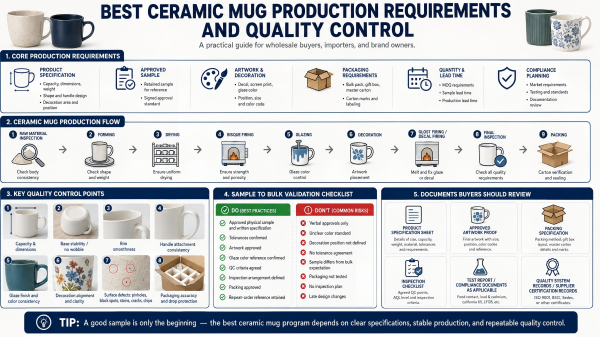
Move From Sample Approval to Production Approval
A ceramic mug sample approval should be treated as a controlled reference, not just an informal visual confirmation. The sample needs accompanying details that explain what must remain consistent during mass production.
In our production discussions, we see that buyers sometimes approve a sample by saying, “Looks good.” That response is helpful, but it may not be enough when questions arise later about shade, print placement, capacity, glaze texture, or carton markings.
A stronger approval package may include:
- Approved physical sample identification
- Product code and revision date
- Body material or agreed product description
- Nominal and usable capacity
- Dimensions and agreed tolerances
- Mug weight range where relevant
- Handle position and overall shape reference
- Glaze color reference or approved standard
- Decoration artwork, color references, and placement dimensions
- Acceptable visual variation for reactive or handcrafted-style finishes
- Packaging layout, barcode, labels, and carton marks
- Inspection level or agreed quality criteria
- Destination-market compliance documents to be verified, where applicable
Build Ceramic Mug Quality Control Into the Order
Ceramic mug quality control should begin before final inspection. It should include review points from raw materials and forming through glazing, decoration, packing, and shipment preparation. The exact checkpoints depend on the product, but the principle is consistent: detect variation before it becomes a full-order problem.
Buyers may ask a supplier how they manage:
- Dimensional checks for height, diameter, capacity, and handle alignment.
- Visual checks for glaze defects, color variation, pinholes, print quality, and surface marks.
- Functional checks for stable placement and practical handle construction.
- Decoration checks for alignment, readability, color consistency, and artwork accuracy.
- Packing checks for inner protection, assortment, carton count, and shipping marks.
- Pre-shipment inspection arrangements based on the buyer’s quality plan.
A buyer may also use an independent inspection provider where appropriate. The inspection standard, sample size, defect definitions, and acceptance criteria should be agreed in advance. I recommend that buyers define critical, major, and minor issues with their own quality team or qualified inspection partner instead of leaving these categories open to interpretation.
Verify Supplier Documentation and Capability
Supplier selection should include more than a catalog review. Buyers should ask whether the supplier can provide relevant factory information, quality-system records, social compliance documents, product test reports, and production references appropriate to the order.
Our company, Liling Saida Ceramics Co., Ltd., has 15 years of experience in ceramic customization and production. We state that we have passed BSCI and ISO9000 quality-system certification processes. However, responsible buyers should still request and verify current documents, validity periods, audit scope, and relevance to their own sourcing requirements. Certifications are useful procurement inputs, but they are not substitutes for product-specific evaluation, sample review, or inspection planning.
Frequently Asked Questions
What is the best ceramic mug material?
There is no single best ceramic mug material for every project. The right option depends on the intended appearance, retail price, capacity, decoration, order volume, and target customer. Buyers should compare the complete product solution rather than choosing material based only on a general reputation.
What should I check before buying wholesale ceramic mugs?
Buyers should check the target market, retail price, capacity, body shape, decoration method, packaging, MOQ, lead time, and quality requirements. They should also review the supplier’s ability to reproduce the approved sample consistently and verify relevant compliance documentation for the destination market.
Why is ceramic mug sample approval important?
Ceramic mug sample approval creates a reference for the desired shape, glaze, decoration, and packaging. However, a sample should be supported by written specifications, tolerances, and quality criteria. This helps buyers compare mass-produced goods against an agreed standard instead of relying on memory or photos.
How can I reduce defects in bulk ceramic mugs?
Buyers can reduce defects by defining ceramic mug production requirements before production, approving artwork and packaging clearly, agreeing on inspection criteria, and using in-process and pre-shipment checks. Independent inspection may also be appropriate for higher-risk or application-specific orders.
How do I choose a custom ceramic mug supplier?
A custom ceramic mug supplier should be evaluated for communication quality, sampling discipline, manufacturing capability, customization options, quality-control process, packaging knowledge, and document transparency. Buyers should ask practical questions about repeatability, not only request the lowest quotation or the most attractive sample.
Conclusion
The best ceramic mug is the one that fits the market before it enters production. I recommend that importers and wholesalers begin with the target customer, price position, and drinking use. Then they should compare material, shape, decoration, packaging, and production feasibility as one decision. Finally, they should turn the approved concept into clear specifications and quality checkpoints. If you are sourcing wholesale ceramic mugs, we can help you review product requirements, sampling priorities, and practical bulk-production considerations before you commit to an order.