Are you struggling to figure out the true cost of shipping ceramic mugs from China to Europe? You spend weeks getting freight quotes, only to be hit with surprise fees, customs delays, and a box full of broken inventory. This eats into your profits and leaves you frustrated. The secret isn't just finding a cheaper shipper; it's about shifting your focus from the freight bill to the final, sellable cost of each mug.
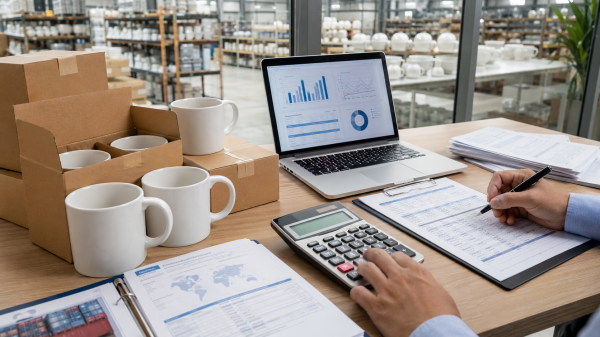
The real cost of shipping ceramic mugs from China to Europe is the "total landed cost per sellable unit." This includes the product cost, freight, insurance, duties, and VAT, minus the critical and often-overlooked cost of goods lost to breakage. Your profitability hinges not on the freight quote itself, but on how expertly your mugs are packaged to minimize damage and optimize shipping density.
That might sound more complicated than just picking a shipping price, but it's the only way to protect your margins. In this article, we'll break down this concept. We will explore why packaging is your most powerful lever for profitability and how to make smarter sourcing decisions.
Why Is Focusing Only on Freight a Costly Mistake?
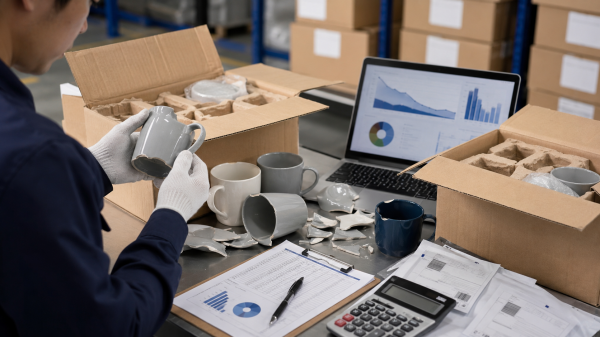
You've just received a fantastic freight quote that's 15% lower than the others. It feels like a win. But what happens when the container arrives and you discover 5% of your mugs are shattered? That "cheap" shipment just became a financial disaster, wiping out your savings and then some.
Focusing only on the ceramic mug shipping cost from China to Europe ignores the much larger financial impact of product damage. The true metric for your e-commerce business's success is the total landed cost ceramic mugs, specifically per sellable unit, not the shipping cost per unit dispatched.
Dive Deeper: From Freight Cost to Landed Cost
Let's move beyond the simple freight quote and look at the whole picture. The landed cost is what a product costs you by the time it's sitting in your warehouse, ready to be sold.
H3: Calculating Your Total Landed Cost
The basic formula looks like this: (Product Cost + Freight + Insurance + Duties/VAT) / (Total Units - Broken Units) = Landed Cost Per Sellable Mug
Let's run a scenario. You're importing 5,000 mugs.
Scenario A: "The Cheap Shipper"
- Mug Cost: €2.00/unit
- Freight & Duties: €0.80/unit (Looks great!)
- Packaging: Basic, thin cardboard dividers.
- Result: A 5% ceramic mug breakage rate shipping (250 broken mugs).
Your total initial cost is (€2.00 + €0.80) * 5,000 = €14,000. But you can only sell 4,750 mugs. Your actual cost per sellable mug is €14,000 / 4,750 = €2.95.
Scenario B: "The Smart Partner"
- Mug Cost: €2.00/unit
- Freight & Duties: €0.90/unit (Slightly higher due to better, denser packaging).
- Packaging: Custom molded pulp inserts.
- Result: A 0.5% breakage rate (25 broken mugs).
Your total initial cost is (€2.00 + €0.90) * 5,000 = €14,500. You can sell 4,975 mugs. Your actual cost per sellable mug is €14,500 / 4,975 = €2.91.
In this example, the "more expensive" shipping option saved you €0.04 per mug. On a 5,000-unit order, that's €200 straight back to your bottom line. Over a year, this adds up to thousands.
H3: The Hidden Costs of Breakage
The financial loss extends far beyond the cost of the broken goods.
- Reputation Damage: Customers who receive broken mugs leave one-star reviews. These negative reviews can tank your product's ranking on platforms like Amazon and deter future buyers.
- Stock-Outs: If 10% of your shipment is unsellable, you might run out of stock faster than anticipated. This means lost sales and a potential drop in your search ranking, which can be hard to recover.
- Operational Drag: Every broken mug means time spent processing refunds, responding to angry customer emails, and filing claims with carriers. Your time is valuable, and it's better spent on growing your business.
How Does Ceramic Mug Packaging for Shipping Affect Your Bottom Line?
Thinking about ceramic mug packaging for shipping feels like a minor detail, right? Just use some bubble wrap and a box. But in my 15 years of exporting ceramics, I've seen this single decision make or break a client's profitability. The wrong choice inflates your shipping volume and fails to protect your precious cargo.
The right ceramic mug packaging for shipping is a strategic tool. It directly reduces your breakage rate to a commercially acceptable level (under 1%). It also optimizes carton dimensions, which can increase the number of units you can fit in a container and significantly lower your per-unit shipping cost.
Dive Deeper: A Practical Comparison of Packaging Materials
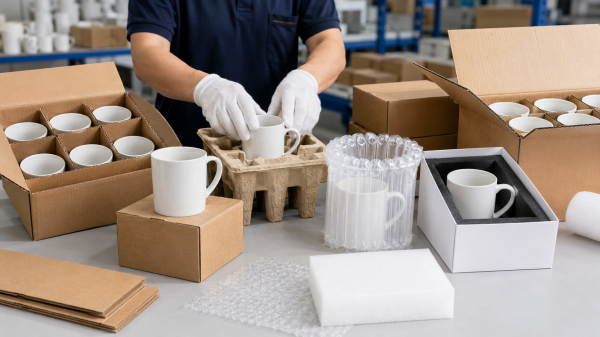
When shipping fragile ceramic products from China, you have several options. Each has trade-offs in protection, cost, and volume. A good manufacturing partner doesn't just offer one solution; they help you choose the right one for your specific mug and budget.
I once worked with an Amazon seller who was fixated on getting the lowest possible unit cost for packaging. They insisted on the thinnest bubble wrap. The result? Their first container had a 12% damage rate. We switched them to molded pulp inserts for their next order. The packaging cost was slightly higher, but their damage rate dropped to less than 1%, and their profit margin soared.
Here’s a breakdown of common options:
| Packaging Material | Protection Level | Unit Cost | Impact on Volume | Best Use Case |
|---|---|---|---|---|
| Bubble Wrap | Low to Medium | Low | High | Lightweight mugs, short-distance shipping, tight budget. |
| Air Column Bags | Medium to High | Medium | Medium | Good all-around protection, especially for odd shapes. |
| Molded Pulp | High | Medium | Low | Standard-shaped mugs, maximizing container density. |
| Custom Foam | Very High | High | Medium to High | High-value or irregularly shaped items, gift sets. |
H3: It’s Not Just Protection, It’s Density
Ocean freight is typically charged by volume (Cubic Meters, or CBM), not weight. This is where smart packaging becomes a secret weapon.
- Bulky vs. Compact: Bubble wrap is cheap but bulky. It creates a lot of empty space inside the master carton. Molded pulp, on the other hand, is custom-formed to the mug's shape. It offers superior protection while taking up minimal extra space.
- The Container Load Factor: Let's say a standard 40ft container (40HC) holds about 68 CBM of cargo.
- With bulky packaging, you might fit 10,000 mugs into the container.
- With compact, molded pulp packaging, you might fit 11,500 mugs into the same container.
That's a 15% increase in product for the exact same freight cost. This instantly and dramatically lowers your ceramic mug shipping cost from China to Europe on a per-unit basis. A reliable manufacturer should be able to run these calculations for you, showing you how different packaging choices impact your container load and final landed cost.
FOB vs. DDP: Which Is Better for Shipping Ceramic Mugs from China to Europe?
You're looking at a quote from a supplier and see the terms "FOB" and "DDP." They seem like confusing acronyms, but choosing the wrong one can lead to unexpected bills and logistical chaos just as your products are about to arrive. This decision impacts who is responsible for the costs and risks of the shipment.
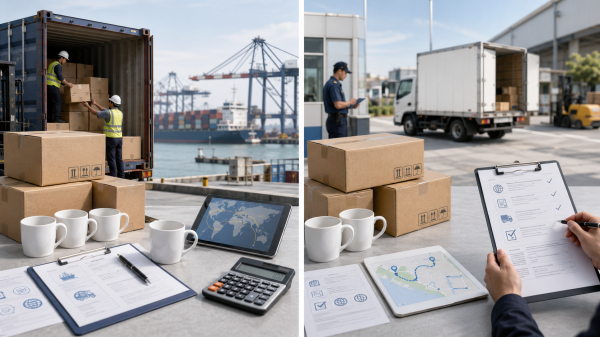
For new importers, DDP (Delivered Duty Paid) often appears simpler because the supplier manages the entire process. However, as your business grows, many sellers prefer FOB (Free On Board) because it gives them more control over their supply chain and can lead to lower overall costs. There is no single "best" answer when considering FOB vs DDP ceramic mugs.
Dive Deeper: Making the Right Incoterm Choice
Incoterms (International Commercial Terms) define the responsibilities of sellers and buyers. For e-commerce sellers importing from China, FOB and DDP are the two you'll encounter most often.
H3: Understanding FOB (Free On Board)
Under FOB terms, the manufacturer's responsibility ends once your goods are loaded onto the shipping vessel at the designated Chinese port (e.g., FOB Shanghai).
- Your Responsibilities: From that point forward, you are responsible for everything. This includes the main ocean freight, insurance, customs clearance in your European country, paying duties and VAT, and arranging final delivery to your warehouse.
- Pros:
- Control: You choose your own freight forwarder. This allows you to shop around for the best rates and service.
- Cost Savings: By managing the logistics yourself (or through your chosen agent), you can often find more competitive pricing than the bundled price a supplier would offer under DDP.
- Transparency: You see every line-item cost, from freight to customs fees.
- Cons:
- More Work: It requires you to be more hands-on. You need to find and manage a reliable freight forwarder and customs broker.
- More Risk: If there are delays at customs or issues with unloading, it's your problem to solve.
H3: Understanding DDP (Delivered Duty Paid)
Under DDP terms, the manufacturer is responsible for delivering the goods all the way to your final destination (e.g., your warehouse in Germany or an Amazon FBA center in France).
- The Supplier's Responsibilities: They handle everything: arranging freight, clearing customs in Europe, paying all duties and VAT, and final delivery. You get one "all-in" price.
- Pros:
- Simplicity: It's the most hands-off option. You pay one invoice and wait for your goods to arrive. This is excellent for beginners who are not yet familiar with the import process.
- Predictable Cost: The price you are quoted is the price you pay. There are no surprise bills for duties or port fees.
- Cons:
- Less Transparency: The supplier's logistics costs are bundled into the price. They often add a markup for the service and risk they are taking on.
- Lack of Control: If the supplier's chosen shipping company is slow or unreliable, you have little recourse. You are dependent on their choices.
As a factory, we are happy to work on either basis. For clients new to shipping fragile ceramic products from China, we often suggest starting with DDP for their first one or two orders. Once they are more comfortable and shipping larger volumes, transitioning to FOB often unlocks better margins.
Frequently Asked Questions
What is a typical ceramic mug breakage rate during shipping?
With basic, inadequate packaging, a ceramic mug breakage rate shipping of 3-5% is unfortunately common. However, with professional, multi-layered packaging like molded pulp or well-designed air columns, you should aim for a breakage rate of less than 1%. A good manufacturer will work with you to achieve this.
How is the ceramic mug shipping cost from China to Europe calculated?
The cost is primarily based on the shipment's volume, measured in cubic meters (CBM). Freight forwarders also consider "volumetric weight," and will charge based on whichever is greater (actual weight or volume). Rates fluctuate based on the shipping lane, season, fuel costs, and container availability.
Can I use my own freight forwarder if I buy from your factory?
Yes, absolutely. We welcome it. In this scenario, we would work on FOB (Free On Board) terms. Our responsibility is to produce your mugs, pack them to your specifications, and deliver them safely to the designated port in China for your forwarder to take over.
Do I need shipping insurance when shipping fragile ceramic products from China?
Yes, it is highly recommended. Excellent packaging is your first and best defense against damage, but it cannot protect against major incidents like a container being dropped or lost at sea. Insurance is a relatively low-cost way to protect your significant financial investment in the inventory.
Conclusion
The key to profitably shipping ceramic mugs from China to Europe is to look beyond the freight quote. Your real goal should be to minimize the total landed cost per sellable mug. As we've seen, the most powerful and overlooked tool to achieve this is strategic packaging. It not only drastically reduces your breakage rate but can also increase your shipping density, lowering the per-unit cost. Choosing between FOB and DDP depends on your experience and desire for control. Ultimately, success is a game of margins, won by smart planning with a partner who understands the complete picture.
If you're an e-commerce seller ready to build a more resilient and profitable supply chain, let's talk. Contact us to discuss your packaging strategy and business goals. We believe the best partnerships start with a conversation about minimizing your risks, not just quoting a price.