Sourcing products for your business can feel like a high-stakes game where the lowest price wins. You're under pressure to secure the best deal on promotional drinkware, but that focus on the unit price is a trap. This narrow view often leads to a cascade of hidden costs, quality headaches, and long-term damage to the brand you've worked so hard to build.
A truly profitable promotional drinkware buying guide teaches you to look beyond the per-unit price and evaluate the Total Cost of Ownership (TCO). This means factoring in all the "hidden" expenses—shipping, customs, insurance, and the business cost of poor quality like customer returns and bad reviews—to find the product that delivers the greatest overall value and profitability for your business.
I’ve spent 15 years on the front lines, guiding wholesalers and e-commerce sellers through this exact process. I've seen firsthand how a decision based on a few cents per mug can end up costing thousands. So, if the sticker price isn't the real price, what should you focus on instead? Let's break down the factors that separate a good deal from a costly mistake.
Why Is the Unit Price a Misleading Metric for Promotional Drinkware?
You’ve just received a quote that’s significantly lower than the others, and it feels like a win. But this is the most dangerous moment in the procurement process. An unrealistically low price is often a warning sign of compromises that will cost you much more down the line. To protect your investment, you must learn to think like a CFO.
A low unit price is misleading because it represents only one piece of a much larger financial puzzle. The real number you should care about is the total landed cost for mugs, which accounts for every expense required to get the product from the factory floor into your customer's hands.

Diving Deeper: From Unit Price to Total Cost of Ownership
Over my career, I've seen countless buyers fixate on the FOB (Free On Board) price. It's an easy number to compare, but it's fundamentally incomplete. A savvy buyer evaluates the Total Cost of Ownership (TCO), or the total landed cost, which reveals the true financial impact of your purchase.
Here are the components you must factor in:
- FOB Price: The price of the goods at the factory. This is your starting point.
- Freight: The cost of shipping from the port of origin to your destination port. This can vary dramatically based on container availability and fuel surcharges.
- Insurance: A small but crucial cost to protect against loss or damage during transit.
- Customs & Duties: Taxes levied by your country on imported goods. These are non-negotiable and can be a significant percentage of the product's value.
- Inland Transportation: The cost of moving the container from the destination port to your warehouse.
- The Cost of Poor Quality (CoPQ): This is the most overlooked and potentially largest expense. It includes:
- Returns and Refunds: Direct cash loss from customers returning defective products.
- Replacement Costs: The expense of sending a new item to a dissatisfied customer.
- Brand Damage: The long-term, unquantifiable cost of negative reviews and a reputation for selling low-quality items.
I once worked with a European client who was tempted by a 10% lower unit price from a new supplier for a large order of ceramic promotional mugs. They jumped at the deal. Unfortunately, the supplier used cheaper packaging and had poor loading procedures. By the time the container arrived, nearly 20% of the mugs were broken. Factoring in the lost product, the cost of sorting the inventory, and the air-freight needed to rush a partial re-order, their total landed cost was almost 30% higher than my original, "more expensive" quote. They missed their promotional deadline and learned a hard lesson.
Here’s a simplified comparison:
| Cost Component | Supplier A (Cheap) | Supplier B (Value) |
|---|---|---|
| Unit Price (10,000 mugs) | $1.80 | $2.00 |
| Initial Order Cost | $18,000 | $20,000 |
| Freight & Customs | $4,000 | $4,000 |
| Damage Rate (5%) | $900 (500 mugs) | $200 (100 mugs) |
| Cost of Sorting & Repackaging | $500 | $0 |
| Total Landed Cost | $23,400 | $24,200 |
| Effective Cost Per Good Mug | $2.46 | $2.44 |
As you can see, a higher damage rate from the "cheaper" supplier completely erases the initial price advantage and adds operational headaches. A reliable promotional drinkware supplier understands this and builds quality into the process from the start.
How Does Poor Quality Control Destroy Your Promotional Drinkware Profits?
You might think a few minor imperfections are an acceptable trade-off for a lower price, especially for a promotional item. This is a critical miscalculation for any wholesaler or e-commerce seller. In today's market, where a single bad review can tank a product listing, those "minor" defects are direct threats to your bottom line.
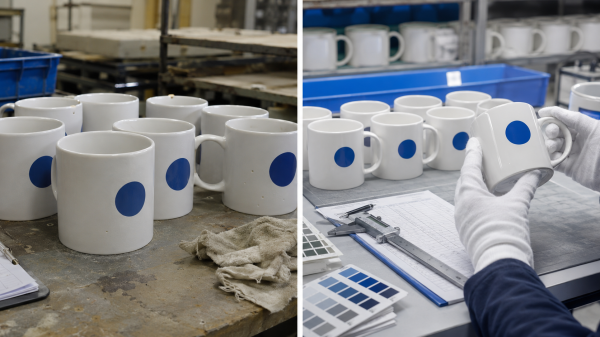
Poor promotional drinkware quality control doesn't just lead to a few unhappy customers; it creates a domino effect of business losses. Each flawed mug translates into negative social proof, increased customer service overhead, costly return shipping, and irreversible damage to your brand's reputation for reliability.
Diving Deeper: Common Defects and Their Business Impact
When a factory offers a "too-good-to-be-true" price, it's because they are cutting corners. As someone who manages production schedules, I know exactly where those cuts are made and the defects they produce. Understanding this helps you spot risk before you commit to an order.
H3: Predictable Flaws from Unrealistic Prices
- Pinholes and Pitting: These tiny holes in the glaze are usually caused by rushing the firing process or using improperly prepared clay. For you, this means the mug looks cheap, can harbor bacteria, and will be the subject of customer complaints about "feeling gritty" or "being defective."
- Color Inconsistency: A factory trying to save money may use lower-grade pigments or rush the mixing process. The result? Your brand's specific Pantone color looks faded on some mugs and overly saturated on others, destroying the uniformity of your custom logo drinkware and making your brand look unprofessional.
- Poor Decal Adhesion: Applying and firing decals is a precise art. Rushing this step to increase output means the logo or design might peel, flake, or fade after only a few dishwasher cycles. This is a death sentence for an e-commerce product. The first Amazon review that says "logo washed off after one week" will kill your sales velocity.
- Glaze Crazing: A network of fine cracks in the glaze that appears over time. This is caused by a mismatch between the clay body and the glaze, a classic sign of a factory not doing its R&D. While not immediately visible, it's a ticking time bomb that leads to delayed customer complaints and returns.
H3: What to Ask About Your Supplier's QC Process
Instead of asking "how cheap can you make it?", start asking "how do you ensure quality?" A professional partner will be happy to discuss their promotional drinkware quality control.
Look for evidence of a mature system:
- Verifiable Certifications: Ask for their ISO 9001 (quality management) and BSCI (social compliance) audit reports. A legitimate factory will have these ready. Treat them as essential documents you must verify.
- Raw Material Inspection: Do they test incoming clay and glazes for consistency?
- In-Process Checks: Are there quality checkpoints after key stages, like forming, glazing, and decal application?
- Final Inspection Protocol: What is their AQL (Acceptable Quality Limit)? How do they perform final inspections before packing? Do they check for all the defects listed above?
A good supplier isn't afraid of these questions. In fact, we welcome them. It shows us that you are a serious buyer focused on building a sustainable business, which is exactly the type of client we want to partner with.
What Separates a Supplier from a True Promotional Drinkware Partner?
You can send a Request for Quote (RFQ) to ten factories and get ten prices back. That's a transaction. But this approach leaves you vulnerable, as you are simply choosing a vendor, not a partner. A vendor says "yes" to your price target, even if they know they can't achieve it without sacrificing quality.
A true promotional drinkware partner brings their experience to the table to protect you. They act as a consultant and an extension of your own team, guiding you toward a result that is not only cost-effective but also high-quality, manufacturable, and brand-enhancing.

Diving Deeper: Vendor vs. Partner
In my role, I speak with dozens of potential clients each week. The most successful ones are those who are looking for a partnership, not just a price. A strategic partner actively helps you avoid pitfalls because your success is tied to their own. We want repeat business, not a one-time order that ends in disaster.
H3: Red Flags of a Purely Transactional Vendor
- They say "yes" to everything: If you propose an extremely low price or a very tight deadline and they agree without any questions, be very suspicious. An experienced manufacturer knows the real costs and timelines.
- They don't ask questions: A good partner will ask about the end-use of the product, your target market, and your brand standards. They want to understand your goals to recommend the best solution, like suggesting a more durable glaze for a restaurant-grade mug.
- Poor communication: Vague answers, slow response times, and an unwillingness to provide detailed production updates are signs that you are not a priority and that they may be hiding problems.
- Unwillingness to share certifications: If a supplier is hesitant to show you their BSCI or ISO 9001 reports, it’s a major red flag.
H3: Hallmarks of a Strategic Partner
- They provide expert guidance: A partner will review your design for custom promotional mugs and suggest improvements. For example, "This thin handle might be a weak point in shipping; let's thicken it slightly" or "This color will be difficult to match consistently; here are two similar shades that are more stable."
- They are transparent about costs and limitations: A partner will explain why they can't meet an unrealistic price point. They will break down the costs of materials, labor, and quality assurance, helping you understand what you're paying for.
- They are proactive communicators: They will keep you updated on your production schedule, alert you to potential delays (like a port closure or national holiday), and work with you to find solutions.
- They invest in compliance: They readily provide their certifications because they see them as a key selling point and a mark of their professionalism. They operate as a reliable promotional drinkware supplier you can count on for the long term.
Choosing a partner isn't about paying more. It's about investing in a relationship that reduces risk, ensures quality, and ultimately makes your business more resilient and profitable.
Frequently Asked Questions
How do I verify a supplier's certifications like ISO 9001 or BSCI?
Always ask for the full report, not just the certificate. Pay attention to the date of the audit and the scope. You can often verify the authenticity of the audit through the website of the auditing body (like SGS, Intertek, or TÜV) mentioned in the report.
What is a typical breakage rate for ceramic mugs during shipping?
For a well-packaged container shipment from an experienced supplier, the breakage rate should be well under 1-2%. If a supplier tells you to expect 5% or more as "normal," it is a clear indicator of poor packaging standards or low-quality product.
Is air freight ever worth it for promotional mugs?
Generally, no. Ceramic mugs are heavy and dense, making air freight prohibitively expensive. It can erase any potential profit. Air freight should only be considered for small, urgent sample orders or as a last-resort emergency measure to replace a small portion of a damaged sea shipment.
How can I test the quality of a sample custom promotional mug?
Don't just look at it. Use it. Run it through the dishwasher 10-20 times to test the decal. Tap it gently to listen for a clear ring, not a dull thud (which can indicate cracks). Fill it with boiling water and then cold water to test for thermal shock resistance.
Conclusion
The path to profitability in the world of sourcing is paved with smart decisions, not just low prices. This promotional drinkware buying guide is designed to shift your focus from the misleading unit price to the all-important Total Cost of Ownership. By understanding the true costs associated with shipping, customs, and especially the high price of poor quality, you can protect your investment and your brand. Remember that a defect on a ceramic promotional mug isn't just a flaw; it's a potential bad review and a lost customer. Choose a partner, not just a vendor—one who values quality as much as you do.
If you are planning your next order and want to have a transparent discussion about balancing cost, quality, and risk, my team and I are here to help. Reach out, and let's work together to build a profitable sourcing strategy that strengthens your brand.