Struggling to get clear quotes from ceramic mug suppliers? It can feel like you're asking all the questions but not getting the right answers, leaving you worried about hidden costs and potential quality issues. The key isn't just asking more questions; it's about asking the right ones. The most important questions buyers ask are those that unlock a productive, long-term partnership with a manufacturer.
The most critical questions buyers ask a ceramic mug manufacturer extend far beyond a simple price inquiry. Smart buyers focus on minimum order quantity (MOQ), detailed customization options, the pre-production sample process, quality control standards (like AQL), and documented compliance with market-specific regulations such as FDA or California's Prop 65. Asking these specific questions is the only way to accurately determine the total landed cost and ensure a successful order.

In my 15 years in this industry, I've seen countless new buyers focus only on the price per mug. It's a natural starting point, but it's a trap. Let's move beyond that first, simple question and explore the smarter inquiries that lead to a profitable product line.
The #1 Question: "What's Your Price?"
Every sourcing journey starts here. You have a budget, and you need to know if a product is viable. But when you send a vague "What's your price?" email, you get an equally vague—and often useless—answer. To get a real number, you need to provide the right context.
The unit price of a custom ceramic mug depends heavily on the order quantity, design complexity, glaze type, printing method, and packaging requirements. A simple "price per piece" is misleading without these crucial details. A better approach is to ask for a quote based on a clear project brief.
From "What's your price?" to "Can you quote based on this brief?"
A common question I get from new Amazon sellers is, "What's the price for a custom mug?" I always reply by helping them build a proper brief. A professional custom ceramic mug manufacturer needs specifics to give you an accurate price. Trying to get a price without these details is like asking a builder for the cost of a house without mentioning how many rooms it has.
A successful inquiry that gets a fast, accurate quote often includes:
- Mug Style & Capacity: Do you want a standard 11oz C-handle mug, a 15oz bistro mug, or something unique? A reference image and desired capacity (in oz or ml) are incredibly helpful.
- Order Quantity: This is one of the biggest factors. The price for 1,000 units is significantly different from the price for 10,000 units. Provide a few quantity tiers (e.g., 1,000, 2,500, and 5,000) to see the price breaks. This is closely tied to the
ceramic mug MOQ(Minimum Order Quantity), which for most custom designs starts around 1,000-1,200 pieces to be cost-effective. - Artwork & Customization:
- Artwork: Provide your logo or design in a vector format (.ai, .eps).
- Colors: How many colors are in your design? Is it a simple one-color logo or a full-color photograph?
- Placement: Will the logo be on one side, both sides, or a full wrap?
- Packaging: Do you need each mug in an individual plain white box, a custom-printed gift box, or bulk-packed on pallets? E-commerce sellers, for instance, need robust
ceramic mug packaging for e-commercethat can survive transit.
By framing your question this way, you move from a vague inquiry to a professional request for quotation (RFQ). You're not just asking for a price; you're starting a technical conversation that shows you're a serious buyer.
The Hidden Costs Question: "Is Shipping Included?"
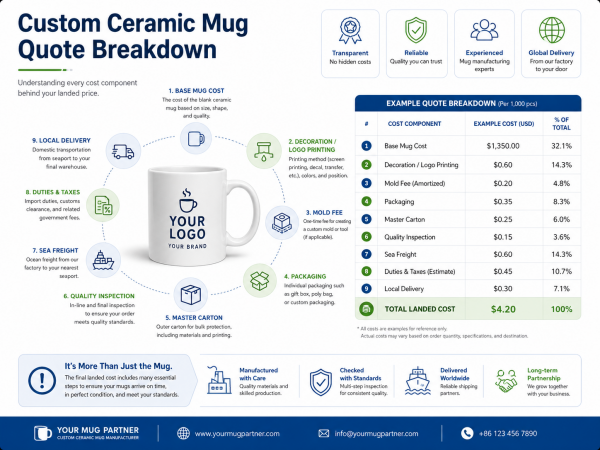
Getting a great ex-works (EXW) price feels like a win, but it's only one piece of the puzzle. If you're not careful, you can be blindsided by massive shipping, insurance, and customs fees that completely destroy your profit margins. The real goal is to understand your total landed cost.
Shipping is almost never included in the initial unit price from a factory. Buyers must budget for freight (sea or air), insurance, customs duties, port fees, and last-mile delivery. Asking your supplier for a full cost breakdown is one of the most important questions buyers ask to avoid budget overruns.
From "Is shipping included?" to "What are the total landed costs to my door?"
Shifting your focus from the factory price to the final landed cost is a game-changer. This means understanding Incoterms—the standard trade terms that define who pays for what.
Here's a simple breakdown:
- EXW (Ex Works): You are responsible for everything, from picking up the goods at our factory door in Liling to getting them to your warehouse.
- FOB (Free On Board): We handle getting the goods to the nearest port (e.g., Shanghai) and loading them onto the ship. You take over from there, paying for the ocean freight, insurance, and all costs in your country. This is the most common term.
- DDP (Delivered Duty Paid): We handle everything, delivering the goods directly to your specified address with all duties and taxes paid. This is the simplest for you but gives you the least control and is often the most expensive option.
I remember working with a new e-commerce seller who wanted to launch a line of branded mugs. Her initial inquiry was for 200 units. The per-unit cost was high due to the small quantity, and the cost to air-ship 200 heavy ceramic mugs was astronomical. Her project was dead on arrival.
We worked together to reframe the inquiry. The new question became: "What's the most cost-effective way to get 1,000 branded mugs, packaged for e-commerce, to an Amazon FBA warehouse in California?"
This "smarter" question allowed us to build a viable plan:
- We hit the 1,000-unit MOQ, which dramatically lowered her unit cost.
- We designed durable, drop-tested ceramic mug packaging to minimize breakage.
- We quoted for FOB Shanghai and connected her with a reliable freight forwarder who could handle the sea freight and customs clearance, providing a clear path to calculating her final landed cost.
The project went from unviable to successful, all because the question changed. These are the kinds of ceramic mug sourcing questions that define a professional buyer.
The Quality Assurance Question: "Are Your Mugs Good Quality?"
Every supplier on the planet will tell you they have "good quality." But "good" is subjective. It won't protect you from a shipment full of cracked handles, pinholes in the glaze, or misaligned logos. Vague assurances don't mean anything; a defined process does.
"Good quality" is verified through a documented ceramic mug quality control process, clear material specifications, and objective third-party inspections. One of the best questions buyers ask is for the supplier's QC checklist and their Acceptable Quality Limit (AQL) standards.
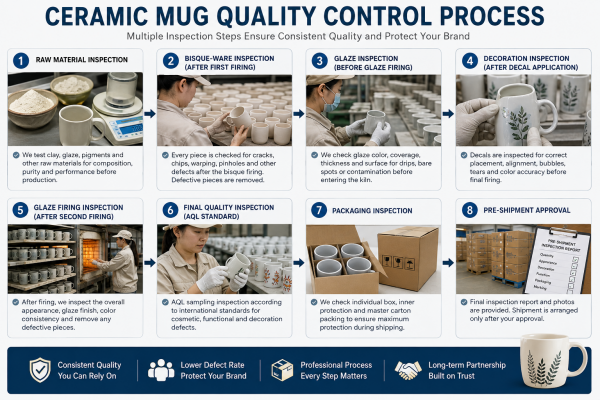
From "Is it good quality?" to "Can you describe your quality control process and AQL standards?"
This question immediately separates professional suppliers from amateur operations. A serious ceramic mug manufacturer in China will have a clear, multi-stage QC system. As an ISO9001-certified factory, our process looks like this:
- Incoming Quality Control (IQC): We inspect the raw materials—the clay, the glaze, the decal paper—before they even enter production.
- In-Process Quality Control (IPQC): Our teams check the products at key stages. After forming, after glazing, and after firing. This catches issues early, saving time and money.
- Final Quality Control (FQC): Before anything is packed, a dedicated team inspects the finished goods based on an agreed-upon standard.
This is where the Acceptable Quality Limit (AQL) comes in. It's a statistical method used across all manufacturing industries to determine the sample size for inspection and the maximum number of defects allowed. Instead of saying "no defects," which is impossible in high-volume ceramics production, AQL provides a clear, objective, and internationally recognized standard for what is considered an acceptable shipment.
Pro Tip: For your first few orders with any new supplier, I strongly recommend hiring a third-party inspection company to conduct a Pre-Shipment Inspection (PSI). They act as your eyes and ears in the factory, verifying the quality against your standards before you pay the final balance.
Asking about process and standards gives you a framework for quality. It's one of the most vital questions to ask a ceramic mug manufacturer before placing an order.
The Safety Question: "Are Your Mugs Safe?"
When you sell a product that people eat or drink from, safety is not optional. A mug that leaches lead or cadmium can lead to devastating health issues, product recalls, legal action, and the end of your brand. You cannot afford to get this wrong.
Mug safety is confirmed through compliance with food-grade regulations in your target market. For the US, this means being aware of FDA compliance for ceramic mugs. If you sell in California, you must also meet the stringent standards for Prop 65 ceramic mugs. For Europe, it's typically LFGB.
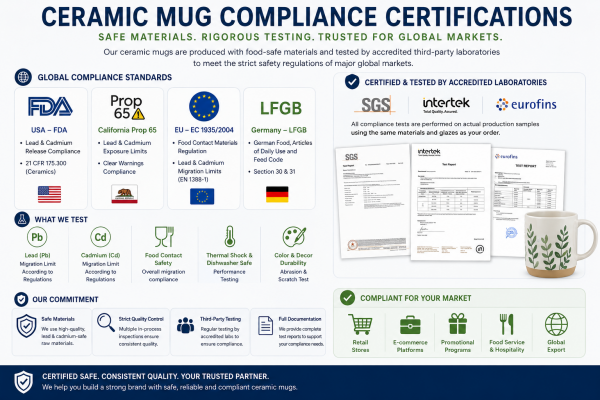
From "Are they safe?" to "Can you provide current test reports for [Target Market]?"
This question is precise and non-negotiable. An experienced wholesale ceramic mug supplier who exports to Western markets will understand immediately and should be able to provide documentation.
Here’s what you need to know:
- Regulations are Market-Specific: A test report for EU standards doesn't guarantee compliance in the US. You must specify your exact sales market.
- Test Reports Have an Expiration Date: These reports are typically valid for one year. Always check the date on the report to ensure it's current.
- Reports Apply to Materials, Not Always to the Final Product: A factory might have a report for its standard white glaze. If you order a custom red mug, that red glaze may need to be tested separately.
For maximum security, many buyers choose to have their specific production batch tested by a third-party lab like SGS, TUV, or Intertek. While this adds a few hundred dollars to your cost, it provides an undeniable certificate of compliance for your exact product.
Navigating ceramic mug compliance is a core part of our service. We guide our clients on the requirements for their market. It’s a standard part of the custom mug supplier checklist and one of the most important discussions we have.
The Sample Question: "Can I Get a Sample?"
You would never buy a car without a test drive. Likewise, you should never commit to thousands of mugs without seeing and holding one first. But just asking for "a sample" can lead to confusion. It's crucial to be specific about what you need.
Yes, you can get a sample, but you must clarify if you need a random stock sample to check basic quality or a full pre-production sample (PPS) with your custom logo. A stock sample is often free (you just pay for shipping), while a PPS involves a fee that is typically refunded against your bulk order.
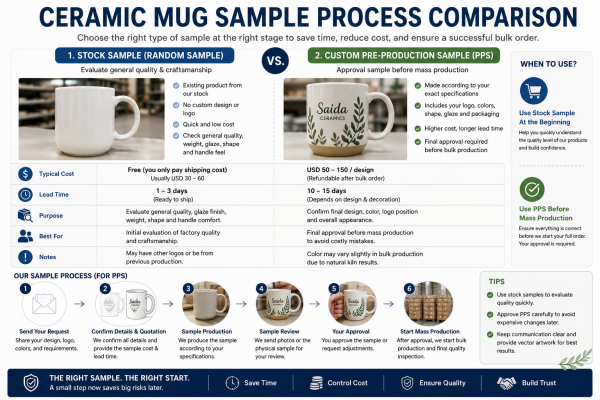
From "Can I get a sample?" to "What is your process and cost for a pre-production sample?"
This question shows the supplier you understand the manufacturing process. It opens a practical discussion about turning your design into a physical product. The ceramic mug sample process is a critical step for quality assurance.
Here's how it typically works:
- Stock Sample (Optional but Recommended): We can send you an existing mug from our showroom. This takes just a few days. It's the fastest way to feel the weight, see the glaze quality, and check the overall finish of our standard products.
- Digital Mockup: Once you provide your artwork, we create a digital rendering of your design on the chosen mug. This lets you approve the placement and scale before we make anything physical.
- Pre-Production Sample (PPS): This is the most important step. We produce one or two complete mugs with your exact design, using the same materials and methods as the bulk run. This is your "golden sample" for final approval. It involves setup costs and usually takes 7-15 days to produce.
- Approval: We ship the PPS to you. You review it, and once you approve it, we begin mass production. This sample is your insurance policy—it's the standard against which the final shipment will be judged.
The cost of the PPS (often $50-$200) can seem like an unnecessary expense to new buyers, but it is the single best investment you can make to prevent a major disaster in your bulk order.
The Supplier Verification Question: "Are You a Factory or a Trading Company?"
Many buyers believe that working directly with a factory is always better. While it can lead to better pricing and more control, the most important thing is finding a partner with the right capabilities and reliability for your business. The trick is asking questions that verify their claims.
Instead of just asking if they are a factory, a smarter approach is to ask for proof. Requesting their business license, recent factory audit reports (like BSCI or ISO9001), and a virtual factory tour are all excellent ways to verify a supplier's status and capabilities.
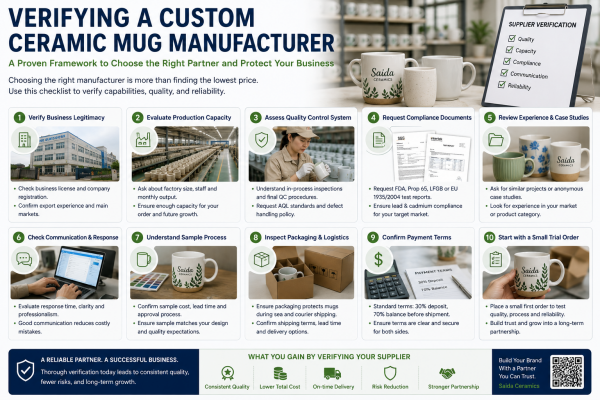
From "Are you a factory?" to "Can you share your BSCI report and a factory video tour?"
This is one of the ceramic mug supplier questions that cuts through the noise. Here’s why it works:
- Factories vs. Trading Companies:
- Factories: We, as a factory, physically make the mugs. This is ideal for buyers needing high-volume, customized products and deep technical expertise.
- Trading Companies: They don't manufacture anything. They source from multiple factories. This can be useful if you need to buy a wide variety of different products in small quantities. However, they add a margin and you have less control over production.
- The Power of Certifications:
- ISO9001: This isn't just a piece of paper. It confirms that we have a robust, documented Quality Management System. It's proof that we are committed to process and consistency.
- BSCI (Business Social Compliance Initiative): This audit is crucial for brands selling in Western markets. It verifies that we adhere to ethical labor practices—no child labor, fair wages, safe working conditions. Sharing our BSCI report shows we are a responsible partner that will protect your brand's reputation.
As a custom ceramic mug manufacturer with 15 years of export experience, we are proud of our facility and our certifications. We welcome these verification questions. They are a core part of any serious buyer's ceramic mug supplier checklist and help build the trust needed for a long-term relationship.
Frequently Asked Questions
What is a typical Minimum Order Quantity (MOQ) for custom ceramic mugs?
The ceramic mug MOQ varies depending on the complexity of the customization, but a general starting point for a fully custom design (new shape or unique glaze) is around 1,000 to 1,200 units. For simpler logo printing on a standard stock mug, some suppliers may offer lower MOQs.
How long does it take to produce and ship a custom mug order?
A typical timeline is: 7–15 days for the pre-production sample, 30–45 days for mass production after sample approval, and 20–40 days for sea shipping to the US or Europe. All told, you should plan for about 2–3 months from order confirmation to delivery.
What's the difference between decal printing and sublimation?
Decal printing involves applying a special transfer with your logo, which is then fired onto the mug at high temperatures, making it durable and dishwasher-safe. It's best for solid-color logos. Sublimation infuses ink into the mug's coating and is excellent for full-color photos, but it can be less resistant to repeated dishwashing over time.
Can I get custom packaging for my mugs?
Absolutely. In fact, custom export packaging for ceramic mugs is highly recommended, especially for e-commerce. We can design everything from simple individual cardboard boxes to premium gift boxes with foam inserts to ensure your products arrive safely and provide a great unboxing experience for your customers.
Conclusion
The journey to sourcing great products begins with asking great questions. As we've seen, the most effective questions buyers ask move beyond the superficial "what's your price?" to dig into the details that truly matter: total landed cost, quality control processes, regulatory compliance, and supplier verification. By framing your inquiries this way, you present yourself as a knowledgeable, serious partner and lay the foundation for a successful and profitable product launch. This thoughtful approach is the secret to avoiding costly mistakes and finding a manufacturer you can trust for years to come.
If you're ready to move beyond simple price checks and build a successful ceramic mug line, my team and I are here to help. Contact us today to discuss your project, and we'll help you build the right brief from day one.